Questions

[4 marks sum]

🎯

Test yourself on this topic

23 questions · timed · auto-graded

Question 14 Marks
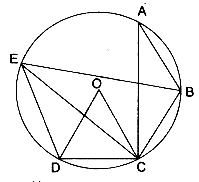
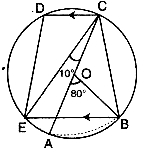
In the diagram given alongside, AC is the diameter of the circle, with centre O. CD and BE are parallel. ∠ AOB = 80° and ∠ ACE = 10°. Calculate: (i) ∠ BEC (ii) ∠ BCD (iii) ∠ CED.
Answer
From the figure, we have
∠ AOB = 80°
∠ ACE = 10°
(i) ∠ BOC = 180° - ∠ AOB
⇒ ∠ BOC = 180° - 80°
⇒ ∠ BOC = 100°
∠ BEC = $\frac{1}{2} \angle BOC$ .( ∵ ∠ Subtended at the centre and ∠ subtend by E by arc BC)
$\Rightarrow \angle B E C=\frac{1}{2} \times 100^{\circ}$
$\Rightarrow \angle B E C=50^{\circ}$
(ii) $\angle ACB =\frac{1}{2} \angle AOB$ ...( ∵ ∠s Subtended by arc AB at the centre at C)
$\Rightarrow \angle ACB =\frac{1}{2} \times 80^{\circ}$
$\Rightarrow \angle ACB =40^{\circ}$
∠ ECD = ∠ BEC ...( ∵ Alternate ∠s as CD || BE)
∠ ECD = 50°
⇒ ∠ BCD = ∠ ACB + ∠ ECA + ∠ ECD
⇒ ∠ BCD = 40° + 10° + 50°
⇒ ∠ BCD = 100°
(iii) BCDE is a cyclic quadrilateral, ....(∵ Its opposite ∠s are supplementary)
⇒ ∠ BED = 180° - ∠ BCD
⇒ ∠ BED = 180° - 100° ....( From ii)
⇒ ∠ BED = 80°
⇒ ∠ BEC + ∠ CED = 80°
⇒ ∠ CED = 80° - ∠ BED
⇒ ∠ CED = 80° - 50°
⇒ ∠ CED = 30° ....( From i)
View full question & answer
Question 24 Marks
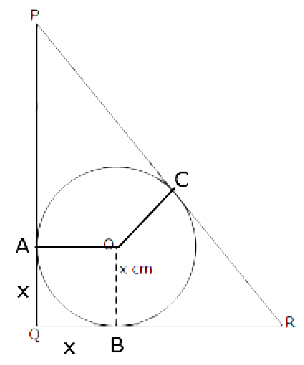
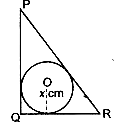
In triangle PQR, PQ = 24 cm, QR = –7 cm and ∠PQR = 90°. Find the radius of the inscribed circle.
Answer
Since ΔPQR is a right-angled angle,
PR = $\sqrt{7^2+24^2}=\sqrt{49+576}=\sqrt{625}=25 cm$
Let the given inscribed circle touches the sides of the given triangle at points A, B and C respectively.
Then, clearly, OAQB is a square.
=> AQ = BQ = x cm
PA = PQ – AQ = (24 – x) cm
RB = QR – BQ = (7 – x) cm
Since tangents from an exterior point to a circle are equal,
PC = PA = (24 – x) cm
And, RC = RB = (7 – x) cm
PR = PC + CR
=> 25 = (24 – x) + (7 – x)
=> 25 = 31 – 2x
=> 2x = 6
=> x = 3 cm
Hence, the radius of the inscribed circle is 3 cm.
View full question & answer
Question 34 Marks
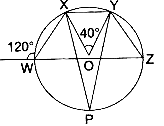
In the figure alongside O is the centre of circle ∠ XOY = 40°, ∠ TWX = 40° and XY is parallel to TZ.
Find: (i) ∠ XZY, (ii) ∠ YXZ (iii) ∠ TZY.
Answer
Construction: Take a point P on the circumference of the circle. Join XP and YP.
Determination of Amgles:
(i) ∠ XOY = 2∠ XPY ....( Angle subtended by an arc of a circle at the centre is twice the angle subtended by that arc at any point on the circumference of the circle)
⇒ 40° = 2 ∠ XPY ....( ∵ ∠ XOY = 40° )
⇒ ∠ XPY $=\frac{40^{\circ}}{2}=20^{\circ}$
⇒ ∠ XPY = 20° ...( ∵ ∠ XPY = ∠ XZY )
Angles in a same segment of a circle are equal.
(ii) ∠ XWT + ∠ XWZ = 180° ...(Linear Pair Axiom)
⇒ 120° + ∠ XWZ = 180°
⇒ ∠ XWZ = 180° - 120° = 60°
∠ XWZ + ∠ XYZ = 180° ....(Opposite angles of a cyclic quadrilateral are supplementary)
⇒ 60° + ∠ XYZ = 180°
⇒ ∠ XYZ = 180° - 60° = 120°
∴ In ΔXYZ,
∠ YXZ + 120° + 20° = 180°
⇒ ∠ YXZ + 140° = 180°
⇒ ∠ YXZ = 180° - 140° = 40°
(iii) ∵ XY || TZ and transversal YZ intersects then
⇒ ∠ XYZ + ∠ TZY = 180° ....(Sum of the consecutive interior angles is 180° )
⇒ 120° + ∠ TZY = 180°
⇒ ∠ TZY = 180° - 120° = 60°
View full question & answer
Question 44 Marks
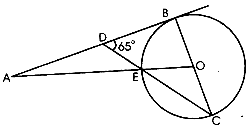
In the adjoining figure, O is the centre of the circle and AB is a tangent to it at point B. ∠BDC = 65° Find ∠BAO.
Answer
AB is a straight line.
$\therefore \angle ADE +\angle BDE =180^{\circ}$
$\Rightarrow \angle ADE +65^{\circ}=180^{\circ}$
$\Rightarrow \angle ADE =115^{\circ}$ ………..(i)
AB i.e. DB is tangent to the circle at point B and BC is the diameter.
$\therefore \angle DB =90^{\circ}$
$\ln \triangle BDC$
$\angle DBC +\angle BDC +\angle DCB =180^{\circ}$
$\Rightarrow 90^{\circ}+65^{\circ}+\angle DCB =180^{\circ}$
$\Rightarrow \angle DCB =25^{\circ}$
Now, OE = OC (radii of the same circle)
$\therefore \angle D C B$ or $\angle O C E=\angle O E C=25^{\circ}$
Also,
$\angle OEC =\angle DEC =25^{\circ}$
(vertically opposite angles)
In $\triangle ADE,$
$\angle ADE +\angle DEA +\angle DAE =180^{\circ}$
From (i) and (ii)
$115^{\circ}+25^{\circ}+\angle DAE =180^{\circ}$
$\Rightarrow \angle DAE \text { or } \angle BAO =180^{\circ}-140^{\circ}=40^{\circ}$
$\therefore \angle BAO =40^{\circ}$
View full question & answer
Question 54 Marks
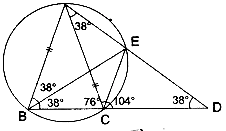
In the figure, AB = AC = CD, ∠ADC = 38°. Calculate: (i) ∠ ABC, (ii) ∠ BEC.
Answer
(i) ∵ AC = CD
∴ ∠ CAD = ∠ ADC = 38°
Now, in Δ ACD,
∠ ACD + ∠ CAD + ∠ ADC = 180°
⇒ ∠ ACD + 38° + 38° = 180°
⇒ ∠ ACD = 104°
Now,
⇒ ∠ ACB + ∠ ACD = 180°
⇒ ∠ ACB + 104° = 180°
⇒ ∠ ACB = 76°

Again, AB = AC
∴ ∠ ABC = ∠ ACB = 76°

(ii) In Δ ABC,
∠ BAC + ∠ ABC + ∠ ACB = 180°
⇒ ∠ BAC + 76° + 76° = 180°
⇒ ∠ BAC = 28°
Now, ∠ BEC = ∠ BAC = 28° ....(Angles subtended by the same chord)

View full question & answer
Question 64 Marks
In the adjoining diagram, chords AB, BC and CD are equal. O is the centre of the circle. If ∠ ABC = 120°, Calculate: (i) ∠ BAC, (ii) ∠ BEC, (iii) ∠ BED, (iv) ∠ COD
Answer
(i) In Δ ABC,
∠ ABC + ∠ BAC + ∠ BCA = 180° ....( ∵ The sum of three angles of a triangle is 180°)
120° + ∠ BAC + ∠ BCA = 180° ....( ∵ ∠ ABC = 120° (Given))
∠ BAC + ∠ BCA = 60°
But, BA = BC.
∠ BAC + ∠ BCA = 60°
2 ∠ BCA = 60°
∠ BCA = 30°
(ii) ∠ BEC = ∠ BAC = 30°
(iii) AB = BC = CD
Arc AB = Arc BC = Arc CD
Now,
∠ COB = 2 ∠ CAB
∠ COB = 2 x 30° = 60°
∠ DOC = ∠ COB = 60°
∠ DEC =$\frac{1}{2} \angle DOC =\frac{1}{2} \times 60^{\circ}=30^{\circ}$
∴ ∠ BED = ∠ BEC + ∠ DEC
∠ BED = ∠ BAC + ∠ DEC
∠ BED = 30° + 30° = 60°
(iv) ∠ COD = 60°
View full question & answer
Question 74 Marks
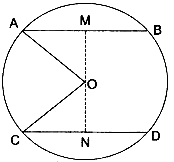
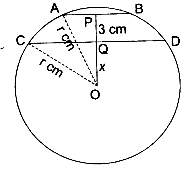
$AB, CD$ are parallel chords of a circle $7 \ cm$ apart. If $AB = 6 \ cm, CD = 8 \ cm$, find the radius of the circle.
Answer
Let $O$ be the centre of the circle $OM$ and $ON$ are perpendiculars on $AB$ and $CD.$

MON is one straight line.
Here
AM = $\frac{1}{2} AB =3 cm$
$C N=\frac{1}{2} C D 4 $cmLet, $ON = x cm$ and radius $OA = OC = r cm$
From right angled triangle $OCN,$
$ON^2 = OC^2 - CN^2 ...$(By Pythagoras Theorem)
$x^2 = r^2 - 16 ...(1)$
From right-angled triangle $OAM,$
$OM^2 = OA^2 - AM^2 .$..(By Pythagoras Theorem)
$(7 - x)^2 = r^2 - 9 ...(2)$
From $(1)$ and $(2),$
$(7 - x)^2- x^2= 7$
$49 + x^2 - 14x - x^2 = 7$
$14x = 42$
$x = 3r^2 = x^2 + 16 ....(From(1))$
$r^2 = 9 + 16 = 25$
$r = 5 cm$
Hence, the radius of the circle is $5 \ cm.$
View full question & answer
Question 84 Marks
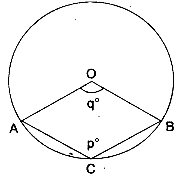
C is a point on the minor arc AB of the circle, with centre O. Given ∠ACB = p°, ∠AOB = q°.
(i) Express q in terms of p.
(ii) Calculate p if ACBO is a parallelogram.
(iii) If ACBO is a parallelogram, then find the value of q + p.
Answer
(i) Reflex ∠ AOB = 360° - q°
ACB = $\frac{1}{2}$ reflex ∠ AOB .....(angle at the centre property)
$p^{\circ}=\frac{1}{2}\left(360^{\circ}-q^{\circ}\right)$
2p° = 360° - q°
q° = 360° - 2p°
q = 360° - 2p
(ii) If ACBO is a parallelogram, then
p = q
q = 360° - 2p
p = 360° - 2p
p + 2p = 360°
$p=\frac{360^{\circ}}{3}=120^{\circ}$
(iii) If ACBO is a parallelogram, then
p = q
Also, p = 120° ....(From(ii))
p + q = p + p = 2p
p + q = 2 + 120°= 240°.
View full question & answer
Question 94 Marks
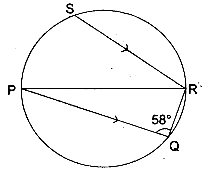
In the adjoining figure, PQ is the diameter, chord SR is parallel to PQ. Give ∠ PQR = 58°.
Calculate:
(i) ∠ RPQ,
(ii) ∠ STP ( T is a point on the minor arc)
Answer
(i) ∠ PRQ = 90°...(∠in a semicircle)
In Δ PQR,
∠ RPQ + ∠ PQR + ∠ PRQ = 180°....(∵ The sum of the three ∠s of a Δ is 180°)
⇒ ∠ RPQ + 58° + 90° = 180°
⇒ ∠ RPQ + 148° = 180°
⇒ ∠ RPQ = 180° - 148°
⇒ ∠ RPQ = 32°
(ii) ∵ PQ || SR and RP intersects them
∠ PRS = ∠ RPQ ...(Alternate angles)
∴ ∠ PRS = 32°
∵ PTSR is a cyclic quadrilateral.
∴ ∠ PTS + ∠ PRS = 180°....( ∵ Opposite ∠s of a cyclic quadrilateral are supplementary)
⇒ ∠ PTS + 32° = 180°
⇒ ∠ PTS = 180° - 32° = 148°
⇒ ∠ STP = 148°.
View full question & answer
Question 104 Marks
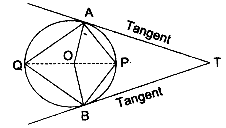
In the adjoining diagram TA and TB are tangents, O is the centre. If ∠ PAT = 35° and ∠ PBT = 40°.
Calculate:
(i) ∠ AQP, (ii) ∠ BQP
(iii) ∠ AQB, (iv) ∠ APB
(v) ∠ AOB, (vi) ∠ ATB
Answer
(i) ∠ AQP = ∠ PAT = 35°....( Angles are in alternate segment)
(ii) ∠ BQP = ∠ PBT = 40°....( Angles are in alternate segment)
(iii) ∠ AQB = ∠ AQP + ∠ BQP
∠ AQB = 35° + 40° = 75°
(iv) ∠ APB + ∠ AQB = 180°....(Opposite ∠s of a cyclic quadrilateral are supplementary)
∴ ∠ APB + 75° = 180°
∴ ∠ APB = 105°
(v) ∠ AOB = 2∠ AQB = 2(75°) = 150°....(Angle at the centre = 2 Angle at the circumference)
(vi) In quadrilateral AOBT:
∠ ATB = 360° - (∠OAT + ∠OBT + ∠AOB)
∠ ATB = 360° - (90° + 15° + 90°) = 30°....(∠OAT = ∠OBT = 90° radius, ⊥ tangent).
View full question & answer
Question 114 Marks
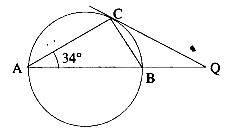
In the given figure, AB is a diameter. The tangent at C meets AB produced at Q. If ∠ CAB = 34°, find:(i) ∠ CBA, (ii) ∠ CQA.
Answer
(i) AB is a diameter.
∴ ∠ ACB = 90°
The angle in a semicircle is the right angle.
∴ In ΔACB,
∠ A + ∠ C + ∠ B = 180°
34° + 90° + ∠ B = 180°
∠ B = 180° - (34° + 90°)
∠ B = 180° - 124°
∠ B = 56°
(ii) Now,
CQ is tangent.
∴ ∠ QCB = ∠ CAB.....(Alternate segment angle)
∴ ∠ QCB = 34°
and ∠ CBQ = 180° - ∠ CBA
∠ CBQ = 180° - 56° = 124°
∴ ∠ CQA = 180° - (∠ QCB + ∠ CBQ)
∠ CQA = 180° - (34° + 124°)
∠ CQA = 180° - 158° = 22°.
View full question & answer
Question 124 Marks
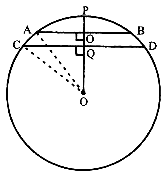
In Fig. $O$ is the centre of the circle of radius $5 cm . O P \perp A B, O Q \perp C D, A B \| C D, A B=6 cm$ and $C D=8 cm$. Determine PQ.

Answer
Join $O A$ and $O C$.
Since, the perpendicular from the centre of the circle to a chord bisects the chord. Therefore, P and Q are midpoints of $A B$ and $C D$ respectively.
Consequently,
$A P=P B=\frac{1}{2} A B=3 cm$.
and $C Q=Q D=\frac{1}{2} C D=4 cm$.
In the right-angled triangle OAP, we have
$OA^2 = OP^2+ AP^2$
$\Rightarrow 5^2 = OP^2 + 3^2$
$\Rightarrow OP^2 = 5^2 - 3^2= 16 cm$
$\Rightarrow OP = 4 cm^2$​​​​​​​
In the right angled triangle OCQ we have
$OC^2= OQ^2 + CQ^2$
$\Rightarrow 5^2= OQ^2+ 4^2$
$\Rightarrow OQ^2 = 5^2 - 4^2 = 9 cm^2$
$\Rightarrow OQ = 3 cm$
$\therefore PQ = PO - QO$
$\therefore PQ = OP - OQ = (4 - 3) cm = 1 cm$
View full question & answer
Question 134 Marks
$A B$ and $C D$ are two parallel chords of a circle such that $A B=10 cm$ and $C D=24 cm$. If the chords are on the opposite sides of the centre and the distance between them is $17 \ cm$ , find the radius of the circle.
Answer
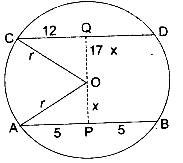
Let $O$ be the centre of the given circle and let it's radius be rcm . Draw $O P \perp A B$ and $O Q \perp C D$. Since $A B \| C D$. Therefore, points $P, O$ and $Q$ are collinear. $S o, P Q=17 cm$.

Let $Op = x cm$. Then, $OQ =(17- x ) cm$ Join $O A$ and $O C$. Then, $O A=O C=r$.
Since, the perpendicular from the centre to a chord of the circle bisects the chord.
$\therefore A P=P B=5 cm$ and $C Q=Q D=12 cm$.In right triangles $O A P$ and $O C Q$,
we have
$OA^2= OP^2 + AP^2​​​​​​​$​​​​​​​ and $OC^2 = OQ^2 + CQ^2$
$\Rightarrow r^2= x^2 + 5^2 ...(i)$
and $r^2 = (17 - x)^2 + 12^2 ....(ii)$
$\Rightarrow x^2+ 5^2 = (17 - x)^2 + 12^2 ....$(On equating the values of $r^2$)
$\Rightarrow x^2+ 25 = 289 - 34x + x^2+ 144$
$\Rightarrow 34x = 408$
$\Rightarrow x = 12 cm$
Putting $x = 12 cm$ in $(i)$, we get
$r^2 = 12^2 + 5^2 = 169$
$\Rightarrow r = 13 cm$
Hence, the radius of the circle is $13 \ cm.$
View full question & answer
Question 144 Marks
QUESTION $A B$ and $C D$ are two chords of a circle such that $A B=6 cm, C D=12 cm$ and $A B \| C D$. If the distance between $A B$ and $C D$ is 3 cm , find the radius of the circle.
Answer
Let $A B$ and $C D$ be two parallel chords of a circle with centre $O$ such that $A B=6 cm$ and $C D=12 cm$.
Let the radius of the circle be rcm ,
Draw $O P \perp A B$ and $O Q \perp C D$.
Since $A B \| C D$ and $O P \perp A B, O Q \perp C D$.
Therefore, points $O , Q$ and P are collinear.
Clearly, $PQ =3 cm$.
Let $O Q=x cm$. Then, $O P=(x+3) cm$
In right triangles OAP and $O C Q$, we have
$OA^2 = OP^2 + AP^2$​​​​​​​ and $OC^2 = OQ^2 + CQ^2$
$\Rightarrow r^2 = (x + 3)^2 + 3^2​​​​​​​$​​​​​​​ and $r^2= x^2 + 6^2​​​​​​​$

$\ldots .\left(\because AP =\frac{1}{2} AB =3 cm\right.$ and $\left.C Q=\frac{1}{2} C D=6 cm \right)$
$\Rightarrow (x + 3)^2 + 3^2 = x^2 + 6^2 ...$(On equating the value of $r^2)$
$\Rightarrow 6x = 18$
$\Rightarrow x = 3 cm$
Putting the values of x in $r^2= x^2 + 6^2$, we get
$r^2= x^2 + 6^2 = 45$
$\Rightarrow r =\sqrt{45} cm =6.7 cm$
Hence the radius of the circle is $6.7 cm$
View full question & answer
Question 154 Marks
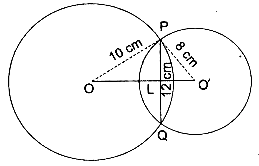
Two circles of radii 10 cm and 8 cm intersect and the length of the common chord is 12 cm. Find the distance between their centres.
Answer
Let O and O' be the centres of two circles with radii 10 cm and 8 cm respectively.
So, OP = 10 cm, O'P = 8 cm
and PQ = 12 cm
then PL = $\frac{1}{2} PQ =6 cm$


In Δ OLP,
OP2 = OL2 + LP2
⇒ OL2 = OP2 - LP2
$\Rightarrow OL =\sqrt{(10)^2-(6) 2}=\sqrt{64}=8 cm \ln O^{\prime} LP$,
$\begin{aligned} O ^{\prime} L & =\sqrt{ O ^{\prime} P ^2- LP ^2} \\ O ^{\prime} L & =\sqrt{8^2-6^2} \\ O ^{\prime} L & =\sqrt{64-36} \\ O ^{\prime} L & =\sqrt{28} cm \end{aligned}$
O'L = 5.29 cmDistance between centres
OO' = OL + LO'
OO' = (8 + 5.29) cm
OO' = 13.29 cm
View full question & answer
Question 164 Marks
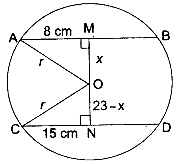
Two chords $A B, C D$ of lengths 16 cm and 30 cm , are parallel. If the distance between $A B$ and $C D$ is 23 cm . Find the radius of the circle.
Answer
Let $A B$ and $C D$ be the two parallel chords of a circle with centre $O$ and radius $r cm$. $OM \perp AB$ and $ON \perp CD$
AM = $\frac{1}{2} AB =\frac{1}{2} \times 16=8 cm$
$CN =\frac{1}{2} CD =\frac{1}{2} \times 30=15 cm$
Let $OM = x cm, MN = 23 cm$
so $ON = (23 - x) cm$
$OA = OC = r cm$
In $\triangle OAM,$
$OA^2 = AM^2 + OM^2$
$\Rightarrow r^2= (8)^2+ (x)^2 ....(i)$​​​​​​​


In $\triangle OCN,$
$OC^2 = CN^2+ ON^2$
$\Rightarrow r^2= (15)^2 + (23 - x )^2 ....(ii)$
From (i) and $(ii),$
$x^2 + 64 = 225 + (23 - x)^2$
$\Rightarrow x^2 + 64 = 225 + 529 - 46x + x^2$
$\Rightarrow 46x = 225 + 529 - 64$
$\Rightarrow 46x = 690$
$\Rightarrow x = 15 cm$
From$ (i),$
$r^2 = (8)^2 + (15)^2$
$r^2 = 64 + 225$
$r^2 = 289$
$\Rightarrow r = 17 cm$
Hence, the radius of a circle is $17 cm.$
View full question & answer
Question 174 Marks
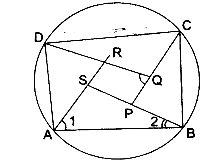
Prove that the quadrilateral formed by angle bisectors of a cyclic quadrilateral $ABCD$ is also cyclic.
Answer
Given: In cyclic $ABCD$ the bisectors formed a quadrilateral $ABCD.$
To prove: $PQRS$ is a cyclic quadrilateral.
Proof: In cyclic quadrilateral ABCD, AR and BS be the bisectors of $\angle A$ and $\angle B.$
So, $\angle 1 = \angle A/2$ and $\angle 2 = \angle B/2$
In $\triangle  ASB, \angle RSP$ is the exterior angle
So $\angle RSP = \angle 1 + \angle 2$
$\angle RSP =\frac{\angle A }{2}+\frac{\angle B }{2}$ ....(i)
Similarly, $\angle PQR =\frac{\angle C }{2}+\frac{\angle D }{2}$ ....(ii)
Adding (i) and (ii),
$\angle PQR +\angle RSP =\frac{1}{2}(\angle A +\angle B +\angle C +\angle D )$
$=\frac{1}{2} \times 360^{\circ}=180^{\circ}$
$\angle PQR +\angle RSP =180^{\circ}$​​​​​​​

But these are the opposite angles of quadrilateral PQRS
Hence PQRS is a cyclic quadrilateral.
Hence proved.
View full question & answer
Question 184 Marks
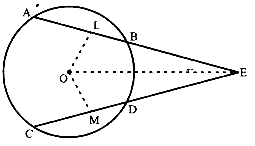
Two equal chords AB and CD of a circle with center O, when produced meet at a point E, as shown in Fig. Prove that BE = DE and AE = CE.
Answer
Given: Two equal chords AB and CD intersecting at a point E.
To prove: BE = BE and AE = CE
Construction: Join OE. Draw OL ⊥ AB and OM ⊥ CD'
Proof: We have
AB = CD
⇒ OL = OM ....(∵Equal chords are equidistant from the centre)
In triangles OLE and OME, we have
OL = OM
∠OLE = ∠OME ...(Each equal to 90°)
and OE = OE ...(Common)
So, by SAS-Criterion of congruences
Δ OLE ≅ ΔOME
⇒ LE = ME ....(i)
Now, AB = CD
$\Rightarrow \frac{1}{2} AB =\frac{1}{2} CD \Rightarrow BL = DM$ ...(ii)
Subtracting (ii) from (i), we get
LE - BL = ME - DM
⇒ BE = DE
Again, AB = CD and BE = DE
⇒ AB + BE = CD + DE
⇒ AE = CE
Hence, BE = DE and AE = CE.
Hence proved.
View full question & answer
Question 194 Marks
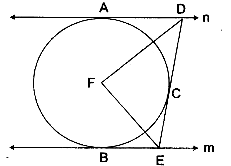
In Fig. l and m are two parallel tangents at A and B. The tangent at C makes an intercept DE between n and m. Prove that ∠ DFE = 90°
Answer
In triangles ADF and DFC, we have DA = DC ...(Tangents drawn from external point are equal in length)
DF = DF ...(Common)
AF = CF ...(Radii of the same circle)
So, by SSS-Criterion of congruence, we get
Δ ADF = ΔDFC
⇒ ∠ADF = ∠CDF
⇒ ∠ADC = 2∠CDF ...(i)
Similarly, we can prove that
∠BEF = ∠CEF
⇒ ∠CEB = 2∠CEF ....(ii)
Now, ∠ADC + ∠CEB = 180° ...(Sum of the interior angles on the same side of transversal is 180°)
⇒ 2(∠CDF + ∠CDF) = 180°
⇒ ∠CDF + ∠CEF = $\frac{180^{\circ}}{2}$
⇒ ∠CDF + ∠CEF = 90°
Now, in ∠DEF,
⇒ ∠DFE + ∠CDF + ∠CEF = 180°
⇒ ∠DFE + 90° = 180°
⇒ ∠DFE = 180° - 90°
⇒ ∠DFE = 90°.
View full question & answer
Question 204 Marks
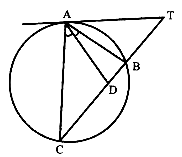
In Fig. TA is a tangent to a circle from the point T and TBC is a secant to the circle. If AD is the bisector of ∠BAC, prove that ΔADT is isosceles.
Answer
In order to prove that ΔADT is isosceles i.e., TA = TD, it is sufficient to show that ∠TAD = ∠TDA.
Since ∠TAB and ∠BCA are angles in the alternate segments of chord AB.
∴ ∠TAB = ∠BCA ...(i)
It is given that AD is the bisector of ∠BAC.
∠BAD = ∠CAD ...(ii)
Now, ∠TAD = ∠TAB + ∠BAD
⇒ ∠TAD = ∠BCA + ∠CAD....(Using (i) and (ii))
⇒ ∠TAD = ∠DCA + ∠CAD....( ∵∠BCA = ∠DCA)
⇒ ∠TAD = 180° - ∠CAD....( In ΔCAD, ∠CAD + ∠DCA +∠CDA = 180° ∴ ∠CAD + ∠BCA = 180° - ∠CAD)
⇒ ∠TAD = ∠TDA....(∵∠CDA + ∠TDA = 180°)
= TD = TA
Hence, ΔADT is isosceles
Hence proved.
View full question & answer
Question 214 Marks
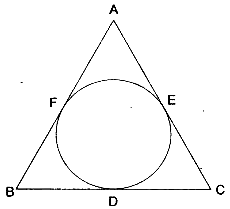
In Fig. the incircle of ΔABC touches the sides BC, CA, and AB at D, E respectively. Show that: AF + BD + CE = AE + BF + CD = $\frac{1}{2}$ ( Perimeter of ΔABC)

Answer
Since lengths of the tangents drawn from an exterior point to a circle are equal.
∴ AF = AE ...(i)
BD = BF ...(ii)
and CE = CD ...(iii) Adding (i), (ii) and (iii), we get
AF + BD + CE = AE + BF + CD
Now, Perimeter of Δ ABC = AB + BC + AC
= (AF + FB) + (BD + CD) + (AE + EC)
= (AF + AE) + (BD + BF) + (CD + CE)
= 2AF + 2BD + 2CE
= 2( AF + BD + CE) ....(From (i), (ii) and (iii), we get AE = AF, BD = BF, and CD = CE)
∴ AF + BD + CE = $\frac{1}{2}$( Perimeter of ΔABC) ∴ AF + BD + CE = AE + BF + CD = $\frac{1}{2}$ ( Perimeter of ΔABC)
Hence proved.
View full question & answer
Question 224 Marks
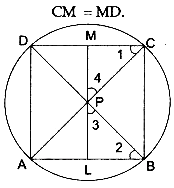
The diagonals of a cyclic quadrilateral are at right angles. Prove that the perpendicular from the point of their intersection on any side when produced backward bisects the opposite side.
Answer
Let ABCD be a cyclic quadrilateral such that its diagonals AC and BD intersect in P at right angles.
Let PL ⊥ AB such that LP produced to meet CD in M. We have to prove that M bisects CD. i.e.,

Consider arc AD, Clearly, it makes angles ∠ 1 and ∠2 in the same segment.
∠ 1 = ∠ 2 ...(i)
In the right-angled triangle PLB, we have
∠ 2 + ∠ 3 + ∠ PLB = 180°
⇒ ∠ 2 + ∠ 3 + 90° = 180°
⇒ ∠ 2 + ∠ 3 = 90° ....(ii)
Since, LPM is a straight line.
∴ ∠ 3 + ∠ BPD + ∠ 4 = 180°
⇒ ∠ 3 + 90° + ∠ 4 = 180°
⇒ ∠ 3 + ∠ 4 = 90° ...(iii)
From (ii) and (iii), we get
∠ 2 + ∠ 3 = ∠ 3 + ∠ 4
∠ 2 = ∠ 3 ...(iv)
From (i) and (iv), we get
∠ 1 = ∠ 4
PM = CM
Similarly,
PM = DM
Hence, CM = MD
Hence proved.
View full question & answer
Question 234 Marks
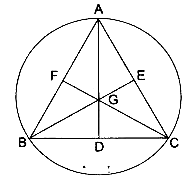
In an equilateral triangle, prove that the centroid and center of the circum-circle (circumcentre) coincide.
Answer
Given: An equilateral triangle ABC in which D, E, and F are the midpoints of sides BC, CA and AB respectively.
To prove: The centroid and circumference are coincident.
Construction: Draw medians AD, BE and CF.

Proof:
Let G be the centroid of ΔABC i.e., the point of intersection of AD, BE, and CF. In triangles BEC and BFC, we have
$\angle B = \angle C = 60^\circ$
$BC = BC$
and BF = CE ...[ ∵ AB = AC ⇒ $\left.\frac{1}{2} AB =\frac{1}{2} AC \Rightarrow BF = CE \right]$
$\therefore \triangle BEC = \triangle BFC$
$\Rightarrow BE = CF ...(i)$
Similarly,
$\triangle CAF$ and $\triangle CAD$
$\Rightarrow CF = AD ...(ii)$
From (i) and (ii),
$AD = BE = CF$
$\Rightarrow \frac{2}{3} AD =\frac{2}{3} B E=\frac{2}{3} CF$
$CG =\frac{2}{3} CF$
$GA =\frac{2}{3} AD$
$GB =\frac{2}{3} BE$
$GA = GB = GC $
$GA = GB = GC$
$\Rightarrow G$ is the equidistant from the vertices
$\Rightarrow G $is the circumcentre of $\triangle ABC.$
Hence, the centroid and circumcentre are coincident.
View full question & answer
[4 marks sum] - Mathematics STD 10 Questions - Vidyadip