Questions

[4 marks sum]

🎯

Test yourself on this topic

37 questions · timed · auto-graded

Question 14 Marks
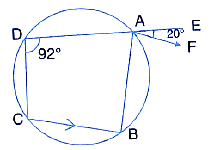
In the given figure, ABCD is a cyclic quadrilateral. AF is drawn parallel to CB and DA is produced to point E. if ∠ADC = 92°, ∠FAE = 20°; determine ∠BCD. Give reason in support of your answer.
Answer
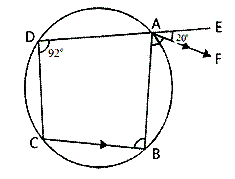
In cyclic quad. ABCD,
AF || CB and DA is produced to E such that ∠ADC = 92° and ∠FAE = 20°
Now we need to find the measure of ∠BCD
In cyclic quad. ABCD,
∠B + ∠D = 180°
⇒ ∠B + 92° = 180°
⇒ ∠B = 180° - 92°
⇒ ∠B = 88°
Since AF || CB, ∠FAB = ∠B = 88°
But, ∠FAE = 20° (given)
Ext. ∠BAE = ∠BAF + ∠FAE
= 88° + 22° = 108°
But, Ext. ∠BAE = ∠BCD
∴ ∠BCD = 108°
View full question & answer
Question 24 Marks
The quadrilateral formed by angle bisectors of a cyclic quadrilateral is also cyclic. Prove it.
Answer

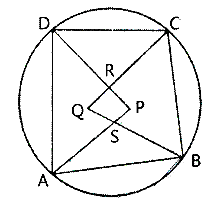
Given – ABCD is a cyclic quadrilateral and PQRS is a
Quadrilateral formed by the angle Bisectors of angle ∠A, ∠B , ∠C and ∠D
To prove – PQRS is a cyclic quadrilateral. Proof – In APD ∠PAD + ∠ADP + ∠APD = 180° .…. (1)
Similarly, IN ∆BQC,
∠QBC + ∠BCQ + ∠BQC = 180° …………(2)
Adding (1) and (2) .we get
∠PAD + ∠ADP + ∠APD + ∠QBC + ∠BCQ + ∠BQC = 180° +180°
∠PAD + ∠ADP + ∠QBC + ∠BCQ + ∠APD + ∠BQC = 360°
$\text { But } \angle PAD +\angle ADP +\angle QBC +\angle BCQ =\frac{1}{2}(\angle A +\angle B +\angle C +\angle D )$
$=\frac{1}{2} \times 360^{\circ}=180^{\circ}$
∴ ∠APD + ∠BQC = 360° -180° = 180° (from (3))
But these are the sum of opposite angles of quadrilateral PRQS.
∴ Quad. PRQS is a cyclic quadrilateral.
View full question & answer
Question 34 Marks
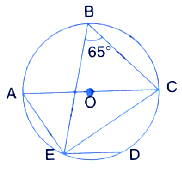
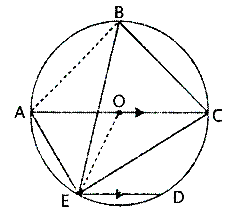
In the given figure, chord ED is parallel to diameter AC of the circle. Given ∠CBE = 65°, calculate ∠DEC.
Answer

Join OE.
Arc EC subtends ∠EOC at the centre and ∠EBC at the remaining Part of the circle.
∠EOC = 2 ∠EBC = 2 ×65° =130°
Now in ΔOEC, OE = OC (radii of the same circle)
∴ ∠OEC = ∠OCE
But, in ΔEOC ,
∠OEC + ∠OCE + ∠EOC = 180° (Angles of a triangle)
⇒ ∠OCE + ∠OCE + ∠EOC = 180°
⇒ 2 ∠OCE + 130° = 180°
⇒ 2 ∠OCE = 180° -130°
⇒ 2 ∠OCE = 50°
$\angle O C E=\frac{50^{\circ}}{2}=25^{\circ}$
∴ AC || ED (Given)
∴ ∠DEC = ∠OCE
⇒∠DEC = 25°
View full question & answer
Question 44 Marks
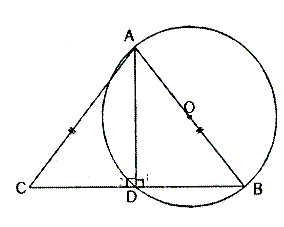
Prove that the circle drawn on any one of the equal sides of an isosceles triangle as diameter bisects the base.
Answer

Given – In ∆ABC, AB = AC and a circle with AB as diameter is drawn
Which intersects the side BC and D.
To prove – D is the mid point of BC
Construction – Join AD.
Proof - ∠1 = 90° (Angle in a semi circle)
But ∠1+ ∠2 = 180° (Linear pair)
∴ ∠2 = 90°
Now in right ∆ABD and ∆ACD, Hyp. AB = Hyp. AC (Given)
Side AD = AD ( Common)
∴ By the right Angle – Hypotenuse – side criterion of congruence, we have
ΔABD ≅ ∆ACD ( RHS criterion of congruence)
The corresponding parts of the congruent triangle are congruent.
∴ BD = DC (c.p.c.t)
Hence D is the mid point of BC.
View full question & answer
Question 54 Marks
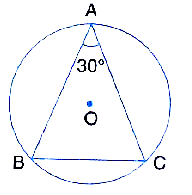
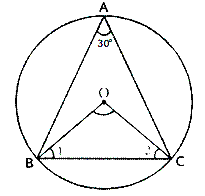
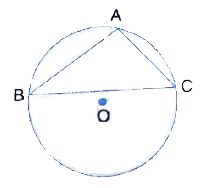
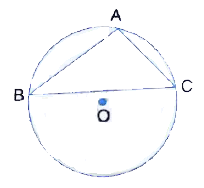
In the given figure, ABC is a triangle in which ∠BAC = 30°. Show that BC is equal to the radius of the circumcircle of the triangle ABC, whose centre is O.
Answer

Given – In the figure ABC is a triangle in which ∠A = 30°
To prove – BC is the radius of circumcircle of ∆ABC whose centre is O.
Construction – join OB and OC.
Proof :
∠BOC = 2∠BAC = 2 × 30°= 60°
Now in ∆OBC,
OB = OC (Radii of the same circle)
∠OBC = ∠OCB
But, in ΔBOC,
∠OBC + ∠OCB + ∠BOC = 180° (Angles of a triangle)
⇒ ∠OBC + ∠OBC + 60° = 180°
⇒ 2∠OBC + 60° = 180°
⇒ 2OBC = 180° - 60°
⇒ 2∠OBC = 120°
$\Rightarrow O B C=\frac{120^{\circ}}{2}=60^{\circ}$
⇒ ∠OBC = ∠OCB = ∠BOC = 60°
⇒ ΔBOC is an equilateral triangle
⇒ BC = OB = OC
But, OB and OC are the radii of the circum – circle
∴ BC is also the radius of the circum – circle
View full question & answer
Question 64 Marks
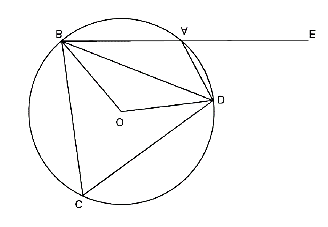
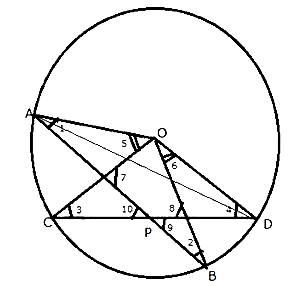
In the figure given, $O$ is the centre of the circle. $\angle DAE =70^{\circ}$, Find giving suitable reasons the measure of:
1) $\angle BCD$
2) $\angle BOD$
3) $\angle OBD$
Answer
$\text { 1) } \angle D A E=70^{\circ} \ldots \text { (given) }$
$\angle B A D+\angle D A E=180^{\circ} \ldots . . \text { (linear pair) }$
$=. \angle B A D+70^{\circ}=180^{\circ}$
$\Rightarrow \angle B A D=110^{\circ}$
Since ABCD is a cyclic quadrilateral, sum of the measures of the opposite anglesare supplementary.
$\text { So, } \angle B C D+\angle B A D=180^{\circ}$
$\Rightarrow \angle B C D+110^{\circ}=180^{\circ}$
$\Rightarrow \angle=70^{\circ}$
2) $\angle B O D=2 \angle B C D$ (Inscribed angle theorem)
$\Rightarrow \angle B O D=2\left(70^{\circ}\right)=140^{\circ}$
3) InΔOBD
OB=OD ....(radii of same circle)
$\Rightarrow \angle O B D=\angle O D B$
By Angle Sum property,
$\angle O B D+\angle O D B+\angle B O D=180^{\circ}$
$\Rightarrow 2 \angle O B D+\angle B O D=180^{\circ}$
$\Rightarrow 2 \angle O B D+140^{\circ}=180^{\circ}$
$\Rightarrow 2 \angle O B D=40^{\circ}$
$\Rightarrow \angle O B D=20^{\circ}$
View full question & answer
Question 74 Marks
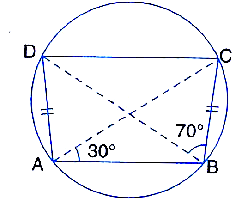
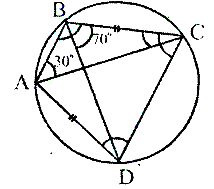
In the figure, given below, AD = BC, ∠BAC = 30° and ∠CBD = 70°.
Find: (i) ∠BCD (ii) ∠BCA (iii) ∠ABC (iv) ∠ADB
Answer
In the figure, ABCD is a cyclic quadrilateral
AC and BD are its diagonals
∠BAC = 30° and ∠CBD = 70°
Now we have to find the measure of
∠BCD, ∠BCA, ∠ABC and ∠ADB
We have ∠CAD = ∠CBD = 70° [Angles in the same segment] Similarly, ∠BAD = ∠BDC = 30°
∴ ∠BAD = ∠BAC + ∠CAD
= 30° + 70°
= 100°
(i) Now ∠BCD + ∠BAD =180° [Opposite angles of cyclic quadrilateral]
⇒ ∠BCD + ∠BAD = 180°
⇒ ∠BCD + 100° = 180°
⇒ ∠BCD = 180° -100°
⇒ ∠BCD = 80°
(ii) Since AD = BC, ABCD is an isosceles trapezium and AB ∥ DC
∠BAC = ∠DCA [Alternate angles]
⇒ ∠DCA = 30°
∴ ∠ABD = ∠DAC = 30° [Angles in the same segment]
∴ ∠BCA = ∠BCD - ∠DAC
= 80° - 30°
= 50°

(iii) ∠ABC = ∠ABD + ∠CBD
= 30° + 70°
= 100°
(iv) ∠ADB = ∠BCA = 50° [Angles in the same segment]
View full question & answer
Question 84 Marks
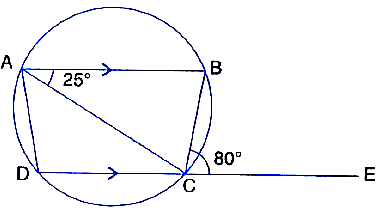
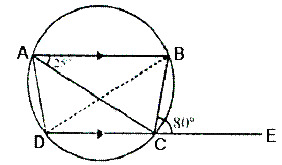
In the given figure, AB is parallel to DC ∠BCE = 80° and ∠BAC = 25°.

Find:
(i) ∠CAD (ii) ∠CBD (iii) ∠ADC
Answer

In the given figure,
ABCD is a cyclic quad in which AB ∥ DC
∴ ABCD is an isosceles trapezium
∴ AD = BC
Ext. ∠BCE = ∠BAD (Exterior angle of a cyclic qud is equal to interior opposite angle)
∴ ∠BAD = 80° (∵∠BCE = 80°)
But ∠BAC = 25°
∴ ∠CAD = ∠BAD - ∠BAC
= 80° - 25°
= 55°
(ii) ∠CBD = ∠CAD (Angle of the same segment)
= 55°
(iii) ∠ADC = ∠BCD (Angles of the isosceles trapezium)
= 180° - ∠BCE
= 180° - 80°
= 100°
View full question & answer
Question 94 Marks
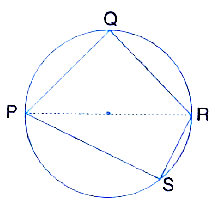
The following figure shows a circle with PR as its diameter.
If PQ = 7 cm and QR = 3RS = 6 cm, find the perimeter of the cyclic quadrilateral PQRS.
Answer
In the figure, PQRS is a cyclic quadrilateral in which PR is a diameter
$PQ = 7 cm$
$QR = 3 RS = 6 cm$
$3 RS = 6 cm\Rightarrow RS = 2 cm$
Now in $\triangle PQR,$
$∠Q = 90°$ (Angles in a semi circle)
$P R^2=P Q^2+Q R^2 \text { (Pythagoras theorem) }$
$=72^2+62^2$
$=49+36$
$=85$
$\text { Again in right }=\triangle P S Q, P R^2=P S^2+R S^2$
$85=P S^2+2^2$
$P S^2=85-4=81=(9)^2$
$P S=9 cm $
Now, perimeter of quad $PQRS = PQ + QR + RS + SP$
$= (7 + 9 + 6 )cm$
$= 24$
View full question & answer
Question 104 Marks
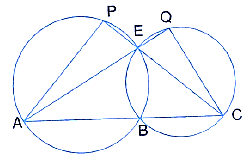
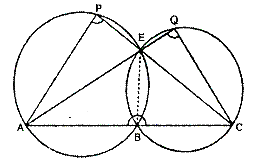
In the given figure; ABC, AEQ and CEP are straight lines. Show that ∠APE and ∠CQE are supplementary.
Answer

Given – In the figure, ABC, AEQ and CEP are straight line
To prove - ∠APE + ∠CQE = 180
Construction – join EB
Proof – in cyclic quad ABEP,
∠APE + ∠ABE = 180° ………. (1)
Similarly, in cyclic quad BCQE
∠CQE + ∠CBE = 180° ………. (2)
Adding (1) and (2),
∠APE + ∠ABE + ∠CQE + ∠CBE = 180° + 180° = 360°
⇒ ∠APE +∠ABE + ∠CBE = 360°
But, ∠ABE + ∠CBE = 180° (Linear pair)
∠APE + ∠CQE + 180° = 360°
⇒ ∠APE + ∠CQE = 360° -180° = 180°
Hence ∠APE and ∠CQE are supplementary.
View full question & answer
Question 114 Marks
In the given figure, AB = AD = DC = PB and ∠DBC = x°. determine, in terms of x : (i) ∠ABD, (ii) ∠APB
Hence or otherwise, prove that AP is parallel to DB.
Answer

Given – In the figure, AB = AD = DC = PB and DBC = X
Join AC and BD
To find : the measure of ∠ABD and ∠APB
Proof : ∠DAC = ∠DBC = X
(angels in the same segment)
But ∠DCA = ∠DAC = X ( ∵ AD = DC )
Also, we have, ∠ABD = ∠DAC (angles in the same segment)
In ∆ABP, ext ∠ABC = ∠BAP + ∠APB
But, ∠BAP = ∠APB ( ∵ AB = BP)
2 × X = ∠APB+ ∠APB = 2∠APB
∴ 2∠APB = 2X
⇒ ∠APB = X
∴ ∠APB = ∠DBC = X ,
But these are corresponding angles
∴ AP || DB
View full question & answer
Question 124 Marks
The figure shows a circle with centre $O . A B$ is the side of regular pentagon and $A C$ is the side of regular hexagon. Find the angles of triangle $ABC$.
Image
Answer
Image
Join $OA, OB$ and $OC$
Since AB is the side of a regular pentagon,
$\angle A O B=\frac{360^{\circ}}{5}=72^{\circ}$
Again AC is the side of a regular hexagon,
$\angle A O C=\frac{360^{\circ}}{6}=60^{\circ}$
But $\angle AOB + \angle AOC + \angle BOC = 360^\circ$ (Angles at a point)
$\Rightarrow 72^\circ + 60^\circ + \angle BOC = 360^\circ$
$\Rightarrow 132^\circ + \angle BOC = 360^\circ$
$\Rightarrow \angle BOC = 360^\circ -132^\circ$
$\Rightarrow \angle BOC = 228^\circ$
Now, Arc $BC$ subtends $\angle BOC$ at the centre and
$\angle BAC$ at the remaining part of the circle.
$\Rightarrow \angle B A C=\frac{1}{2} \angle B O C$
$\Rightarrow \angle B A C=\frac{1}{2} \times 228^{\circ}=114^{\circ}$
Similarly, we can prove that
$\Rightarrow \angle A B C=\frac{1}{2} \angle A O C$
$\Rightarrow \angle A B C=\frac{1}{2} \times 60^{\circ}=30^{\circ} \text { And }$
$\Rightarrow \angle A C B=\frac{1}{2} A O B$
$\Rightarrow \angle A C B=\frac{1}{2} \times 72^{\circ}=36^{\circ}$
Thus, angles of the triangle are, $114^\circ, 30^\circ$ and $36^\circ$
View full question & answer
Question 134 Marks
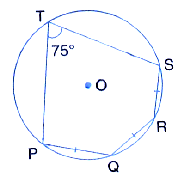
The given figure shows a circle with centre O. Also, PQ = QR = RS and ∠PTS = 75°. Calculate:
(i) ∠POS, (ii) ∠QOR, (iii) ∠PQR.
Answer

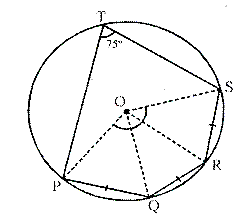
Join OP, OQ and OS.
∵ PQ = QR = RS,
∠POQ = ∠QOR = ∠ROS
(Equal chords subtends equal angles at the centre)
Arc PQRS subtends ∠POS at the center and ∠PTS at the remaining Parts of the circle.
∴ ∠POS = 2∠PTS = 2 × 75° = 150°
⇒ ∠POQ + ∠QOR + ∠ROS = 150°
$\Rightarrow \angle P O Q=\angle Q O R=\angle R O S=\frac{150^{\circ}}{3}=50^{\circ}$
In Δ OPQ, OP = OQ (radii of the same circle)
∴ ∠OPQ = ∠OQP
But ∠OQP + ∠POQ = 180°
∴ ∠OPQ + ∠QP = 50° = 180°
⇒ ∠OPQ + ∠OQP = 180° - 50°
⇒ ∠OPQ + ∠OPQ = 130°
⇒ 2∠OPQ = 130°
$\Rightarrow \angle O P Q=\angle O Q P=\frac{130^{\circ}}{2}=65^{\circ}$
Similarly, we can prove that
In ΔOQR, ∠OQR = ∠ORQ = 65°
And in ΔORS, ∠ORS = OSR = 65°
(i) Now ∠POS = 150°
(ii) QOR = 50° and
(iii) ∠PQR = ∠PQO + ∠OQR = 65° + 65° = 130°
View full question & answer
Question 144 Marks
If two sides of a cyclic quadrilateral are parallel; prove that:
(i) its other two sides are equal.
(ii) its diagonals are equal.
Answer

Given –
ABCD is a cyclic quadrilateral in which AB ∥ DC. AC and BD are its diagonals.
To prove –
(i) AD = BC
(ii) AC = BD
Proof –
(i) AB || DC ⇒ ∠DCA = ∠CAB (Alternate angles)
Now, chord AD subtends ∠DCA and chord BC subtends ∠CAB
At the circumference of the circle.
∴ ∠DCA = ∠CAB (proved)
∴ Chord AD = Chord BC or AD = BC
(ii) Now in ∠ABC and ∠ADB ,
AB = AB (Common)
∠ACB = ∠ADB (Angles in the same segment)
BC = AD (Proved)
By Side – Angle – Side criterion of congruence, we have
ΔACB≅ ΔADB (SAS postulate)
The corresponding parts of the congruent triangles are congruent.
∴ AC = BD (c.p.c.t)
View full question & answer
Question 154 Marks
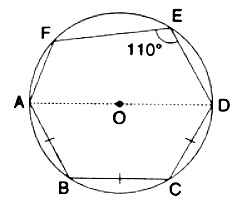
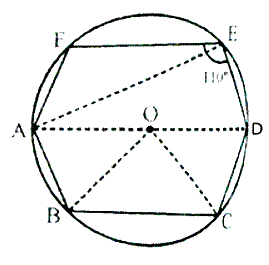
In the following figure, AD is the diameter of the circle with centre O. chords AB, BC and CD are equal. If ∠DEF = 110°, Calculate: ∠ FAB.
Answer

Join AE , OB and OC
∵ Chord AB = Chord BC = Chord CD (given)
∴ ∠AOB = ∠BOC = ∠COD
(Equal chords subtends equal angles at the centre)
But ∠AOB + ∠BOC + ∠COD = 180°
( AOD is a straight line )
∠AOB = ∠BOC = ∠COD = 60°
In ∠OAB, OA = OB
∴ ∠OAB = ∠OBA (radii of the same circle)
But ∠OAB + ∠OBA = 180° - AOB
= 180° - 60°
= 120°
∴ ∠OAB = ∠OBA = 60°
In cyclic quadrilateral ADEF,
∠DEF + ∠DAF =180°
⇒ ∠DAF = 180° - ∠DEF
= 180° -110°
= 70°
Now, ∠FAB = ∠DAF +∠OAB
= 70° + 60° = 130°
View full question & answer
Question 164 Marks
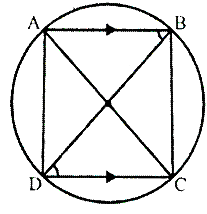
In a cyclic-trapezium, the non-parallel sides are equal and the diagonals are also equal. Prove it.
Answer


A cyclic trapezium ABCD in which AB ∥ DC and AC and BD are joined.
To prove-
(i) AD = BC
(ii) AC = BD
Proof :
∵ chord AD subtends ∠ABD and chord BC subtends BDC
At the circumference of the circle.
But ∠ABD = ∠BDC (proved)
Chord AD = Chord BC
⇒ AD = BC
Now in ∆ADC and ∆ BCD
DC = DC (Common)
∠CAD = ∠CBD (angles in the same segment)
And AD = BC (proved)
By Side – Angle – Side criterion of congruence, we have
∴ ∆ADC ≅ ∆BCD ( SAS axion)
The corresponding parts of the congruent triangle are congruent
∴ AC = BD (c.p.c.t)
View full question & answer
Question 174 Marks
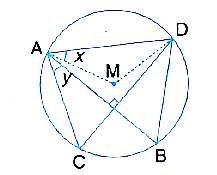
In the given figure, M is the centre of the circle. Chords AB and CD are perpendicular to each other.
If ∠MAD = x and ∠BAC = y : express ∠ABD in terms of y.
Answer
In the figure, M is the centre of the circle.
Chords AB and CD are perpendicular to each other at L.
∠MAD = x and ∠BAC = y
∴ Arc AD ∠AMDat the centre and ∠ABD at the remaining
(Angle in the same segment)
(Angle at the centre is double the angle at the circumference subtended by the same chord)
⇒ ∠AMD = 2∠ABD
$\Rightarrow \angle ABD =\frac{1}{2}\left(180^{\circ}-2 x\right)$
⇒∠ABD = 90° - x
AB ⊥ CD, ∠ALC = 90°
In ∆ALC,
∴ ∠LAC +∠LCA = 90°
⇒ ∠BAC + ∠DAC = 90°
⇒ y + ∠DAC = 90°
∴ ∠DAC = 90° - y
We have, ∠DAC = ∠ABD (Angles in the same segment)
∴ ∠ABD = 90° - y
View full question & answer
Question 184 Marks
In a cyclic quadrilateral ABCD, ∠A : ∠C = 3 : 1 and ∠B : ∠D = 1: 5; Find each angle of the quadrilateral .
Answer
Let ∠A and ∠C be 3x and x respectively
In cyclic quadrilateral ABCD,
∠A + ∠C = 180°
(pairs of opposite angles in a cyclic quadrilateral are supplementary)
⇒ 3x + x = 180°
$\Rightarrow x=\frac{180^{\circ}}{4}=45^{\circ}$
∴ ∠A = 135° and ∠C = 45°
Let the measure of ∠B and ∠D be y and 5y respectively In cyclic quadrilateral ABCD,
∠B + ∠D = 180°
(pair of opposite angles in a cyclic quadrilateral are supplementary are supplementary)
⇒ y +5y = 180°
$\Rightarrow y=\frac{180^{\circ}}{6}=30^{\circ}$
∴ ∠B= 30° and ∠D = 150°
View full question & answer
Question 194 Marks
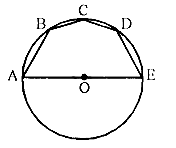
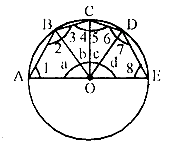
In the given figure, AE is the diameter of the circle. Write down the numerical value of ∠ABC + ∠CDE. Give reasons for your answer.
Answer

Join OA, OB, OC, OD.
In ΔOAB,
OA = OB .........(Radii of the same circle)
∠ 1 = ∠ 2
Similarly we can prove that
∠3 = ∠4,
∠5 = ∠6,
∠7 = ∠8
In A OAB,
∠1 + ∠2 + ∠a = 180° .......(Angles of a triangle)
Similarly ∠3 + ∠4 + ∠b = 180°
∠5 + ∠6 + ∠c = 180°
∠7 + ∠8 + ∠d = 180°
Adding we get
∠1 + ∠2 + ∠3 + ∠4 + ∠5 + ∠6 + ∠7 + ∠8 + ∠a + ∠b + ∠c + ∠d = 4 x 180° = 720°
⇒∠2 + ∠2 + ∠3 + ∠3 + ∠6 + ∠6+ ∠ 7 + ∠7 + ∠a + ∠b + ∠c + ∠d = 720°
⇒ 2 ∠2 + 2 ∠3 + 2 ∠6 + 2 ∠7 + ∠a + ∠ b + ∠ c + ∠ d = 720°
⇒ 2 (∠2 + ∠3) + 2 (∠6 + ∠7| + 180° = 720° ( ∠a + ∠b + ∠c + ∠d = 180°)
⇒ 2 ∠ ABC + 2 ∠ CDE = 720° – 180° = 540°
⇒ 2 (∠ ABC + ∠ CDE) = 540°
⇒ ∠ ABC + ∠ CDE = 270°
View full question & answer
Question 204 Marks
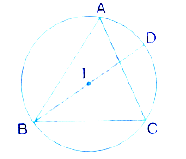
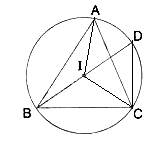
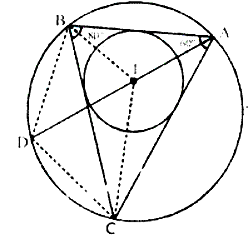
In the given figure, I is the incentre of ΔABC. BI when produced meets the circumcircle of
ΔABC at D. ∠BAC = 55° and ∠ACB = 65°; calculate:
(i) ∠DCA, (ii) ∠DAC, (iii) ∠DCI, (iv) AIC
Answer

Join IA, IC and CD
(i) IB is the bisector of ∠ABC
$\Rightarrow \angle A B D=\frac{1}{2} \angle B C=\frac{1}{2}\left(180^{\circ}-65^{\circ}-55^{\circ}\right)=30^{\circ}$
∠DCA = ∠ABD = 30°
(Angle in the same segment)
(ii) ∠DAC = ∠CBD = 30°
(Angle in the same segment)
(iii) ∠ACI = ∠ACB = 65° = 32.5°
(CI is the angular bisector of ∠ACB )
∴ ∠DCI = ∠DCA + ∠ACI = 30° + 32.5° = 62.5°
(iv) ∠IAC = ∠BAC = 55° = 27.5°
(AI is the angular bisector of ∠BAC )
∴ ∠AIC = 180° - ∠IAC - ∠ICA = 180° - 27.5°- 32.5° = 120°
View full question & answer
Question 214 Marks
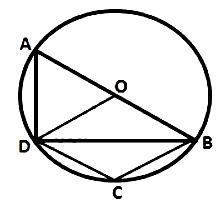
In the given figure, AB is a diameter of the circle with centre O. DO is parallel to CB and ∠DCB = 120°.
Calculate : ∠ADC
Also, show that the Δ AOD is an equilateral triangle.
Answer

∠ABD + ∠DBC = 30° + 30° = 60°
⇒ ∠ABC = 60°
In cyclic quadrilateral ABCD,
∠ADC + ∠ABC =180°
(pair of opposite angles in a cyclic quadrilateral are supplementary)
⇒ ∠ADC =180° - 60° =120°
In ∆AOD, OA = OD (radii of the same circle)
∠AOD =∠ DAO Or ∠DAB = 60° (proved in (i))
∠DAO = 60°
⇒ ∠ADO = ∠AOD =∠DAO = 60°
∴ ∆AOD is an equilateral triangle.
View full question & answer
Question 224 Marks
ABCD is a cyclic quadrilateral in which AB and DC on being produced, meet at P such that PA
= PD. Prove that AD is parallel to BC.
Answer

Let ABCD be the given cyclic quadrilateral
Also, PA = PD (Given)
∴ ∠PAD = ∠PDA ……..(1)
∴ ∠BAD = 180° - ∠PAD
And ∠CDA = 180° - PDA = 180° - ∠PAD (From (1))
We know that the opposite angles of a cyclic quadrilateral are supplementary
∴ ∠ABC = 180° - ∠CDA = 180° - (180° - ∠PAD) = ∠PAD
And ∠DCB = 180° - ∠BAD = 180° - (180° - ∠PAD) = ∠PAD
∴ ∠ABC = ∠DCB = ∠PAD = ∠PAD
That means AD || BC
View full question & answer
Question 234 Marks
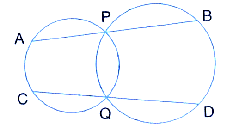
Two circle intersect at P and Q. through P, a straight line APB is drawn to meet the circles in A
and B. Through Q, a straight line is drawn to meet the circles at C and D. prove that AC is
parallel to BD.
Answer

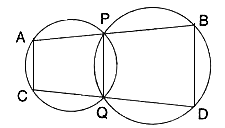
Join AC, PQ and BD
ACQP is a cyclic quadrilateral
∴ ∠CAP + ∠PQC = 180° ………….(i)
(pair of opposite in a cyclic quadrilateral are supplementary)
PQDB is a cyclic quadrilateral
∴ ∠PQD + ∠DBP = 180° ………….(ii)
(pair of opposite angles in a cyclic quadrilateral are supplementary)
Again, ∠PQC + ∠PQD = 180° …………. (iii)
(CQD is a straight line)
Using (i), (ii) and (iii)
∴ ∠CAP + ∠DBP = 180° Or
∴ ∠CAB + ∠DBA =180°
We know, if a transversal intersects two lines such That a pair of interior angles on the same side of the Transversal is supplementary, then the two lines are parallel
∴ AC || BD
View full question & answer
Question 244 Marks
Two chords AB and CD intersect at P inside the circle. Prove that the sum of the angles
subtended by the arcs AC and BD at the centre O is equal to twice the angle APC.
Answer

Given : two chords AB and CD intersect each other at P inside the circle. OA,
OB, OC and OD are joined.
To prove: ∠AOC + ∠BOD = 2∠APC
Construction: Join AD.
Proof: Arc AC subtends ∠AOCat the centre and ∠ADCat the remaining
Part of the circle.
∠AOC = 2∠ADC …………(1)
Similarly,
∠BOD = 2 ∠BAD ………….(2)
Adding (1) and (2),
∠AOC + ∠BOD = 2∠ADC + 2∠BAD
= 2(∠ADC +∠BAD ……….(3)
But ΔPAD,
Ext. ∠APC = ∠PAD +∠ADC
= ∠BAD +∠ADC ……………(4)
From (3) and (4),
∠AOC + ∠BOD = 2∠APC
View full question & answer
Question 254 Marks
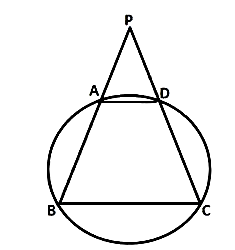
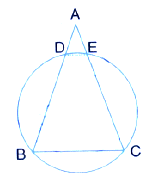
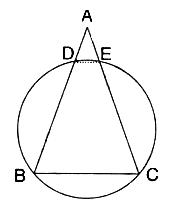
In the following figure AB = AC. Prove that DECB is an isosceles trapezium.
Answer

Here, AB = AC
⇒ ∠B =∠C
∴ DECB is a cyclic quadrilateral
(Ina triangle, angles opposite to equal sides are equal)
Also, ∠B + ∠DEC = 180° ………. (1)
(pair of opposite angles in a cyclic quadrilateral are supplementary)
⇒∠C + ∠DEC = 180° (from (1))
But this is the sum of interior angles
On one side of a transversal.
∴ DE || BC But ∠ADE = ∠AED = ∠C (Corresponding angles)
Thus, ∠ADE = ∠AED
⇒AD = AE
⇒AB - AD = AC - AE(∴ AB = AC)
⇒BD = CE
Thus, we have, DE || BC and BD = CE
Hence, DECB is an isosceles trapezium
View full question & answer
Question 264 Marks
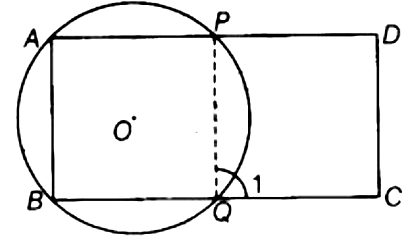
ABCD is a parallelogram. A circle through vertices A and Bmeets side BC at point P and side AD at point Q. Show that quadrilateral PCDQ is cyclic.
Answer
Given ABCD is a parallelogram. A circle whose centre O passes through A, B is so drawn that it intersect AD at P and BC at Q . To prove points P , Q , C and D are con-cyclic.

Construction Join PQ
Proof : ∠ 1 = ∠ A (exterior angle property of cyclic quadrilateral)
But ∠ A = ∠ C (opposite angles of a parallelogram)
∴ ∠1 = ∠ C .....(i)
But ∠C + ∠ D = 180° (sum of cointerior angles on same side is 180°)
⇒ ∠1 = ∠ D = 180° (from Eq. (i))
Thus , the quadrilateral QCDP is cyclic.
So , the points P,Q,C and D are con-cyclic.
Hence proved.
View full question & answer
Question 274 Marks
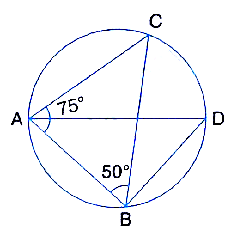
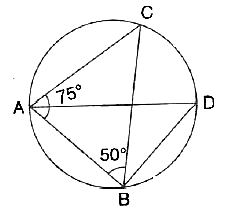
Given: ∠CAB = 75° and ∠CBA = 50°. Find the value of ∠DAB + ∠ABD.
Answer

In ΔABC, ∠CBA = 50° ,∠CAB = 75°
∠ACB = 180° - (∠CBA + CAB)
= 180° - (50° + 75° )
= 180° - 125°
= 55°
But ∠ADB = ∠ACB = 55°
(Angle subtended by the same chord on the circle are equal)
Now consider ΔABD,
∠DAB + ∠ABD + ∠ADB = 180°
⇒ ∠DAB +∠ABD + 55° = 180°
⇒ ∠DAB +∠ABD = 180° - 55°
⇒ ∠DAB + ∠ABD = 125°
View full question & answer
Question 284 Marks
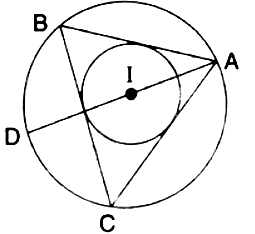
If I is the incentre of triangle ABC and AI when produced meets the cicrumcircle of triangle ABC in points D. f ∠BAC = 66° and ∠ABC = 80°. Calculate : ∠BIC.
Answer

Join DB and DC , IB and IC ,
∠ BAC = 66° , ∠ ABC = 80° , I is the incentre of theΔ ABC,
∠BAC = 66° and ∠ABC = 80°
In ∠ABC, ∠ACB = 180° - (∠ABC + ∠BAC)
⇒ ∠ACB = 180° - (80° + 66°)
⇒ ∠ACB = 180° - (156°)
⇒ ∠ACB = 34°
Since IC bisects the ∠C
$\therefore \angle ICB =\frac{1}{2} \angle C =\frac{1}{2} \times 34^{\circ}=17^{\circ}$
Now in IBC
∠ IBC + ∠ICB + ∠ BIC =180°
⇒ 40° +17° + ∠ BIC = 180°
⇒ 57° + ∠ BIC = 180°
⇒ ∠ BIC = 180° - 57°
⇒ ∠ BIC = 123°
View full question & answer
Question 294 Marks
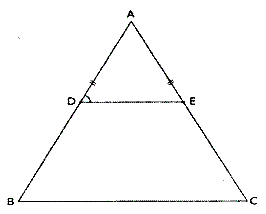
D and E are points on equal sides AB and AC of an isosceles triangle ABC such that AD = AE. Prove that the points B, C, E and D are concyclic.
Answer

Given – In ∆ABC, AB = AC and D and E are points on AB and AC
Such that AD = AE. DE is joined.
To prove B, C, E, D are concyclic.
Proof – In ∆ABC, AB = AC
∴ ∠B = ∠C (Angles opposite to equal sides)
Similarly, In ∆ADE, AD = AE (Given)
∴ ∠ADE = ∠AED (Angles opposite to equal sides)
In ∆ABC,
$\therefore \frac{A D}{A B}=\frac{A E}{A C}$
DE || BC
∴ ∠ADE = ∠B (corresponding angles)
But ∠B = ∠C (proved)
∴ Ext ∠ADE = its interior opposite ∠C
∴ BCED is a cyclic quadrilateral
Hence B, C, E and D are concyclic.
View full question & answer
Question 304 Marks
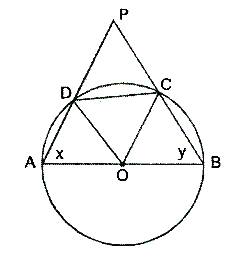
ABCD is a cyclic quadrilateral of a circle with centre O such that AB is a diameter of this circle and the length of the chord CD is equal to the radius of the circle. If AD and BC produced meet at P, Show that APB = 60°
Answer

In a circle, ABCD is a cyclic quadrilateral in which
AB is the diameter and chord CD is equal to the radius of the circle
To prove - ∠APB = 60°
Construction – Join OC and OD
Proof – Since chord CD = CO = DO (radii of the circle)
∴ ΔDOC is an equilateral triangle
∴ ∠DOC = ∠ODC = ∠DCO = 60°
Let ∠A = x and ∠B = y
Since OA =OB = OC = OD (radii of the same circle)
∴ ∠ODA = ∠OAD = x
∠OCB = ∠OBC = y and
∴ ∠AOD = 180° - 2x and ∠BOC = 180°- 2y
But AOB is a straight line
∴ ∠AOD+∠BOC+∠COD = 180°
⇒ 180° - 2x +180° - 2y + 60° =180°
⇒ 2x +2y = 240°
⇒ x + y = 120°
But ∠A +∠B+∠P = 180° (Angles of a triangle)
⇒ 120° + ∠P =180°
⇒ ∠P= 180° - 120°
⇒ ∠P = 60°
Hence ∠APB= 60°
View full question & answer
Question 314 Marks
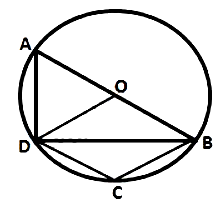
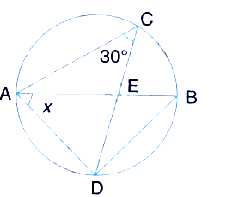
In the given circle with diameter AB, find the value of x.
Answer
∠ABD = ∠ACD = 30° [Angle in the same segment]
Now in ΔADB ,
∠BAD + ∠ADB + ∠ABD = 180° [angles of a triangle]
But, ∠ADB = 90° [ Angle in a semi-circle]
∴ x + 90° + 30° = 180°
⇒ x = 180° -120°
⇒ x = 60°
View full question & answer
Question 324 Marks
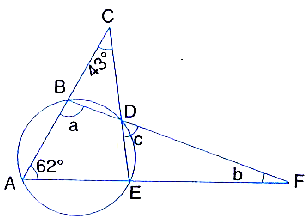
In the given figure, ∠ACE = 43° and ∠CAF = 62° ; Find the values of a, b and c.
Answer

Now, ∠ACE = 43° and ∠CAF = 62° (given)
In ΔAEC
∴∠ACE + ∠CAE + ∠AEC = 180°
⇒ 43° + 62° + ∠AEC = 180°
⇒ 105° + ∠AEC = 180°
⇒∠AEC = 180° -105° = 75°
Now, ∠ABD + ∠AED = 180°
(Opposite angles of a cyclic quad and ∠AED = ∠AEC)
⇒ a + 75° = 180°
⇒ a = 180° - 75°
⇒ a = 105°
∠EDF = ∠BAF
∴ c = 62° (Angles in the alternate segments)
In ΔBAF,a + 62° + b = 180°
⇒ 105° + 62° + b = 180°
⇒ 167° + b = 180°
⇒ b = 180° -167° = 13°
Hence, a = 105°, b = 13° and c = 62°
View full question & answer
Question 334 Marks
In cyclic quadrilateral ABCD; AD = BC, ∠BAC = 30° and ∠CBD = 70°; find:
(i) ∠BCD (ii) ∠BCA (iii) ∠ABC (iv) ∠ADC
Answer

ABCD is a cyclic quadrilateral and AD = BC
∠BAC = 30° , ∠CBD = 70°
∠DAC = ∠CBD(Angles in the same segment)
⇒ ∠DAC = 70° ( ∵ CBD = 70°)
⇒ ∠BAD = ∠BAC + ∠DAC = 30° + 70° = 100°
Since the sum of opposite angles of cyclic quadrilateral is supplementary
∠BAD + ∠BCD =180°
⇒ 100°+ ∠BCD = 180° (From (1))
⇒ ∠BCD = 180° -100° = 80°
Since , AD = BC ,∠ACD = ∠BDC (Equal chords subtends equal angles)
But ∠ACB = ∠ADB (angles in the same segment)
∴ ∠ACD + ∠ACB = ∠BDC + ∠ADB
⇒ ∠BCD = ∠ADC = 80°
But in ∆BCD,
∠CBD + ∠BCD + ∠BDC = 180 (angles oaf a triangle)
⇒ 70° + 80° + ∠BDC = 180°
⇒ 150° + ∠BDC = 180°
∴ ∠BDC = 180° -150° = 30°
⇒ ∠ACD = 30° (∠ACD = ∠BDC )
∴ ∠BCA = ∠BCD - ∠ACD = 80° - 30° = 50°
Since the sum of opposite angles of cyclic quadrilateral is supplementary
∠ADC + ∠ABC =180°
⇒ 80° + ABC = 180°
⇒ ∠ABC =180° - 80° = 100°
View full question & answer
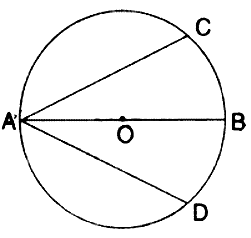
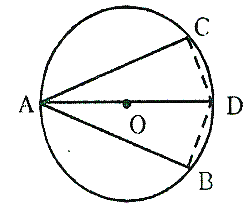
Question 344 Marks
In the following figure $, AB$ is the diameter of a circle with centre $O$.
If chord $AC =$ chord $AD,$ Prove that:
$(i)$ arc $BC =$ arc $DB$
$(ii)\ AB$ is bisector of $\angle CAD.$
Further, if the length of arc $AC$ is twice the length of arc $BC,$ find : $(a) \angle BAC\ \  (b) \angle ABC$
​​​​​​​
Answer

Given $–$ In a circle with centre $O, AB$ is the diameter and $AC$ and $AD$ are two chords such that $AC = AD$
To prove: $(i)$ arc $BC =$ arc $DB$
$(ii)\ AB$ is the bisector of $\angle CAD$
$(iii)$ If arc $AC = 2$ arc $BC,$ then find
$(a) \angle BAC$
$(b) \angle ABC$
Construction : Join $BC$ and $BD$
Proof : In right angled $\triangle ABC$ and $\triangle ABD$ Side $AC = AD \ ($Given$)$
Hyp. $AB = AB \ ($ Common$)$
$\therefore$ By right Angle $–$ Hypotenuse $–$ Side criterion of congruence
$\triangle ABC ≅\triangle ABD$
$(i)$ The corresponding parts of the congruent triangle are congruent.
$\therefore BC = BD \ (c.p.c.t)$
$\therefore$ Arc $BC =$ Arc $BD\ ( $equal chords have equal arcs$)$
$(ii) \angle BAC = \angle BAD$
$\therefore AB$ is the bisector of $\angle CAD$
$(iii)$ If Arc $AC = 2$ arc $BC,$
Then $\angle ABC = 2\angle BAC$
But $\angle ABC + \angle BAC = 90^\circ$
$\Rightarrow 2\angle BAC + \angle BAC = 90^\circ$
$\Rightarrow 3\angle BAC = 90^\circ$
$\Rightarrow \angle B A C=\frac{90^{\circ}}{3}=30^{\circ}$
$\angle A B C=2 \angle B A C$
$ \Rightarrow \angle A B C=2 \times 30^{\circ}=60^{\circ}$
View full question & answer
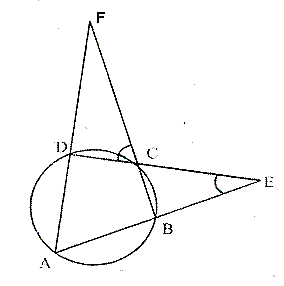
Question 354 Marks
$\text{ABCD}$ is a cyclic quadrilateral. Sides $AB $ and $DC$ produced meet at point $E$ ; whereas sides $BC$ and $AD$ produced meet at point $F$. If $\angle DCF : \angle F : \angle E = 3 : 5 : 4,$ Find the angles of the cyclic quadrilateral $\text{ABCD}.$
Answer

Given $–$ In a circle, $\text{ABCD}$ is a cyclic quadrilateral $AB$ and $DC$
Are produced to meet at $E$ and $BC$ and $AD$ are produced to meet at $F$.
$\angle DCF : \angle F : \angle E = 3 : 5 : 4$
Let $\angle DCF = 3X,\angle F = 5x,\angle E = 4x$
Now, we have to find $, \angle A,\angle B,\angle C$ and $\angle D$
In cyclic quad. $\text{ABCD}, \ BC$ is produced.
$\therefore \angle A =\angle DCF = 3x$
In $\triangle CDF,$
Ext $\angle CDA =\angle DCF +\angle 3x +5x = 8x$
In $\triangle BCE,$
Ext $\angle ABC =\angle BCE +\angle E\ (\angle BCE =\angle DCF,$ Vertically opposite angles$)$
$= \angle DCF +\angle E$
$= 3x + 4x = 7x$
Now, in cyclic quad $\text{ABCD},$
Since $, \angle B +\angle = 180^\circ$
$($since sum of opposite of a cyclic quadrilateral are supplementary$)$
$\Rightarrow 7x + 8x = 180^\circ$
$\Rightarrow 15x = 180^\circ$
$\Rightarrow x=\frac{180^{\circ}}{15}=12^{\circ}$
$\angle A =3 x =3 \times 12^{\circ}=36^{\circ}$
$\angle B =7 x =7 \times 12^{\circ}=84^{\circ}$
$\angle C =180^{\circ}-\angle A =180^{\circ}-36^{\circ}=144^{\circ}$
$\angle D =8 x =8 \times 12^{\circ}=96^{\circ}$
View full question & answer
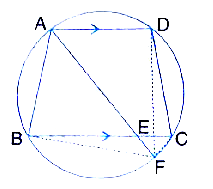
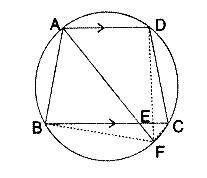
Question 364 Marks
In the following figure, ABCD is a cyclic quadrilateral in which AD is parallel to BC.

If the bisector of angle A meets BC at point E and the given circle at point F, Prove that:
(i) EF = FC (ii) BF = DF
Answer

Given – ABCD is a cyclic quadrilateral in which AD || BC
Bisector of ∠A meets BC at E and the given circle at F. DF and BF are joined.
To prove –
(i) EF = FC
(ii) BF = DF
Proof – ABCD is a cyclic quadrilateral and AD ∥ BC
∵ AF is the bisector of ∠A, ∠BAF = ∠DAF
Also, ∠DAE = ∠BAE
∠DAE = ∠AEB (Alternate angles)
(i) In ΔABE, ∠ABE = 180° - 2∠AEB
∠CEF = ∠AEB (vertically opposite angles)
∠ADC = 180° - ABC = 180° - (180° - 2∠AEB)
∠ADC = 2∠AEB
∠AFC = 180° - ∠ADC
= 180° - 2∠AEB (since ADFC is a cyclic quadrilateral)
∠ECF = 180° - (∠AFC + ∠CEF)
= 180 - (180 - 2∠AEB + ∠AEB)
= ∠AEB
∴ EC = EF
(ii) ∴ Arc BF = Arc DF (Equal arcs subtends equal angles)
⇒ BF = DF (Equal arcs have equal chords)
View full question & answer
Question 374 Marks
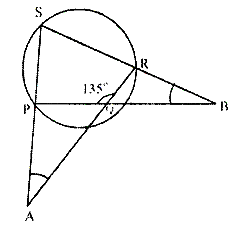
In a cyclic – quadrilateral PQRS, angle PQR = 135°. Sides SP and RQ produced meet at point A : whereas sides PQ and SR produced meet at point B.
If ∠A : ∠B = 2 : 1; find angles A and B.
Answer

PQRS is a cyclic quadrilateral in which ∠PQR = 135°
Sides SP and RQ are produced to meet at A and Sides PQ and SR are produced to meet at B.
∠A = ∠B = 2 : 1
Let ∠A = 2X , then ∠B - X
Now, in cyclic quad PQRS,
Since, ∠PQR = 135°, = 180°-135° = 45°
(since sum of opposite angles of a cyclic quadrilateral are supplementary)
Since, ∠PQR and ∠PQA are linear pair,
∠PQR + ∠PQA = 180°
⇒135° + PQA = 180°
⇒ ∠PQA = 180° -135° = 45°
Now, In ∆PBS,
∠P = 180° - (45° + x ) = 180° - 45° - x = 135° - x …..(1)
Again, in ∆PQA,
EXT ∠P = ∠PQA +∠ = 45° + 2X ……….(2)
From (1) and (2),
45° + 2x =135° - x
⇒ 2x + x = 135° - 45°
⇒3x = 90°
⇒ x = 30°
Hence, ∠A = 2x = 2 ×30° = 60°
And ∠B = x = 30°
View full question & answer
[4 marks sum] - Mathematics STD 10 Questions - Vidyadip