Questions

[5 marks sum]

🎯

Test yourself on this topic

10 questions · timed · auto-graded

Question 15 Marks
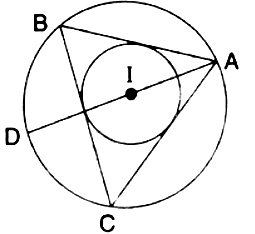
If I is the incentre of triangle ABC and AI when produced meets the cicrumcircle of triangle ABC in points D. f ∠BAC = 66° and ∠ABC = 80°. Calculate : ∠BIC.
Answer
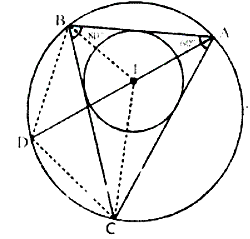
Join DB and DC , IB and IC ,
∠ BAC = 66° , ∠ ABC = 80° , I is the incentre of theΔ ABC,
∠BAC = 66° and ∠ABC = 80°
In ∠ABC, ∠ACB = 180° - (∠ABC + ∠BAC)
⇒ ∠ACB = 180° - (80° + 66°)
⇒ ∠ACB = 180° - (156°)
⇒ ∠ACB = 34°
Since IC bisects the ∠C
$\therefore \angle ICB =\frac{1}{2} \angle C =\frac{1}{2} \times 34^{\circ}=17^{\circ}$
Now in IBC
∠ IBC + ∠ICB + ∠ BIC =180°
⇒ 40° +17° + ∠ BIC = 180°
⇒ 57° + ∠ BIC = 180°
⇒ ∠ BIC = 180° - 57°
⇒ ∠ BIC = 123°
View full question & answer
Question 25 Marks
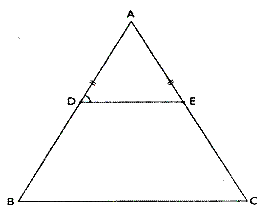
D and E are points on equal sides AB and AC of an isosceles triangle ABC such that AD = AE. Prove that the points B, C, E and D are concyclic.
Answer

Given – In ∆ABC, AB = AC and D and E are points on AB and AC
Such that AD = AE. DE is joined.
To prove B, C, E, D are concyclic.
Proof – In ∆ABC, AB = AC
∴ ∠B = ∠C (Angles opposite to equal sides)
Similarly, In ∆ADE, AD = AE (Given)
∴ ∠ADE = ∠AED (Angles opposite to equal sides)
In ∆ABC,
$\therefore \frac{A D}{A B}=\frac{A E}{A C}$
DE || BC
∴ ∠ADE = ∠B (corresponding angles)
But ∠B = ∠C (proved)
∴ Ext ∠ADE = its interior opposite ∠C
∴ BCED is a cyclic quadrilateral
Hence B, C, E and D are concyclic.
View full question & answer
Question 35 Marks
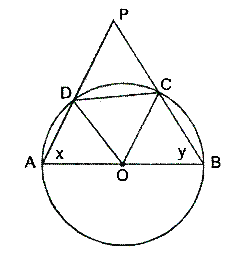
ABCD is a cyclic quadrilateral of a circle with centre O such that AB is a diameter of this circle and the length of the chord CD is equal to the radius of the circle. If AD and BC produced meet at P, Show that APB = 60°
Answer

In a circle, ABCD is a cyclic quadrilateral in which
AB is the diameter and chord CD is equal to the radius of the circle
To prove - ∠APB = 60°
Construction – Join OC and OD
Proof – Since chord CD = CO = DO (radii of the circle)
∴ ΔDOC is an equilateral triangle
∴ ∠DOC = ∠ODC = ∠DCO = 60°
Let ∠A = x and ∠B = y
Since OA =OB = OC = OD (radii of the same circle)
∴ ∠ODA = ∠OAD = x
∠OCB = ∠OBC = y and
∴ ∠AOD = 180° - 2x and ∠BOC = 180°- 2y
But AOB is a straight line
∴ ∠AOD+∠BOC+∠COD = 180°
⇒ 180° - 2x +180° - 2y + 60° =180°
⇒ 2x +2y = 240°
⇒ x + y = 120°
But ∠A +∠B+∠P = 180° (Angles of a triangle)
⇒ 120° + ∠P =180°
⇒ ∠P= 180° - 120°
⇒ ∠P = 60°
Hence ∠APB= 60°
View full question & answer
Question 45 Marks
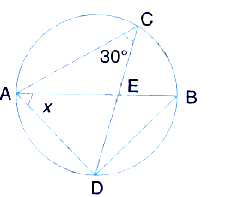
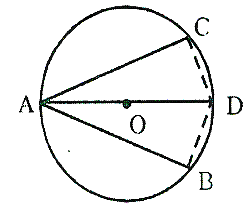
In the given circle with diameter AB, find the value of x.
Answer
∠ABD = ∠ACD = 30° [Angle in the same segment]
Now in ΔADB ,
∠BAD + ∠ADB + ∠ABD = 180° [angles of a triangle]
But, ∠ADB = 90° [ Angle in a semi-circle]
∴ x + 90° + 30° = 180°
⇒ x = 180° -120°
⇒ x = 60°
View full question & answer
Question 55 Marks
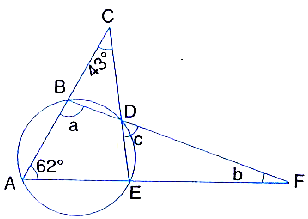
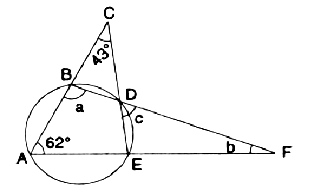
In the given figure, ∠ACE = 43° and ∠CAF = 62° ; Find the values of a, b and c.
Answer

Now, ∠ACE = 43° and ∠CAF = 62° (given)
In ΔAEC
∴∠ACE + ∠CAE + ∠AEC = 180°
⇒ 43° + 62° + ∠AEC = 180°
⇒ 105° + ∠AEC = 180°
⇒∠AEC = 180° -105° = 75°
Now, ∠ABD + ∠AED = 180°
(Opposite angles of a cyclic quad and ∠AED = ∠AEC)
⇒ a + 75° = 180°
⇒ a = 180° - 75°
⇒ a = 105°
∠EDF = ∠BAF
∴ c = 62° (Angles in the alternate segments)
In ΔBAF,a + 62° + b = 180°
⇒ 105° + 62° + b = 180°
⇒ 167° + b = 180°
⇒ b = 180° -167° = 13°
Hence, a = 105°, b = 13° and c = 62°
View full question & answer
Question 65 Marks
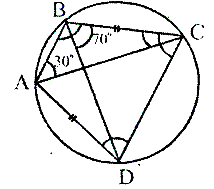
In cyclic quadrilateral ABCD; AD = BC, ∠BAC = 30° and ∠CBD = 70°; find:
(i) ∠BCD (ii) ∠BCA (iii) ∠ABC (iv) ∠ADC
Answer

ABCD is a cyclic quadrilateral and AD = BC
∠BAC = 30° , ∠CBD = 70°
∠DAC = ∠CBD(Angles in the same segment)
⇒ ∠DAC = 70° ( ∵ CBD = 70°)
⇒ ∠BAD = ∠BAC + ∠DAC = 30° + 70° = 100°
Since the sum of opposite angles of cyclic quadrilateral is supplementary
∠BAD + ∠BCD =180°
⇒ 100°+ ∠BCD = 180° (From (1))
⇒ ∠BCD = 180° -100° = 80°
Since , AD = BC ,∠ACD = ∠BDC (Equal chords subtends equal angles)
But ∠ACB = ∠ADB (angles in the same segment)
∴ ∠ACD + ∠ACB = ∠BDC + ∠ADB
⇒ ∠BCD = ∠ADC = 80°
But in ∆BCD,
∠CBD + ∠BCD + ∠BDC = 180 (angles oaf a triangle)
⇒ 70° + 80° + ∠BDC = 180°
⇒ 150° + ∠BDC = 180°
∴ ∠BDC = 180° -150° = 30°
⇒ ∠ACD = 30° (∠ACD = ∠BDC )
∴ ∠BCA = ∠BCD - ∠ACD = 80° - 30° = 50°
Since the sum of opposite angles of cyclic quadrilateral is supplementary
∠ADC + ∠ABC =180°
⇒ 80° + ABC = 180°
⇒ ∠ABC =180° - 80° = 100°
View full question & answer
Question 75 Marks
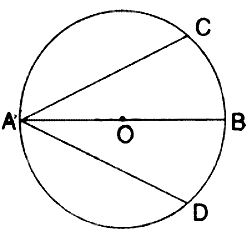
In the following figure, AB is the diameter of a circle with centre O.
If chord AC = chord AD, Prove that:
(i) arc BC = arc DB
(ii) AB is bisector of ∠CAD.
Further, if the length of arc AC is twice the length of arc BC, find : (a) ∠BAC (b) ∠ABC
Answer

Given – In a circle with centre O, AB is the diameter and AC and AD are two chords such that AC = AD
To prove: (i) arc BC = arc DB
(ii) AB is the bisector of ∠CAD
(iii) If arc AC = 2 arc BC, then find
(a) ∠BAC
(b) ∠ABC
Construction: Join BC and BD
Proof : In right angled ∆ABC and ∆ABD Side AC = AD (Given)
Hyp. AB = AB ( Common)
∴ By right Angle – Hypotenuse – Side criterion of congruence
ΔABC ≅ΔABD
(i) The corresponding parts of the congruent triangle are congruent.
∴ BC = BD (c.p.c.t)
∴ Arc BC = Arc BD ( equal chords have equal arcs)
(ii) ∠BAC = ∠BAD
∴ AB is the bisector of ∠CAD
(iii) If Arc AC = 2 arc BC,
Then ∠ABC = 2∠BAC
But ∠ABC + ∠BAC = 90°
⇒2∠BAC + ∠BAC = 90°
⇒3∠BAC = 90°
$\Rightarrow \angle B A C=\frac{90^{\circ}}{3}=30^{\circ}$
$\angle A B C=2 \angle B A C \Rightarrow \angle A B C=2 \times 30^{\circ}=60^{\circ}$
View full question & answer
Question 85 Marks
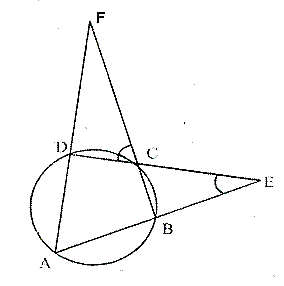
ABCD is a cyclic quadrilateral. Sides AB and DC produced meet at point E; whereas sides BC and AD produced meet at point F. If ∠DCF : ∠F : ∠E = 3 : 5 : 4, Find the angles of the cyclic quadrilateral ABCD.
Answer

Given – In a circle, ABCD is a cyclic quadrilateral AB and DC
Are produced to meet at E and BC and AD are produced to meet at F.
∠DCF : ∠F : ∠E = 3 : 5 : 4
Let ∠DCF = 3X,∠F = 5x,∠E = 4x
Now, we have to find, ∠A,∠B,∠C and ∠D
In cyclic quad. ABCD, BC is produced.
∴ ∠A =∠DCF = 3x
In ΔCDF,
Ext ∠CDA =∠DCF +∠ 3x +5x = 8x
In ΔBCE,
Ext ∠ABC =∠BCE +∠E (∠BCE =∠DCF, Vertically opposite angles)
= ∠DCF +∠E
= 3x + 4x = 7x
Now, in cyclic quad ABCD,
Since, ∠B +∠ = 180°
(since sum of opposite of a cyclic quadrilateral are supplementary)
⇒ 7x + 8x = 180°
⇒15x = 180°
$\Rightarrow x=\frac{180^{\circ}}{15}=12^{\circ}$
$\angle A =3 x =3 \times 12^{\circ}=36^{\circ}$
$\angle B =7 x =7 \times 12^{\circ}=84^{\circ}$
$\angle C =180^{\circ}-\angle A =180^{\circ}-36^{\circ}=144^{\circ}$
$\angle D =8 x =8 \times 12^{\circ}=96^{\circ}$
View full question & answer
Question 95 Marks
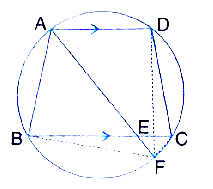
In the following figure, ABCD is a cyclic quadrilateral in which AD is parallel to BC.

If the bisector of angle A meets BC at point E and the given circle at point F, Prove that:
(i) EF = FC (ii) BF = DF
Answer

Given – ABCD is a cyclic quadrilateral in which AD || BC
Bisector of ∠A meets BC at E and the given circle at F. DF and BF are joined.
To prove –
(i) EF = FC
(ii) BF = DF
Proof – ABCD is a cyclic quadrilateral and AD ∥ BC
∵ AF is the bisector of ∠A, ∠BAF = ∠DAF
Also, ∠DAE = ∠BAE
∠DAE = ∠AEB (Alternate angles)
(i) In ΔABE, ∠ABE = 180° - 2∠AEB
∠CEF = ∠AEB (vertically opposite angles)
∠ADC = 180° - ABC = 180° - (180° - 2∠AEB)
∠ADC = 2∠AEB
∠AFC = 180° - ∠ADC
= 180° - 2∠AEB (since ADFC is a cyclic quadrilateral)
∠ECF = 180° - (∠AFC + ∠CEF)
= 180 - (180 - 2∠AEB + ∠AEB)
= ∠AEB
∴ EC = EF
(ii) ∴ Arc BF = Arc DF (Equal arcs subtends equal angles)
⇒ BF = DF (Equal arcs have equal chords)
View full question & answer
Question 105 Marks
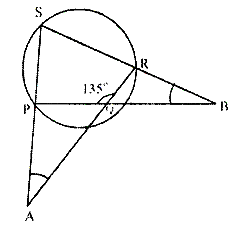
In a cyclic – quadrilateral PQRS, angle PQR = 135°. Sides SP and RQ produced meet at point A : whereas sides PQ and SR produced meet at point B.
If ∠A : ∠B = 2 : 1; find angles A and B.
Answer

PQRS is a cyclic quadrilateral in which ∠PQR = 135°
Sides SP and RQ are produced to meet at A and Sides PQ and SR are produced to meet at B.
∠A = ∠B = 2 : 1
Let ∠A = 2X , then ∠B - X
Now, in cyclic quad PQRS,
Since, ∠PQR = 135°, = 180°-135° = 45°
(since sum of opposite angles of a cyclic quadrilateral are supplementary)
Since, ∠PQR and ∠PQA are linear pair,
∠PQR + ∠PQA = 180°
⇒135° + PQA = 180°
⇒ ∠PQA = 180° -135° = 45°
Now, In ∆PBS,
∠P = 180° - (45° + x ) = 180° - 45° - x = 135° - x …..(1)
Again, in ∆PQA,
EXT ∠P = ∠PQA +∠ = 45° + 2X ……….(2)
From (1) and (2),
45° + 2x =135° - x
⇒ 2x + x = 135° - 45°
⇒3x = 90°
⇒ x = 30°
Hence, ∠A = 2x = 2 ×30° = 60°
And ∠B = x = 30°
View full question & answer
[5 marks sum] - Mathematics STD 10 Questions - Vidyadip