Questions

[3 marks sum]

🎯

Test yourself on this topic

18 questions · timed · auto-graded

Question 13 Marks
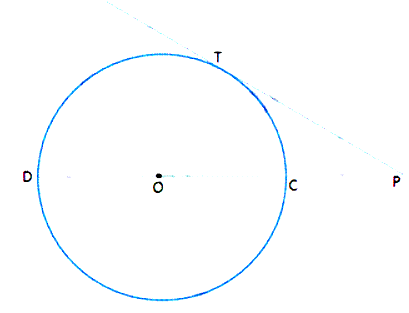
In following fig., PT is tangent to the circle at T and CD is a diameter of the same circle. If PC= 3cm and PT= 6cm, find the radius of the circle.
Answer
Let $O D=O C=x cm$ (radius of same circle)
Since, $P C D$ is a secant and PT is a tangent to the given circle, we have
$
P C \cdot P D=P T^2
$
$3 \cdot(3+2 x)=6^2$
$
\Rightarrow 9+6 x=36
$
$
\Rightarrow 6 x =27
$
$
\Rightarrow x =\frac{27}{6}=\frac{9}{2}
$
Radius of the circle is $\frac{9}{2} cm$, diameter is $9 cm$
View full question & answer
Question 23 Marks
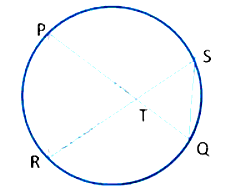
In following fig., chords PQ and RS of a circle intersect at T. If RS = 18cm, ST = 6cm and PT = 18cm, find the length of TQ.
Answer
Let $TQ = x cm$
In $\triangle PTR$ and $\triangle STQ$
$\angle TPR =\angle TSQ$ (angles in the same segment)
$\angle$ PTR $=\angle$ STQ (vertically opposite L's)
$\therefore \angle PTR =\angle STQ \quad\{ AA$ corollary $\}$
$\frac{ PT }{ ST }=\frac{ TR }{ TQ }$ (similar sides of similar triangles)
$\frac{18}{6}=\frac{12}{ x }$
$=x=4$
$\Rightarrow TQ =4 cm$
View full question & answer
Question 33 Marks
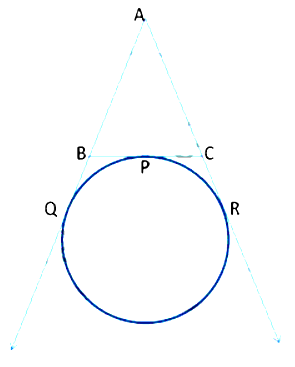
In following fig., a circle is touching the side BC of Δ ABC at P and AB and AC produced at Q and R respectively. Prove that AQ is half the perimeter of Δ ABC.
Answer
To prove: $A Q=\frac{1}{2}$ (Perimeter of $\triangle A B C$ )
Proof: $B Q=B R=5-r\ldots(1)$
$PC = CR =12- r\ldots(2)$
(Lengths of tangents drawn from an external point to a circle are equal)
Perimeter of $6 ABC = AB + BC + AC$
$
=A B+B P+P C+A C
$
$=A B+B Q+C R+A C$ $\quad$$\quad$$\quad$Using (1)
$
=A Q+A R
$
$
=2 AQ
$
$2 AQ =$ Perimeter of $\triangle ABC$
$AQ =\frac{1}{2}$ (Perimeter of $\left.\triangle ABC \right)$
View full question & answer
Question 43 Marks
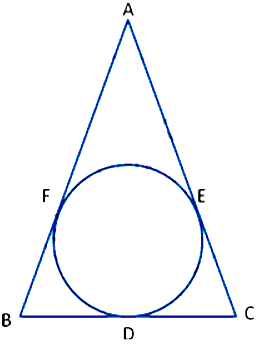
In following figure , the incircle of Δ ABC , touches the sides BC , CA and AB at D , E and F respectively. Show AF + BD + CE = AE + BF + CD
Answer
To prove:- AF + BD + CE = AE + BF + CD
Proof:- AF = AE ----(1) {Length of tangents drawn from an external point to a circle are equal }
BD = BF ----(2}
CE = CD ----(3}
Adding (1), {2} and {3}
AF + BD + CE = AE + BF + CD
View full question & answer
Question 53 Marks
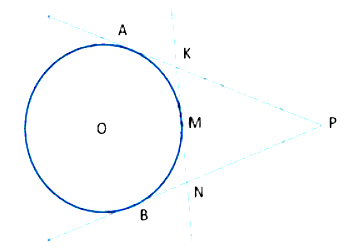
PA and PB are tangents from P to the circle with centre O. At M, a tangent is drawn cutting PA at K and PB at N. Prove that KN = AK + BN.
Answer

KA = KM ---(1) {Length of tangents drawn from an external point to a circle are equal }
NM = NB
KN = KM + MN
KN = KA+ BM {Using (1)}
View full question & answer
Question 63 Marks
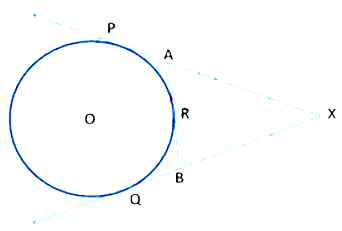
In the figure, XP and XQ are tangents from X to the circle with centre O. R is a point on the circle. Prove that XA + AR = XB + BR.
Answer
XP = XQ
AR = AP
BR = BQ {Length of tangents drawn from an external point to a circle are equal}
XP = XQ

XA + AP = XB + BR
XA + AR = XB + BR {Using {1)}
View full question & answer
Question 73 Marks
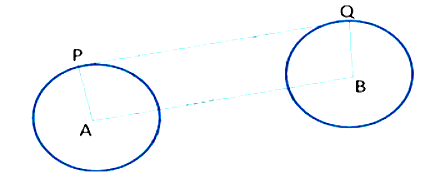
Calculate the length of direct common tangent to two circles of radii 3cm and Bern with their centres $13\ cm$ apart.
Answer
To find:$ PQ$
$R_1 = 3cm, R_2 = 8cm$
$AB= 13cm$
$PQ^2= AB^2 -(R_2 -R_1)^2$
$\Rightarrow PQ^2 = 13^2 - ( 8 - 3)^2$
$\Rightarrow PQ^2 = 169 - 25$
$\Rightarrow PQ^2 = 144$
$\Rightarrow PQ = 12cm$
Length of direct common tangent is $12\ cm$
View full question & answer
Question 83 Marks
The length of the direct common tangent to two circles of radii $12\ cm$ and $4\ cm$ is $15\ cm$. calculate the distance between their centres.
Answer
$R_1 = 4cm, R_2 = 12cm$
$PQ = l5 cm$
$AB^2 = PQ^2 + (R_2 - R_1)^2$
$=> AB^2 = 15^2 + (12 - 4)^2$
$=> AB^2 = 225 + 64$
$=>AB^2 = 289$
$=> AB = 17cm$
The diameter between the centre is $17\ cm$
View full question & answer
Question 93 Marks
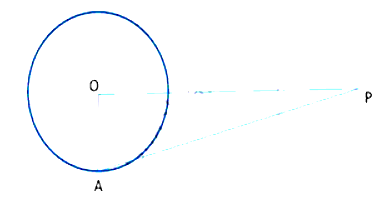
Find the length of the tangent from a point which is at a distance of $5cm$ from the centre of the circle of radius $3cm$.
Answer

$\mathrm{OA} \perp \mathrm{AP}$ (radius is perpendicular to tangent at the point of contact)
In right $\triangle O A P$,
$O P^2=O A^2+A P^2$
$A P^2=5^2-3^2$
$=25-9=16$
$A P=4 \mathrm{~cm}$
The length of the tangent is 4 cm .
View full question & answer
Question 103 Marks
Two circles are drawn with sides $AB, AC$ of a triangle $ABC$ as diameters. They intersect at a point $D$. Prove that $D$ lies on $BC$.
Answer
$AB$ and $AC$ are diameters of circles with oentre $O$ and $O^1$ respectively
$∠ ADB = 90 °$ ---( 1) (Angle in a semi circle is a right angle)
Similarly, $∠ ADB = 90°$ ---(2)
Adding ( 1) and (2)
$∠ ADB + ∠ ADC = 90 + 90$
$∠ BDC = 180°$
Hence, BDC is a straight line.
View full question & answer
Question 113 Marks
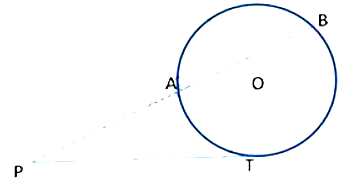
In fig., PT is a tangent to the circle at T and PAB is a secant to the same circle. If $PB = 9cm$ and $AB = 5 cm$, find PT.
Answer
Given AP and AQ are diameters of circles with centre $O$ and $O^1$ respectively
∴ ∠ APB = 90° ---( 1) (Angle in a semidrde is a right angle)
Similarly, ∠ ABQ = 90° ---(2)
Adding (1) and (2)
∠ APB + ∠ ABQ = 90° + 90°
∠ PBQ = 180°
Hence, PBQ is a straight line
∴ P, B and Q are collinear.
View full question & answer
Question 123 Marks
In a cyclic quadrilateral ABCD , AB || CD and ∠ B = 65° , find the remaining angles.
Answer
∠ B = 65°( given)
∠ B + ∠ D = 180 (Opposite angles of a cydic quadrilateral)
65 + ∠ D = 180
∠ D = 115
Also, AB || CD
∴ ∠ B + ∠ C = 180 (Sum of angles on same side of transversal)
∠ C = 180 - 65 = 115
Again, ∠ A+ ∠ C = 180° (Opposite angles of a cyclic quadrilateral
∠ A = 180 - 115 = 65°
View full question & answer
Question 133 Marks
In following figure.,ABCD is a cyclic quadrilateral . If ∠ BCD = 100° and ∠ ABD = 70° , find ∠ ADB.
Answer
In cyclic quadrilateral ABCD,
∠ BCD + ∠ DAB = 180° (Opposite angles of a cyclic quadrilateral)
100 + ∠ DAB = 180
∠ DAB = 80°
In Δ DAB ,
∠ DAB + ∠ ABD + ∠ BDA = 180°
80 + 70° + ∠ BDA = 180°
∠ BDA = 30°
View full question & answer
Question 143 Marks
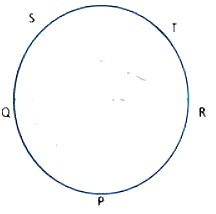
In following figure , Δ PQR is an isosceles teiangle with PQ = PR and m ∠ PQR = 35° .Find m ∠ QSR and ∠ QTR
Answer
In Δ PQR.,
PQ = PR
∴ ∠ PQR = ∠ PRQ = 35°
Also , ∠ PQR + ∠ PRQ + ∠QPR = 180°
35 + 35 + ∠QPR = 180
∠QPR = 110°
In cyclic quadrilateral PQSR ,
∠QPR + ∠QSR = 180
110 + ∠QSR = 180
∠QSR = 70<
Also , ∠QSR = ∠QTR = 70° (Angles in the same segment)
View full question & answer
Question 153 Marks
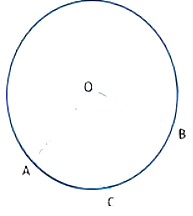
In following figure , C is a point on the minor arc AB of the circle with centre O . Given ∠ ACB = p° , ∠ AOB = q° , express q in terms of p. Calculate p if OACB is a parallelogram.
Answer
$
\angle AOB = q
$
Reflex $\angle A O B=360-q$
Since $\operatorname{arc} A B$ subtends reflex $\angle A O B=(360-q)^{\circ}$ at the centre and $\angle A C B$ on the remaining part of the circle.
$
\therefore \angle ACB =\frac{1}{2}(\text { reflex } \angle AOB )
$
If $O A C B$ is a parallelogram
$
\angle A O B=\angle A C B
$
$
q=p
$
$360-2 p=p$
$
3 p=360
$
$
p=120^{\circ}
$
View full question & answer
Question 163 Marks
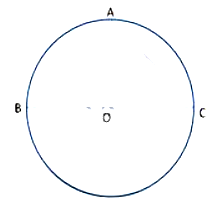
In following figure . O is the centre of the circle. Find ∠ BAC.
Answer
$BOC$ is the diameter of circle,
$
\therefore \angle B O C=180^{\circ}
$
Since are $BC$ makes $\angle BOC$ at the centre and $\angle BAC$ on the remaining part of the circle.
$
\therefore \angle BAC =\frac{1}{2} \angle BOC
$
$\therefore \angle BAC =\frac{1}{2} \times 180=90^{\circ}$
View full question & answer
Question 173 Marks
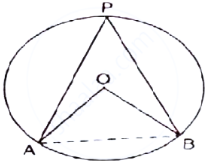
In following figure , O is the centre of the circle. If ∠ APB = 50° then find ∠ AOB and ∠ OAB.
Image
Answer
Since arc AB makes ∠ AOB at the centre and ∠ APB = 500 on the remaining part of the circle.
∠ AOB = 2 ∠ APB
∠ AOB = 2(50) = 100°
AO= OB = x (radii of same circle)
In Δ AOB
∠ AOB + ∠ BAO + ∠ ABO = 180
180 + x + x = 180
2x = 80
x = 40
∴ ∠ OAB = 40° 
View full question & answer
Question 183 Marks
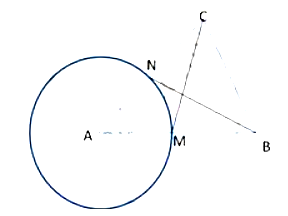
In following fig. ABC is an equilateral triangle . A circle is drawn with centre A so that ot cuts AB and AC at M and N respectively. Prove that BN = CM.
Answer
ABC is an equilateral triangle,
∴ AB = AC
Also AN = MB (radii of same circle)
⇒ NC = MB
In Δ BNC and Δ CMB
NC = MB (proved above)
∠ B = ∠ C (60° each)
BC = BC (common)
∴ Δ BNC and Δ CMB (SAS)
∴ BN = CM (CPCT)
View full question & answer
[3 marks sum] - Mathematics STD 10 Questions - Vidyadip