Questions

[5 marks sum]

🎯

Test yourself on this topic

14 questions · timed · auto-graded

Question 15 Marks
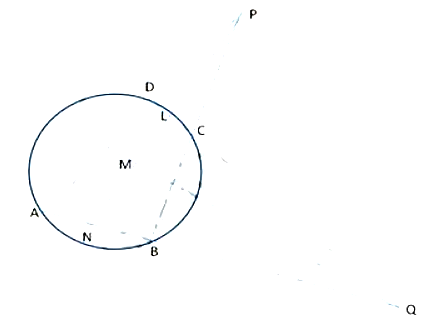
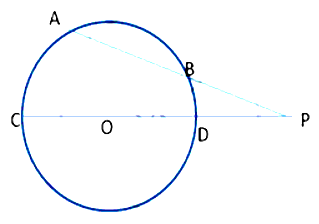
In fig., AB and DC are two chords of a circle with centre O. these chords when produced meet at P. if PB = Bern, BA = 7cm and PO = 14.5cm, find the radius of the circle.
Answer
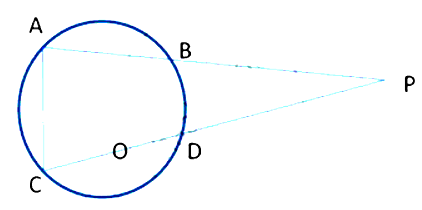

Let $O D=O C=r$ (say)
$P O=14.5, C P=r+14.5$
$P D=14.5-r$
In $\triangle BPD$ and $\triangle APC$
$\angle BPD =\angle APC \text { (Common) }$
$\angle ABD +\angle DBP =180^{\circ}\ldots(1)$ ( Linear pair )
Also, $\angle ABD +\angle ACD =180^{\circ}\ldots(2)$
$(Opposite\quad angles\quad of\quad a \quad cyclic\quad quadrilateral)$
$\text { From }(1) \text { and }\{2\}$
$\angle DBP =\angle ACD$
$\therefore \triangle BPD \sim \triangle CPA \quad (AA \quad corollary)$
$\frac{8}{ r +14.5}=\frac{4.5- r }{15}$
$120^{\circ}=14.5^2- r ^2$
$r 2=210.25-120$
$r ^2=90.25$
$r =9.50$
Radius of the circle is $9.5 cm$.
View full question & answer
Question 25 Marks
Bisectors of angles $A, B$ and $C$ of a triangle $A B C$ intersect its circumcircle at $D, E$ and $F$ respectively. Prove that the angles of $\triangle D E F$ are $90^{\circ}-\frac{ A }{2}, 90^{\circ}-\frac{ B }{2}$ and $90^{\circ}-\frac{ C }{2}$ respectively.
Answer


Since $A D, B E$ and $C F$ are bisectors of $\angle A, \angle B$ and $\angle C$ respectively.
$\therefore \angle 1=\angle 2=\angle \frac{ A }{2}$
$\angle 3=\angle 4=\angle \frac{ B }{2} $
$\angle 5=\angle 6=\angle \frac{ C }{2}$
$\angle ADE =\angle 3$
Also $\angle ADF =\angle 6 \ldots$...(2) (angles in the same segment)
Adding (1) and (2)
$\angle ADE +\angle ADF =\angle 3+\angle 6$
$\angle D =\frac{1}{2} \angle B +\frac{1}{2} \angle C $
$\angle D =\frac{1}{2}( B +\angle C )=\frac{1}{2}(180-\angle A )\left(\angle A +\angle B +\angle C =180^{\circ}\right)$
$\angle D =90-\frac{1}{2} \angle A$
Similarly,
$\angle E =90-\frac{1}{2} \angle B , \angle F =90-\frac{1}{2} \angle C$
View full question & answer
Question 35 Marks
Prove that the angles bisectors of the angles formed by producing opposite sides of a cyclic quadrilateral (provided they are not parallel) intersect at right triangle.
Answer

Here, ABCD is a cyclic quadrilateral. PM is bisector of ∠ APB and QM is bisector of ∠ AQD
In Δ PDL and Δ PBN, ∠ 1=∠ 2 (PM is a bisector of LP)
∠ 3 = ∠ 9 (exterior angle of cydic quad. = interior opposite angle)
∴ ∠ 4 = ∠ 7
But, ∠ 4 = ∠ 8 (vertical opposite angles)
∴ ∠ 7 = ∠ 8
Now in Δ QMN and Δ QML
∠ 7 = ∠ 8 (proved above)
∠ S = ∠ 6 (QM is bisector of Q)
∴ Δ QMN ~ Δ QML
⇒ ∠ QMN and ∠ QML
But, ∠ QMN + ∠ QML = 180°
∴ ∠ QMN = ∠ QML = 90°
Hence, ∠ PMQ = 90 °
View full question & answer
Question 45 Marks
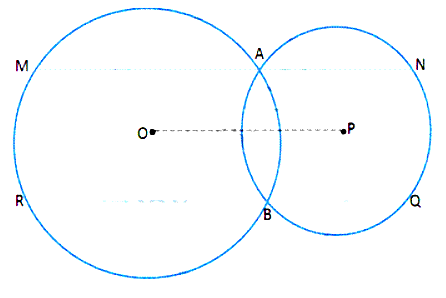
Two circles with centres O and P intersect each other at A and B as shown in following fig. Two straight lines MAN and RBQ are drawn parallel to OP.
Prove that (i) MN = 20 P (ii) MN= RQ.
Answer

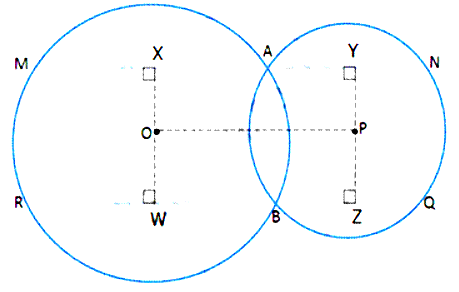
Given: Two cirdes with centres 0 and P, and MN II OP || RQ
To prove: (i) MN = 20P (ii) MN= RQ.
Construction: OX ⊥ MN, PY ⊥ MN, OW ⊥ RZ, PZ ⊥ RQ
Proof: Since each angle of the quadrilateral XYZW is a right angle, sc XYZW is a rectangle.
Also, XYPO is a rectangle. ...(1)
Now, perpendicular drawn from the centre to the chord bisects the chord.
Therefore, MA = 2 XA and AN = 2 AY ...(2)
Now, MN = MA + AN = 2 XA + 2 AY [from (2)]
⇒ MN = 2(XA + AY) = 2 XY
⇒ MN = 2 OP [As XYPO is a rectangle, XY = OP] ... (3)
This proves part (i).
By similar arguments, we have RQ = 2 OP ...(4)
Using (3) and ( 4), we get
MN= RQ.
This proves part (ii).
View full question & answer
Question 55 Marks
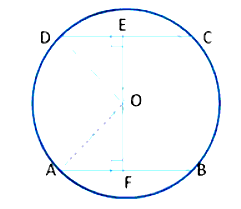
Prove that the line segment joining the midpoints of two parallel chords of a circle passes through its centre.
Answer

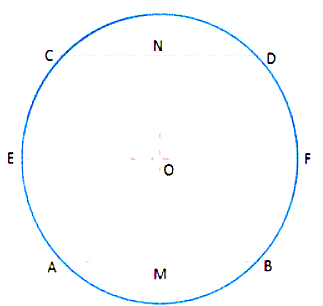
Given: AB and CO are two chords of a cirde with centre O.
AB II CD , M and N are midpoints of AB and CO respectively.
To prove : MN passes through centre O.
Construction : Join OM, ON, and through O, draw a straight line EF parallel to AB.
Proof : OM ⊥ AB
(line joining the midpoin t of a chord to the centre of a circle is perpendicular to it)
∠ AMO = 90°
∠ MOE = 90° [cointerior angle of ∠ AMO]
∠ NOE = 90° [corresponding angle of ∠ AMO]
∠ MOE + ∠ NOE = 180°
∠ MON is a straight line .
Hence, MN passes through centre O.
View full question & answer
Question 65 Marks
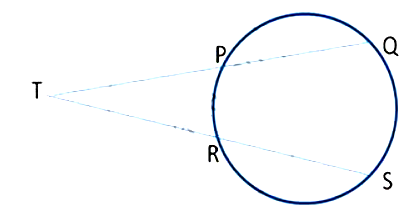
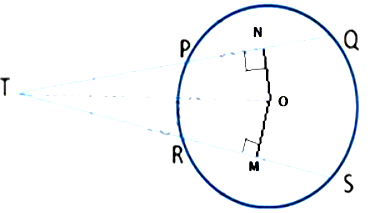
In fig. the centre of the circle is O. PQ and RS are two equal chords of the circle which , when produced , meet at T outside the circle . Prove that (a) TP = TR (b) TQ = TS.
Answer


Given $PQ = RS$
To prove : $TP = TR$ and $TQ = TS$
Construction: Draw $ON \perp PQ$ and $OM \perp RS$
Proof: Since equal vhords are equidistance from the circle therefore
$P Q=R S \Rightarrow O N=O M\ldots(1)$
Also perpendicular drawn from the centre bisects the chord.
So, $PN = NQ =\frac{1}{2}$ "PQ" and $RM = MS =\frac{1}{2}$ "RS"
But $P Q=R S$, we get
$P N=R M\ldots(2)$
And,$N Q=M S\ldots(3)$
Now in $\triangle TMO$ and $\triangle TNO$,
$TO = TO...(common)$
$M O=N O$ (BY (1))
$\angle TMO =\angle TNO...(Each \quad 90\quad degrees)$
Therefore , $\triangle TMO \cong \triangle TNO$ ,..(By RHS)
$\Rightarrow TN = TM...(by\quad CPCT)\ldots(4)$
Substracting, (2) from (4), we get
$TN - PN = TM - RM$
$\Rightarrow TP = TR$
Adding (3) and (4), we get
$TN + NQ = TM + MS$
$\Rightarrow TQ = TS$
Adding (3) and (4), we get
$TN + NQ = TM + MS$
$\Rightarrow TQ = TS$
Hence proved.
View full question & answer
Question 75 Marks
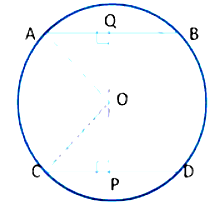
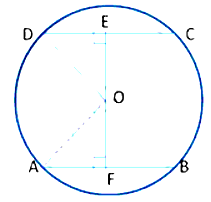
Two chords of lengths $10\ cm$ and $24\ cm$ are drawn parallel o each other in a circle. If they are on the same side of the centre and the distance between them is $17\ cm$, find the radius of the circle.
Answer

$CP = PO = 12cm$
Let $OA = OC = r$ (say)
Also, let $OQ = x, \therefore OP = 17 - x$
In right $\triangle OPC,$
By Pythagoras theorem,
$OC^2 = OP^2 + PC^2$
$r^2 = (17- x)^2 + 122 ----( 1 )$
Similarly, In $\triangle OQA,$
$OA^2 = AQ^2 + QO^2$
$r^2 = 5^2 + x^2 ----(2)$
From (1) and { 2}
$( 17 - x)^2 + 12^2 = 52 + x^2$
$289 - 34 x + 144 - 25 = 0$
$34x = 408$
$x = 12$
From {2}
$r^2 = 5^2 + 12^2$
$25+ 144= 169$
$r = 13$
The radius of the circle is $13\ cm .$
View full question & answer
Question 85 Marks
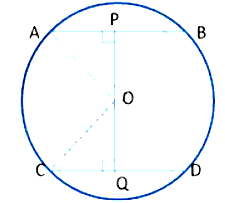
Two chords AB and CD of lengths 6cm and 12cm are drawn parallel inside the circle. If the distance between the chords of the circle is 3cm, find the radius of the circle.
Answer


$A P=P B=3 cm$
$C Q=Q D=6 cm$ (Perpendicular from centre to a chord bisects the chord)
$O A=O C=r \text { (say) }$
Let $OP = x , \therefore OQ =3- x$
In right $\triangle O Q C$,
By Pythagoras theorem,
$O C^2=O Q^2+C Q^2$
$r^2=(3-x)^2+6^2\ldots(1)$
Similarly, In $\triangle O P A$,
$OA ^2= AP ^2+ PO ^2$
$r^2=3^2+x^2\ldots(2)$
From (1) and (2)
$(3-x)^2+6^2=3^2+x^2$
$-6 x+36=0$
$x=6$
from (2)
$r^2=3^2+6^2=9+36=45$
$r=3 \sqrt{5}$
Thus, radius of the circle is $3 \sqrt{5} cm$
 
View full question & answer
Question 95 Marks
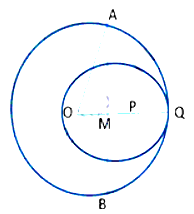
Two circles of radii 5cm and 3cm with centres O and P touch each other internally. If the perpendicular bisector of the line segment OP meets the circumference of the larger circle at A and B, find the length of AB.
Answer


$OA = OQ =5 cm \text { (Radius of bigger circle) }$
$PQ =3 cm \quad \text { (Radius of smaller circle) }$
$OP =2 cm$
$\text { Perpendicular bisector of } OP \text {, i.e. } AB \text { meets } OP \text { at } M \text {. }$
$OM = MP =\frac{1}{2} OP =1 cm$
$\text { In right } \triangle OMA \text {, }$
By Pythagoras theorem,
$OA ^2= OM ^2+ MA ^2$
$MA ^2=5^2-1^2$
$=25-1$
$=24$
$AM =2 \sqrt{6} cm$
$AM = MB =2 \sqrt{6} cm$
$AB = AM + MB =2 \sqrt{6}+2 \sqrt{6}=4 \sqrt{6}$
View full question & answer
Question 105 Marks
A chord of length $6 \ cm$ is at a distance of $7.2 \ cm$ from the centre of a circle. Another chord of the same circle is of length $14.4 \ cm$. Find its distance from the centre.
Answer

$AF = FB = 3cm$
$CE = ED = 7.2cm$
(Perpendicular from centre to a chord bisects the chord)
In right $\triangle AFO$, By Pythagoras theorem,
$OA^2 =OF^2+ AF^2$
$OA^2 = (7.2)^2 + (3)^2$
$OA^2 = 51.84 + 9$
$OA^2 = 60.84$
$OA = 7.8cm$
$OA = OC = 7.8cm$ (radii of same circle)
Similarly, In right $\triangle OFC,$
$OC^2 = OE^2 + EC^2$
$OE^2 = (7 .8)^2 - (7.2)^2$
$= 60.84 - 51.84$
$OE^2 = 9$
$OE = 3cm$
Distance from centre of chord $CD$ with length $14.4\ cm$ is $3\ cm.$
View full question & answer
Question 115 Marks
A chord of a length $16.8 \ cm$ is at a distance of $11.2 \ cm$ from the centre of a circle . Find the length of the chord of the same circle which is at a distance of $8.4 \ cm$ from the centre.
Answer

$AF = FB = 8.4 cm$
And $DE = EC ----(1)$
(Perpendicular from centre to a chord bisects the chord)
In right $\triangle ODA,$
By Pythagoras theorem, $OA^2 = OF^2 + AF^2$
$= (11.2)^2 + (8.4)^2$
$= 125.44 + 70.56$
$OA^2 = 196$
$OA = 14 cm$
$OA = OD = 14cm$ (radii of same circle)
Similarly, In $\triangle DEO$
$OD^2 = OE^2 + DE^2$
$DE^2 = 14^2 + 8.4^2$
$= 196 - 70.56$
$DE^2 = 125.44$
$DE = 11.2 cm$
$\therefore $ length of chord $DC = 2DE = 2(11.2) = 22.4 \ cm$
View full question & answer
Question 125 Marks
AB and AC are two equal chords of a circle with centre o such that LABO and LCBO are equal. Prove that AB = BC.
Answer

Given: AB = AC, ∠ ABO = ∠ CBO
To Prove: AB = BC
Construction : Draw ON ⊥ AB and OM ⊥ BC
Proof : In triangles BNO and BMO,
∠ NBO = ∠ MBO (Given)
∠ BNO = ∠ BMO (Each 90 ° )
BO= BO (common)
Thus , Δ BNO ≅ Δ BMO (By AAS)
⇒ BN =BM
⇒ 2 BN = 2 BM (Since perpendicular drawn from the centre bisects the chord)
⇒ AB = BC
Hence Proved.
View full question & answer
Question 135 Marks
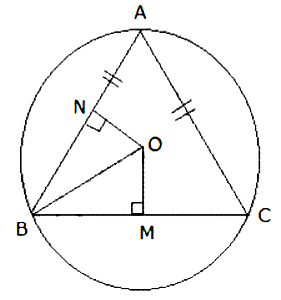
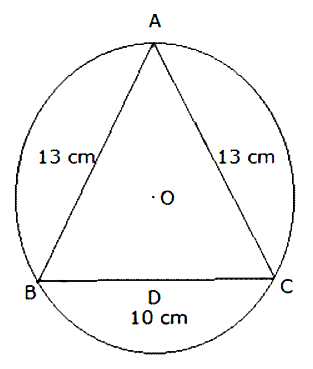
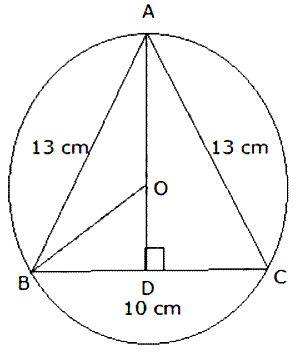
In figure, $A B C$ is an isosceles triangle inscribed in a circle with centre $O$ such that $A B=A C=13 cm$ and $B C=10 cm$. Find the radius of the circle.
Answer

Since ABC is an isosceles triangle, $AOO$ is the perpendicular bisector of $BC$.
In triangle ADC, by Pythagoras theorem we have
$AD^2 = AC^2 - DC^2 = 13^2 - 5^2 = 169 - 25 = 144$
$\Rightarrow AD = 12 cm$
$\Rightarrow AO + OD = 12$
$\Rightarrow AO = 12 - x ...$(Assuming $OD = x cm$)
Again in triangle OBD,
$BO^2 = BD^2 + OD^2 = 25 + x^2 ..(As BD = 5 cm)$
$\Rightarrow (12 - x)^2 = 25 + x^2 ..(As AO = BO = radius)$
$\Rightarrow 144 + x^2 - 24 x = 25 + x^2$
$\Rightarrow -24 x = 25 - 144 = - 119$
$\Rightarrow x = 4.96 cm$
$\Rightarrow AO = 12 - 4. 96 = 7 .04 cm$
View full question & answer
Question 145 Marks
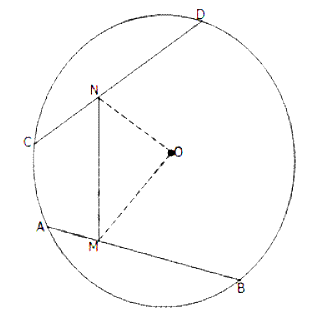
In fig, AB and CD are two equal chords of a circle with centre O. If M and N are the midpoints of AB and CD respectively,
prove that (a) ∠ ONM = ∠ ONM (b) ∠ AMN = ∠ CNM.
Answer

M and N are mid points of equal diords AB and CD respectively.
ON ⊥ CD and OM ⊥ AB
∴ ∠ ONC = ∠ OMA (90° each) ...(1)
(A line bisecting the chord and passing through the centre of the circle is perpendicular to the chord)
∴ AB = CD
ON = OM (equal chords are equidistant from the centre)
In Δ MON ,
MO = NO
∴ ∠ ONM = ∠ OMN ..(2)
Subtracting (2) from ( 1)
∠ONC - ∠ ONM = ∠ OMA - ∠ OMN
∠ CNM =∠ AMN
View full question & answer
[5 marks sum] - Mathematics STD 10 Questions - Vidyadip