Questions

[5 marks sum]

🎯

Test yourself on this topic

9 questions · timed · auto-graded

Question 15 Marks
Using ruler and compasses only construct a triangle ABC in which BC = 4cm, ∠ACB = 45° and perpendicular from A on BC is 2.5 cm. Draw a circle circumscribing the triangle ABC and measure its radius.
Answer
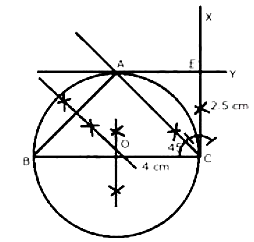
 
Steps of Construction:
i) Draw a line segment BC = 4 cm.
ii) At C, draw a perpendicular line CX and from it, cut off CE = 2.5 cm.
iii) From E, draw another perpendicular line EY.
iv) From C, draw a ray making an angle of 45o with CB, which intersects EY at A.
v) Join AB.
vi) ΔABC is the required triangle.
vii) Draw perpendicular bisectors of sides AB and BC intersecting each other at O.
viii) With centre O, and radius OB, draw a circle which will pass through A, B and C.
Measuring the radius OB = OC = OA = 2 cm  
View full question & answer
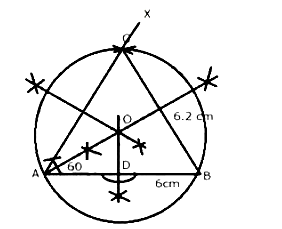
Question 25 Marks
Using ruler and compasses only,
(i) Construct a triangle ABC with the following data:
Base AB = 6 cm, BC = 6.2 cm and ∠CAB = 60°
(ii) In the same diagram, draw a circle which passes through the points A, B and C and mark its center O.
(iii) draw a perpendicular from O to AB which meets AB in D.
(iv) Prove that AD = BD
Answer
 
Steps of construction:
i) Draw a line segment AB = 6 cm
ii) At A, draw a ray making an angle of 60o with BC.
iii) With B as centre and radius = 6.2 cm draw an arc which intersects AX ray at C.
iv) Join BC.
ΔABC is the required triangle.
v) Draw the perpendicular bisectors of AB and AC intersecting each other at O.
vi) With centre O, and radius as OA or OB or OC, draw a circle which will pass through A, B and C. 
vii) From O, draw OD ⊥ AB.
Proof: In right ΔOAD and ΔOBD
OA = OB (radii of same circle)
Side OD = OD (common)
∴ ΔOAD ≅ ΔOBD  (RHS)
⇒ AD =BD (CPCT)
View full question & answer
Question 35 Marks
Using ruler and compasses only,
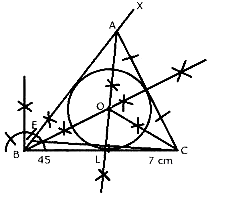
(i) Construct triangle ABC, having given BC = 7cm, AB – AC = 1cm and ∠ABC = 45°.
(ii) Inscribe a circle in the ΔABC constructed in (i) above. Measure its radius.
Answer
  
Steps of Construction:
i) Construction of triangle:
a) Draw a line segment BC = 7 cm
b) At B, draw a ray BX making an angle of 45o and cut off BE = AB − AC = 1cm
c) Join EC and draw the perpendicular bisector of EC intersecting BX at A.
d) Join AC.
ΔABC is the required triangle.
ii) Construction of incircle:
e) Draw angle bisectors of ∠ ABC and ∠ ACB intersecting each other at O.
f) From O, draw perpendiculars OL to BC.
g) O as centre and OL as radius draw circle which touches the sides of the ΔABC. This is
the required in-circle of ΔABC.
On measuring, radius OL = 1.8 cm
View full question & answer
Question 45 Marks
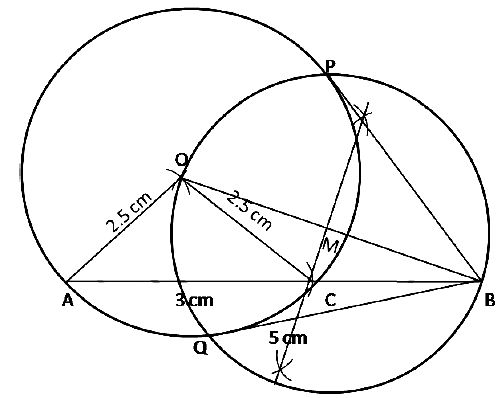
Draw a line AB = 5 cm. Mark a point C on AB such that AC = 3 cm. Using a ruler and a compass only, construct :
1) A circle of radius 2.5 cm, passing through A and C.
2) Construct two tangents to the circle from the external point B. Measure and record the length of the tangents.
Answer
Steps for construction:
1) Draw AB = 5 cm using a ruler.
2) With A as the centre cut an arc of 3 cm on AB to obtain C.
3) With A as the centre and radius 2.5 cm, draw an arc above AB
4) With same radius and C as the centre draw an arc to cut the previous arc and mark the intersection as O.
5) With O as the centre and radius 2.5 cm, draw a circle so that points A and C lie on the circle formed.
6) Join OB.
7) Draw the perpendicular bisector of OB to obtain the mid-point of OB, M.
8) With the M as the centre and radius equal to OM, draw a circle to cut the previous circle at points P and Q.
9) Join PB and QB. PB and QB are the required tangents to the given circle from exterior point B.

QB = PB = 3 cm
That is, length of the tangents is 3 cm.
View full question & answer
Question 55 Marks
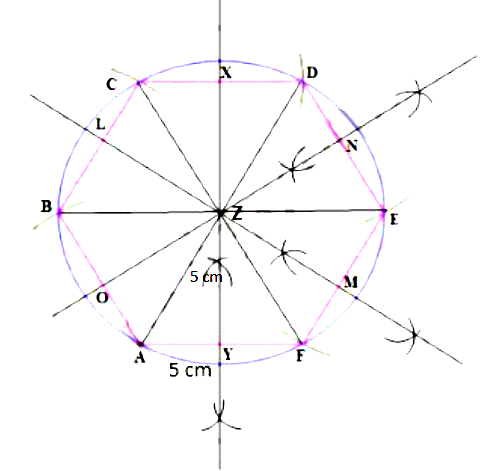
Construct a regular hexagon of side 5 cm. Hence construct all its lines of symmetry and name them.
Answer
Steps of construction:
1) Draw AF measuring 5 cm using a ruler.
2) With A as the centre and radius equal to AF, draw an arc above AF
3) With F as the centre, and the same radius cut the previous arc at Z
4) With Z as the centre and same radius draw a circle passing through A and F.
5) With A as the centre and same radius, draw an arc to cut the circle above AF at B.
6) With B as the centre and same radius, draw ar arc to cut the circle at C.
7) Repeat this process to get remaining vertices of the hexagon at D and E.
8) Join consecutive arcs on the circle to form the hexagon.
9) Draw the perpendicular bisectors of AF, FE and DE.
10) Extend the bisectors of AF, FE and DE to meet CD, BC and AB at X, L and O respectively.
11) Join AD, CF and EB.
12) These are the 6 lines of symmetry of the regular hexagon.

View full question & answer
Question 65 Marks
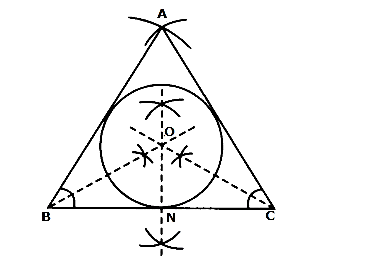
Contruct a ΔABC with BC=6.5cm, AB=5.5 cm, AB=5.5 cm. construct the incircle of the triangle. Mesure and record the radius of the incricle.
 
 
Answer
Steps of construction: 
1) Draw BC=6.5cm.
2) with B as centre, draw an arc of radius 5.5 cm.
3) with C as centre, draw an arc of radius 5 cm. 
Let this arc meets the pervious arc at A.
4) join AB and AC to get ΔABC. 
5) Draw the bi sectors of ∠ABC and ∠ACB. 
let  thses bisectors meet each other at O. 
6) Draw ON ⊥ BC. 
7) with O as centre and radius ON, draw a incircle that touches all the side of ΔABC, 
8) By mesurment, radius ON=1.5 cm 
 
 
View full question & answer
Question 75 Marks
Using a ruler and compasses only:
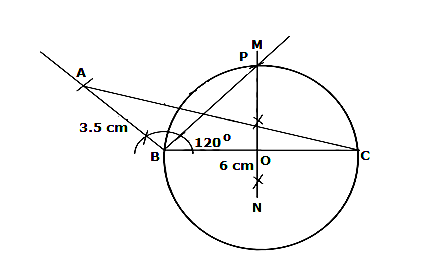
(1) construct a triangle $A B C$ with the ffollowing data: $A B=3.5 cm , B C=6 cm$ and $\angle A B C=120^{\circ}$.
(2) In the same diagram, draw a circle with BV as diameter. find a point $P$ on the circumference of thge circle which is equidistant from $A B$ and $B C$.
(3) Mesure $\angle B C P$
Answer
Step of constructions: 
(1) Draw a line segment BC=6 cm.
At B, draw a ray BX making an angle of 120° with BC. with B as center and radius 3.5 cm, out off AB=3.5 cm. join AC
Thus, ABC is the required triangle. 
(2) Draw perpendicular bisector MN of BC at point O. With O as center and radius =OB, draw a cirde.
Draw angle bisector of ∠ABC which meets the circle at point P. Thus, point P is equidistant from AB and BC. 
(2) On mesuring, ∠BCP=30°

View full question & answer
Question 85 Marks
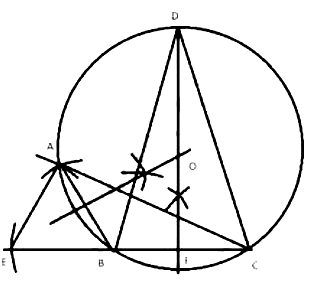
Construct a triangle ABC in which base BC = 5.5 cm, AB = 6cm and ∠ABC = 120°.
(1) Construct a circle circumscribing the triangle ABC.
(2) draw a cyclic quadrilateral ABCD so that D is equidistant from B and C. 
Answer
1.
 
a. Draw a line BC = 5.4 cm.
b. Draw AB = 6 cm, such that m∠ABC = 120°.
c. Construct the perpendicular bisectors of AB and BC, such that they intersect at O.
d. Draw a circle with O as the radius.
2.
e. Extend the perpendicular bisector of BC, such that
it intersects the circle at D.
f. Join BD and CD.
g. Here BD = DC.  
View full question & answer
Question 95 Marks
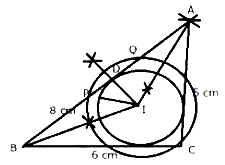
(i) Using ruler and compasses only, construct a triangle ABC in which AB = 8 cm, BC = 6 cm
and CA = 5cm.
(ii) Find its in centre and mark it I.
(iii) With I as centre, draw a circle which will cut off 2 cm chords from each side of the triangle.
What is the length of the radius of this circle. 
Answer

Steps of Construction:
i) Draw a line segment $BC =6 cm$.
ii) With centre $B$ and radius $8 cm$ draw an arc.
iii) With centre $C$ and radius $5 cm$ draw another arc which intersects the first arc at $A$.
iv) Join $A B$ and $A C$.
$\triangle ABC$ is the required triangle.
v) Draw the angle bisectors of $\angle B$ and $\angle A$ intersecting each other at I. Then I is the incentre of the triangle $A B C$
vi) Through I, draw ID $\perp AB$
vii) Now from D, cut off $D P=D Q=\frac{2}{2}=1 cm$
viii) With centre I, and radius IP or IQ, draw a circle which will intersect each side of triangle $A B C$ cutting chords of $2 cm$ each.
View full question & answer
[5 marks sum] - Mathematics STD 10 Questions - Vidyadip