Question 13 Marks
In the following diagram a rectangular platform with a semi-circular end on one side is $22$ metreslong from one end to the other end. If the length of the half circumference is $11$ metres. Find thecost of constructing the platform, $1.5$ metres high at the rate of Rs. $4$ per cubic metres.
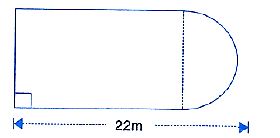
AnswerLength of the platform $= 22 m$
Circumference of semicircle $= 11 m$
$\therefore$ Radius $=\frac{c \times 2}{2 \times \pi}=\frac{11 \times 7}{22}=\frac{7}{2} m$
Therefore, breadth of the rectangular part $=\frac{7}{2} \times 2=7$
$\text { And length }=22-\frac{7}{2}=\frac{37}{2}=18.5 m$
$\text { Now area of platform }=1 \times b+\frac{1}{2} \pi r^2$
$=18.5 \times 7+\frac{1}{2} \times \frac{22}{7} \times \frac{7}{2} \times \frac{7}{2} m ^2$
$=129.5+\frac{77}{4} m ^2$
$=148.75 m ^2$
Height of the platform $= 1.5 m$
$\therefore$ Volume $=148.75 \times 15=223.125 m ^3$
Rate of construction=Rs 4 perm ${ }^3$
Total expenditure=Rs $4 \times 223.125=$ Rs $892.50$
View full question & answer→Question 23 Marks
An iron pole consisting of a cylindrical portion $110\ cm$ high and of base diameter $12\ cm$ is surmounted by a cone $9\ cm$ high. Find the mass of the pole, given that $1\ cm^3$ of iron has $8$ gm of mass (approx).
Answer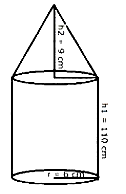
Radius of the base of poles $(r) = 6\ cm$
Height of the cylindrical part $(h_1) = 110\ cm$
Height of the conical part $(h_2) = 9\ cm$
Total volume of the iron pole $=\pi r^2 h_1+\frac{1}{3} \pi r^2 h_2=\pi r^2\left(h_1+\frac{1}{3} h_2\right)$
$=\frac{355}{113} \times 6 \times 6\left(110+\frac{1}{3} \times 9\right)$
$=-\frac{355}{113} \times 36 \times 113$
$=12780 cm ^3$
Weight of $1 cm ^3=8 gm$
Therefore, total weight $=12780 \times 8=102240 gm =102.24 kg$ View full question & answer→Question 33 Marks
The diameter of a sphere is $6\ cm,$ It is melted and drawn into a wire of diameter $0.2\ cm.$ Findthe length of the wire.
AnswerDiameter of a sphere $= 6\ cm$
Radius $= 3\ cm$
$\therefore$ Volume $=\frac{4}{3} \pi r^3=\frac{4}{3} \times \frac{22}{7} \times 3 \times 3 \times 3=\frac{792}{7} cm ^3......(1)$
Diameter of cylindrical wire $= 0.2\ cm$
Therefore, radius of wire $=\frac{0.2}{2}=0.1=\frac{1}{10} cm$
Let length of wire $= h$
$\therefore$ Volume $=\pi r^2 h=\frac{22}{7} \times \frac{1}{10} \times \frac{1}{10} \times h m^3=\frac{22 h}{700}.......(2)$
From (i) and (ii)
$\frac{22 h}{700}=\frac{792}{7}$
$\Rightarrow h=\frac{792}{7} \times \frac{700}{22}$
$\Rightarrow h=3600 cm =36 m $
Hence, length of the wire $= 36\ m$
View full question & answer→Question 43 Marks
A conical tent is to accommodate $77$ persons. Each person must have $16m^3$ of air to breathe. Given the radius of the tent as $7m$, find the height of the tent and also its curved surface area.
AnswerAccording to the condition in the question,
$77 \times 16=\frac{1}{3} \pi r ^2 h$
$\Rightarrow 77 \times 16=\frac{1}{3} \times \frac{22}{7} \times 7 \times 7 \times h$
$\Rightarrow h =\frac{77 \times 16 \times 3 \times 7}{22 \times 7 \times 7}$
$\Rightarrow h =\frac{11 \times 16 \times 3}{22}$
$\Rightarrow h =24 m $
We know that,
$l^2= r^2+ h^2$
$\Rightarrow l^2= (7)^2+ (24)^2$
$\Rightarrow l^2= 49 + 576$
$\Rightarrow l^2= 625$
$\Rightarrow l = 25 m$
$\therefore$ Curved Surface Area $=\pi rl =\frac{22}{7} \times 7 \times 25=550 m ^2$
Thereforethe height of the tent is 24m and it curved surface area is $550m^2$.
View full question & answer→Question 53 Marks
What is the least number of solid metallic spheres, each of $6\ cm$ diameter, that should be meltedand recast to form a solid metal cone whose height is $45\ cm$ and diameter $12\ cm?$
AnswerLet the number of solid metallic spheres be $'n'$
Volume of $1$ sphere
$=\frac{4}{3} \pi(3)^3$
Volume of metallic cone
$=\frac{1}{3} \pi 6^2 \times 45$
$n=\frac{\text { Volume of metal cone }}{\text { Volume of } 1 \text { sphere }}$
$\Rightarrow n=\frac{\frac{1}{3} \pi 6^2 \times 45}{\frac{4}{3} \pi(3)^3}$
$\Rightarrow n=\frac{6 \times 6 \times 45}{4 \times 3 \times 3 \times 3}$
$\Rightarrow n=15$
The least number of spheres needed to form the cone is $15$
View full question & answer→Question 63 Marks
A certain number of metallic cones, each of radius $2\ cm$ and height $3\ cm,$ are melted and recast into a solid sphere of radius $6\ cm.$ Find the number of cones used.
AnswerLet the number of cones melted be $n.$
Let the radius of sphere ber$_s= 6 cm$
Radius of cone ber$_c= 2 cm$
And, height of the cone be $h = 3 cm$
Volume of sphere $= n$ (Volume of a metallic cone)
$\Rightarrow \frac{4}{3} \pi r _{ s }^3= n \left(\frac{1}{3} \pi r _{ c }^2 h \right)$
$\Rightarrow \frac{4}{3} \pi r _{ s }^3= n \left(\frac{1}{3} \pi r _{ c }^2 h \right)$
$\Rightarrow \frac{4 r _{ s }^3}{ r _{ c }^2 h }= n$
$\Rightarrow n =\frac{4(6)^3}{(2)^2(3)}$
$\Rightarrow n =\frac{4 \times 216}{4 \times 3}$
$\Rightarrow n =72$
Hence , the number of cones is $72.$
View full question & answer→Question 73 Marks
Two solid spheres of radii $2 cm$ and $4 cm$ are melted and recast into a cone of height $8 cm.$ Find the radius of the cone so formed.
AnswerRadius of small sphere $= r = 2 cm$
Radius of big sphere $= R = 4 cm$
Volume of small sphere $=\frac{4}{3} \pi r^3=\frac{4 \pi}{3} \times(2)^3=\frac{32 \pi}{3} cm ^3$
Volume of big sphere $=\frac{4}{3} \pi R^3=\frac{4 \pi}{3} \times(4)^3=\frac{256 \pi}{3} cm ^3$
Volume of both the spheres $=\frac{32 \pi}{3}+\frac{256 \pi}{3}=\frac{288 \pi}{3} cm ^3$
we need to find $R_1 . h=8 cm$ (Given)
Volume of the cone $=\frac{1}{3} \pi R_1^2 \times(8)$
Volume of the cone = Volume of both the sphere
$\Rightarrow \frac{1}{3} \pi R_1^2 \times(8)=\frac{288 \pi}{3} $
$ \Rightarrow R_1^2 \times(8)=288 $
$ \Rightarrow R_1^2=\frac{288}{8} \Rightarrow R_1^2=36 $
$ \Rightarrow R_1=6 cm $
View full question & answer→Question 83 Marks
A solid is in the form of a right circular cone mounted on a hemisphere. The diameter of the baseof the cone, which exactly coincides with hemisphere, is 7 cm and its height is 8 cm. the solid isplaced in a cylindrical vessel of internal radius 7 cm and height 10 cm. How much water, in cm3,will be required to fill the vessel completely.
Answer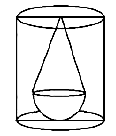
Diameter of hemisphere = 7 cm
Diameter of the base of the cone = 7 cm
Therefore, radius (r) = 3.5 cm
Height (h) = 8 cm
Volume of the solid =
$\frac{1}{3} \pi r^2 h+\frac{2}{3} \pi r^3=\frac{1}{3} \pi r^2(h+2 r)$
$=\frac{1}{3} \times \frac{22}{7} \times 3.5 \times 3.5(8+2 \times 3.5)$
$=\frac{77}{6}(8+7)$
$=\frac{385}{2}$
$=192.5 cm ^3$
Now, radius of cylindrical vessel (R) = 7 cm
Height (H) = 10 cm
$\therefore \text { Volume }=\pi R^2 h$
$=\frac{22}{7} \times 7 \times 7 \times 10$
$=1540 cm ^3$
Volume of water required to fill $=1540-192.5=1347.5 cm ^3$ View full question & answer→Question 93 Marks
A metal container in the form of a cylinder is surmounted by a hemisphere of the same radius. The internal height of the cylinder is $7\ m$ and the internal radius is $3.5\ m.$ Calculate: the internal volume of the container in $m^3$.
Answer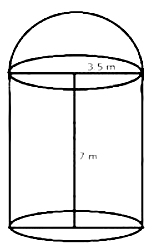
Radius of the cylinder $= 3.5\ m$
Height $= 7\ m$
$\text { Volume of the container }=\pi r ^2 h +\frac{2}{3} \pi r ^3$
$=\left(\frac{22}{7} \times 3.5 \times 3.5 \times 7\right)+\left(\frac{2}{3} \times \frac{22}{7} \times 3.5 \times 3.5 \times 3.5\right)$
$=\frac{539}{2}+\frac{539}{6}$
$=\frac{1617+539}{6}$
$=\frac{2156}{6}$
$=359.33 m ^3$ View full question & answer→Question 103 Marks
A metal container in the form of a cylinder is surmounted by a hemisphere of the same radius. The internal height of the cylinder is $7 m$ and the internal radius is $3.5 m.$ Calculate: the total area of the internal surface, excluding the base.
Answer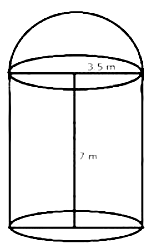
Radius of the cylinder $= 3.5 m$
Height $= 7 m$
Total surface area of container excluding the base $=$ Curved
surface area of the cylinder $+$ area of hemisphere
$=2 \pi rh +2 \pi r ^2$
$ =\left(2 \times \frac{22}{7} \times 3.5 \times 7\right)+\left(2 \times \frac{22}{7} \times 3.5 \times 3.5\right) $
$ =154+77 m ^2$
$ =231 m ^2$ View full question & answer→Question 113 Marks
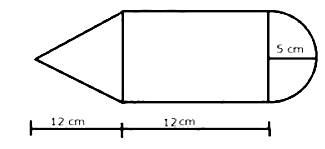
The given figure shows the cross-section of a cone, a cylinder and a hemisphere all with the same diameter $10\ cm$ and the other dimensions are as shown. Calculate: the total volume of the solid.
Answer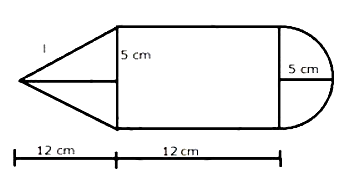
Diameter $= 10 cm$
Therefore, radius $(r) = 5 cm$
Height of the cone $(h) = 12 cm$
Height of the cylinder $= 12 cm$
$=\frac{1}{3} \pi r ^2 h +\pi r ^2 h +\frac{2}{3} \pi r ^3$
$=\pi r ^2\left(\frac{1}{3} h + h +\frac{2}{3} r \right)$
$=\frac{22}{7} \times 5 \times 5\left(\frac{1}{3} \times 12+12+\frac{2}{3} \times 5\right)$
$=\frac{550}{7}\left(4+12+\frac{10}{3}\right)$
$=\frac{550}{7}\left(16+\frac{10}{3}\right)$
$=\frac{550}{7} \times \frac{58}{3}$
$=\frac{31900}{21}$
$=1519.0476 cm ^3$ View full question & answer→Question 123 Marks
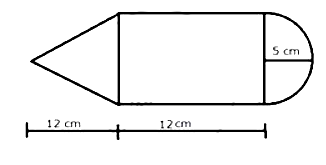
The given figure shows the cross-section of a cone, a cylinder and a hemisphere all with the same diameter $10\ cm$ and the other dimensions are as shown. Calculate :the total surface area .
Answer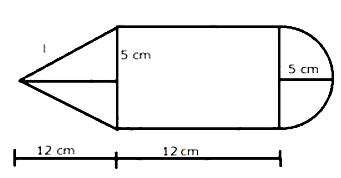
Diameter $= 10 cm$
Therefore, radius $(r) = 5 cm$
Height of the cone $(h) = 12 cm$
Height of the cylinder $= 12 cm$
$\therefore l =\sqrt{ h ^2+ r ^2}=\sqrt{12^2+5^2}=\sqrt{144+25}=\sqrt{169}=13 cm$
$=\pi rl +2 \pi rh +2 \pi r ^2$
$=\pi r ( l +2 h +2 r )$
$=\frac{22}{7} \times 5(13+(2 \times 12)+(2 \times 5))$
$=\frac{110}{7}(13+24+10)$
$=\frac{110}{7} \times 47$
$=\frac{5170}{7}$
$=738.57 cm ^2$ View full question & answer→Question 133 Marks
Water flows, at $9$ km per hour, through a cylindrical pipe of cross-sectional area $25 cm^2.$ If thiswater is collected into a rectangular cistern of dimensions $7.5$ m by $5$ m by $4$ m; calculate therise in level in the cistern in $1$ hour $15$ minutes.
AnswerRate of flow of water $= 9\ km/hr$
Water flow in $1$ hour $15$ minutes
i.e.in $\frac{5}{4} h r=9 \times \frac{5}{4}=\frac{45}{4} km =\frac{45}{4} \times 1000=11250 m$
Area of cross-section $=25 cm ^2=\frac{25}{10000} m ^2=\frac{1}{400} m ^2$
Therefore, volume of water $=\frac{1}{400} \times 11250=28.125 m ^3$
Dimensions of water tank=7.5m $\times 5 m \times 4 m$
Area of tank $=l \times b=7.5 \times 5=37.5 m ^2$
Let h be the height of water then,
$37.5 \times h=28.125$
$h=\frac{28.125}{37.5}=0.75 m =75 cm $
View full question & answer→Question 143 Marks
Spherical marbles of diameter $1.4\ cm$ are dropped into beaker containing some water and arefully submerged. The diameter of the beaker is $7\ cm.$ Find how many marbles have been droppedin it if the water rises by $5.6\ cm.$
AnswerDiameter of spherical marble $= 1.4 cm$
Therefore, radius $= 0.7 cm$
Volume of one ball $=\frac{4}{3} \pi r^3=\frac{4}{3} \pi(0.7)^3 ............(1)$
Diameter of beaker $= 7 cm$
Therefore, radius $=\frac{7}{2} cm$ Height of water $=5.6 cm$
Volume of water $=\pi r^2 h=\pi \times\left(\frac{7}{2} \times \frac{7}{2} \times 5.6\right) cm ^3=\pi \times \frac{49 \times 56}{4 \times 10} cm ^3$
No. of balls dropped
$=\frac{\pi \times 49 \times 56 \times 3}{4 \times 10 \times \pi 4 \times(0.7)^3}$
$ =150$
View full question & answer→Question 153 Marks
A cylindrical container with diameter of base $42\ cm$ contains sufficient water to submerge arectangular solid of iron with dimensions $22 cm \times 14 cm \times 10.5 cm.$ Find the rise in level of thewater when the solid is submerged.
AnswerDiameter of cylindrical container $= 42 cm$
Therefore, radius $(r) = 21 cm$
Dimensions of rectangular solid $=22 cm \times 14 cm \times 10.5 xm$
Volume of solid $=22 \times 14 \times 10.5 cm ^3$ .......... (1)
Let height of water $= h$
Therefore, volume of water in the container $=\pi r^2 h$
$=\frac{22}{7} \times 21 \times 21 \times hcm ^3=22 \times 63 hcm ^3$ .........(2)
From (1) and (2)
$22 \times 63 h=22 \times 14 \times 10.5$
$\Rightarrow \frac{h=22 \times 14 \times 10.5}{22 \times 63}$
$\Rightarrow h=\frac{7}{3}$
$\Rightarrow h=2 \frac{1}{3} \text { or } 2.33 cm $
View full question & answer→Question 163 Marks
A cylindrical boiler, $2 m$ high, is $3.5 m$ in diameter. It has a hemispherical lid. Find the volumeof its interior, including the part covered by the lid.
Answer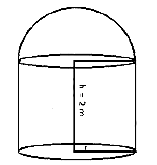
Diameter of cylindrical boiler $= 3.5 m$
$\therefore$ Radius $(r)=\frac{3.5}{2}=\frac{35}{20}=\frac{7}{4} m$
Height $(h) = 2m$
Radius of hemisphere $( R )=\frac{7}{4} m$
Total volume of the boiler $=\pi r^2 h+\frac{2}{3} \pi r^3$
$=\pi r^2\left(h+\frac{2}{3} r\right) $
$ =\frac{22}{7} \times \frac{7}{7} \times \frac{7}{4}\left(2+\frac{2}{3} \times \frac{7}{4}\right)$
$=\frac{77}{8}\left(2+\frac{7}{6}\right) $
$=\frac{77}{8} \times \frac{19}{6} $
$ =\frac{1463}{48} $
$=30.48 m ^3$ View full question & answer→Question 173 Marks
A circus tent is cylindrical to a height of $4 m$ and conical above it. If its diameter is $105 m$ andits slant height is $80 m,$ Calculate the total area of canvas required. Also, find the total cost ofcanvas used at $Rs. 15$ per metre if the width is $1.5 m$
Answer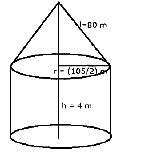
Radius of the cylindrical part of the tent $(r) =\frac{105}{2} m$
Slant height $(l)=80m$
Therefore, total curved surface area of the tent= $2 \pi r h+\pi r l$
$=\left(2 \times \frac{22}{7} \times \frac{105}{2} \times 4\right)+\left(\frac{22}{7} \times \frac{105}{2} \times 80\right) $
$=1320+13200$
$ =14520 m ^2$
Width of canvas used $=1.5 m$
Total cost of canvas at the rate of $Rs.15$ per meter
Length of canvas $=\frac{14520}{1.5}=9680 m$
$=9680 \times 15=R s .145200$ View full question & answer→Question 183 Marks
From a solid right circular cylinder with height $10\ cm$ and radius of the base $6\ cm,$ a right circularcone of the same height and same base is removed. Find the volume of the remaining solid.
AnswerHeight of the cylinder $(h)=10 cm$ and radius of the base $(r)=6 cm$
Volume of the cylinder $=\pi r^2 h$
Height of the cone $=10 cm$
Radius of the base of cone $=6 cm$
Volume of the cone $=\frac{1}{3} \pi r^2 h$
Volume of the remaining part
$ =\pi r^2 h-\frac{1}{3} \pi r^2 h$
$=\frac{2}{3} \pi r^2 h$
$=\frac{2}{3} \times \frac{22}{7} \times 6 \times 6 \times 10$
$=\frac{5280}{7}$
$=754 \frac{2}{7} cm ^3 $
View full question & answer→Question 193 Marks
A hollow cylinder has solid hemisphere inward at one end and on the other end it is closed witha flat circular plate. The height of water is $10\ cm$ when flat circular surface is downward. Findthe level of water, when it is inverted upside down, common diameter is $7\ cm$ and height of the
cylinder is $20\ cm.$
Answer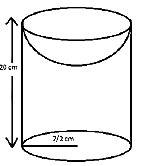
Let the height of the water level be 'h', after the solid is turned upside down.Volume of water in the cylinder
$=\pi\left(\frac{7}{2}\right)^2 10$
Volume of the hemisphere
$=\frac{2}{3} \pi\left(\frac{7}{2}\right)^3$
Volume of water in the cylinder
$=$ Volume of water level $−$ Volume of the hemisphere
$\pi\left(\frac{7}{2}\right)^2 10=\pi\left(\frac{7}{2}\right)^2 h-\frac{2}{3} \pi\left(\frac{7}{2}\right)^2$
$\Rightarrow 10=h-\frac{7}{3}$
$h=10+\frac{7}{3}$
$h=12 \frac{1}{3} cm $
The height of water when the hemisphere is facing downwards is
$12 \frac{1}{3} cm$ View full question & answer→Question 203 Marks
The given figure shows the cross section of a water channel consisting of a rectangle and a semicircle.Assuming that the channel is always full, find the volume of water discharged through itin one minute if water is flowing at the rate of 20 cm per second. Give your answer in cubicmetres correct to one place of decimal.
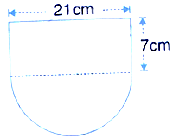
AnswerLength $= 21 cm,$ Breadth $= 7 cm$
Radius of semicircle $=\frac{21}{2} cm$
Area of cross section of the water channel $=1 \times b+\frac{1}{2} \pi r^2$
$=21 \times 7+\frac{1}{2} \times \frac{22}{7} \times \frac{21}{2} \times \frac{21}{2}$
$=147+\frac{693}{4}$
$=\frac{588+693}{4}$
$=\frac{1281}{4} cm ^2$
Flow of water in one minute at the rate of $20$ cm per second
$\Rightarrow$ Length of the water column $=20 \times 60=1200 cm$
$\text { Therefore, volume of water }=$
$=\frac{1281}{4} \times 1200 cm ^2$
$=384300 cm ^2$
$=\frac{384300}{100 \times 100 \times 100} m ^3$
$=0.3843 m ^3$
$0.4 m ^3$
View full question & answer→Question 213 Marks
The radii of the bases of two solid right circular cones of same height are $r_1$ and $r_2$ respectively.The cones area melted and recast into a solid sphere of radius R. Find the height of each cone interms $r_1, r_2$ and R.
AnswerLet the height of the solid cones be ' $h$ '
Volume of solid circular cones
$V _1=\frac{1}{3} \pi r _1^2 h$
$ V _2=\frac{1}{3} \pi r _2^2 h $
Volume of sphere
$ =\frac{4}{3} \pi R ^3 $
Volume of sphere $=$ Volume of cone $1+$ volume of cone 2
$\frac{4}{3} \pi R ^3=\frac{1}{3} \pi r _1^2 h +\frac{1}{3} \pi r _2^2 h$
$ \Rightarrow 4 R ^3= r _1^2 h + r _2^2 h $
$ \Rightarrow h \left( r _1^2+ r _2^2\right)=(4 R )^3 $
$\Rightarrow h =\frac{4 R ^3}{\left( r _1^2+ r _2^2\right)} $
View full question & answer→Question 223 Marks
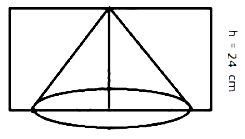
From a rectangular solid of metal $42 cm$ by $30 cm$ by $20 cm,$ a conical cavity of diameter $14 cm$ and depth $24 cm$ is drilled out. Find: the volume of remaining solid
AnswerDimensions of rectangular solids $=(42 \times 30 \times 20) cm$
volume $=(42 \times 30 \times 20)=25200 cm ^3$
Radius of conical cavity $(r) =7 cm$
height $(h)=24 cm$
$\text { Volume of cone }=\frac{1}{3} \pi r^2 h$
$=\frac{1}{3} \times \frac{22}{7} \times 7 \times 7 \times 24$
$=1232 cm ^3$
Volume of remaining solid $=(25200-1232)=23968 cm ^3$
Radius of conical cavity $(r) =7 cm$
height $(h) = 24 cm$
$\text { Volume of cone }=\frac{1}{3} \pi r ^2 h$
$=\frac{1}{3} \times \frac{22}{7} \times 7 \times 7 \times 24$
$=1232 cm ^3$
Volume of remaining solid $= (25200 - 1232) = 23968 cm^3$ View full question & answer→Question 233 Marks
From a rectangular solid of metal $42 cm$ by $30 cm$ by $20 cm,$ a conical cavity of diameter $14 cm$
and depth $24 cm$ is drilled out. Find: the surface area of remaining solid
AnswerTotal surface area of cuboid $= 2 (lb+bh+lh)$
$=2(42 \times 30+30 \times 20+20 \times 42) $
$ =2(1260+600+840)$
$=2 \times 2700$
$ =5400 cm ^2$
Diameter of the cone $= 14 cm$
$\Rightarrow$ Radius of the cone $=\frac{14}{2}=7 cm$
Area of circular base $=\pi r^2=\frac{22}{7} \times 7 \times 7=154 cm ^2$
$\pi r l=\frac{22}{7} \times 7 \times \sqrt{7^2+24^2}=22 \sqrt{49+576}=22 \times 25=550 cm ^2$
Area of curved surface area of cone =
$\pi r l=\frac{22}{7} \times 7 \times \sqrt{7^2+24^2}=22 \sqrt{49+576}=22 \times 25=550 cm ^2$
Surface area of remaining part $=5400+550-154=5796 cm ^2$
View full question & answer→Question 243 Marks
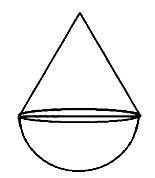
A cone of height $15 cm$ and diameter $7 cm$ is mounted on a hemisphere of same diameter.Determine the volume of the solid thus formed.
AnswerHeight of cone $= 15 cm$
and radius of the base=$\frac{7}{2} cm$
Therefore, volume of the solid $=$ volume of the conical part $+$ volume of hemispherical part.
$=\frac{1}{3} \pi r^2 h+\frac{2}{3} \pi r^3$
$=\frac{1}{3} \pi r^2(h+2 r)$
$=\frac{1}{3} \times \frac{22}{7} \times \frac{7}{2} \times \frac{7}{2}\left(15+2 \times \frac{7}{2}\right) $
$=\frac{847}{3} $
$=282.33 cm ^3$ View full question & answer→Question 253 Marks
A solid cone of radius $\ cm$ and height $8\ cm$ is melted and made into small spheres of radius $0.5\ cm.$ Find the number of sphere formed.
AnswerRadius of a solid cone $(r) = 5 cm$
Height of the cone $= 8 cm$
$\Rightarrow$ Volume of a cone
$=\frac{1}{3} \pi r^2 h$
$=\frac{1}{3} \times 5 \times 5 \times 8 cm ^3$
$=\frac{200 \pi}{3} cm ^3$
Radius of each sphere $= 0.5 cm$
$\therefore \text { Volume of one sphere }=\frac{4}{3} \pi r^3$
$=\frac{4}{3} \times I I \times \frac{1}{2} \times \frac{1}{2} \times \frac{1}{2} cm ^3$
$=I \frac{I}{6}$
$\text { Number of spheres }=\frac{\text { Total volume }}{\text { Volume of one sphere }}$
$=\frac{\frac{200 \pi}{3}}{\frac{\pi}{6}} \times \frac{6}{\pi}$
$=\frac{200 \pi}{3} \times \frac{6}{\pi}$
$=400$
View full question & answer→Question 263 Marks
A hemispherical bowl of diameter $7.2 cm$ is filled completely with chocolate sauce. This sauceis poured into a inverted cone of radius $4.8 cm.$ Find the height of the cone is it is completely filled.
AnswerDiameter of the hemispherical bowl $= 7.2 cm$
Therefore, radius $= 3.6 cm$
Volume of sauce in hemispherical bowl = $\frac{2}{3} \pi r^3=\frac{2}{3} \pi \times(3.6)^3$
Radius of the cone $= 4.8 cm$
Volume of cone $=\frac{1}{3} \pi r^2 h=\frac{1}{3} \pi \times(4.8)^2 \times h$
Now, volume of sauce in hemispherical bowl = volume of cone
$\Rightarrow \frac{2}{3} \pi \times(3.6)^3=\frac{1}{3} \pi \times(4.8)^2 \times h $
$ \Rightarrow \frac{h=2 \times 3.6 \times 3.6 \times 3.6}{4.8 \times 4.8}$
$ \Rightarrow h =4.05$
Height of the cone $= 4.05 cm$
View full question & answer→Question 273 Marks
A hemi-spherical bowl of internal radius 9 cm is full of liquid. This liquid is to be filled into conical shaped small containers each of diameter 3 cm and height 4 cm. How manycontainersare necessary to empty the bowl?
AnswerRadius of hemispherical bowl = 9 cm
Volume $=\frac{1}{2} \times \frac{4}{3} \pi r ^3=\frac{2}{3} \pi 9^3=\frac{2}{3} \pi \times 729=486 \pi cm ^2$
Diameter each of cylindrical bottle = 3 cm
Radius $=\frac{3}{2} cm$, and height $=4 cm$
$\therefore$ Volume of bottle $=\frac{1}{3} \pi r ^2 h =\frac{1}{3} \pi \times\left(\frac{3}{2}\right)^2 \times 4=3 \pi$
$\therefore$ No. of. bottles $=\frac{486 \pi}{3 \pi}=162$
View full question & answer→Question 283 Marks
A solid rectangular block of metal $49 cm$ by $44 cm$ by $18 cm$ is melted and formed into a solidsphere. Calculate the radius of the sphere.
AnswerVolume of rectangular block $= 49 \times 44 \times 18 cm^3 = 38808 cm^3 … (1)$
Let r be the radius of sphere
$\therefore$ Volume $=\frac{4}{3} \pi r^3=\frac{4}{3} \times \frac{22}{7} \times r^3=\frac{88}{21} r^3 \ldots \ldots . .(2)$
From $(1)$ and $(2)$
$\frac{88}{21} r^3=38808 $
$ \Rightarrow r^3=38808 \times \frac{21}{88}=441 \times 21 $
$ \Rightarrow r^3=9261 $
$ \Rightarrow r=21 cm $
Radius of sphere $= 21 cm$
View full question & answer→Question 293 Marks
Total volume of three identical cones is the same as that of a bigger cone whose height is $9$ cmand diameter $40 cm.$ Find the radius of the base of each smaller cone, if height of each is $108cm$
AnswerLet the radius of the smaller cone be 'r' cm.
Volume of larger cone
$\frac{1}{3} \pi \times 20^2 \times 9$
Volume of smaller cone
$=\frac{1}{3} \pi \times r^2 \times 108$
Volume of larger cone $= 3 \times$ Volume of smaller cone
$\frac{1}{3} \pi \times 20^2 \times 9=\frac{1}{3} \pi \times r^2 \times 108 \times 3 $
$ \Rightarrow r^2=\frac{20^2 \times 9}{108 \times 3} $
$ \Rightarrow r=\frac{20}{6}=\frac{10}{3}$
View full question & answer→Question 303 Marks
The radii of the internal and external surface of a metallic spherical. It is melted and recast intoa solid right circular cone of height $32\ cm.$ Find the diameter of the base of the cone.
AnswerInternal radius $= 3\ cm$
External radius $= 5\ cm$
Volume of spherical shell
$=\frac{4}{3} \pi\left(5^3-3^3\right)$
$=\frac{4}{3} \times \frac{22}{7}(125-27)$
$=\frac{4}{3} \times \frac{22}{7} \times 98$
Volume of solid circular cone
$\frac{1}{3} \pi r^2 h$
$\frac{1}{3} \times \frac{22}{7} \times r^2 \times 32$
Vol. of Cone = Vol. of sphere
$\Rightarrow \frac{1}{3} \times \frac{22}{7} \times r^2 \times 32=\frac{4}{3} \times \frac{22}{7} \times 98$
$\Rightarrow r^2=\frac{4 \times 98}{32}$
$\therefore r=\frac{7}{2}=3.5 cm $
View full question & answer→Question 313 Marks
$A$ solid sphere of radius $15\ cm$ is melted and recast into solid right circular cones of radius $2.5\ cm$ and height $8\ cm.$ Calculate the number of cones recast.
AnswerRadius of a solid sphere $= R = 15\ cm$
$\therefore$ Volume of sphere melted $=\frac{4}{3} \pi R ^3=\frac{4}{3} \times \pi \times 15 \times 15 \times 15$
Radius of each cone recasted $= r = 2.5\ cm$
Height of each cone recasted $= h = 8\ cm$
$\therefore$ Volume of each one cone recasted =$\frac{1}{3} \pi r ^2 h =\frac{1}{3} \times \pi \times 2.5 \times 2.5 \times 8$
$\therefore$ Number of cones recasted $=\frac{\text { Volume of sphre melted }}{\text { Volume of each cone formed }}$
$=\frac{\frac{4}{3} \times \pi \times 15 \times 15}{\frac{1}{3} \times \pi \times 2.5 \times 2.5 \times 8}$
$=270$
View full question & answer→Question 323 Marks
The surface area of a solid metallic sphere is $2464 cm^2.$ It is melted and recast into solid right circular cones of radius $3.5 cm$ and height $7 cm.$ Calculate : the number of cones recast. $\left(\right.$ Take $\left.\pi=\frac{22}{7}\right)$
Answer$\therefore R = 14 cm$
Volume of sphere melted = $\frac{4}{3} \pi R ^3$
$=\frac{4}{3} \times \pi \times 14 \times 14 \times 14$
Radius of each cone recasted $= r = 3.5 cm$
Height of each cone recasted $= h = 7 cm$
$\therefore$ Volume of each cone recasted $=\frac{1}{3} \pi r ^2 h$
$=\frac{1}{3} \times \pi \times 3.5 \times 3.5 \times 7$
$\therefore$ Number of cones recasted $=\frac{\text { Volume of sphere melted }}{\text { Volume of each cone formed }}$
$=\frac{\frac{4}{3} \times \pi \times 14 \times 14 \times 14}{\frac{1}{3} \times \pi \times 3.5 \times 3.5 \times 7}$
$=128$
View full question & answer→Question 333 Marks
A hollow sphere of internal and external radii 6 cm and 8 cm respectively is melted and reactinto small cones of base radius 2 cm and height 8 cm. Find the number of cones.
AnswerLet the number of small cones be 'n'
Volume of sphere
$=\frac{4}{3} \pi\left(8^3-6^3\right)$
$=\frac{4}{3} \times \pi \times 2 \times 148$ Volume of small spheres
$=\frac{1}{3} \pi r^2 h$
$=\frac{1}{3} \times \pi \times 3^2 \times 4$
Volume of sphere $=n \times$ Volume of small sphere
$\Rightarrow \frac{4}{3} \times \pi \times 2 \times 148=n \times \frac{1}{3} \times \pi \times 2^2 \times 8$
$\Rightarrow n=\frac{4 \times 2 \times 148 \times 3}{4 \times 8 \times 3}$
The number of cones=37 cm
View full question & answer→Question 343 Marks
A solid metallic cone, with radius 6 cm and height 10cm, is made of some heavy metal A. Inorder to reduce its weight, a conical hole is made in the cone as shown and it is completely filledwith a lighter metal B. The conical hole has a diameter of cm and depth 4 cm calculate the ratioof the volume of metal A to the volume of the metal B in the solid.
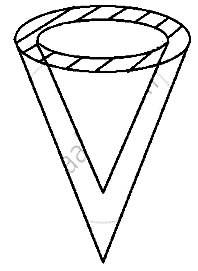
AnswerVolume of the whole cone of metal A
$=\frac{1}{3} \pi r^2 h$
$=\frac{1}{3} \times \pi \times 6^2 \times 10$
$=120 \pi$
Volume of the cone with metal B
$=\frac{1}{3} \pi r^2 h$
$=\frac{1}{3} \times \pi \times 3^2 \times 4$
$=12 \pi$
Final Volume of cone with metal $A=120 \pi-12 \pi=108 \pi$
$\frac{Volumeof conewithmetal A}{Volumeof conewithmetal B}$
$=\frac{108 \pi}{12 \pi}=\frac{9}{1}$
View full question & answer→Question 353 Marks
The internal and external diameters of a hollow hemi-spherical vessel are $21 cm$ and $28 cm$ respectively. Find: total surface area.
AnswerExternal radius $(R)=14 cm$
Internal radius $( r )=\frac{21}{2} cm$
Total surface area $=$
$ 2 \pi R^2+2 \pi r^2+\pi\left(R^2-r^2\right) $
$=693+1232+\frac{22}{7}\left((14)^2-\left(\frac{21}{2}\right)^2\right)$
$ =1925+\frac{22}{7}\left(196-\frac{441}{4}\right) $
$ =1925+\frac{22}{7} \times \frac{343}{4} $
$=1925+269.5$
$=2194.5 cm ^2$
View full question & answer→Question 363 Marks
Eight metallic spheres; each of radius $2 mm,$ are melted and cast into a single sphere. Calculatethe radius of the new sphere.
AnswerRadius of metallic sphere $=2 mm =\frac{1}{5} cm$
Volume
$=\frac{4}{3} \pi r^3=\frac{4}{3} \times \frac{22}{7} \times \frac{1}{5} \times \frac{1}{5} \times \frac{1}{5} $
$=\frac{88}{21 \times 125} cm ^3$
Volume of $8$ spheres $=\frac{88 \times 8}{21 \times 125}=\frac{704}{21 \times 125} cm ^3......(1)$
Let radius of new sphere $=R$
$\therefore$ volume $=\frac{4}{3} \pi r^3=\frac{4}{3} \times \frac{22}{7} R^3=\frac{88}{21} R^3.......(2)$
From $(1)$ and $(2)$
$\frac{88}{21} R^3=\frac{704}{21 \times 125} $
$ \Rightarrow \frac{88}{21} R^3=\frac{704}{21 \times 125} $
$ \Rightarrow R^3=\frac{704}{21 \times 125} \times \frac{21}{88}=\frac{8}{125} $
$ \Rightarrow R=\frac{2}{5}=0.4 cm =4 mm $
View full question & answer→Question 373 Marks
The surface area of a sphere is $2464\ cm ^2$ ,find its volume
AnswerSurface area of the sphere $=2464 cm ^2$
Let radius $= r,$ then
$4 \pi r^2=2464 \\ \Rightarrow 4 \times \frac{22}{7} \times r^2=2464 $
$ \Rightarrow r^2=\frac{2462 \times 7}{4 \times 22}=196 $
$ \Rightarrow r=14 cm$
$\text { Volume }=\frac{4}{3} \pi r^3 $
$ \therefore \frac{4}{3} \pi r^3=\frac{4}{3} \times \frac{22}{7} \times 14 \times 14 \times 14$
$=11498.67 cm ^3$
View full question & answer→Question 383 Marks
Metallic spheres of radii 6 cm, 8 cm and 10 cm respectively are melted and re casted into a singlesolid sphere. Taking π = 3.1, find the surface area of solid sphere formed.
AnswerLet radius of the larger sphere be 'R'
Volume of single sphere
=Vol. of sphere 1 + Vol. of sphere 2 + Vol. of sphere 3
$\frac{4}{3} \pi R^3=\frac{4}{3} \pi r_1^3+\frac{4}{3} \pi r_2^3+\frac{4}{3} \pi r_3^3$
$\Rightarrow \frac{4}{3} \pi R^3=\frac{4}{3} \pi r 6^3+\frac{4}{3} \pi 10^3$
$\Rightarrow R^3=\left(6^3+8^3+10^3\right)$
$\Rightarrow R^3=1728$
$\Rightarrow R=12$
Surface area of the sphere
$=4 \pi R^2$
$=4 \pi 12^2$
$=1785.6 cm ^2$
View full question & answer→Question 393 Marks
A heap of wheat is in the form of a cone of diameter $16.8\ m$ and height $3.5\ m.$ Find its volume.How much cloth is required to just cover the heap?
AnswerDiameter of the cone $= 16.8\ m$
Therefore, radius $(r) = 8.4\ m$
Height $(h) = 3.5\ m$
(1) Volume of heap of wheat $\frac{1}{3} \pi r^2 h$
$=\frac{1}{3} \times \frac{22}{7} \times 8.4 \times 8.4 \times 3.5$
$=258.72 m ^3$
(2) Slant height $( I )=\sqrt{r^2+h^2}$
$\sqrt{(8.4)^2+(3.5)^2}$
$=\sqrt{70.56+12.25}$
$=\sqrt{82.81}$
$=9.1 m $
Therefore, cloth required or curved surface area $= \pi rl$
$=\frac{22}{7} \times 8.4 \times 9.1$
$=240.24 m ^2$
View full question & answer→Question 403 Marks
There are two cones. The curved surface area of one is twice that of the other. The slant heightof the latter is twice that of the former find the ratio of their radii.
AnswerLet slant height of the first cone $=\ell$
then slant height of the second cone $=2 \ell$
Radius of the first cone $=1 r$
Radius of the second cone $=2 r$
Then, curved surface area of first cone $=\pi r_1 l$
curved surface area of second cone $=\pi r_2(2 l)=2 \pi r_2 l$
According to given condition:
$ \pi r_1 l=2\left(2 \pi r_2 l\right)$
$\pi \pi r_1=4 \pi r_2 l$
$r_1=4 r_2$
$\frac{r_1}{r_2}=\frac{4}{1}$
$\therefore r_1: r_2=4: 1 $
View full question & answer→Question 413 Marks
The diameter of two cones are equal. If their slant heights are in the ratio 5 : 4, find the ratio oftheir curved surface areas.
AnswerLet radius of each cone = r
Ratio between their slant heights = 5:4
Let slant height of the first cone = 5x
and slant height of second cone = 4x
Therefore, curved surface area of the first cone $=\pi r \times(5 x)=5 \pi r x$
curved surface area of the second cone $=\pi r l=\pi r \times(4 x)=4 \pi r x$
Hence, ratio between them $=5 \pi r x: 4 \pi r x=5: 4$
View full question & answer→Question 423 Marks
The curved surface area of a cone is 12320 cm2. If the radius of its base is 56 cm, find its height.
AnswerCurved surface area $=12320 cm ^2$
Radius of base $(r)=56 cm$
Let slant height $=\ell$
$\therefore \pi r l=12320$
$\Rightarrow \frac{22}{7} \times 56 \times l=12320$
$\Rightarrow l=\frac{12320 \times 7}{56 \times 22}$
$\Rightarrow l=70 cm $
Height of the cone $=$
$=\sqrt{l^2-r^2}$
$=\sqrt{(70)^2-(56)^2}$
$=\sqrt{4900-3136}$
$=\sqrt{1764}$
$=42 cm $
View full question & answer→Question 433 Marks
Find the volume of a cone whose slant height is $17\ cm$ and radius of base is $8\ cm.$
AnswerSlant height $(ℓ) = 17\ cm$
Radius $(r) = 8\ cm$
But,
$1^2=r^2+h^2$
$\Rightarrow h^2=1^2-r^2$
$\Rightarrow h^2=17^2-8^2$
$\Rightarrow h ^{\wedge} 2=289-64=225=(15)^{\wedge} 2$
$\therefore h =15$
$\text { Now, volume of cone }=\frac{1}{3} \pi r^2 h$
$=\frac{1}{3} \times \frac{22}{7} \times 8 \times 8 \times 15 cm ^3$
$=\frac{7040}{7} cm ^3$
$=1005.71 cm ^3$
View full question & answer→Question 443 Marks
The total surface area of a right circular cone of slant height $13 cm$ is $90\pi cm^2$. Calculate: its volume in $cm^3$. Take $\pi = 3.14$
AnswerTotal surface area of cone = $90\pi\ cm^2$
slant height (l) = 13 cm
Now
$h=\sqrt{1^2-r^2}$
$=\sqrt{13^2-5^2}$
$=\sqrt{169-25}$
$=\sqrt{144}$
$h=12 cm $
$\text { Volume }=\frac{1}{3} \pi r ^2 h$
$=\frac{1}{3} \times 3.14 \times 5 \times 5 \times 12$
$=314 cm ^3$
View full question & answer→Question 453 Marks
The total surface area of a right circular cone of slant height $13 cm$ is $90\pi cm^2.$ Calculate:its radius in cm.
AnswerTotal surface area of cone $=90\pi^2 cm$
slant height $(l) = 13 cm$
Let $r$ be its radius, then
Total surface area $=\pi r l+\pi r^2=\pi r^{l+r}$
$\therefore \pi r(l+r)=90 \pi$
$\Rightarrow r(13+r)=90$
$\Rightarrow r^2+13 r-90=0$
$\Rightarrow r^2+18 r-5 r-90=0$
$\Rightarrow r(r+18)-5(r+18)=0$
$\Rightarrow(r+18)(r-5)=0$
Either $r+18 =0,$ then $r = -18$ which is not possible
or $r – 5 = 0,$ then $r = 5$
Therefore, radius $= 5\ cm$
View full question & answer→Question 463 Marks
$A$ solid cone of height $8\ cm$ and base radius $6\ cm$ is melted and recast into identical cones eachof height $2\ cm$ and diameter $1\ cm.$ Find the number of cones formed.
AnswerHeight of solid cone $(h)=8 cm$
Radius $(r)=6 cm$
Volume of solid cone $=\frac{1}{3} \pi r^2 h$
$ =\frac{1}{3} \times \pi \times 6 \times 6 \times 8$
$=96 \pi cm ^3 $
Height of smaller cone $=2 cm$
and radius $=1 / 2 cm$
Volume of smaller cone $=\frac{1}{3} \times \pi \times \frac{1}{2} \times \frac{1}{2} \times 2$
$ =\frac{1}{6} \pi cm ^3 $
Number of cones so formed
$ \frac{96 \pi}{\frac{1}{6}} \pi$
$=96 \pi \times \frac{6}{\pi}$
$=576 $
View full question & answer→Question 473 Marks
A cylinderical container with diameter of base $42\ cm$ contains sufficient water to submerge a rectangular soild of iron with dimesions $22\ cm \times 14\ cm \times 10.5\ cm.$ find the rise in level of the water the solid is submerged.
AnswerDiameter of cylindrical container $=42 cm$
Therefore, radius $( r )=21 cm$
Dimensions of reactangular solid $=22 cm \times 14 cm \times 10.5 cm$
Volume of solid $=22 x 14 \times 10.5 cm ^3$
Let height of water $=h$
Therefore, volume of water in the container $=\pi r^2 h$
$=\frac{22}{7} \times 21 \times 21 \times hcm ^3=22 \times 63 hcm ^3 \ldots \ldots \ldots .(2)$.
From (1) and (2)
$22 \times 63 h=22 \times 14 \times 10.5$
$\Rightarrow h=\frac{22 \times 14 \times 10.5}{22 \times 63}$
$\Rightarrow h=\frac{7}{3}$
$\Rightarrow h=2 \frac{1}{3} \text { or } 2.33 cm $
View full question & answer→Question 483 Marks
A cylinder has a diameter of $20\ cm.$ The area of curved surface is $100$ sq. cm. Find:the height of the cylinder correct to one decimal place.
AnswerDiameter of the cylinder $= 20\ cm$
Hence, Radius $(r) = 10\ cm$
Height $= h\ cm$
$\text { Curved surface area }=2 \pi rh$
$\therefore 2 \pi rh =100 cm ^2$ $\Rightarrow 2 \times \frac{22}{7} \times 10 \times h =100$
$\Rightarrow h =\frac{100 \times 7}{22 \times 10 \times 2}$
$=\frac{35}{22}$
$\Rightarrow h =1.6 cm $
View full question & answer→Question 493 Marks
How many cubic meters of earth must be dug out to make a well $28\ m$ deep and $2.8\ m$ in diameter? Also, find the cost of plastering its inner surface at $Rs.4.50$ per sq.meter.
Answer$\text { Radius of the well }=\frac{2.8}{2}=1.4\ m$
$\text { Depth of the well }=28\ m $
Therefore, volume of earth dug out $=\pi r ^2 h$
$=\frac{22}{7} \times 1.4 \times 1.4 \times 28$
$=\frac{17248}{100}$
$=172.48\ m ^3$
Area of curved surface $=2 \pi rh$
$=2 \times \frac{22}{7} \times 1.4 \times 28$
$=246.40\ m ^2$
Cost of plastering the rate of $Rs 4.50$ per sq m
$=\text { Rs. } 246.40 \times 4.50$
$=\text { Rs. } 1108.8$
View full question & answer→Question 503 Marks
A cylinder of circumference $8\ cm$ and length $21\ cm$ rolls without sliding for $4 \frac{1}{2}$ seconds at the rate of $9$ complete rounds per second. Find the area covered by the cylinder in $4 \frac{1}{2}$ seconds.
AnswerCircumference of cylinder $= 8\ cm$
Therefore, radius $=\frac{c}{2 \pi}=\frac{8 \times 7}{2 \times 22}=\frac{14}{11}\ cm$
Length of the cylinder $(h)= 21\ cm$
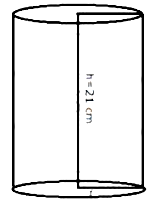
Curverd surface area $=2 \pi r h$
$=2 \times \frac{22}{7} \times \frac{14}{11} \times 21$
$=168\ cm ^2$
Area convered in one revalution $=168\ cm ^2$
Area converd in 9 revalution $=168\ cm ^2 \times 9=1512\ cm ^2$
Therefore, area converd in $1$ second $=1512\ cm ^2$
Hence, area converd in $4 \frac{1}{2}$ second $=12=5=1512\ cm ^2 \times \frac{9}{2}$
$=6804\ cm ^2$ View full question & answer→