Question 13 Marks
Find the length of the median through the vertex A of triangle ABC whose vertices are A (7, -3), B(S, 3) and C(3, -1).
Answer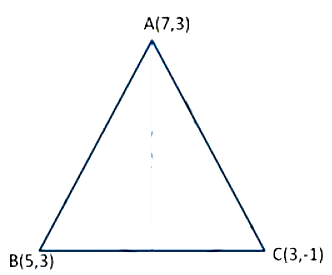
We know that the median of triangle bisects the opposite side
$
\therefore BD : DC =1: 1
$
Coordinates of $D$ are,
$
D ( x , y )= D \left(\frac{5+3}{2}, \frac{3-1}{2}\right)= D (4,1)
$
Length of median $AD =\sqrt{(7-4)^2+(-3-1)^2}=\sqrt{9+16}=\sqrt{25}=5$ units View full question & answer→Question 23 Marks
Three consecutive vertices of a parallelogram ABCD are $A(S, 5), B(-7, -5)$ and $C(-5, 5).$ Find the coordinates of the fourth vertex D.
Answer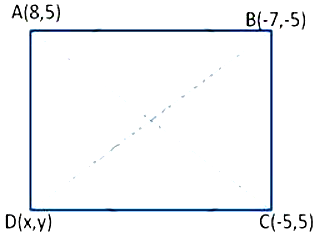
we know that in a parallelogram diagonals bisect each other
$\therefore$ midpoint of $A C=$ midpoint of $B D$
$O \left(\frac{8-5}{2}, \frac{5+5}{2}\right)= O \left(\frac{ x -7}{2}, \frac{ y -5}{2}\right)$
$\frac{8-5}{2}=\frac{ x -7}{2}, \frac{5+5}{2}=\frac{ y -5}{2}$
$\frac{3}{2}=\frac{ x -7}{2}, 10= y -5 $
$x =10, y =15$
Coordinates of fourth vertex D are $(10,15)$ View full question & answer→Question 33 Marks
P( -2, 5), Q(3, 6 ), R( -4, 3) and S(-9, 2) are the vertices of a quadrilateral. Find the coordinates of the midpoints of the diagonals PR and QS. Give a special name to the quadrilateral.
Answer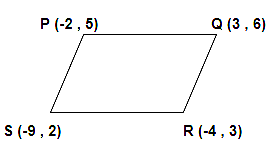
Coordinates of mid point of PR are $\left(\frac{-2-4}{2}, \frac{5+3}{2}\right)$ i.e. $(-3,4)$
Coordinates of mid point of QS are $\left(\frac{-9+3}{2}, \frac{2+6}{2}\right)$ i.e. $(-3,4)$
The midpoint of PR is same as that of Qs, i.e. diagonals PR and QS bisect each other .
Hence, PQRS is a parallelogram. View full question & answer→Question 43 Marks
The coordinates of the end points of the diameter of a circle are (3, 1) and (7, 11). Find the coordinates of the centre of the circle.
Answer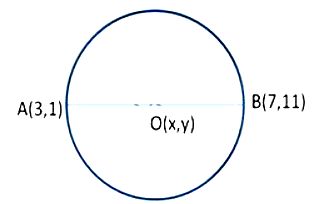
Let $O(x, y)$ be the centre of the circle with diameter $A B$,
$\therefore O$ is midpoint of $Ab$
i.e. $AO : OB =1: 1$
Coordinates of $O$ are,
$
O(x, y)=O\left(\frac{3+7}{2}, \frac{1+11}{2}\right)=O(5,6)
$
Thus, the coordinates of centre are $(5,6)$. View full question & answer→Question 53 Marks
The mid point of the line segment joining the points $(p, 2)$ and $(3, 6)$ is $(2, q).$ Find the numerical values of a and b.
Answer
$A C: C B=1: 1$
Coordinates of $C$ are,
$C(2, q)=C\left(\frac{p+3}{2}, \frac{2+6}{2}\right) $
$2=\frac{p+3}{2}, q=4 $
$4=p+3, q=4 $
$p=1, q=4$
the values of $p$ and $q$ are $1$ and $4$ respectively. View full question & answer→Question 63 Marks
The midpoint of the line segment joining the points $P\ (2 , m)$ and $Q\ (n , 4)$ is $R\ (3 , 5).$ Find the values of $m$ and $n.$
Answer
Given : $PR : RQ =1: 1$
Coordinates of $R$ are ,
$R(3,5)=R\left(\frac{2+n}{2}, \frac{m+4}{2}\right)$
$B=\frac{2+n}{2}, 5=\frac{m+4}{2}$
$6=2+n, 10=m+4$
$n=4, m=6 $
The values of $m$ and $n$ are $6$ and $4$ respectively. View full question & answer→Question 73 Marks
$A, B$ and $C$ are collinear points such that $A B=\frac{1}{2} A C$. If the coordinates of $A, B$ and $C$ are $(-4,-4)$ $(-2, b)$ anf $(a, 2)$, Find the values of $a$ and $b$.
Answer
$\frac{ AB }{ AC }=\frac{1}{2}$
$\therefore A B: B C=1: 1$
Coordinates of $B$ are,
$B(-2, b)=B\left(\frac{-4+a}{2}, \frac{-4+2}{2}\right)$
$-2=\frac{-4+a}{2}, b=-1$
$-4=-4+a, b=-1 $
The values of $a$ and $b$ are $0$ and $-1$ respectively. View full question & answer→Question 83 Marks
$P , Q$ and $R$ are collinear points such that $PQ = QR .$ IF the coordinates of $P , Q$ and $R$ are $(-5 , x) , (y , 7) , (1 , -3)$ respectively, find the values of $x$ and $y.$
Answer
Given $PQ = PR$, i.e. $PQ : QR =1: 1$
Coordinates of $Q$ are ,
$Q(y, 7)=Q\left(\frac{1-5}{2}, \frac{-3+x}{2}\right)$
$y=-2,7=\frac{-3+x}{2}$
$y=-2,14=-3+x$
$17=x$
The value of $x$ and $y$ are $17$ and $-2$ respectively. View full question & answer→Question 93 Marks
A lies on the $x -$ axis amd $B$ lies on the $y-$axis . The midpoint of the line segment $AB$ is $(4 , -3).$ Find the coordinates of $A$ and $B .$
Answer
Coordinates of $B$ are $(14,6)$
Let $(x, 0)$ lies on the $x-$ axis and $B(0, y)$ lies on $y-$ axis, given $A P: P B=1: 1$
Coordinates of $P$ are,
$ P(4,-3)=P\left(\frac{x+0}{2}, \frac{0+y}{2}\right)$
$4=\frac{x}{2},,-3=\frac{4}{2}$
$x=8, y=-6 $
Co-ordinates of $A$ are $(8,0)$ and $B$ are $(0,-6)$ View full question & answer→Question 103 Marks
A(2, 5), B(-2, 4) and C(-2, 6) are the vertices of a triangle ABC. Prove that ABC is an isosceles triangle.
Answer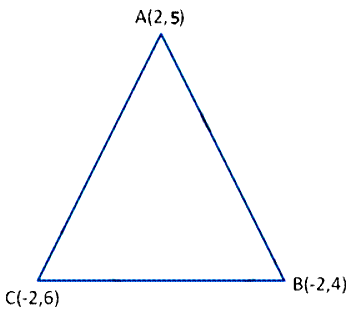
$A B=\sqrt{(2+2)^2+(5-4)^2}=\sqrt{16+1}=\sqrt{17}$ units
$B C=\sqrt{(-2+2)^2+(4-6)^2}=\sqrt{0+4}=2$ units
$A C=\sqrt{(2+2)^2+(5-6)^2}=\sqrt{16+1}=\sqrt{17}$ units
It can be seen that $AB = AC$
Hence, the given coordinates are the vertices of an isosceles triangle. View full question & answer→Question 113 Marks
The centre of a circle is (a+2, a-1). Find the value of a, given that the circle passes through the points (2, -2) and (8, -2).
Answer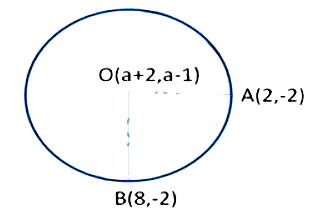
$O A=O B \quad$ [radii of same circle]
$
\begin{aligned}
& \therefore O A^2=O B^2 \\
& (a+2-2)^2+(a-1+2)^2=(a+2-8)^2+(a-1+2)^2 \\
& a^2+(a+1)^2=(a-6)^2+(a+1)^2 \\
& a^2=a^2+36-12 a \\
& 12 a=36 \\
& a=3
\end{aligned}
$ View full question & answer→Question 123 Marks
$A(6, -2), B(3, -2)$ and $C(S, 6)$ are the three vertices of a parallelogram $ABCD.$ Find the coordinates of the fourth vertex $c.$
Answer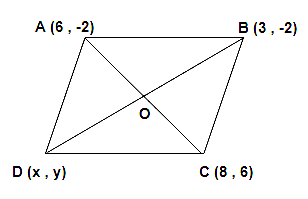
We know that in a parallelogram, diagonals bisect each other .
$\therefore \text { midpoint of } AC =\text { midpoint of } BD$
$O \left(\frac{6+8}{2}, \frac{-2+6}{2}\right)= O \left(\frac{ x +3}{2}, \frac{ y -2}{2}\right)$
$\therefore \frac{6+8}{2}=\frac{ x +3}{2}, \frac{-2+6}{2}=\frac{ y -2}{2} $
$14= x +3,4= y -2$
$x =11, y =6$
the coordinates of the fourth vertex Dare $(11,6)$ View full question & answer→Question 133 Marks
A triangle is formed by line segments joining the points $(5, 1 ), (3, 4)$ and $(1, 1).$ Find the coordinates of the centroid.
Answer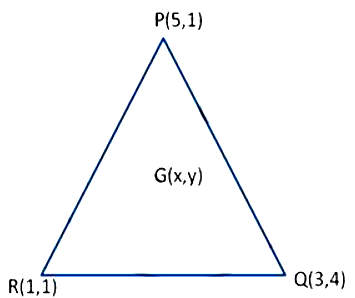
Let $G(x, y)$ be he centroid of $\triangle P Q R$
Coordinates of $G$ are ,
$ G(x, y)=G\left(\frac{5+3+1}{3}, \frac{1+4+1}{3}\right)$
$=G(3,2) $ View full question & answer→Question 143 Marks
The mid-point of the line segment joining $A (- 2 , 0)$ and $B (x , y)$ is $P (6 , 3).$ Find the coordinates of $B.$
Answer
Coordinates of $P$ are,
$P(6,3)=P\left(\frac{-2+x}{2}, \frac{0+y}{2}\right)$
$6=\frac{-2+x}{2}, 3=\frac{y}{2}$
$\Rightarrow 12=-2+x, y=6$
$\Rightarrow x=14 $
Coordinates of $B$ are $(14,6)$ View full question & answer→Question 153 Marks
Two vertices of a triangle are (1, 4) and (3, 1). If the centroid of the triangle is the origin, find the third vertex.
Answer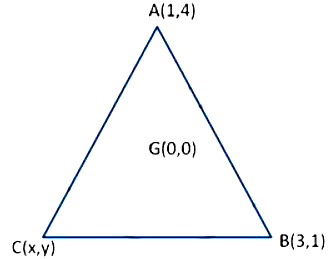
Given the centroid of $\triangle A B C$ is at origin, i.e. $G(0,0)$.
Let the coordinates of third vertex be $(x, y)$.
Coordinates of $G$ are,
$G(0,0)=G\left(\frac{1+3+x}{3}, \frac{4+1+y}{3}\right)$
$O=\frac{4+x}{2}, O=\frac{5+y}{2}$
$x=-4, y=-5$
Coordinates of third vertex are $(-4,-5)$ View full question & answer→Question 163 Marks
Find the centroid of a triangle whose vertices are $(3, -5), (-7, 4)$ and $( 10, -2).$
Answer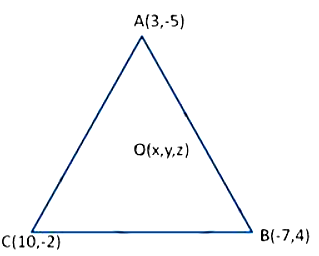
Let $O$ be he centroid of $\triangle A B C$
Coordinates of $O$ are
$ O(x, y, z)=O\left(\frac{3+10-7}{3}, \frac{-5+4-2}{3}\right)$
$=O(2,-1) $ View full question & answer→Question 173 Marks
$B$ is a point on the line segment $AC.$ The coordinates of $A$ and $B$ are $(2, 5)$ and $(1, 0).$ If $AC= 3 AB,$ find the coordinates of $C.$
Answer
Given $A C: A B=3: 1$
$\therefore A B: B C=1: 2$
Coordinates of $B$ are
$1=\frac{x+4}{3}, 0=\frac{y+10}{3}$
$3=x+4,0=y+10$
$x=-1, y=-10$
Hence the coordinates of $C$ are $(-1,-10)$. View full question & answer→Question 183 Marks
Find the coordinates of point $P$ which divides line segment joining $A ( 3, -10)$ and $B (3, 2)$ in such a way that $PB: AB= 1.5.$
Answer
Given: $- PB : AB =1: 5$
$\therefore P B: P A=1: 4$
Coordinates of Pare
$( x , y )=\left(\frac{4 \times 3-3}{5}, \frac{4 \times 2-10}{5}\right)=\left(\frac{9}{5},-\frac{2}{5}\right)$
$P\left(\frac{9}{5},-\frac{2}{5}\right)$ View full question & answer→Question 193 Marks
In what ratio is the line joining $(2, -1)$ and $(-5, 6)$ divided by the $y$ axis ?
Answer
Let the point $P (0, y )$ lies on $y$-axis which divides the line segment $AB$ in the ratio $k : 1$.
Coordinates of $P$ are,
$0=\frac{-5 k +2}{ k +1}, y =\frac{6 k -1}{ k +1}$
$\Rightarrow 5 k =2$
$\Rightarrow k =\frac{2}{5} $
Hence, the required ratio is $2: 5$. View full question & answer→Question 203 Marks
Find the ratio in which the line segment joining $P ( 4, -6)$ and $Q ( -3, 8)$ is divided by the line $y = 0.$
Answer
Given $P Q$ is divided by the line $Y=O$ i.e. $x$-axis.
Let $S(x, O)$ be the pcint on line $Y=0$, which divides the line segment $P Q$ in the ratio $k: 1$.
Coordinates of $S$ are
$x=\frac{-3 k +4}{ k +1}, 0=\frac{8 k -6}{ k +1}$
$\Rightarrow 8 k =6$
$\Rightarrow k =\frac{3}{4} $
Hence, the required ratio is $3: 4$. View full question & answer→Question 213 Marks
Find the ratio in which the line segment joining $A (2, -3)$ and $B(S, 6) i\sim$ divided by the $x-$axis.
Answer
Let the point on $x$-axis be $P(x, O)$ which divides the line segment $A B$ in the ratio $k: 1$.
Coordinates of $P$ are
$ x=\frac{5 k+2}{k+1}, 0=\frac{6 k-3}{k+1}$
$\Rightarrow 0=6 k-3$
$k=\frac{1}{2}$
Hence, the required ratio is $1: 2$. View full question & answer→Question 223 Marks
Find the ratio in which the point $R ( 1, 5)$ divides the line segment joining the points $S (-2, -1)$ and $T (5, 13).$
Answer
Let $R$ divides the line segment $S T$ in the ratio $k: 1$. Coordinates of $R$
$R(x, y)=R(1,5)$
$R\left(\frac{5 k-2}{k+1}, \frac{13 k-1}{k+1}\right)=R(1,5)$
$\frac{5 k-2}{k+1}=1$
$5 k-2=k+1$
$4 k=3$
$k=\frac{3}{4} $
Hence, required ratiois $k: 1=3: 4$. View full question & answer→Question 233 Marks
Find the coordinate of a point P which divides the line segment joining :
$A(-8, -5)$ and $B (7, 10)$ in the ratio $2:3.$
Answer
Let the point $P$ divides the line segment $AB$ in the ratio $2: 3$.
$\therefore$ coordinates of $P$ are
$x=\frac{2 \times 7+3 \times-8}{2+3}=-2$
$y=\frac{2 \times 10+3 \times-5}{2+3}=1$ View full question & answer→Question 243 Marks
Find the coordinate of a point P which divides the line segment joining :
$D(-7, 9)$ and $E( 15, -2)$ in the ratio $4:7.$
Answer
Let the point $P$ divides $DE$ in the ratio $4: 7$.
$\therefore$ cooordinates of $P$ are
$x=\frac{4 \times 15+7 \times-7}{4+7}=1 $
$y=\frac{4 \times-2+7 \times 9}{4+7}=5$ View full question & answer→Question 253 Marks
Find the coordinate of a point P which divides the line segment joining :
$5(2, 6)$ and $R(9, -8)$ in the ratio $3: 4.$
Answer
Let the point $P$ divides the line segment $SR$ in the ratio $3: 4$.
$\therefore$ coordinates of $P$ are
$x=\frac{3 \times 9+4 \times 2}{3+4}=5$
$y=\frac{3 \times-8+4 \times 6}{3+4}=0$ View full question & answer→Question 263 Marks
Find the coordinate of a point P which divides the line segment joining :
$M( -4, -5)$ and $N (3, 2)$ in the ratio $2 : 5.$
Answer
Let the point $P$ divides the line segment $MN$ in the ratio $2: 5 .$
cooordinates of $P$ are
$x=\frac{2 \times 3+5 \times-4}{2+5}=-\frac{14}{7}=-2$
$y=\frac{2 \times 2+5 \times-5}{2+5}=-3$ View full question & answer→Question 273 Marks
Find the coordinate of a point P which divides the line segment joining :
$A (3, -3)$ and $B (6, 9)$ in the ratio $1 :2.$
Answer
Let the point $P$ divides the line segment $AB$ in the ratio $1: 2$.
$\therefore$ coordinates of Pare
$x=\frac{1 \times 6+2 \times 3}{1+2}=4$
$y=\frac{1 \times 9+2 x-3}{1+2}=1$ View full question & answer→Question 283 Marks
Q is a point on the line segment AB. The coordinates of A and B are $(2, 7)$ and $(7, 12)$ along the line AB so that $AQ = 4BQ.$ Find the coordinates of $Q.$
Answer
$AQ : BQ =4: 1$
Coordinates of $Q$ are
$Q(x, y)=Q\left(\frac{4 \times 7+1 \times 2}{4+1}, \frac{4 \times 12+1 \times 7}{4+1}\right)=Q(6,11)$
Thus the coordinates of $Q$ are $(6,11)$
$AQ =\sqrt{(2-6)^2+(7-11)^2}=\sqrt{16+16}=4 \sqrt{2}$
$BQ =\sqrt{(7-6)^2+(12-11)^2}=\sqrt{1+1}=\sqrt{2} $
$\Rightarrow AQ =4 BQ$ View full question & answer→Question 293 Marks
Prove that the following set of point is collinear :
(4, -5),(1 , 1),(-2 , 7)
Answer$
M (4,-5) N (1,1) S (-2,7)
$
$MN =\sqrt{(4-1)^2+(-5-1)^2}=\sqrt{9+36}=3 \sqrt{5}$ units
NS $=\sqrt{(1+2)^2+(1-7)^2}=\sqrt{9+36}=3 \sqrt{5}$ units
$M S=\sqrt{(4+2)^2+(-5-7)^2}=\sqrt{36+144}=6 \sqrt{5}$ units
$MN + NS =3 \sqrt{5}+3 \sqrt{5}=6 \sqrt{5}= MS$
$\because M N+N S=M S$
$\because M , N$ and $S$ are collinear points.
View full question & answer→Question 303 Marks
Prove that the following set of point is collinear :
$(5 , 1),(3 , 2),(1 , 3)$
Answer$P(5,1) Q(3,2) R(1,3) $
$P Q=\sqrt{(5-3)^2+(1-2)^2}=\sqrt{4+1}=\sqrt{5} \text { units } $
$Q R=\sqrt{(3-1)^2+(2-3)^2}=\sqrt{4+1}=\sqrt{5} \text { units } $
$P R=\sqrt{(5-1)^2+(1-3)^2}=\sqrt{16+4}=\sqrt{20} \text { units } $
$P Q+Q R=\sqrt{5}+\sqrt{5}=2 \sqrt{5}=P R $
$\because P Q+Q R=P R$
$\because P , Q$ and $R$ are collinear points.
View full question & answer→Question 313 Marks
Prove that the following set of point is collinear :
$(5 , 5),(3 , 4),(-7 , -1)$
Answer$A(5,5) B(3,4) C(-7,-1) $
$A B=\sqrt{(5-3)^2+(5-4)^2}=\sqrt{4+1}=\sqrt{5} \text { units } $
$B C=\sqrt{(3+7)^2+(4+1)^2}=\sqrt{100+25}=5 \sqrt{5} \text { units } $
$A C=\sqrt{(5+7)^2+(5+1)^2}=\sqrt{144+36}=6 \sqrt{5} \text { units } $
$A B+B C=\sqrt{5}+5 \sqrt{5}=6 \sqrt{5}=A C $
$\because A B+B C=A C$
hence $A, B$ and $C$ are collinear points.
View full question & answer→Question 323 Marks
A line segment of length $10$ units has one end at $A (-4 , 3).$ If the ordinate of te othyer end $B$ is $9,$ find the abscissa of this end.
Answer$A(-4,3)$, Let the other point $B(x, 9)$
Given,$A B=10$ units
$\sqrt{(-4- x )^2+(3-9)^2}=10$
squaring both sides,
$\Rightarrow 16+x^2+8 x+36=100 $
$\Rightarrow x^2+8 x-48=0 $
$\Rightarrow x^2+12 x-4 x-48=0 $
$\Rightarrow x(x+12)-4(x+12)=0 $
$\Rightarrow(x-4)(x+12)=0 $
$\Rightarrow x=4 \text { or }-12$
The abscissa of other end is $4$ or $-12 .$
View full question & answer→Question 333 Marks
Find the value of $m$ if the distance between the points $(m,-4)$ and $(3,2)$ is $3 \sqrt{5}$ units.
AnswerLet the points $(m,-4)$ and $(3,2)$ be $A$ amd $B$ respectively.
Given $A B=3 \sqrt{5}$ units
$
\sqrt{( m -3)^2+(-4-2)^2}=3 \sqrt{5}
$
squaring both sides
$
m^2-6 m+9+36=45
$
$
\Rightarrow m ^2-6 m =0
$
$
\Rightarrow m ( m -6)=0
$
$\Rightarrow m =0$ or 6 .
View full question & answer→Question 343 Marks
Find the value of a if the distance between the points $(5 , a)$ and $(1 , 5)$ is $5$ units .
AnswerLet the points $(5, a)$ and $(1,-5)$ be $P$ and $Q$ respectively.
Given,$P Q=5$ units
$\sqrt{(5-1)^2+(a+5)^2}=5$
squaring both sides, we get ,
$16+a^2+25+10 " a "=25$
$\Rightarrow a^2+10 a+16=0 $
$\Rightarrow a^2+8 a+2 a+16=0$
$\Rightarrow(a+8)(a+2)=0$
$\therefore a=-8,-2$
View full question & answer→Question 353 Marks
Find the distance of a point $(12 , 5)$ from another point on the line $x = 0$ whose ordinate is $9.$
AnswerPoint on the line $x=0$ lies on given its ordinate is $9.$
$\therefore$ point is $P(0,9)$
Let the point $(12,5)$ be $A$.
$AP =\sqrt{(12-0)^2+(5-9)^2} $
$=\sqrt{144+16} $
$=\sqrt{160} $
$=4 \sqrt{10} \text { units }$
View full question & answer→Question 363 Marks
Find the distance of a point $(13 , -9)$ from another point on the line $y = 0$ whose abscissa is $1.$
AnswerPoint on the line $y=0$ lies on $x$-axis given acscissa is $1 .$
$\therefore$ point is $P (1,0)$
Let $(13,-9)$ be point $A$
$AP =\sqrt{(13-1)^2+(-9-0)^2}$
$=\sqrt{144+81} $
$=\sqrt{225}$
$=15 \text { units }$
View full question & answer→Question 373 Marks
Find the distance of a point $(7 , 5)$ from another point on the x - axis whose abscissa is $-5.$
AnswerLet the point on $x$ - axis be $(x, 0)$ given abscissa is $-5 .$
$\therefore$ point is $P(-5,0)$
Let $(7,5)$ be point $A$
$A P=\sqrt{(7+5)^2+(5-0)^2} $
$=\sqrt{144+25} $
$=\sqrt{169} $
$=13 \text { units }$
View full question & answer→Question 383 Marks
Find the distance between P and Q if P lies on the y - axis and has an ordinate $5$ while Q lies on the x - axis and has an abscissa $12 .$
Answer$P$ lies on $y$-axis and has ordinate
$\therefore P (0,5)$
$Q$ lies on $x$-axis and has an abscissa
$\therefore Q(12,0) $
$\therefore P Q=\sqrt{(12-0)^2+(0-5)^2}$
$=\sqrt{144+25}$
$=\sqrt{169} $
$=13 \text { units. }$
View full question & answer→Question 393 Marks
Find the distance between the following point :
$(\sin \theta - \cos ec \theta , \cos \theta - \cot \theta)$ and $(\cos \theta - \cos ec \theta , -\sin \theta - \cot \theta)$
Answer$ A (\sin \theta-\operatorname{cosec} \theta, \cos \theta-\cot \theta) $
$ B (\cos \theta-\operatorname{cosec} \theta,-\sin \theta-\cot \theta) $
$AB =\sqrt{(\cos \theta-\operatorname{cosec} \theta-\sin \theta+\operatorname{cosec} \theta)^2+(-\sin \theta-\cot \theta-\cos \theta+\cot \theta)^2} $
$=\sqrt{(\cos \theta-\sin \theta)^2+(-\sin \theta-\cos \theta)^2}$
$=\sqrt{\cos ^2 \theta+\sin ^2 \theta-2 \cos \theta \sin \theta+\sin ^2 \theta+\cos ^2 \theta+2 \sin \theta \cos \theta}$
$=\sqrt{2} \text { units. }$
View full question & answer→