Question 12 Marks
$O (0, 0), A (3, 5)$ and $B (−5, −3)$ are the vertices of triangle $OAB$. Find the equation of median of triangle $OAB$ through vertex $O$
AnswerLet the median through $O$ meets AB at $D$. So, $D$ is the mid-point of $AB$. Co-ordinates of point $D$ are
$\left(\frac{3-5}{2}, \frac{5-3}{2}\right)=(-1,1)$
Slope of $O D=\frac{1-0}{-1-0}=-1$
$(x_1, y_1) = (0, 0)$
The equation of the median $OD$ is
$y – y_1 = m(x – x_1)$
$y − 0 = −1(x − 0)$
$x + y = 0$
View full question & answer→Question 22 Marks
The equation of a line AB is 2x – 2y + 3 = 0
(i) Find the slope of line AB.
(ii) Calculate the angle that the line AB makes with the positive direction of the x-axis.
Answer(i) 2x − 2y + 3 = 0
2y = 2x + 3
$y=x+\frac{3}{2}$
Slope of the line AB = 1
(ii) Required angle = θ Slope = tan θ = 1 = tan 45° θ = 45°
View full question & answer→Question 32 Marks
Find the slope of the line which is perpendicular to:
$\frac{x}{3}-2 y=4$
Answer$\frac{x}{3}-2 y=4 $
$ 2 y=\frac{x}{3}=-4 $
$y=\frac{x}{6}-2$
Slope of this line $= 1/6$
Slope of the line which is perpendicular to the given line = $\frac{-1}{\text { Slope of this line }}=-\frac{1}{\frac{1}{6}}=-6$
View full question & answer→Question 42 Marks
Find the slope of the line which is perpendicular to:
$x-\frac{y}{2}+3=0$
Answer$x-\frac{y}{2}+3=0 $
$ \frac{y}{2}=x+3 $
$ y=2 x+6$
Slope of this line $= 2$
Slope of the line which is perpendicular to the given line
$=\frac{-1}{\text { Slope of the given line }}=\frac{-1}{2}$
View full question & answer→Question 52 Marks
Find the slope of the line which is parallel to:
$\frac{x}{2}-\frac{y}{3}-1=0$
Answer$\frac{x}{2}-\frac{y}{3}-1=0$
$ \frac{y}{3}-\frac{x}{2}-1$
$y=\frac{3 x}{2}-3$
Slope of this line $=\frac{3}{2}$
Slope of the line which is parallel to the given line $=$ Slope of the given line $=\frac{3}{2}$
View full question & answer→Question 62 Marks
Find the slope of the line which is parallel to:
x + 2y + 3 = 0
Answerx + 2y + 3 = 0
2y = −x − 3
$y=\frac{-1}{2} \times-\frac{3}{2}$
Slope of this line $\frac{-1}{2}$
Slope of the line which is parallel to the given line = Slope of the given line $=\frac{-1}{2}$
View full question & answer→Question 72 Marks
Determine x so that slope of the line through (1, 4) and (x, 2) is 2.
AnswerGiven, the slope of the line through (1, 4) and (x, 2) is 2.
$\frac{2-4}{x-1}=2$
$\frac{-2}{x-1}=2$
x-1
$\frac{-1}{x-1}=1$
-1 = x -1
x = 0
View full question & answer→Question 82 Marks
Is the line x – 3y = 4 perpendicular to the line 3x – y = 7?
Answerx − 3y = 4
3y = x − 4
$y=\frac{1}{3} \times-\frac{4}{3}$
Slope of this line $=\frac{1}{3}$
3x − y = 7
y = 3x - 7
Slope of this line = 3
Product of slopes of the two lines = 1 ≠ -1
So, the lines are not perpendicular to each other.
View full question & answer→Question 92 Marks
The equation of a line is x – y = 4. Find its slope and y – intercept. Also, find its inclination.
AnswerGiven equation of a line is x - y = 4
⟹ y = x - 4
Comparing this equation with y = mx + c. We have:
Slope = m = 1
y-intercept = c = −4
Let the inclination be θ.
Slope = 1 = tan θ = tan 45°
∴ θ = 45°
View full question & answer→Question 102 Marks
A (1, −5), B (2, 2) and C (−2, 4) are the vertices of triangle ABC, Find the equation of :
the line through C and parallel to AB.
Answerslope of $A B=\frac{2+5}{2-1}=7$
Slope of the line parallel to AB = Slope of AB = 7
So, the equation of the line passing through C and parallel to AB is
y − 4 = 7(x + 2)
y − 4 = 7x + 14
y = 7x + 18
View full question & answer→Question 112 Marks
A $(1, −5),$ B$ (2, 2)$ and C$ (−2, 4)$ are the vertices of triangle ABC, Find the equation of :
the altitude of the triangle through B.
AnswerLet BE be the altitude of the triangle through B.
Slope of AC $=\frac{4+5}{-2-1}=\frac{9}{-3}=-3$
$\therefore$ stope of $BE =\frac{-1}{\text { slope of } A C}=\frac{1}{3}$
Equation of altitude BE is
$y-2=\frac{1}{3}(x-2)$
$3 y-6=x-2 $
$ 3 y=x+4$
View full question & answer→Question 122 Marks
A (1, −5), B (2, 2) and C (−2, 4) are the vertices of triangle ABC, Find the equation of :
the median of the triangle through A.
AnswerWe know the median through A will pass through the mid-point of BC. Let AD be the median through A. Co-ordinates of the mid-point of BC, i.e., D are
$\left(\frac{2-2}{2}, \frac{2+4}{2}\right)=(0,3)$
slope of AD $=\frac{3+5}{0-1}=-8$
Equation of the median AD is
y - 3 = -8(x - 0)
8x + y = 3
View full question & answer→Question 132 Marks
In the following diagram, write down:
(i) the co-ordinates of the points A, B and C.
(ii) the equation of the line through A and parallel to BC.
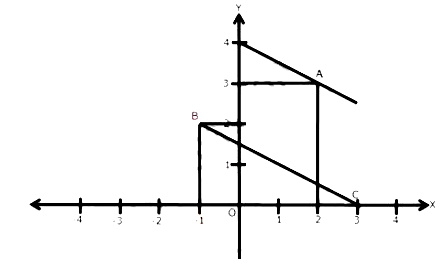
Answer(i) The co-ordinates of points A, B and C are $(2, 3), (−1, 2)$ and $(3, 0)$ respectively.
(ii) Slope of $B C=\frac{0-2}{3+1}=-\frac{2}{4}=\frac{-1}{2}$
Slope of a line parallel to BC = Slope of BC $=\frac{-1}{2}$
Required equation of a line passing through A and parallel to BC is given by
$y − y_1 = m (x − x_1)$
$y-3=\frac{-1}{2}(x-2) $
$2 y-6=-x+2 $
$x+2 y=8$
View full question & answer→Question 142 Marks
Find the slope and y-intercept of the line: 3x – 4y = 5
Answer$3 x-4 y=5 \Rightarrow 4 y=3 x-5 \Rightarrow y=\frac{3}{4} x-\frac{5}{4}$
Comparing this equation with y = mx + c, we have:
Slope = m =3/4
y-intercept = c = $=\frac{-5}{4}$
View full question & answer→Question 152 Marks
Find the slope and y-intercept of the line: ax – by = 0
Answerax − by = 0
⟹ by = ax ⟹ y =(a/b)x
Comparing this equation with y = mx + c,
we have:
Slope = m =a/b
y-intercept = c = 0
View full question & answer→Question 162 Marks
Find the equation of the line passing through $(−5, 7)$ and parallel to $y$ - axis ?
AnswerThe slope of the line parallel to y-axis is not defined. That is slope of the line is tan 90° and hence the given line is parallel to y-axis.$(x_1, y_1) = (−5, 7)$
Required equation of the line is
$x − x_1 =0$
$⟹ x + 5 = 0$
View full question & answer→Question 172 Marks
Find the equation of the line passing through $(−5, 7)$ and parallel to: $x$-axis ?
AnswerThe slope of the line parallel to x-axis is $0.$
$(x_1, y_1) = (−5, 7)$
Required equation of the line is
$y − y_1 = m (x − x_1)y − 7 = 0(x + 5)$
$y = 7$
View full question & answer→Question 182 Marks
If the lines $y = 3x + 7$ and $2y + px = 3$ are perpendicular to each other, find the value of $p.$
Answer$y = 3x + 7$
Slope of this line $= 3$
$2y + px = 3 2y = − px + 3$
$y=-\frac{p x}{2}+\frac{3}{2}$
Slope of this line $=\frac{p}{2}$
Since, the lines are perpendicular to each other, the product of their slopes is $-1.$
$\therefore(3)-\left(\frac{p}{2}\right)=-1$
$\frac{3 p}{2}=1$
$p=\frac{2}{3}$
View full question & answer→Question 192 Marks
The co-ordinates of two points A and B are (-3, 4) and (2, -1) Find: the co-ordinates of the point where the line AB intersects the y-axis.
AnswerLet the line AB intersects the y-axis at point (0, y).
Putting x = 0 in the equation of the line, we get,
0 + y = 1
y = 1
Thus, the co-ordinates of the point where the line AB intersects the y-axis are (0, 1).
View full question & answer→Question 202 Marks
The co-ordinates of two points $A$ and $B$ are $(-3, 4)$ and $(2, -1)$ Find the equation of $AB$
AnswerGiven, co-ordinates of two points $A$ and $B$ are $(-3, 4)$ and $(2, -1).$
Slope $=\frac{-1-4}{2+3}=-\frac{5}{5}=-1$
The equation of the line AB is given by:
$y − y_1 = m (x − x_1)$
$y + 1 = −1(x − 2)$
$y + 1 = −x + 2$
$x +y =1$
View full question & answer→Question 212 Marks
The co-ordinates of two points P and Q are (2, 6) and (−3, 5) respectively Find the co-ordinates of the point where PQ intersects the x-axis.
AnswerLet the line PQ intersects the x-axis at point A (x, 0).
Putting y = 0 in the equation of the line PQ, we get,
0 = x + 28
x = −28
Thus, the co-ordinates of the point where PQ intersects the x-axis are A (−28, 0).
View full question & answer→Question 222 Marks
The co-ordinates of two points $P$ and $Q$ are $(2, 6)$ and $(−3, 5)$ respectively Find the equation of $PQ;$
AnswerThe equation of the line $PQ$ is given by:
$y − y1 = m (x − x_1)$
$y − 6 = 1/5 (x − 2)$
$5y − 30 = x − 2$
$5y = x + 28$
View full question & answer→Question 232 Marks
The co-ordinates of two points P and Q are (2, 6) and (−3, 5) respectively Find the gradient of PQ;
AnswerGiven, co-ordinates of two points P and Q are (2, 6) and (-3, 5) respectively
Gradient of $PQ =\frac{5-6}{-3-2}$
Gradient of $PQ =\frac{-1}{-5}$
Gradient of $PQ =\frac{1}{5}$
View full question & answer→Question 242 Marks
Find the equation of a line whose:
y – intercept = −1 and inclination = 45°
AnswerGiven, y-intercept = c = −1 and inclination = 45o.
Slope = m = tan 45° = 1
Substituting the values of c and m in the equation y = mx + c, we get,
y = x - 1, which is the required equation.
View full question & answer→Question 252 Marks
$A (1, 4), B (3, 2)$ and $C (7, 5)$ are vertices of a triangle ABC. Find the co-ordinates of the centroid of triangle ABC.
AnswerCo-ordinates of the centroid -
$x=\frac{x_1+x_2+x_3}{3}=\frac{1+3+7}{3}=\frac{11}{3}$
$ y=\frac{y_1+y_2+y_3}{3}=\frac{4+2+5}{3}=\frac{11}{3}$
The co-ordinates of the centroid of triangle ABC are $\left(\frac{11}{3}, \frac{11}{3}\right)$.
View full question & answer→Question 262 Marks
The line through P (5, 3) intersects y-axis at Q.
Find the co-ordinates of Q.
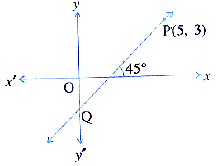
AnswerFrom subpart (ii), the equation of the line PQ
Is x – y = 2
Given that the line intersects with the y – axis, x = 0
Thus, substituting x = 0 in the equation x – y = 2
We have, 0 – y = 2
⇒ y = − 2
Thus, the coordinates point of intersection Q
Are q(0, −2)
View full question & answer→Question 272 Marks
The line through $P (5, 3)$ intersects y-axis at $Q.$
write the equation of the line
AnswerThe equation of a line passing through the pointA$(x1, y1)$ with slope ‘m’ is
$y – y_1 = m (x – x_1)$
Therefore, the equation of the line passing
through the point P (5, 3) with slope $1$ is
$y -3 = 1 \times (x – 5)$
$\Rightarrow y – 3 = x – 5$
$\Rightarrow x – y = 2$
View full question & answer→Question 282 Marks
The line through P (5, 3) intersects y-axis at Q.
write the slope of the line
AnswerThe equation of the y-axis is x = 0
Given that the required line through P (5, 3)
Intersects the y-axis at Q and the angle of inclination is 45°
Therefore slope of the line PQ = tan 45° = 1
View full question & answer→Question 292 Marks
Find the equation of a line whose:
y- intercept = 2 and slope = 3
AnswerGiven, y-intercept = c = 2 and slope = m = 3.
Substituting the values of c and m in the equation y = mx + c, we get,
y = 3x + 2, which is the required equation.
View full question & answer→Question 302 Marks
Find the equations of the line through $(1, 3)$ and making an intercept of $5$ on the $y$-axis.
AnswerSince, y-intercept $= 5$, so the corresponding point on y-axis is $(0, 5).$
The line passes through $(1, 3)$
$\therefore $ Slope of the line =(3-5)/(1-0)=(-2)/1=-2
Required equation of the line is given by:
$y- y_1=m (x -x_1)$
$y − 5 = −2(x − 0)$
$y − 5 = −2x$
$2x + y = 5$
View full question & answer→Question 312 Marks
Find the equation of the line whose slope is $-5/6$ and x-intercept is $6.$
AnswerSince, x-intercept is $6,$ so the corresponding point on x-axis is $(6, 0).$
slope $=m=\frac{-5}{6}$
Required equation of the line is given by:
$y-y_1=m\left(x-x_1\right)$
$ y-0=\frac{-5}{6}(x-6) $
$6 y=-5 x+30$
$ 5 x+6 y=30$
View full question & answer→Question 322 Marks
$A, B$ and $C$ have co-ordinates $(0, 3), (4, 4)$ and $(8, 0)$ respectively. Find the equation of the line through A and perpendicular to $BC.$
AnswerSlope of $B C=\frac{0-4}{8-4}=\frac{-4}{4}=-1$
Slope of line perpendicular to $B C=\frac{-1}{\text { slope of } B C}=1$
The equation of the line through A and perpendicular to BC is given by:
$y - y_1 =m(x - x_1)$
$y − 3 = 1(x - 0)$
$y − 3 = x$
$y = x + 3$
View full question & answer→Question 332 Marks
Find the slope of the line perpendicular to AB if: A = (3, −2) and B = (−1, 2)
AnswerSlope of $A B=\frac{2+2}{-1-3}$
Slope of $A B=\frac{4}{-4}$
Slope of $A B=-1$
Slope of the line perpendicular to $A B=\frac{-1}{\text { slope of } A B}$
Slope of the line perpendicular to $A B=\frac{-1}{-1}$
Slope of the line perpendicular to AB=1
View full question & answer→Question 342 Marks
Find the slope of the line perpendicular to AB if: $A = (0, −5)$ and $B = (−2, 4)$
AnswerSlope of $A B=\frac{-4-5}{-2-0}$
Slope of $A B=-\frac{9}{2}$
Slope of the line perpendicular to AB $=\frac{-1}{\text { slope of } AB }$
$=\frac{-1}{-\frac{9}{2}}$
$=\frac{2}{9}$
View full question & answer→Question 352 Marks
Find the value(s) of $k$ so that $PQ$ will be parallel to $RS.$ Given $: P (3, −1), Q (7, 11), R (−1, −1)$ and $S (1, k)$
AnswerSince, $PQ \| RS,$
Slope of $PQ =$ Slope of $RS$
Slope of $P Q=\frac{11+1}{7-3}=\frac{12}{4}=3$
Slope of RS $=\frac{k+1}{1+1}=\frac{k+1}{2}$
$\therefore 3=\frac{k+1}{2}$
$k+1=6$
$k=5$
View full question & answer→Question 362 Marks
Find the value(s) of k so that PQ will be parallel to RS. Given: $P (2, 4), Q (3, 6), R (8, 1)$ and $S (10, k)$
AnswerSince, $PQ || RS,$
Slope of PQ = Slope of RS
Slope of $P Q=\frac{6-4}{3-2}=2$
Slope of RS $=\frac{k-1}{10-8}$
$\therefore 2=\frac{k-1}{2} $
$k-1=4$
$k=5$
View full question & answer→Question 372 Marks
The points $(K, 3), (2, −4)$ and $(-K + 1, −2)$ are collinear. Find K.
AnswerGiven, points $A (K, 3), B (2, −4)$ and $C (−K + 1, −2)$ are collinear.
$\therefore$ Slope of AB = Slope of BC
$\frac{-4-3}{2-k}=\frac{-2+4}{-k+1-2} $
$ \frac{-7}{2-k}=\frac{2}{-k-1} $
$7 k+7=4-2 k $
$9 k=-3 $
$k=\frac{-1}{3}$
View full question & answer→Question 382 Marks
Find the slope and the inclination of the line AB if:
$A=(-1,2 \sqrt{3})$ and $B=(-2, \sqrt{3})$
Answer$A=(-1,2 \sqrt{3})$ and $B=(-2, \sqrt{3})$
slope of $A B=($ sqrt3 -2 sqrt3 $) /(-2+1)=-$ sqrt3 $/-1=\operatorname{sqrt3}=\tan \theta$
Inclination of line AB = θ = 60°
View full question & answer→Question 392 Marks
Find the slope and the inclination of the line AB if:
$A=(0,-\sqrt{3})$ and $B=(3,0)$
Answer$A=(0,-\sqrt{3})$ and $B=(3,0)$
Slope of $A B=\frac{0+\sqrt{3}}{3-0}=\frac{\sqrt{3}}{3}=\frac{1}{\sqrt{3}}=\tan \theta$
Inclination of line AB = θ = 30°
View full question & answer→Question 402 Marks
Find the slope and the inclination of the line AB if :
A = (−3, −2) and B = (1, 2)
AnswerA = (-3, -2) and B = (1, 2)
Slope of AB =
$\frac{2+2}{1+3}=\frac{4}{4}=1=\tan \theta$
Inclination of line AB = θ = 45°
View full question & answer→Question 412 Marks
The slope of the side BC of a rectangle ABCD is 2/3
Find:
(i) the slope of the side AB.
(ii) the slope of the side AD.
Answer(i) Since, BC is perpendicular to AB,
Slope of $A B=-\frac{1}{\text { slope of } B C}=\frac{-1}{\frac{2}{3}}=\frac{-3}{2}$
(ii) Since, AD is parallel to BC,
Slope of $A D=$ Slope of $B C=\frac{2}{3}$
View full question & answer→Question 422 Marks
The side AB of an equilateral triangle ABC is parallel to the x-axis. Find the slopes of all its sides.
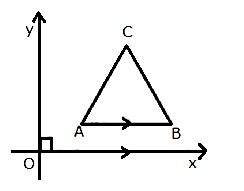
AnswerWe know that the slope of any line parallel to x-axis is $0.$
Therefore, slope of $AB = 0$
Since, $ABC$ is an equilateral triangle, $\angle A = 60^\circ$
$\text { Slope of } A C=\tan 60^{\circ}=\sqrt{3}$
$\text { Slope of } B C=-\tan 60^{\circ}=-\sqrt{3}$
View full question & answer→Question 432 Marks
Find $x$, if the slope of the line joining $(x, 2)$ and $(8,-11)$ is $\frac{-3}{4}$
AnswerLet $A = (x, 2)$ and $B = (8, -11)$
Slope of $A B=\frac{-11-2}{8-x}$
$\frac{-11-2}{8-x}=-\frac{3}{4}$ (Given)
$\frac{13}{8-x}=\frac{3}{4} $
$52=24-3 x $
$3 x=24-52 $
$ 3 x=-28$
$x=\frac{-28}{3}$
View full question & answer→Question 442 Marks
The line y = mx + 8 contains the point (−4, 4), calculate the value of m.
AnswerGiven, the line y = mx + 8 contains the point (−4, 4).
Substituting x = −4 and y = 4 in the given equation, we have:
4 = −4m + 8
4m = 4 = m = 1
View full question & answer→Question 452 Marks
the point (−3, 2) lies on the line ax + 3y + 6 = 0, calculate the value of a.
AnswerGiven, the point (−3, 2) lies on the line ax + 3y + 6 = 0.
Substituting x = −3 and y = 2 in the given equation, we have:
a(−3) + 3(2) + 6 = 0
−3a + 12 = 0
3a = 12
a = 4
View full question & answer→Question 462 Marks
For what value of k will the point (3, −k) lie on the line 9x + 4y = 3?
AnswerThe given equation of the line is 9x + 4y = 3.
Put x = 3 and y = -k, we have:
9(3) + 4(−k) = 3
27 − 4k = 3
4k = 27 − 3 = 24
k = 6
View full question & answer→Question 472 Marks
The line given by the equation $2 x-\frac{y}{3}=7$ passes through the point $( k , 6)$; calculate the value of $k$.
AnswerGiven, the line given by the equation $2 x-\frac{y}{3}=7$ passes through the point $(k, 6).$
Substituting $x = k$ and $y = 6$ in the given equation, we have:
$2 x-\frac{6}{3}=7$
$ 2 k-2=7$
$2 k=9 $
$k=4.5$
View full question & answer→Question 482 Marks
Find, if point (-2,-1.5) lie on the line x – 2y + 5 = 0
AnswerSubstituting x = −2 and y = −1.5 in the given equation, we have:
L.H.S. = −2 − 2 × (−1.5) + 5
= −2 + 3 + 5
= 6 ≠ R.H.S.
Thus, the point (-2, -1.5) does not lie on the given line.
View full question & answer→Question 492 Marks
Find, if point (2,-1.5) lie on the line x – 2y + 5 = 0
AnswerSubstituting x = 2 and y = −1.5 in the given equation, we have:
L.H.S. = 2 − 2 × (−1.5) + 5
= 2 + 3 + 5
= 10 ≠ R.H.S.
Thus, the point (2, −1.5) does not lie on the given line.
View full question & answer→Question 502 Marks
Find, if point (5,5) lie on the line x – 2y + 5 = 0
AnswerSubstituting x = 5 and y = 5 in the given equation, we have:
L.H.S. = 5 − 2 × 5 + 5
= 5 − 10 + 5
= 10 − 10
= 0 = R.H.S.
Thus, the point (5, 5) lies on the given line.
View full question & answer→