Question 14 Marks
A straight line passes through the point $(3, 2)$ and the portion of this line, intercepted between the positive axes, is bisected at this point. Find the equation of the line.
Answer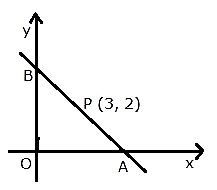
Let the line intersect the x-axis at point A (x, 0) and y-axis at point B (0, y).
Since, P is the mid-point of AB, we have:
$\left(\frac{x+0}{2}, \frac{0+y}{2}\right)=(3,2)$
$\left(\frac{x}{2}, \frac{y}{2}\right)=(3,2)$
$x = 6, y = 4$
Thus, $A = (6, 0)$ and $B = (0, 4)$
Slope of line $A B=\frac{4-0}{0-6}=\frac{4}{-6}=\frac{-2}{3}$
Let $(x1, y1) = (6, 0)$
The required equation of the line AB is given by
$y – y_1 = m(x – x_1)$
$y-0=\frac{-2}{3}(x-6)$
$3y = −2x + 12$
$2x + 3y = 12$ View full question & answer→Question 24 Marks
A line through origin meets the line $x = 3y + 2$ at right angles at point $X$. Find the co-ordinates of $X$.
AnswerThe given line is
x = 3y + 2 ...(1)
3y = x – 2
$y=\frac{1}{3} x-\frac{2}{3}$
Slope of this line is $\frac{1}{3}$
The required line intersects the given line at right angle.
∴ Slope of the required line $=\frac{-1}{\frac{1}{2}}=-3$
The required line passes through $(0, 0) = (x_1, y_1)$
The equation of the required line is
$y – y_1 = m(x – x_1)$
$y - 0 = -3(x - 0)$
$3x + y = 0......(2)$
Point X is the intersection of the lines (1) and (2).
Using (1) in (2), we get,
$9y + 6 + y = 0$
$y=\frac{-6}{10}=\frac{-3}{5}$
$\therefore x=3 y+2=\frac{-9}{5}+2=\frac{1}{5}$
Thus, the co-ordinates of the point $X$ are $\left(\frac{1}{5}, \frac{-3}{5}\right)$
View full question & answer→Question 34 Marks
$(1, 5)$ and $(-3, -1)$ are the co-ordinates of vertices $A$ and $C$ respectively of rhombus $ABCD.$ Find
the equations of the diagonals $AC$ and $BD.$
Answer$A = (1, 5)$ and $C = (-3, -1)$
We know that in a rhombus, diagonals bisect each other at right angle.
Let $O$ be the point of intersection of the diagonals $AC$ and $BD.$ Co-ordinates of $O$ are
$\left(\frac{1-3}{2}, \frac{5-1}{2}\right)=(-1,2)$
slope of $A C=\frac{-1-5}{-3-1}=\frac{-6}{-4}=\frac{3}{2}$
slope $= m \frac{3}{2},\left(x_1, y_1\right)=(1,5)$
Equation of the line $AC$ is
$y – y_1 = m (x – x_1)$
$y-5=\frac{3}{2}(x-1)$
$2y − 10 = 3x − 3$
$3x − 2y + 7 = 0$
For line $BD:$
Slope $= m = \frac{-1}{\text { slope of } A C}=\frac{-2}{3}$
$(x_1, y_1) = (−1, 2)$
Equation of the line BD is
$y – y_1 = m(x – x_1)$
$y-2=\frac{-2}{3}=(x+1)$
$3 y-6=-2 x-2$
$2 x+3 y=4$
View full question & answer→Question 44 Marks
$A$ line $AB$ meets $X-$ axis at $A$ and $Y-$ axis at $B. P(4, -1)$ divides AB in the ration $1 : 2.$
1. Find the co-ordinates of $A$ and $B$.
2. Find the equation of the line through $P$ and perpendicular to $A B$.
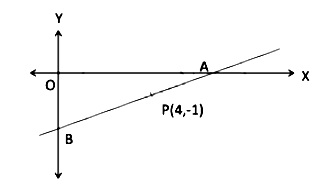
Answer1. i.SinceA lies on the $X-$ axis, let the co-ordinates of $A$ be $(x, 0).$
Since $B$ lies on the $Y-$ axis, let the co-ordinates of $B$ be $(0, y).$
Let $m = 1$ and $n = 2$
Using Section formula,
Coordinates of $P =\left(\frac{1(0)+2(x)}{1+2}, \frac{1 y+2(0)}{1+2}\right)$
$\Rightarrow(4,-1)=\left(\frac{2 x}{3}, \frac{y}{3}\right)$
$\Rightarrow \frac{2 x}{3}=4 \text { and } \frac{y}{3}=-1$
$\Rightarrow x = 6$ and $y = -3$
So, the co-ordinates of $A$ are $(6, 0)$ and that of $B$ are $(0, -3).$
(ii) Slope of $AB =\frac{-3-0}{0-6}=\frac{-3}{-6}=\frac{1}{2}$
$\Rightarrow$ Slope of line perpendicular to $AB = m = -2$
$P = (4, -1)$
Thus, the required equation is
$y - y_1 = m(x - x_1)$
$\Rightarrow y - (-1) = -2(x - 4)$
$\Rightarrow y + 1 = -2x + 8$
$\Rightarrow 2x + y = 7$
View full question & answer→Question 54 Marks
In the figure, ABC is a triangle and BC is parallel to the y-axis. AB and AC intersect the y-axis at P and Q respectively.
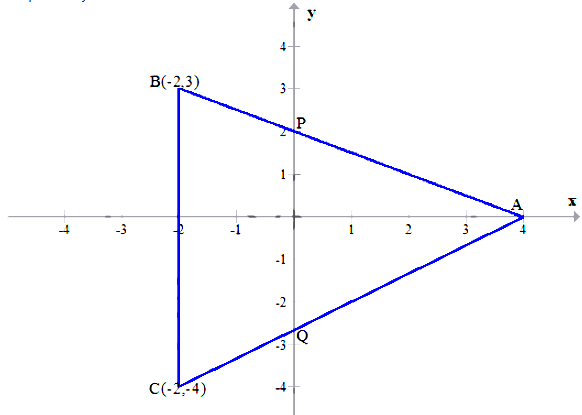
(1) Write the co-ordinates of A.
(2) Find the length of Ab and AC.
(3) Find the radio in which Q divides Ac.
(4)find the equation of the line AC.
Answer(1) The line intresects the $x-$ axis where $y=0$
Hence, the co-ordinates of $A$ are $(4,0)$
(2)Length of $Ab =\sqrt{(4-(-2))^2+(0-3)^2}=\sqrt{36+9}=\sqrt{45}=3 \sqrt{5}$ unit
Length of $A c=\sqrt{(4-(-2))^2+(0+4)^2}=\sqrt{36+16}=\sqrt{52}=25 \sqrt{13}$ units
(3) Let K be the required ratio which divides the line segment joining the co-ordinates $A (4,0)$ and $O(-2,-4)$
Let the co-ordinates of $Q$ be $x$ and $y$
$\therefore x=\frac{k(-2)+1(4)}{k+1}$ and $\frac{y=k(-4)+0}{k+1}$
$\therefore x=\frac{k(-2)+1(4)}{k+1}$ and $\frac{y=k(-4)+0}{k+1}$
$Q$ lies on the $y-$ axis where $x=0,$
$\Rightarrow \frac{-2 k+4}{k+1}=0$
$\Rightarrow-2 k+4=0$
$\Rightarrow 2 k=4$
$\Rightarrow k=\frac{4}{2}=\frac{2}{1}$
Thus the required ratio is $2: 1$
(4) Slope of line $A c=m=\frac{-4-0}{-2-4}=-\frac{4}{-6}=\frac{2}{3}$
Thus, the equation of the line $AC$ is given by
$y-0=\frac{2}{3}(x-4)$
i.e $3 y=2 x-8$
i.e $2 x-3 y=8$
View full question & answer→Question 64 Marks
Three vertices of a parallelogram ABCD taken in order are $A(3,6),B(5,10)$ and $C(3,2),$ find :
$(1)$ the co-ordinates of the fourth vertex D.
$(2)$ Length of diagonal BD.
$(3)$ equation of side AB of the parallelogram ABCD
Answer$(1)$ Let $(x,y)$ be the co-ordinates of D.
We know that the diagonals of a parallelogram bisect each other.
$\therefore$ Mid-point of diagonal AC=mid -point of diagonal BD
$\Rightarrow\left(\frac{3+3}{2}, \frac{6+2}{2}\right)=\left(\frac{5+x}{2}, \frac{10+y}{2}\right)$
$ \Rightarrow(3,4)=\left(\frac{5+x}{2}, \frac{10+y}{2}\right)$
$\Rightarrow \frac{5+x}{2}=3 \Rightarrow 5+x=6 \Rightarrow x=1$ and $\frac{10+y}{2}=4 \Rightarrow 10+y=8 \Rightarrow y=-2$
$\therefore$ Co-ordinates of $D$ are $(1,-2)$.
$(2)$ Length of diagonal BD
$=\sqrt{(1-5)^2+(-2-10)^2} $
$ =\sqrt{(-4)^2+(-12)^2} $
$ =\sqrt{16+144} $
$ =\sqrt{160} $
$ =4 \sqrt{10} \text { unit }$
$(3)$ Slope of side $A B=m \frac{10-6}{5-3}=\frac{4}{2}=2$
Thus, the equation of side AB is given by
$y-6=2(x-3)$
i.e. $y-6=2 x-6$
i.e. $2 x-y=0$
i.e $y=2 x$
View full question & answer→Question 74 Marks
find the equation of line through the line $2x-y=1$ and $3x+2y=-9$ and making an angle of $30^\circ$ with positive direction of x-axis.
Answersince the line passing thorough the x-axis makes an angle of $30^\circ$ with the positive direction of the x-axis,
the slope of the line is given by tan $30^{\circ}=\frac{1}{\sqrt{3}}$
The intersection of the lines $2 x-y=1$ and $3 x+2 y=-9$
is given by solving the equation simulataneously.
So, multiplying equation $2 x-y=1$ by $2,$ we get.
$4 x-2 y=2$
Now add this resulting to the second equation $3 x+2 y=-9$
$\Rightarrow 7 \times=-7 \Rightarrow \times=-1$
Substituting the value of $x \in 2 x-y=1$, we get $y=-3$
Thus, the intersection of the lines is $(-1,-3)$.
To find the equation of the required line, We use the slope-point form, so we get
$y-(-3)=\frac{1}{\sqrt{3}}(x-(1)) $
$ \text { i.e. } y+3=\frac{1}{\sqrt{3}}(x+1)$
$ \text { i.e } y=\frac{x}{\sqrt{3}}+\frac{1}{\sqrt{3}}-3$
View full question & answer→Question 84 Marks
A line through point $P(4,3)$ meets x-axis at point A and the y-axis at point B. If BP is double of PA, find the equation of AB.
AnswerSince a line through point P meets x-axis at point A and at point B,
Co-ordinates of A are (x,0) and Co-ordinates of B are (0,y).
Now, BP=2PA
$\Rightarrow \frac{B P}{P A}=\frac{2}{1}$
$\Rightarrow P$ divides $AB$ in the ratio2 $: 1$
So, the coodinates of $P$ are $\left(\frac{2 \times x+1 \times 0}{2 \times 1}, \frac{2 \times 0+1 \times y}{2 \times 1}\right)=\left(\frac{2 x}{3}, \frac{y}{3}\right)$
But, coodinates of $P$ are $(4,3)$
$\Rightarrow 2 \frac{x}{3}=4 \Rightarrow 2 x=12 \Rightarrow x=6$ and $\frac{V}{3}=3 \Rightarrow y=9$
$\Rightarrow$ Co-ordinates of $A$ are $(6,0)$ and coodinates of $B$ are $(0,9)$
$\therefore$ Slope of line $A B=\frac{9-0}{0-6}=\frac{9}{-6}=-\frac{3}{2}$
Thus, the equation of line Ab is given by
$y-0=-\frac{3}{2}(x-6)$
i.e $2 y=3 x+18$
i.e $3 x+2 y=18$
View full question & answer→Question 94 Marks
In the given figure. line $AB$ meets $y-$ axis at point $A.$ Line through $C(2,10)$ and $D$ intersects line $AB$ at right angle at poiunt $R$ find
(1) equation of line $AB$
(2) equation of line $CD$
(3) Co-ordinates of point $E$ and $D$
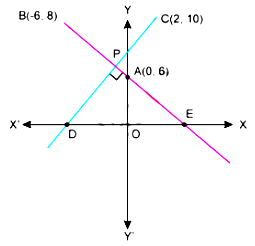
Answer(1) Slope of line $AB =m=\frac{8-6}{-6-0}=\frac{2}{-6}=-\frac{1}{3}$
The $y-$ interoept of the line $AB$ is $6.$
Thus , the equation of th given line is given by the slope -intercept from $y=m x+c$
i.e. $y=-\frac{1}{3} \times+6$
i.e. $3 y=-x+18$
i.e. $x+3 y=18$, Which is the required equation.
(2) Since $AB$ and $CD$ intersect at right angles,
$\text { slope }_{A B} \times \text { slope }_{C D}=-1$
$\Rightarrow-\frac{1}{3} \times \text { slope }_{C D}=-1$
$\Rightarrow \text { Slope }_{C D}=3$
U sing the slope-point from, the equation of $CD$ is given by
$y-y_1=m\left(x-x_1\right)$
i.e. $y-10=3(x-2)$
i.e. $y-10=3 x-6$
i.e. $3 x-y+4=0$ Which is the required equation of line $CD.$
(3) Since point $E$ satisfies the equation Of $AB,$ and the y-coordinate of $E$ is $0,$ We can find the $x-$ Coodinate of $E.$
$x+3(0)=18$
$\Rightarrow x=18$
So, the coordinates of $E$ are $(18,0).$
Now, since point $D$ satisfies the equation Of $CD,$ and the y-coordinate of $D$ is $0,$ We can find the $x-$ coordinate Of $D.$
$3 x-(0)+4=0$
$\Rightarrow 3 x=-4$
$\Rightarrow x=-\frac{4}{3}$
So, the coordinates of $D$ are $\left(-\frac{4}{3}, 0\right)$
View full question & answer→Question 104 Marks
A straight line passes the points p(-1,4) and Q(5,-2). It intersects x-axis at point A and y-axis at point B.M is mid-t point of the line segment AB.find:
(1) the equation of the line.
(2) the co-ordinates of point A and B
(3) the co-ordinates of point M
Answer(1) The equation of the line passing through the points P(-1,4) and Q (5,-2) is
$y-4=\frac{-2-4}{5-(-1)}(x-(-1))$
i.e $y-4=\frac{-6}{6}(x+1)$
i.e. $y-4=-1(x+1)$
i.e. $y-4=-x-1$
i.e $x+y=3$
(2) The line x+y=3 cuts x-axis at point A. Hence, its y-Coodinate is 0. And , x-coordinate is given by
$x+0=3 \Rightarrow x-3$
So, the coordinates of A are (3, 0)
The line x+y=3 cuts y-axis at point B. Hence, its x-coodinate is 0.And, y-coordinates is given by
$0+y=3 \Rightarrow y=3$
So, the coodinates of B are (0,3).
So, the coordinates of B are (0.3).
(3) Since M is the mid-point of line segment AB,
So, coodinates of $M =\left(\frac{3+0}{2}, \frac{0+3}{2}\right)=\left(\frac{3}{2}, \frac{3}{2}\right)$
View full question & answer→Question 114 Marks
The line segment joining the points A $(3, -4)$ and B $(-2, 1)$ is divided in the ratio $1 : 3$ at point P
in it. Find the co-ordinates of P. Also, find the equation of the line through P and perpendicular to the line $5x – 3y = 4.$
AnswerUsing section formula, the co-ordinates of the point P are
$\left(\frac{1 \times(-2)+3 \times 3}{1+3}, \frac{1 \times 1+3(-4)}{1+3}\right) $
$=\left(\frac{7}{4}, \frac{-11}{4}\right)=\left(x_1, y_1\right)$
The equation of the given line is
$5 x-3 y+4=0$
$\Rightarrow y=\frac{5 x}{3}+\frac{4}{3}$
Slope of this line $=\frac{5}{3}$
Since, the required line is perpendicular to the given line,
Slope of the required line $=\frac{-1}{\frac{5}{3}}=\frac{-3}{5}$
Thus, the equation of the required line is
$y − y_1 = m(x − x_1)$
$y+\frac{11}{4}=\frac{-3}{5}\left(x-\frac{7}{4}\right) $
$ \frac{4 y+11}{4}=\frac{-3}{5}\left(\frac{4 x-7}{4}\right)$
$20y + 55 = -12x + 21$
$12x +20y +34 = 0$
$6x +10y +17 = 0$
View full question & answer→Question 124 Marks
The ordinate of a point lying on the line joining the points $(6, 4)$ and $(7, -5)$ is $-23$. Find the coordinates
of that point.
AnswerLet A = (6, 4) and B = (7,-5)
Slope of the line AB $=\frac{-5-4}{7-6}=-9$
(x1 , y1) = (6, 4)
The equation of the line AB is given by
$y − y_1 = m (x − x_1)$
$y − 4 = −9 (x − 6)$
$y − 4 = − 9x + 54$
$9x + y = 58 $......(1)
Now, given that the ordinate of the required point is -23.
Putting y = −23 in (1), we get,
$9x − 23 = 58$
$9x = 81$
$x = 9$
Thus, the co-ordinates of the required point is (9, −23).
View full question & answer→Question 134 Marks
$A$ line $AB$ meets the $x-$ axis at point $A$ and $y-$ axis at point $B.$ The point $P(−4, −2)$ divides the line segment $AB$ internally such that $AP : PB = 1 : 2,$ Find:
(i) the co-ordinates of $A$ and $B$
(ii) equation of line through $P$ and perpendicular to $AB.$
Answer(i) Let the co-ordinates of point $A$ (lying on x-axis) be $(x, 0)$ and the co-ordinates of point $B$
(lying y-axis) be $(0, y).$
Given, $P = (−4, −2)$ and $AP : PB = 1 : 2$
Using section formula, we have :
$(-4,-2)=\left(\frac{1 \times 0+2 \times x}{1+2}, \frac{1 \times y+2 \times 0}{1+2}\right)$
$(-4,-2)=\left(\frac{2 x}{3}, \frac{y}{3}\right)$
$\Rightarrow-4=\frac{2 x}{3} \quad-2=\frac{y}{3}$
$\Rightarrow x=-6 \quad y=-6$
Thus, the co-ordinates of $A$ and $B$ are $(−6, 0)$ and $(0, -6).$
(ii) Slope of $AB =\frac{-6-0}{0+6}=\frac{-6}{6}=-1$
Slope of the required line perpendicular to AB =$\frac{-1}{-1}=1$
$(x_{1} y_1) = (−4, −2)$
Required equation of the line passing through $P$ and perpendicular to $AB$ is given by
$y - y = m( x_1 y_1)$
$y + 2 = 1(x + 4)$
$y + 2 = x + 4$
$y = x + 2$
View full question & answer→Question 144 Marks
$A(8, −6), B(−4, 2)$ and $C(0, −10)$ are vertices of a triangle $ABC.$ If $P$ is the mid-point of $AB$ and $Q$ is the mid-point of $AC, $ use co-ordinate geometry to show that $PQ$ is parallel to $BC.$ Give a special name to quadrilateral $PBCQ.$
Answer$P$ is the mid-point of $AB.$ So, the co-ordinate of point $P$ are
$\left(\frac{8-4}{2}, \frac{-6+2}{2}\right)=(2,-2)$
$Q$ is the mid-point of $AC.$ So, the co-ordinate of point $Q$ are
$\left(\frac{8+0}{2}, \frac{-6-10}{2}\right)=(4,-8)$
Slope of $P Q=\frac{-8+2}{4-2}=\frac{-6}{2}=-3$
Slope of $B C=\frac{-10-2}{0+4}=\frac{-12}{4}=-3$
Since, slope of PQ = Slope of BC,
$\therefore PQ \| BC$
Also, we have :
$\text { Slope of } PB =\frac{-2-2}{2+4}=\frac{-2}{3}$
$\text { Slope of QC }=\frac{-8+10}{4-10}=\frac{1}{2}$
Thus, $PB$ is not parallel to $QC.$
Hence, $PBCQ$ is a trapezium.
View full question & answer→Question 154 Marks
The vertices of a triangle $ABC$ are $A (0, 5), B (−1, −2)$ and $C (11, 7).$ Write down the equation of $BC$ Find :
(i)the equation of line through $A$ and perpendicular to $BC.(ii)$ the co-ordinates of the point $P,$ where the perpendicular through $A,$ as obtained in (i), meets
$BC.$
AnswerSlope of $B C=\frac{7+2}{11+1}=\frac{9}{12}=\frac{3}{4}$
Equation of the line $BC$ is given by
$y – y_1 = 1 m (x – x_1)$
$y+2=\frac{3}{4}(x+1)$
$4 y+8=3 x+3$
$3 x-4 y=5 .....(1)$
(i) Slope of line perpendicular to $BC =\frac{-1}{\frac{3}{4}}=\frac{-4}{3}$
Required equation of the line through $A (0, 5)$ and perpendicular to $BC$ is
$y – y_1 = m_1 (x − x_1)$
$y-5=\frac{-4}{3}(x+0)$
$3 y-15=-4 x$
$4 x+3 y=15.....(2)$
(ii) The required point will be the point of intersection of lines $(1)$ and $(2).$
$(1) \Rightarrow 9x - 12y = 15$
$(2) \Rightarrow 16x + 12y = 60$
Adding the above two equations, we get,
$25x = 75$
$x = 3$
So, $4y = 3x − 5 = 9 − 5 = 4$
$y = 1$
Thus, the co-ordinates of the required point is $(3, 1).$
View full question & answer→Question 164 Marks
Determine whether the line through points $(-2, 3)$ and $(4, 1)$ is perpendicular to the line
$3x = y + 1.$
Does line $3x = y + 1$ bisect the line segment joining the two given points?
AnswerLet $A = (−2, 3)$ and $B = (4, 1)$
Slope of AB = m1 = $\frac{1-3}{4+2}=\frac{-2}{6}=\frac{-1}{3}$
Equation of line AB is
$y – y_1 = m1(x – x_1)$
$3y − 9 = - x − 2$
$x + 3y = 7 ...(1)$
Slope of the given line $3x = y + 1$ is $3 = 2 m .$
$\therefore m_1 m_2 = - 1$
Hence, the line through points A and B is perpendicular to the given line.
Given line is $3x = y +1 ...(2)$
Solving (1) and (2), we get,
$x = 1$ and $y = 2$
So, the two lines intersect at point P = (1, 2).
The co-ordinates of the mid-point of AB are
$\left(\frac{-2+4}{2}, \frac{3+1}{2}\right)=(1,2)=P$
Hence, the line 3x = y + 1 bisects the line segment joining the points A and B.
View full question & answer→Question 174 Marks
Find the equation of the line which is perpendicular to the line $\frac{x}{a}-\frac{y}{b}=1$ at the point where this line meets $y-$ axis.
AnswerThe given line is
$\frac{x}{a}-\frac{y}{b}=1$
$\Rightarrow \frac{y}{b}=\frac{x}{a}-1$
$\Rightarrow y=\frac{b}{a} x-b$
Slope of this line $=\frac{b}{a}$
Slope of the required line $=\frac{-1}{\frac{b}{a}}=\frac{-a}{b}$
Let the required line passes through the point $P (0, y).$
Putting $x = 0$ in the equation $\frac{x}{y}-\frac{y}{b}=1$,we get,
$0-\frac{y}{b}=1$
$\Rightarrow y = - b$
Thus, $P = (0, −b) = (x_1, y_1)$
The equation of the required line is
$y – y_1 = m(x – x_1)$
$y+b=\frac{-a}{b}(x-0)$
$by + b^2 = − ax$
$ax + by + b^2 = 0$
View full question & answer→Question 184 Marks
Find the equation of the line passing through the point of intersection of $7x + 6y = 71$ and $5x –8y = − 23$; and perpendicular to the line$ 4x – 2y = 1$
Answer$7x + 6y = 71$
$⟹ 28x + 24 = 284 ...(1)$
$5x − 8y = −23$
$⟹ 15x − 24y = −69 ...(2)$
Adding (1) and (2), we get,
$43x = 215$
$x = 5$
From (2), $8y = 5x + 23 = 25 + 23 = 48$
$⟹ y = 6$
Thus, the required line passes through the point $(5, 6).$
$4x − 2y = 1$
$2y = 4x − 1$
$y=2 x-\frac{1}{2}$
Slope of this line = 2
Slope of the required line $=\frac{1}{2}$
The required equation of the line is
$y – y_1 = m (x_1,x_2)$
$y-6=\frac{-1}{2}(x-5)$
$2y − 12 = −x + 5$
$x + 2y = 17$
View full question & answer→Question 194 Marks
Find the value of a for which the points $A(a, 3), B(2, 1)$ and $C(5, a)$ are collinear. Hence, find the equation of the line.
AnswerIf $3$ points are collinear, the slope between any $2$ points is the same.
Thus, for $A(a, 3), B(2, 1)$ and $C(5, a)$ to be collinear, the slope Between $A$ and $B$ and between $B$ and $C$ should be the same.
$\Rightarrow \frac{1-3}{2-a}=\frac{a-1}{5-2}$
$\Rightarrow \frac{-2}{2-a}=\frac{a-1}{3}$
$\Rightarrow \frac{2}{a-2}=\frac{a-1}{3}$
$\Rightarrow 6=(a-2)(a-1)$
$\Rightarrow a^2-3 a+2=6$
$\Rightarrow a^2-3 a-4=0$
$\Rightarrow a=-1 \text { or } 4$
Thus, slope can be:
$\frac{2}{a-2}=\frac{2}{-1-2}=-\frac{2}{3}$ OR $\frac{2}{a-2}=\frac{2}{4-2}=1$
Thus, the equation of the line can be:
$\frac{y-1}{x-2}=-\frac{2}{3}$
$\Rightarrow 3 y+2 x=5$
$\text { or }$
$\frac{y-1}{x-2}=1$
$\Rightarrow y-x=-1$
$\Rightarrow x-y=1$
View full question & answer→Question 204 Marks
The points $A, B$ and $C$ are $(4, 0), (2, 2)$ and $(0, 6)$ respectively. Find the equations of $AB$ and
$BC$. If $AB$ cuts the y-axis at P and BC cuts the x-axis at $Q$, Find the co-ordinates of $P$ and $Q.$
AnswerFor the line AB :
Slope of $A B=m=\frac{2-0}{2-4}=\frac{2}{-2}=-1$
$(x_1, y_1) = (4, 0)$
Equation of the line AB is
$y − y_1 = m (x − x_1)$
$y − 0 = −1 (x − 4)$
$y = − x + 4$
$x + y = 4 ....(1)$
For the line BC :
Slope of $B C=m \frac{6-2}{0-2}=\frac{4}{-2}=-2$
$(x_1, y_{1)} = (2, 2)$
Equation of the line BC is
$y − y_1 = m(x − x_1)$
$y − 2 = −2 (x − 2)$
$y − 2 = − 2x + 4$
$2x + y = 6 ....(2)$
Given that AB cuts the y-axis at P. So, the abscissa of point P is 0.
Putting x = 0 in (1), we get, y = 4
Thus, the co-ordinates of point P are (0, 4).
Given that BC cuts the x-axis at Q. So, the ordinate of point Q is 0. Putting y = 0 in (2), we get,
$2x = 6$
$⟹ x = 3$
Thus, the co-ordinates of point Q are (3, 0).
View full question & answer→Question 214 Marks
The point P is the foot of perpendicular from $A (−5, 7)$ to the line whose equation is $2x – 3y + 18 = 0$. Determine :
(i) the equation of the line $AP$
(ii) the co-ordinates of$ P.$
Answer(i) The given equation is
$2x − 3y + 18 = 0$
$3y = 2x + 18$
$y=\frac{2}{3} x+6$
Slope of this line $=\frac{2}{3}$
Slope of a line perpendicular to this line $=\frac{-1}{\frac{2}{3}}=\frac{-3}{2}$
$(x_{1,} y_{1)} = (−5, 7)$
The required equation of the line AP is given by
$y − y_1 = m (x − x_1)$
$y-7=\frac{-3}{2}(x+5)$
$2y − 14 = −3x − 15$
$3x + 2y + 1 = 0$
(ii) P is the foot of perpendicular from point A.
So P is the point of intersection of the lines $2x − 3y + 18 = 0$ and $3x + 2y + 1 = 0.$
$2x − 3y + 18 = 0$
$⟹ 4x − 6y + 36 = 0$
$3x + 2y + 1 = 0$
$⟹ 9x + 6y + 3 = 0$
Adding the two equations, we get,
$13x + 39 = 0$
$x = −3$
$\therefore 3y = 2x + 18 = −6 + 18 = 12$
$y = 4$
Thus, the co-ordinates of the point P are $(−3, 4).$
View full question & answer→Question 224 Marks
The line $4x − 3y + 12 = 0$ meets $x-$ axis at $A.$ Write the co-ordinates of $A.$ determine the equation of the line through $A$ and perpendicular to $4x – 3y + 12 = 0$
AnswerFor the point $A$ (the point on x-axis), the value of $y = 0.$
$4x - 3y + 12 = 0$
$\Rightarrow 4x = -12$
$\Rightarrow x = -3$
Co-ordinates of point $A$ are $(-3, 0).$ Here, $(x_1, y_1) = (-3, 0)$
The given line is $4x - 3y + 12 = 0$
$3y = 4x + 12$
$y=\frac{4}{3} x+4$
Slope of this line $=\frac{4}{3}$
$\therefore$ Slope of a line perpendicular to the given line $=\frac{-1}{\frac{4}{3}}=\frac{-3}{4}$
Required equation of the line passing through A is $y − y_1 = m (x − x_1)$
$y-0=\frac{-3}{4}(x+3)$
$4 y=-3 x-9$
$3 x+4 y+9=0$
View full question & answer→Question 234 Marks
(i) Write down the equation of the line AB , through $(3,2)$ and perpendicular to the line $2 y=3 x+5$ (ii) $A B$ meets the $x$-axis at $A$ and the $y$-axis at $B$. Write down the co-ordinates of $A$ and $B$. Calculate the area of triangle OAB , where O is the origin.
Answer(i) 2y = 3x + 5
$\Rightarrow y=\frac{3 x}{2}+\frac{5}{2}$
Slope of this line $=\frac{3}{2}$
Slope of the line $A B=\frac{-1}{\frac{3}{2}}=\frac{-2}{3}$
$(x_1, y_1) = (3, 2)$
The required equation of the line AB is
$y − y_1 = m (x − x_1)$
$y − 2 =$
$-23 (x - 3)$
$3y − 6 = − 2x + 6$
$2x + 3y = 12$
For the point A (the point on x-axis), the value of y = 0.
$2x + 3y = 12 $
$⟹ 2x = 12 $
$⟹ x = 6$
Co-ordinates of point A are (6, 0).
For the point B (the point on y-axis), the value of x = 0.
$\therefore 2x + 3y = 12$
$⟹ 3y = 12$
$⟹ y = 4$
Co-ordinates of point B are (0, 4).
Area of $\triangle OAB =\frac{1}{2} \times OA \times OB$
$=\frac{1}{2} \times 6 \times 4$
$=12$ sq units
View full question & answer→Question 244 Marks
A (7, −2) and C = (−1, −6) are the vertices of square ABCD. Find the equations of diagonals AC and BD.
AnswerWe know that in a square, diagonals bisect each other at right angle. Let O be the point of in Co-ordinates of O are
$\left(\frac{7-1}{2}, \frac{-2-6}{2}\right)=(3,-4)$
Slope of $A C=\frac{-6+2}{-1-7}=\frac{-4}{-8}=\frac{1}{2}$
For line Ac :
Equation of the line AC is
y - y1 = m (x - x1)
$y+2=\frac{1}{2}(x-7)$\
2y + 4 = x - 7
2y = x - 11
For line BD:
Slope = m = $\frac{-1}{\text { Slopeof } A C}=\frac{-1}{\frac{1}{2}}=-2$
(x1, y1) = (3, -4)
Equation of the line BD is
y − y1 = m (x − x1) y + 4 = − 2(x − 3) y + 4 = − 2x + 6
2x + y = 2
View full question & answer→Question 254 Marks
B (−5, 6) and D (1, 4) are the vertices of rhombus ABCD. Find the equations of diagonals BD
and AC.
AnswerWe know that in a rhombus, diagonals bisect each other at right angle. Let O be the point of intersection of the diagonals AC and BD.Co-ordinates of O are
$\left(\frac{-5+1}{2}, \frac{6+4}{2}\right)=(-2,5)$
Slope of $B D=\frac{4-6}{1+5}=\frac{-2}{6}=\frac{-1}{3}$
for line BD :
Slope $=m=\frac{-1}{3},\left(x_1, y_1\right)=(-5,6)$
Equation of the line BD is
y - y1 = m (x - x1)
$y-6=\frac{-1}{3}(x+5)$
3y - 18 = -x - 5
x + 3y = 13
For line AC:
Slope = m $\frac{-1}{\text { slope of BD }}=3,\left(x_1, y_1\right)=(-2,5)$
Equation of the line AC is
y − y1 = m (x − x1)
y − 5 = 3(x + 2)
y − 5 = 3x + 6
y = 3x + 11
View full question & answer→Question 264 Marks
The line through $A (−2, 3)$ and $B (4, b)$ is perpendicular to the line $2x – 4y = 5.$ Find the value
of $b.$
AnswerThe slope of the line passing through two given points $A(x_1, y_1)$ and $B (x_2, y_2)$ is
Slope of AB$=\frac{y_2-y_1}{x_2-x_1}$
The slope of the line passing through two Given points $A(−2, 3)$ and $B (4, b)$ is
Slope of AB $=\frac{b-3}{4-(-2)}=\frac{b-3}{4+2}=\frac{b-3}{6}$
Equation of the given line is $2x – 4y = 5$
$\Rightarrow$ Equation is $4y = 2x – 5$
$\Rightarrow \text { Equation is } y =\frac{1}{2}(2 x-5)$
$\Rightarrow \text { Equation is } y =\frac{x}{2}-\frac{5}{4}$
Comparing this equation with the general equation,
$Y = mx + c$, we have $m =\frac{1}{2}$
Since the given line and $AB$ are perpendicular
to each other, the product of their slopes is $-1$
$\therefore\left(\frac{b-3}{6}\right) \times \frac{1}{2}=-1$
$\Rightarrow b- 3 =-12$
$\Rightarrow b = 3 -12$
$\Rightarrow b= - 9$
View full question & answer→Question 274 Marks
In $\triangle ABC, A(3, 5), B(7, 8)$ and $C(1, –10).$ Find the equation of the median through $A.$
AnswerThe vertices of $\triangle ABC$ are $A(3, 5), B(7, 8)$ and $C(1, –10).$
Coordinates of the mid-point $D$ of $BC =$
$\left(\frac{7+1}{2}, \frac{8-10}{2}\right)=\left(\frac{8}{2}, \frac{-2}{2}\right)=(4,-1)$
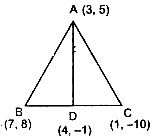
Slope of $AD =\frac{y_2-y_1}{x_2-x_1}$
$=\frac{-1-5}{4-3}$
$=\frac{-6}{1}$ .
Slope of $AD =-6$
Now, the equation of median $AD$ is given by
$y - y_1 = m(x - x_1)$
$\therefore y - 5 = - 6(x - 3)$
$\therefore y - 5 = - 6x + 18$
$\therefore 6x + y - 5 - 18 = 0$
$\therefore 6x + y - 23 = 0$ View full question & answer→Question 284 Marks
Find the equations of the lines passing through point $(-2, 0)$ and equally inclined to the coordinate axes.
AnswerLet AB and CD be two equally inclined lines.
For line AB:
Slope = m = tan $45° = 1$
$(x_1, y_1) = (−2, 0)$
Equation of the line AB is:
$y-y_1=m(x-x_1)$
$y - 0 = 1(x + 2)$
$y = x + 2$ For line CD:
Slope = m = tan (−45o) = −1
$(x_1, y_1) = (−2, 0)$
Equation of the line CD is:
$y-y_1=m(x-x_1)$
$y − 0 = -1(x + 2)$
$y = −x − 2$
$x + y + 2 = 0$
View full question & answer→Question 294 Marks
In triangle $ABC,$ the co-ordinates of vertices $A, B$ and $C$ are $(4, 7), (-2, 3)$ and $(0, 1)$ respectively.
Find the equation of median through vertex $A.$
Also, find the equation of the line through vertex $B$ and parallel to $AC.$
AnswerGiven, the co-ordinates of vertices $A, B$ and $C$ of a triangle $ABC$ are $(4, 7), (-2, 3)$ and $(0, 1)$ respectively.
Let $AD$ be the median through vertex $A.$
Co-ordinates of the point $D$ are
$\left(\frac{-2+0}{2}, \frac{3+1}{2}\right)$
$(-1,2)$
$\therefore$ Slope of $A D=\frac{2-7}{-1-4}=\frac{-5}{-5}=1$
The equation of the median $AD$ is given by:
$y − y_1 = m (x − x_1)$
$y − 2 = 1(x + 1)$
$y − 2 = x + 1$
$y = x + 3$
The slope of the line which is parallel to line $AC$ will be equal to the slope of $AC.$
Slope of $A C=\frac{1-7}{0-4}=\frac{-6}{-4}=\frac{3}{2}$
The equation of the line which is parallel to $AC$ and passes through $B$ is given by:
$y − 3 =3/2(x + 2)$
$2y − 6 = 3x + 6$
$2y = 3x + 12$
View full question & answer→Question 304 Marks
(−2, 4), B (4, 8), C (10, 7) and D (11, -5) are the vertices of a quadrilateral. Show that the quadrilateral, obtained on joining the mid-points of its sides, is a parallelogram.
AnswerLet the given points be A (- 2, 4), B (4, 8), C (10, 7) and D (11, - 5).
Let P, Q, R and S be the mid-points of AB, BC, CD and DA respectively.
Co-ordinates of $P$ are $\left(\frac{-2+4}{2}, \frac{4+8}{2}\right)=(1,6)$
Co-ordinates of $Q$ are $\left(\frac{4+10}{2}, \frac{8+7}{2}\right)=\left(7, \frac{15}{2}\right)$
Co-ordinates of $R$ are $\left(\frac{10+11}{2}, \frac{7-5}{2}\right)=\left(\frac{21}{2}, 1\right)$
Co-ordinates of $S$ are $\left(\frac{-2+11}{2}, \frac{4-5}{2}\right)=\left(\frac{9}{2}, \frac{-1}{2}\right)$
Slope of $P Q=\frac{\frac{15}{2}-6}{7-1}=\frac{\frac{15-12}{2}}{6}=\frac{3}{12}=\frac{1}{4}$
Slope of RS $=\frac{\frac{-1}{2}-1}{\frac{9}{2}-\frac{21}{2}}=\frac{\frac{-1-2}{2}}{\frac{9-21}{2}}=\frac{-3}{-12}=\frac{1}{4}$
Since, slope of PQ = Slope of RS, PQ ∥ RS.
Slope of QR $=\frac{1-\frac{15}{2}}{\frac{21}{2}-7}=\frac{\frac{2-15}{2}}{\frac{21-14}{2}}=-\frac{13}{7}$
Slope of SP $=\frac{6+\frac{1}{2}}{1-\frac{9}{2}}=\frac{\frac{12+1}{2}}{\frac{2-9}{2}}=-\frac{13}{7}$
Since, slope of QR = Slope of SP, QR || SP.
Hence, PQRS is a parallelogram.
View full question & answer→Question 314 Marks
Show that $A(3, 2), B (6, −2)$ and $C (2, −5)$ can be the vertices of a square.
$(i)$ Find the co-ordinates of its fourth vertex $D, $ if $\text{ABCD}$ is a square
$(ii)$ Without using the co$-$ordinates of vertex $D,$ find the equation of side $AD$ of the square and
also the equation of diagonal $BD.$
AnswerUsing distance formula, we have:
$A B=\sqrt{(6-3)^2}+(-2-2)^2=\sqrt{9+16}=5$
$B C=\sqrt{(2-6)^2+\left(-5+2^2\right)}=\sqrt{16+9}=5$
Thus, $AC = BC$
Also, Slope of $AB=\frac{-2-2}{6-3}=\frac{-4}{3}$
Slope of $B C=\frac{-5+2}{2-6}=\frac{-3}{-4}=\frac{3}{4}$
Slope of $AB \times$ Slope of $BC = - 1$
Thus, $AB \perp BC$
Hence, $A, B, C$ can be the vertices of a square$…..$
$(i)$ Slope of $A B=\frac{-2-2}{6-3}$ Slope of $C D$
Equation of the line $CD$ is
$y - y_1 = m (x -x_1)$
$\Rightarrow y + 5 = (-4)$
$\Rightarrow 3y + 15 = -4x +$
$\Rightarrow 4x + 3y = -7 .........(1)$
Slope of $B C=\left(\frac{-5+2}{2-6}\right)=\frac{-3}{-4}=\frac{3}{4}$ slope of $A D$
Equation of the line $AD$ is
$y - y_1 = m (x - x_1)$
$\Rightarrow y-2=\frac{3}{4}(x-3)$
$\Rightarrow 4 y-8=3 x-9$
$\Rightarrow 3 x-4 y=1......(2)$
Now, $D$ is the point of intersection of $CD$ and $AD.$
$(1) \Rightarrow 16x + 12y = -28$
$(2) \Rightarrow 9x -12y = 3$
Adding the above two equations we get,
$25x = -25$
$\Rightarrow x =-1$
so, $4y = 3x -1 = -3 -1= -4$
$\Rightarrow y = − 1$
Thus, the co$-$ordinates of point $D$ are $(−1, −1).$
$(ii)$ The equation of line $AD$ is found in part $(i)$
It is $3x – 4y =1$ Or $4y = 3x – 1$
Slope of $B D=\frac{-1+2}{-1-6}=\frac{1}{-7}=\frac{-1}{7}$
The equation of diagonal $BD$ is
$y - y_1 = m(x - x_1 )$
$\Rightarrow y+1=\frac{-1}{7}(x+1)$
$\Rightarrow 7y + 7 = -x -1$
$\Rightarrow x + 7y + 8 = 0$
View full question & answer→Question 324 Marks
Given equation of line $L_1$ is $y = 4.$
$(i)$ Write the slope of line $L_2$ if $L_2$ is the bisector of angle $O.$
$(ii) $write the co$-$ordinates of point $P.$
$(iii)$ Find the equation of $L_2$
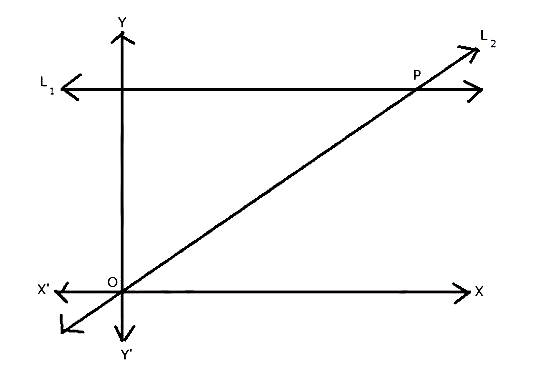
Answer$(i)$ Equation of line $L_1$ is $y = 4$
$\because L_2$ is the bisector of $\angle O$
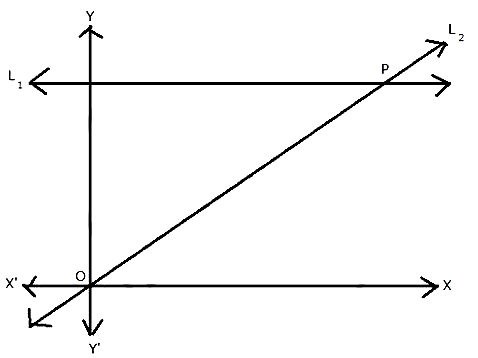
$\therefore \angle POX = 45^\circ$
Slope $= \tan 45^\circ = 1 ...(i)$
Let coordinates of $P$ be $(x, y)$
$\because P$ lies on $L_1$
$(ii) \therefore$ Slope of $L _2=\frac{ y _2- y _1}{x_2-x_1}$
$1=\frac{4-0}{x-0}$
$\Rightarrow 1=\frac{4}{x} .$
from equation $(i) (ii)$
$1=\frac{4}{x}$
$\Rightarrow x = 4$
$\therefore$ Coordinates of $P$ are $(4, 4)$
$(iii)$ Equation of $L_2$ is
$y – y_1 = m (x – x_1)$
$\Rightarrow y – 4 = 1 (x - 4)$
$\Rightarrow y – 4 = x – 4$
$\Rightarrow x = y$ View full question & answer→Question 334 Marks
$\ce{ABCD}$ is a parallelogram where $A(x, y), B (5, 8), C (4, 7)$ and $D (2, -4).$ Find :
$(i)$ co $-$ ordinates of $A.$
$(ii)$ equation of diagonal $BD$
Answer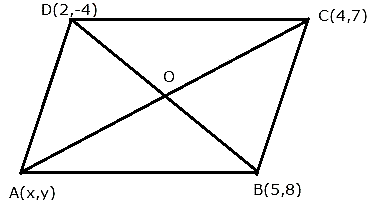
In parallelogram $\text{ABCD}, A (x, y), B(5, 8), C(4, 7)$ and $D(2, -4).$
The diagonals of the parallelogram bisect each other.
$O$ is the point of intersection of $AC$ and $BD$ Since $O$ is the midpoint of $BD,$ its coordinates will be
$O \left(\frac{2+5}{2}, \frac{-4+8}{2}\right)$
i.e. $O \left(\frac{7}{2}, \frac{4}{2}\right)$
i.e. $O \left(\frac{7}{2}, 2\right)$
Now, $O \left(\frac{x+4}{2}, \frac{ y +7}{2}\right)$
$(i)$ Since $O$ is the midpoint of $AC$ also,
$\therefore \frac{x+4}{2}=\frac{7}{2}$
$\Rightarrow x+4=7$
$\Rightarrow x=7-4$
$\therefore x=3$
$\frac{y+7}{2}=2$
$\Rightarrow y+7=4$
$\Rightarrow y=4-7$
$\therefore y=-3$
Thus, Coordinates of $A$ are $(3, 7)$
$\text { (ii) } \frac{y-y_1}{y_2-y_1}=\frac{x-x_1}{x_2-x_1}$
$\Rightarrow y-y_1=\frac{\left(y_2-y_1\right)}{\left(x_2-x_1\right)} \times\left(x-x_1\right.$
$\Rightarrow y+4=\frac{8+4}{5-2} \times(x-2)$
$\Rightarrow y+4=\frac{12}{3} \times(x-2)$
$\Rightarrow y+4=4(x-2)$
$\Rightarrow y+4=4 x-8$
$\Rightarrow 4 x-y=12$ View full question & answer→