Questions

[3 marks sum]

🎯

Test yourself on this topic

12 questions · timed · auto-graded

Question 13 Marks
Using factor theorem, show that $(x - 3)$ is a factor of $x^3 - 7x^2 + 15x - 9$, Hence, factorise the given expression completely.
Answer
Let $p(x) = x^3 - 7x^2 + 15x - 9$
For checking that (x - 3) is a factor of p(x), we find : p(3)
$p(3) = (3)^3 - 7(3)^2 + 15(3) - 9$
$= 27 - 63 + 45 - 9$
$= 72 - 72$
$= 0.$
Hence, $(x - 3)$ is a factor of p(x).
By division of $p(x)$ by $x - 3$, we get the quotient
$= x^2 - 4x + 3$
$\therefore x^3 - 7x^2 +15x - 9$
$= (x - 3) (x^2 - 4x + 3)$
$= (x - 3) (x - 3) (x - 1)$
$= (x - 3)^2 (x - 1).$
View full question & answer
Question 23 Marks
Show that $2x + 7$ is a factor of $2x^3 + 5x^2 - 11 x - 14.$ Hence factorise the given expression completely, using the factor theorem.
Answer
If $2 x+7$ in factor of $2 x^3+5 x^2-11 x-14$ then on putting $2 x+7=0$
$x=-\frac{7}{2} $
$f\left(-\frac{7}{2}\right)=0 $
$=2\left(-\frac{7}{2}\right)^3+5\left(-\frac{7}{2}\right)^2-11\left(\frac{7}{2}\right)-14 $
$ =\frac{-343}{4}+\frac{245}{4}+\frac{77}{4}-14 $
$=\frac{-399}{4}+\frac{245+154}{4} $
$=\frac{-399+399}{4}=0$
Hence $2 x+7$ is one factor.
$\text { Now } 2 x^3+5 x^2-11 x-14 $
$=x^2(2 x+7)-x(2 x+7)-2(2 x+7)$
$=(2 x+7)\left(x^2-x-2\right)$
$=(2 x+7)\left(x^2+x-2 x-2\right) $
$=(2 x+7)[x(x+1)-2(x+1)] $
$=(2 x+7)(x-2)(x+1)$
View full question & answer
Question 33 Marks
Show that $x^2 - 9$ is factor of $x^3 + 5x^2 - 9x - 45.$
Answer
We know that
$x^2 - 9 = (x + 3)(x - 3)$
$x^2 - 9$ will be a factor of
$f(x) = x^3+ 5x^2 - 9x - 45$
Only when both $x + 3$ are factor of this polynomial.
Now, $f(-3) = (-3)^3 + 5(-3)^2-9(-3) -45$
$= -27 + 45 + 27 - 45 = 0$
And $f(3) = (3)^3 + 5(3)^2 - 9(3) -45$
$= 27 + 45 - 27 - 45 = 0$
So, both $x + 3$ and $x - 3$ are factor of $x^3 + 5x^2 - 9x - 45.$
Hence, $x^2 - 9$ is a factor of the given polynomial.
View full question & answer
Question 43 Marks
Find the value of a and b so that the polynomial $x^3 - ax^2 - 13x + b$ has $(x - 1) (x + 3)$ as factor.
Answer
Let $p(x) = x^3- ax^2 - 13x + b$ be the given polynomial.
If $(x - 1)$ and $(x + 3)$ are the factors of p(x) then
$p(1) = 0$
and $p(-3) = 0$
$p(1) = (1)^3 - a(1)^2 - 13(1) + b = 0$
$= 1 - a - 13 + b = 0$
$a - b = -12 ...(1)$
$p(-3) = (-3)^3 - a(-3)^2 - 13(-3) + b = 0$
$= -27 - 9a + 39 + b = 0$
$9a - b = 12 ...(2)$
Solving (1) and (2) we get
$a = 3$
and $b = 15.$
View full question & answer
Question 53 Marks
If $x – 2$ is a factor of $2x^3 - x^2 - px - 2.$
with the value of p, factorize the above expression completely.
Answer
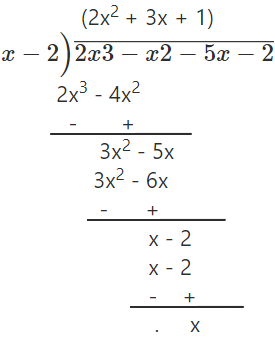
Given expression is $2x^3 - x^2- px - 2$ and $x - 2$ is the factor.
Putting the value of $P$
Image
$\therefore 2x^3 - x^2- 5x - 2 = (x - 2) (2x^2 + 3x + 1)$
The expression can be the written as
$(2x^2 + 3x + 1) (x - 2)$ or $(2x + 1) (x + 1) (x -2).$
View full question & answer
Question 63 Marks
If $x – 2$ is a factor of each of the following three polynomials. Find the value of $‘a’$ in each case:
$x^5 - 3x^4 - ax^3 + 3ax^2 + 2ax + 4.$
Answer
Let $p(x) = x^5 - 3x^4 - ax^3 + 3ax^2 + 2ax + 4 ...(i)$
Since, $(x - 2)$ is facxtor of $p(x),$ so $p(2) = 0$
Put $x = 2$ in equation (i) we get
$p(2) = (2)^5 - 3(2)^4 -a(2)^3 + 3a(2)^2 + 2a(2) + 4$
$= 32 - 3 x 16 - a x 8 + 3a x 4 + 4a + 4$
$= 32 - 48 - 8a + 12a + 4a + 4$
$= 8a - 12$
But $p(2) = 0$
$\Rightarrow 8a = 12 = 0$
$\Rightarrow a =\frac{12}{8}$
$\Rightarrow a =\frac{3}{2}$
View full question & answer
Question 73 Marks
If $x – 2$ is a factor of each of the following three polynomials. Find the value of $‘a’$ in each case:
$x^3 + 2ax^2 + ax - 1$
Answer
Let $p(x) x^3 + 2ax^2 + ax - 1 ...(i)$
Since, $(x - 2)$ is a factor of $p(x)$, so $p(2) = 0$
Put $x = 2$ in equation (i), we get
$p(2) = (2)^3 - 2a(2)^2 + a(2) -1$
$= 8 - 2a x 4 + 2a - 1$
$= 8 - 8a + 2a -1$
$= 7 - 6a$
But $p(2) = 0$
$7 - 6a = 0$
$\Rightarrow -6a = -7$
$\Rightarrow a =\frac{+7}{+6}$
$\Rightarrow a =\frac{7}{6}$
View full question & answer
Question 83 Marks
If $x – 2$ is a factor of each of the following three polynomials. Find the value of $‘a’$ in each case:
$x^2 - 3x + 5a$
Answer
Let $p(x) = x^2 - 3x + 5a ...(i)$
Since, $(x - 2)$ is a factor of $p(x)$, so $p(2) = 0$ ...(by factor theorem)
Put $x = 2$ in equation (i), we get
$p(2) = (2)^2 - 3 x 2 + 5a$
$= 4 - 6 + 5a$
$= 5a - 2$
But $p(2) = 0$
$\Rightarrow 5a -2 = 0$
$\Rightarrow 5a = 2$
$\Rightarrow a =\frac{2}{5}$
View full question & answer
Question 93 Marks
If $p(x) = 4x^3 - 3x^2 + 2x - 4$ find the remainderwhen $p(x)$ is divided by:
$x+\frac{1}{2}$.
Answer
$p(x)=4 x^3-3 x^2+2 x-4$ .... (i)
By the remainder theorem the required remainder
$= p \left(-\frac{1}{2}\right) \text {. }$
Put $x=\left(-\frac{1}{2}\right)$ in equation (i) we get
$ p\left(-\frac{1}{2}\right)=4\left(-\frac{1}{2}\right)^3-3\left(-\frac{1}{2}\right)^2+2\left(-\frac{1}{2}\right)-4$
$=4 \times\left(\frac{1}{8}\right)-3 \times \frac{1}{4}+2 \times\left(-\frac{1}{2}\right)-4$
$=-\frac{1}{2}-\frac{3}{4}-1-4$
$=\frac{-2-3-4-16}{4}$
$=-\frac{25}{4} $
Hence, the remainder is $-\frac{25}{4}$.
View full question & answer
Question 103 Marks
Given that $x + 2$ and $x + 3$ are factors of $2x^3 + ax^2 + 7x - b$. Determine the values of $a$ and $b$.
Answer
If $x + 2$ is a factor is $2x^3 + ax^2 + 7x - b$ then $x + 2 = 0, x = -2$ in equation
$2(-2)^3 + a (-2)^2+ 7(-2) - b = 0$
$2(-8) + a(4) + 7(-2) - b = 0$
$-16 + 4a - 14 - b = 0$
$4a - b = 30 ...(1)$
Also given that $x + 3$ is a factor of
$2x^3+ ax^2 + 7x - b$, then $x + 3 = 0$
$x = -3$ in equation
$2(-3)^3+ a(-3)^2 + 7(-3) - b = 0$
$2(-27) + a(9) + 7(-3) - b = 0$
$-54 + 9a - 21 - b = 0$
$9a - b = 75 ...(2)$
Solving (1) and (2) we get
$a = 9, b = 6.$
View full question & answer
Question 113 Marks
In the following two polynomials. Find the value of ‘a’ if $x + a$ is a factor of each of the two:
$x^3+ ax^2 - 2x + a + 4$
Answer
Let $p(x) = x^3 + ax^2 - 2x + a + 4 ...(i)$
Since, $(x + a)$ is a factor of $p(x)$, so $p(-a) = 0$
Put $x = -a$ in equation (i), we get
$p(-a) = (-a)^3 + a(-a)^2 -2(-a) + a + 4$
$= -a^3 + a(a^2) + 2a + a + 4$
$= -a^3 + a^3 + 3a + 4$
$= 3a + 4$
But $p(-a) = 0$
$\Rightarrow 3a + 4 = 0$
$\Rightarrow 3a = -4$
$\Rightarrow a =-\frac{4}{3}$.
View full question & answer
Question 123 Marks
Show that $(x - 1)$ is a factor of $x^3 - 7x^2 + 14x - 8$. Hence, completely factorise the above expression.
Answer
If $(x - 1)$ is a factor of $x^3 - 7x^2 + 14x - 8$ then on putting $x - 1 = 0$
$x = 1$
$f(1) = 0$
$= 1^3 - 7(1)^2 + 14(1) - 8$
$= 1 - 7 + 14 - 8 = 0$
Hence, $x - 1$ is one factor.
To find other factors
$= x^3 - 7x^2 + 14x - 8$
$= x^2(x - 1) - 6x(x - 1) + 8(x - 1)$
$= (x - 1) (x^2 - 6x + 8)$
$= (x - 1) (x^2 - 4x - 2x + 8)$
$= (x - 1) {x(x - 4) - 2(x - 4)}$
$= (x - 1) (x - 2) (x - 4).$
View full question & answer
[3 marks sum] - Mathematics STD 10 Questions - Vidyadip