Questions

[4 marks sum]

🎯

Test yourself on this topic

3 questions · timed · auto-graded

Question 14 Marks
If $(x-2)$ is a factor of the expression $2 x^3+a x^2+b x-14$ and when the expression is divided by $(x-3)$, it leaves a remainder 52 , find the values of $a$ and $b$.
Answer
Let $f(x)=2 x^3+a x^2+b x-14.....(1)$
as $(x-2)$ is factor of $(1)$
Put $x-2=0$
$\Rightarrow x = 2 in (1)$
$f(2) = 2(2)^3 + a(2)^2 + b(2) - 14$
$0 = 16 + 4a + 2b - 14$
or
$4a + 2b = -2$
$or 2a + b = -1 ...(2)$
Again when f(x) is divided by $(x - 3)$, it leaves remainder $52$
Put $x - 3 = 0$
$\Rightarrow x = 3$
$f(3) = 2(3)^3+ a(3)^2 + b(3) - 14$
$52 = 54 + 9a + 3b - 14$
$52 = 9a + 3b + 40$
$52 - 40 = 9a + 3b$
$\Rightarrow 12 = 9a + 3b$
or
$4 = 3a + b ...(3)$
Solving $(2)$ and $(3)$
$3a + b = 4$
$2a + b = -1$
Sub $- - +$
$a = 5$
Substitute $a = 5$ in $3a + b = 4$
$\Rightarrow 3 x 5 + b = 4$
$15 + b = 4$
$\Rightarrow b = 4 - 15$
$b = -11.$
View full question & answer
Question 24 Marks
Find the value of the constant a and b, if $(x – 2)$ and $(x + 3)$ are both factors of expression $x^3 + ax^2 + bx - 12.$
Answer
Expression $x^3+a x^2+b x-12$
$(x-2)$ is a factor i.e, at $x=2$
the remainder will be xero
$\Rightarrow (2)^3 + a(2)^2 + b(2) - 12 = 0$
$\Rightarrow 8 + 4a + 2b - 12 = 0$
$\Rightarrow 4a + 2b = 4$
$\Rightarrow 2a + b = 2 ...(i)$
when $x+3$ is a factor i.e., at $x=-3$ the remainder will be zero.
$\Rightarrow (-3)^3 + a(-3)^2 + b(-3) -12 = 0$
$\Rightarrow -27 + 9a - 3b - 12 = 0$
$\Rightarrow 9a - 3b = 39$
$\Rightarrow 3a - b = 13 ...(ii)$
Solving $(i)$ and $(ii)$ simultaneously
$2a + b = 2$
By adding
$3a - b = 13$
$5a = 15$
$a = 3$
Substituting the value of a in the equation $(i)$
$\Rightarrow 2 x 3 + b = 2$
$\Rightarrow 6 + b = 2$
$\Rightarrow b = 2 - 6 = -4$
$\Rightarrow a = 3, b = -4.$
View full question & answer
Question 34 Marks
The expression $2x^3 + ax^2 + bx - 2$ leaves the remainder $7$ and $0$ when divided by $(2x - 3)$ and $(x + 2)$ respectively calculate the value of $a$ and $b$. With these value of $a$ and $b$ factorise the expression completely.
Answer
Let $P(x) = 2x^3 + ax^2 + bx - 2$
when $P(x)$ is divided by $2x - 3$
$P\left(\frac{3}{2}\right)=2\left(\frac{3}{2}\right)^3+a\left(\frac{3}{2}\right)^2+b\left(\frac{3}{2}\right)-2=7$
$=\frac{27}{4}+\frac{9}{4} a+\frac{3}{2} b-2=7$
$=\frac{27+9 a+6 b^2-8}{4}=7$
$= 9a + 6b = 28 + 8 - 27$
$= 9a + 6b = 9$
$\Rightarrow 3a + 2b = 3 ...(1)$
Similarly when $P(x)$ is divided by $x + 2$
$x = -2$
$2(-2)^3 + a(-2)^2 + b(-2) -2 = 0$
$-16 + 4a - 2b - 2 = 0$
$\Rightarrow 4a - 2b = 18 ...(2)$
On Solving equation $(1)$ and $(2)$
$3a + 2b = 3$
$4a - 2b = 18$
$7a = 21$
$a = 3$
On substituting value of a in equation $(1)$
$3 x 3 + 2b = 3$
$2b = 3 - 9$
$b=\frac{-6}{2}$
$= -3$
$b = -3$
$a = 3, b = -3$
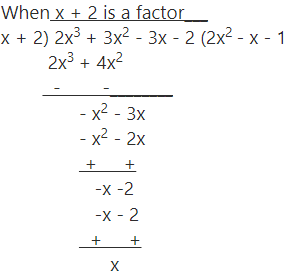
On substituting value of $a$ and $b$
$2x^3 + 3a^2 - 3x - 2$
Image
$2x^2 - x - 1$
$= 2x^2 - 2x + x - 1$
$= 2x(x - 1) + 1(x - 1)$
$(x - 1) (2x + 1)$
Hence required factors are
$(x - 1) (x + 2) (2x + 1).$
View full question & answer
[4 marks sum] - Mathematics STD 10 Questions - Vidyadip