Question 15 Marks
The expression $2 x^3+a x^2+b x-2$ leaves the remainder $7$ and $0$ when divided by $(2 x-3)$ and $(x+2)$ respectively calculate the value of $a$ and $b$. With these value of $a$ and $b$ factorise the expression completely.
Answer
View full question & answer→Let $P(x) = 2x^3 + ax^2 + bx - 2$
when P(x) is divided by $2x - 3$
$P\left(\frac{3}{2}\right)=2\left(\frac{3}{2}\right)^3+a\left(\frac{3}{2}\right)^2+b\left(\frac{3}{2}\right)-2=7$
$=\frac{27}{4}+\frac{9}{4} a+\frac{3}{2} b-2=7$
$=\frac{27+9 a+6 b^2-8}{4}=7$
$= 9a + 6b = 28 + 8 - 27$
$= 9a + 6b = 9$
$\Rightarrow 3a + 2b = 3 ...(1)$
Similarly when P(x) is divided by $x + 2$
$x = -2$
$2(-2)^3 + a(-2)^2 + b(-2) -2 = 0$
$-16 + 4a - 2b - 2 = 0$
$\Rightarrow 4a - 2b = 18 ...(2)$
On Solving equation $(1)$ and $(2)$
$3a + 2b = 3$
$4a - 2b = 18$
$7a = 21$
$a = 3$
On substituting value of a in equation $(1)$
$3 x 3 + 2b = 3$
$2b = 3 - 9$
$b=\frac{-6}{2}$
$= -3$
$b = -3$
$a = 3, b = -3$
On substituting value of a and b
$2x^3 + 3a^2 - 3x - 2$
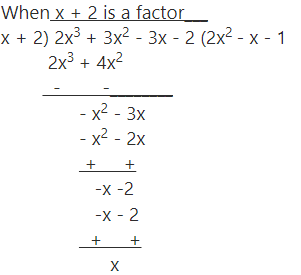
$2x^2 - x - 1$
$= 2x^2 - 2x + x - 1$
$= 2x(x - 1) + 1(x - 1)$
$(x - 1) (2x + 1)$
Hence required factors are
$(x - 1) (x + 2) (2x + 1).$
when P(x) is divided by $2x - 3$
$P\left(\frac{3}{2}\right)=2\left(\frac{3}{2}\right)^3+a\left(\frac{3}{2}\right)^2+b\left(\frac{3}{2}\right)-2=7$
$=\frac{27}{4}+\frac{9}{4} a+\frac{3}{2} b-2=7$
$=\frac{27+9 a+6 b^2-8}{4}=7$
$= 9a + 6b = 28 + 8 - 27$
$= 9a + 6b = 9$
$\Rightarrow 3a + 2b = 3 ...(1)$
Similarly when P(x) is divided by $x + 2$
$x = -2$
$2(-2)^3 + a(-2)^2 + b(-2) -2 = 0$
$-16 + 4a - 2b - 2 = 0$
$\Rightarrow 4a - 2b = 18 ...(2)$
On Solving equation $(1)$ and $(2)$
$3a + 2b = 3$
$4a - 2b = 18$
$7a = 21$
$a = 3$
On substituting value of a in equation $(1)$
$3 x 3 + 2b = 3$
$2b = 3 - 9$
$b=\frac{-6}{2}$
$= -3$
$b = -3$
$a = 3, b = -3$
On substituting value of a and b
$2x^3 + 3a^2 - 3x - 2$
$2x^2 - x - 1$
$= 2x^2 - 2x + x - 1$
$= 2x(x - 1) + 1(x - 1)$
$(x - 1) (2x + 1)$
Hence required factors are
$(x - 1) (x + 2) (2x + 1).$