Question 13 Marks
By factor theorem, show that $(x + 3)$ and $(2x – 1)$ are factors of $2x^2 + 5x – 3.$
AnswerLet $x+3=0$ then $x=-3$
Substituting the value of $x$ in $f(x)$
$
\begin{aligned}
& f(x)=2 x^2+5 x-3=2(-3)^2+5(-3)-3 \\
& f(-3)=18-15-3=0 \\
& \because \text { Remainder }=0
\end{aligned}
$
then $x+3$ is a factor
Again let $2 x-1=0$,
$
\text { then } x=\frac{1}{2}
$
Substituting the value of $x$ in $f(x)$,
$
\begin{aligned}
& f(x)=2 x^2+5 x-3 \\
& f\left(\frac{1}{2}\right)=2\left(\frac{1}{2}\right)^2+5\left(\frac{1}{2}\right)-3 \\
& =2 \times \frac{1}{4}+\frac{5}{2}-3 \\
& =\frac{1}{2}+\frac{5}{2}-3=0
\end{aligned}
$
$\because$ Remainder $=0$,
$\therefore 2 x-1$ is also a factor
Hence proved.
View full question & answer→Question 23 Marks
Find ‘a’ if the two polynomials $ax^3 + 3x^2 – 9 $ and $2x^3 + 4x + a$, leaves the same remainder when divided by $x + 3.$
AnswerFind ' $a$ ' if the two polynomials $a x^3+3 x^2-9$ and $2 x^3+4 x+a$, leaves the same remainder when divided by $x+3$.
The given polynomials are $a x^3+3 x^2-9$
and $2 x^3+4 x+a$
Let $p(x)=a x^3+3 x^2-9$
and $q(x)=2 x^3+4 x+a$
Given that $p(x)$ and $q(x)$ leave the same
remainder when divided by $(x+3)$,
Thus by Remainder Theorem, we have
$p(–3) = q(–3)$
$\Rightarrow a(–3)^3 + 3(–3)^2 - 9 = 2(–3)^3 + 4(–3) + a$
$\Rightarrow –27a + 27 – 9 = –54 – 12 + a$
$\Rightarrow –27a + 18 = –66 + a$
$\Rightarrow –27a - a = –66 – 18$
$\Rightarrow -28a = –84$
$\Rightarrow a=\frac{84}{28}$
$\therefore a=3 .$
View full question & answer→Question 33 Marks
QUESIION When divided by $x-3$ the polynomials $x^2-p x^2+x+6$ and $2 x^3-x^2-(p+3) x-6$ leave the same remainder. Find the value of ' $p$ '
AnswerBy dividing
$
x^3-p x^2+x+6
$
and $2 x^3-x^2-(p+3) x-6$
by $x-3$, the remainder is same
Let $x-3=0$, then $x=3$
Now by Remainder Theorem,
$
\begin{aligned}
& \text { Let } p(x)=x^3-p x^2+x+6 \\
& p(3)=(3)^3-p(3)^2+3+6 \\
& =27-9 p+9 \\
& =36-9 p
\end{aligned}
$
and $q(x)=2 x^3-x^2-(p+3) x-6$
$q(3)=2(3)^2-(3)^2-(3)^2-(p+3) \times 3-6$
$=2 \times 27-9-3 p-9-6$
$=54-24-3 p$
$
=30-3 p
$
$\because$ The remainder in each case is same
$
\begin{aligned}
& \therefore 36-9 p=30-3 p \\
& 36-30=9 p-3 p \\
& \Rightarrow 6=6 p \\
& \Rightarrow p=\frac{6}{6}=1 \\
& \therefore p=1 .
\end{aligned}
$
View full question & answer→Question 43 Marks
$(x-2)$ is a factor of the expression $x^3+a x^2+b x+6$. When this expression is divided by $(x-3)$, it leaves the remainder 3 . Find the values of $a$ and $b$.
AnswerAs $x – 2$ is a factor of
$f(x) = x^3 + ax^2 + bx + 6$
$\therefore f(2) = 0$
$\therefore (2)^3 + a(2)^2 + b(2) + 6 = 0$
$\Rightarrow 8 + 4a + 2b + 6 = 0$
$\Rightarrow 4a + 2b = –14$
$\Rightarrow 2a + b = –7 ....(i)$
as on dividing f(x) by$ x – 3$
remainder $= 3$
$\therefore f(3) = 3$
$\therefore (3)^3 + a(3)^2 + b(3) + 6 = 3$
$\Rightarrow 27 + 9a + 3b + 6 = 3$
$\Rightarrow 9a + 3b = –30$
$\Rightarrow 3a + b = –10 ....(ii)$
Solving simultaneously equation (i) and (ii),
$\therefore 2a + b = –7$
$3a + b – 10$
Subtracting $– – +$
$–a = 3 $
$a = –3$
Subtracting value of a in equation (i)
$2(–3) + b = –7$
$\therefore –6 + b = –7$
$\therefore b = –1$
$\therefore a = –3, b = –1.$
View full question & answer→Question 53 Marks
Find the value of the constants $a$ and $b$, if $(x-2)$ and $(x+3)$ are both factors of the expression $x^3+a x^2+b x-12$.
AnswerLet $x – 2 = 0$, then $x = 0$
Substituting value of x in f$(x)$
$f(x) = x^3 + ax^2 + bx – 12$
$f(2) = (2)^3 + a(2)^2 + b(2) – 12$
$= 8 + 4a + 2b – 12$
$= 4a + 2b – 4$
$\because x – 2$ is a factor
$\therefore 4a + 2b – 4 = 0$
$\Rightarrow 4a + 2b = 4$
$\Rightarrow 2a + b = 2$
Again let $x + 3 = 0,$
then $x = –3$
Substituting the value of x in $f(x)$
$f(x) = x^3 + ax^2 + bx – 12$
$= (–3)^3+ a(–3)^2 + b(–3) – 12$
$= –27 + 9a – 3b – 12$
$= –39 + 9a – 3b$
$\because x + 3$ is a factor of $f(x)$
$\therefore –39 + 9a – 3b = 0$
$\Rightarrow 9a – 3b = 39$
$\Rightarrow 3a – b = 13$
Adding (i) and$ (ii)$
$5a = 15$
$\Rightarrow a = 3$
Substituting the value of a in $(i)$
$2(3) + b = 2$
$\Rightarrow 6 + b = 2$
$\Rightarrow b = 2 – 6$
$\therefore b = –4$
Hence $a = 3, b = –4.$
View full question & answer→Question 63 Marks
What number should be subtracted from $2 x^3-5 x^2+5 x$ so that the resulting polynomial has $2 x-3$ as a factor?
AnswerLet the number to be subtracted be $k$ and the resulting polynomial be $f(x)$, then
$
f(x)=2 x^3-5 x^2+5 x-k
$Since, $2 x-3$ is a factor of $f(x)$,
Now, converting $2 x -3$ to factor theorem
$
\begin{aligned}
& f\left(\frac{3}{2}\right)=0 \\
& \Rightarrow 2 x ^3-5 x ^2+5 x - k =0 \\
& \Rightarrow 2\left(\frac{3}{2}\right)^3-5\left(\frac{3}{2}\right)^2+5\left(\frac{3}{2}\right)-k=0 \\
& \Rightarrow 2 \times \frac{27}{8}-5 \times \frac{9}{4}+5 \times \frac{3}{2}-k=0 \\
& \Rightarrow \frac{27}{4}-\frac{45}{4}+\frac{15}{2}-k=0 \\
& \Rightarrow 27-45+30-4 k =0 \\
& \Rightarrow-4 k +12=0 \\
& \Rightarrow k =\frac{-12}{-4} \\
& \Rightarrow k =3
\end{aligned}
$
View full question & answer→Question 73 Marks
If $( x -2)$ is a factor of $2 x ^3- x ^2+ px -2$, then
(i) find the value of $p$.
(ii) with this value of $p$, factorise the above expression completely
Answer(i) Let $x-2=0$,
then $x=2$
Now $f(x)=2 x^3-x^2+p x-2$
$
\begin{aligned}
& \therefore f (2)=2(2) 3-(2)^2+ p \times 2-2 \\
& =2 \times 8-4+2 p-2 \\
& =16-4+2 p-2 \\
& =10+2 p \\
& \text { (ii) } \therefore f (2)=0 \\
& \text { then } 10+2 p =0 \\
& \Rightarrow 2 p=-10 \\
& \Rightarrow p=-5
\end{aligned}
$
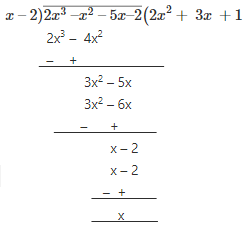
Now, the polynomial will be
$
\begin{aligned}
& 2 x^3-x^2-5 x-2 \\
& =(x-2)\left(2 x^2+3 x+1\right) \\
& =(x-2)\left[2 x^2+2 x+x+1\right] \\
& =(x-2)[2 x(x+1)+1(x+1)] \\
& =(x-2)(x+1)(2 x+1)
\end{aligned}
$
View full question & answer→Question 83 Marks
If $(3 x-2)$ is a factor of $3 x^3-k x^2+21 x-10$, find the value of $k$.
AnswerLet $3 x-2=0$,
then $3 x=2$
$
\Rightarrow x =\frac{2}{3}
$
Substituting the value of $x$ in $f(x)$,
$
\begin{aligned}
& f(x)=3 x^3-k x^2+21 x-10 \\
& f\left(\frac{2}{3}\right)=3\left(\frac{2}{3}\right)^3-k\left(\frac{2}{3}\right)^2+21\left(\frac{2}{3}\right)-10 \\
& =3 \times \frac{8}{27}-k \times \frac{4}{9}+21 \times \frac{2}{3}-10 \\
& =\frac{8}{9}-\frac{4 k}{9}+14-10 \\
& =\frac{8-4 k}{9}+4
\end{aligned}
$
$\because$ Remainder is 0
$
\begin{aligned}
& \frac{8-4 k}{9}+4=0 \\
& \Rightarrow 8-4 k +36=0 \\
& \Rightarrow-4 k +44=0 \\
& \Rightarrow 4 k =44 \\
& \therefore k =11 .
\end{aligned}
$
View full question & answer→Question 93 Marks
If $(2 x+1)$ is a factor of $6 x^3+5 x^2+a x-2$ find the value of $a$
AnswerLet $2 x+1=0$, then $x=-\frac{1}{2}$
Substituting the value of $x$ in $f(x)$,
$
\begin{aligned}
& f ( x )=6 x ^3+5 x ^2+ ax -2 \\
& f\left(-\frac{1}{2}\right)=6\left(-\frac{1}{2}\right)^3+5\left(-\frac{1}{2}\right)^2+a\left(-\frac{1}{2}\right)-2 \\
& =6\left(-\frac{1}{8}\right)+5\left(\frac{1}{4}\right)+a\left(-\frac{1}{2}\right)-2 \\
& =-\frac{3}{4}+\frac{5}{4}-\frac{a}{2}-2 \\
& =\frac{-3+5-2 a-8}{4} \\
& =\frac{-6-2 a}{4} \\
& \therefore 2 x +1 \text { is a factor of } f ( x ) \\
& \therefore \text { Remainder }=0 \\
& \therefore \frac{-6-2 a}{4}=0 \\
& \Rightarrow-6-2 a =0 \\
& \Rightarrow 2 a =-6 \\
& \Rightarrow a =-3 \\
& \therefore a =-3 .
\end{aligned}
$
View full question & answer→Question 103 Marks
Using the Remainder and Factor Theorem, factorise the following polynomial: $x^3+10 x^2-37 x+26$
View full question & answer→Question 113 Marks
Using the Remainder Theorem, factorise completely the following polynomial:
$3x^2 + 2x^2 – 19x + 6$
AnswerLet $f(x) = 3x^2 + 2x^2 – 19x + 6$
Using hit and trial method,
$f(1) = 3 + 2 – 19 + 6 \neq 0$
$f(−1) =–3 + 2 + 19 + 6 \neq 0$
$f(2) = 24 + 8 – 38 + 6 = 0$
Hence, (x – 2) is a factor of f(x)
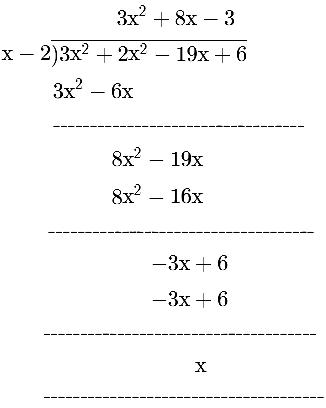
To factorise $3x^2+ 8x − 3$
$= 3x^2+ 9x − x − 3$
$= 3x(x + 3) −1(x + 3)$
$= (3x − 1)(x + 3)$
Hence $3x^3+ 2x^3−19x + 6 = (x − 2)(3x − 1)(x + 3)$ View full question & answer→Question 123 Marks
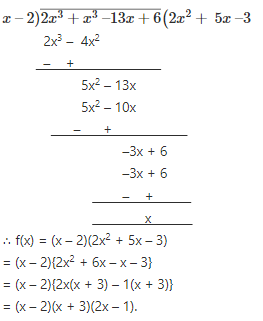
Use the Remainder Theorem to factorise the following expression: $2 x^3+x^2-13 x+6$.
AnswerLet $f(x)=2 x^3+x^2-13 x+6$
Factors of 6 are $\pm 1, \pm 2, \pm 3, \pm 6$
Let $x=2$, then
$
\begin{aligned}
& f(2)=2(2)^3+(2)^2-13 \times 2+6 \\
& =16+4-26+6 \\
& =26-26 \\
&
=0 \\
& \because f(2)=0
\end{aligned}
$
$\therefore x-2$ is the factor of $f(x)$...(By Remainder Theorem)
Dividing $f(x)$ by $x-2$, we get
View full question & answer→Question 133 Marks
Use factor theorem to factorise the following polynominals completely. $x^3 – 13x – 12.$
Answer$f(x)=x^3-13 x-12$
Let $x=4$, then
$ f(x)=(4)^3-13(4)-12$
$=64-52-12$
$=64-64$
$=0$
$\because f(x)=0$
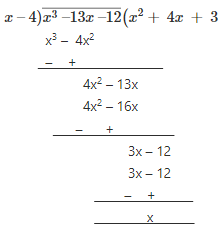
$\therefore x-4$ is a factor of $f(x)$
Now, dividing $f(x)$ by $(x-4)$, we get
$ f(x)=(x-4)\left(x^2+4 x+3\right)$
$=(x-4)\left(x^2+3 x+x+3\right)$
$=(x-4)[x(x+3)+1(x+3)]$
$=(x-4)(x+3)(x+1)$
View full question & answer→Question 143 Marks
Use factor theorem to factorise the following polynominals completely. $x^3 + 2x^2 – 5x – 6$
AnswerLet $f(x)=x^3+2 x^2-5 x-6$
Factors of ( $\because 6= \pm 1: \pm 2, \pm 3, \pm)$
Let $x=-1$, then
$ f(-1)=(-1)^3+2(-1)^2-5(-1)-6$
$=-1+2(1)+5-6$
$=-1+2+5-6$
$=7-7$
$=0$
$\because f(-1)=0$
$\therefore x+1$ is a factor of $f(x)$
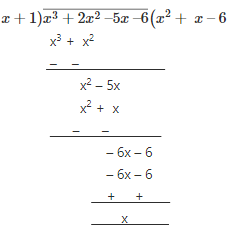
Now, dviding $f(x)$ by $x+1$, we get
$ f(x)=(x+1)\left(x^2+x-6\right)$
$=(x+1)\left(x^2+3 x-2 x-6\right)$
$=(x+1)\{x(x+3)-2(x+3)$
View full question & answer→Question 153 Marks
Show that $2x + 7$ is a factor of $2x^3 + 5x^2 – 11x – 14$. Hence factorise the given expression completely, using the factor theorem.
AnswerLet $2x + 7 = 0,$
then $2x = -7$
$x=\frac{-7}{2}$
substituting the value of x in f(x),
$f(x) = 2x^3 + 5x^2 – 11x – 14$
$f\left(-\frac{7}{2}\right)=2\left(-\frac{7}{2}\right)^3+5\left(-\frac{7}{2}\right)^2-11\left(-\frac{7}{2}\right)-14$
$=\frac{-343}{4}+\frac{245}{4}+\frac{77}{2}-14$
$=\frac{-343+245+154-56}{4}$
$=\frac{-399+399}{4}$
$=0$
Hence, (2x + 7) is a factor of f(x)
Proved.
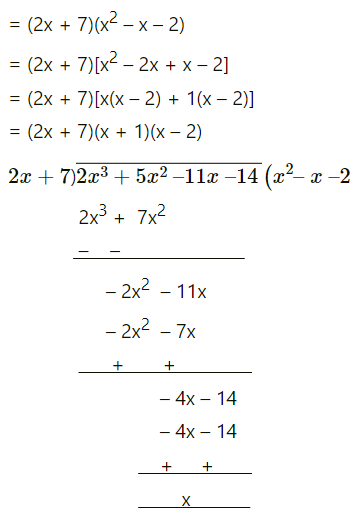
Now, $2x^3 + 5x^2 – 11x – 14$
$=(2 x+7)\left(x^2-x-2\right)$
$=(2 x+7)\left[x^2-2 x+x-2\right]$
$=(2 x+7)[x(x-2)+1(x-2)]$
$=(2 x+7)(x+1)(x-2)$
View full question & answer→Question 163 Marks
Show that $(2x + 1)$ is a factor of $4x^3 + 12x^2 + 11 x + 3$ .Hence factorise $4x^3 + 12x^2 + 11x + 3.$
AnswerLet $2x + 1 = 0,$
then $x =$
Substituting the value of x in f(x),
$f(x) = 4x^3 + 12x^2 + 11x + 3$
$f\left(-\frac{1}{2}\right)=4\left(-\frac{1}{2}\right)^3+12\left(-\frac{1}{2}\right)^2+11\left(-\frac{1}{2}\right)+3$
$=4\left(-\frac{1}{8}\right)+12\left(\frac{1}{4}\right)+11\left(-\frac{1}{2}\right)+3$
$=4 \frac{1}{2}+3-\frac{11}{2}+3$
$=(6)-(6)$
$=0$
$\because $ Remainder $= 0$
$\therefore 2x + 1$ is a factor of
$4x^3 + 12x^2 + 11x + 3$
Now dividing f(x) by $2x + 1,$ we get
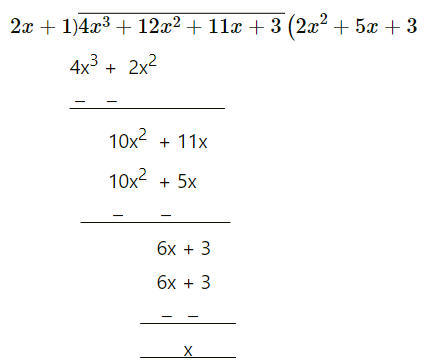
$\therefore 4x^3 + 12x^2 + 11x + 3$
$= (2x + 1)(2x^2 + 5x + 3)$
$= (2x + 1)(2x^2 + 2x + 3x + 3)$
$= (2x + 1)(2x(x + 1) + 3(x + 1)$
$= (2x + 1)((x + 1)(2x + 3))$
$= (2x + 1)(x + 1)(2x + 3).$ View full question & answer→Question 173 Marks
Show that $(x-3)$ is a factor of $x^3-7 x^2+15 x-9$. Hence factorise $x^3-7 x^2+15 x-9$
AnswerLet $x – 3 = 0$, then $x = 3,$
Substituting the value of x in $f(x),$
$f(x = x^3 - 7x^2 + 15x – 9$
$= (3)^3 – 7(3)^2 + 15(3) – 9$
$= 27 – 63 + 45 – 9$
$= 72 – 72$
$= 0$
$\because $ Remainder $= 0$
$\therefore x – 3$ is a factor of $x^3 – 7x^2 + 15x – 9$
Now dividing it by $x – 3$, we get
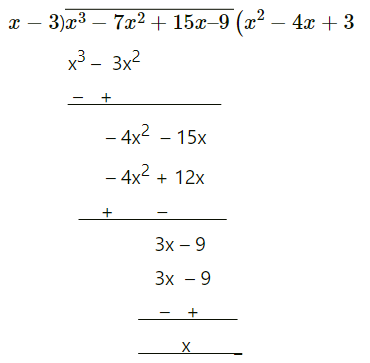
$\therefore x^3 – 7x^2 + 15x – 9$
$= (x – 3)(x^2 – 4x + 3)$
$= (x – 3)(x^2 – x – 3x + 3)$
$= (x – 3)(x(x – 1) – 3(x – 1))$
$= (x – 3)(x – 1)(x – 3)$
$= (x – 3)^2 (x – 1).$ View full question & answer→Question 183 Marks
Show that $(x-1)$ is a factor of $x^3-5 x^2-x+5$ Hence factorise $x^3-5 x^2-x+5$.
AnswerLet $x – 1 = 0$, then $x = 1$
Substituting the value of x in $f(x),$
$f(x) = x^3 – 5x^2 – x + 5$
$= (1)^3 – 5(1)^2 – 1 + 5$
$= 1 – 5 – 1 + 5$
$= 0$
$\because $ Reminder $= 0$
$\therefore x – 1$ is a factor of $x^3 – 5x^2 – x + 5$
Now dividing $f(x)$ by $x – 1$, we get
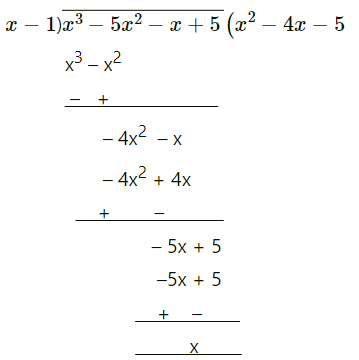
$\therefore x^3 – 5x^2 – x + 5$
$= (x – 1)(x^2 – 4x – 5)$
$= (x – 1)(x^2 – 5x + x – 5)$
$= (x – 1)(x(x – 5) + 1(x – 5))$
$= (x – 1)(x + 1)(x – 5).$ View full question & answer→Question 193 Marks
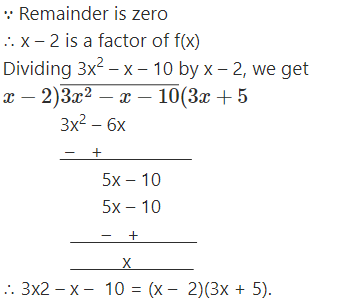
Show that $(x – 2)$ is a factor of $3x^2 – x – 10$ Hence factorise $3x^2 – x – 10.$
AnswerLet $x-2=0$, then $x=2$
Substituting the value of $x$ in $f(x)$,
$ f(x)=3 x^2-x-10$
$ =3(2)^2-2-10$
$=12-2-10$
$=0$
$\because$ $\because$
View full question & answer→Question 203 Marks
Use factor theorem to factorise the following polynomials completely: $x^3 – 19x – 30$
Answer$f(x)=x 3-19 x-30$
Let $x=-2$, then
$f(-2)=(-2)^3-19(-2)-30$
$=-8+38-30$
$=38-38$
$=0$
$\therefore(x+2) \text { is a factor of } f(x)$
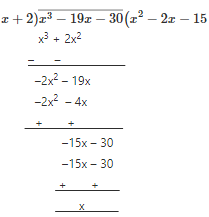
Now dividing $f ( x )$ by $( x +2)$, we get
$ f(x)=x^3-19 x-30$
$=(x+2)\left(x^2-2 x-15\right)$
$=(x+2)\left\{\left(x^2-5 x+3 x-15\right\}\right.$
$=(x+2)\{x(x-5)+3(x-5)\}$
$=(x+2)(x-5)(x+3)$
View full question & answer→Question 213 Marks
Use factor theorem to factorise the following polynomials completely: $4x^3 + 4x^2 – 9x – 9$
Answer$f(x)=4 x^3+4 x^2-9 x-9$
Let $x=-1$, then
$f(-1)=4(-1)^3+4(-1)^2-9(-1)-9$
$=4(-1)+4(1)+9-9$
$=-4+4+9-9$
$=13-13$
$=0$
$\therefore(x+1)$ is a factor of $f(x)$
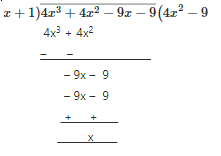
Now dividing $f(x)$ by $x+1$, we get
$ f(x)=4 x^3+4 x^2-9 x-9$
$=(x+1)\left(4 x^2-9\right)$
$=(x+1)\left\{(2 x)^2-(3)^2\right\}$
$=(x+1)(2 x+3)(2 x-3)$
View full question & answer→Question 223 Marks
Prove that $(5 x+4)$ is a factor of $5 x^3+4 x^2-5 x-4$. Hence factorize the given polynomial completely.
Answer$f(x)=5 x^3+4 x^2-5 x-4$
Let $5 x+4=0$, then $5 x=-4$
$\Rightarrow x =\frac{-4}{5}$
$\therefore f\left(-\frac{4}{5}\right)=5\left(-\frac{4}{5}\right)^3+4\left(-\frac{4}{5}\right)^2-5\left(-\frac{4}{5}\right)-4$
$=5 \times\left(-\frac{64}{125}\right)+4 \times \frac{16}{25}+4-4$
$=-\frac{64}{25}+\frac{64}{25}+4-4=0$
$\because f\left(-\frac{4}{5}\right)=0$
$\therefore(5 x +4)$ is a factor of $f ( x )$
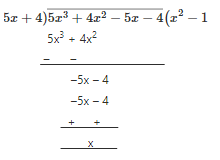
Now dividing $f(x)$ by $5 x+4$, we get
$5 x^3+4 x^2-5 x-4$
$ =(5 x+4)\left(x^2-1\right)$
$=(5 x+4)\left[(x)^2-(1)^2\right]$
$=(5 x+4)(x+1)(x-1)$
View full question & answer→Question 233 Marks
When $3 x^2-5 x+p$ is divided by $(x-2)$, the remainder is $3$ . Find the value of $p$. Also factorise the polynomial $3 x^2-5 x+p-$ 3.
Answer$f(x)=3 x^2-5 x+p$
Let $(x-2)=0$, then $x=2$
$ f(2)=3(2)^2-5(2)+p$
$=3 \times 4-10+p$
$=12-10+p$
$=2+p$
$\because \text { Remainder }=3$
$\therefore 2+p=3$
$\Rightarrow p=3-2=1$
Hence $p=1$
$\text { Now } f(x)=3 x^2-5 x+p-3$
$=3 x^2-5 x+1-3$
$=3 x^2-5 x-2$
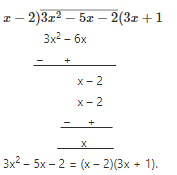
Dividing by $(x-2)$, we get
View full question & answer→Question 243 Marks
If $(2x – 3)$ is a factor of $6x^2 + x + a$, find the value of a. With this value of a, factorise the given expression.
AnswerLet $2 x-3=0$
then $2 x=3$
$\Rightarrow x =\frac{3}{2}$
Substituting the value of $x$ in $f(x)$
$ f(x)=6 x^2+x+a$
$f\left(\frac{3}{2}\right)=6\left(\frac{3}{2}\right)+\frac{3}{2}+a$
$=6 \times \frac{9}{4}+\frac{3}{2}$
$=\frac{27}{2}+\frac{3}{2}+a$
$=\frac{30}{2}+a $
$=15+a$
$\therefore 2 x-3$ is the factor
$\therefore$ Remainder $=0$
$ \therefore 15+a=0$
$\Rightarrow a=-15$
Now $f(x)$ will be $6 x^2+x-15$
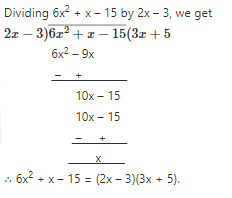
Dividing $6 x^2+x-15$ by $2 x-3$, we get
View full question & answer→Question 253 Marks
When a polynomial f(x) is divided by (x – 1), the remainder is 5 and when it is,, divided by (x – 2), the remainder is 7. Find – the remainder when it is divided by (x – 1) (x – 2).
AnswerWhen f(x) is divided by (x – 1),
Remainder = 5
Let x – 1 = 0
⇒ x = 1
∴ f(1) = 5
When divided by (x – 2),
Remainder = 7
Let x – 2 = 0
⇒ x = 2
∴ f(2) = 7
Let f(x) = (x – 1)(x – 2)q(x) + ax + b
Where q(x) is the quotient and ax + b is remainder
Putting x = 1, we get:
f(1) = (1 – 1)(1 – 2)q(1) + a x 1 + b
= 0 + a + b
= a + b
and x = 2, then
f(2) = (2 – 1)(2 – 2)q(2) + a x 2 + b
= 0 + 2a + b
= 2a + b
∴ a + b = 5 ....(i)
2a + b = 7 ....(ii)
Subtracting, we get
–a = – 2
⇒ a = 2
Substituting the value of a in (5)
2 + b = 5
⇒ b = 5 – 2 = 3
∴ a = 2, b = 3
∴ Remainder = ax + b
= 2x + 3.
View full question & answer→