Questions

[5 marks sum]

🎯

Test yourself on this topic

36 questions · timed · auto-graded

Question 15 Marks
A ladder rests against a wall at an angle $a$, to the horizontal. Its foot is pulled away from the wall through a distance ' $a$ ', so that it slides a distance ' $b$ ' down the wall making an angle $\beta$ with the horizontal. Show that $\frac{a}{b}=\frac{\cos \alpha-\cos \beta}{\sin \beta-\sin \alpha}$.
Answer
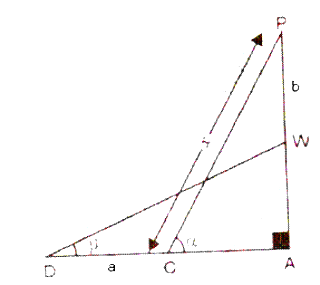

Let $C P$ and $D W$ be the two position of the ladder such that $C P=D W=x$ (say).
$
C D=a, P W=b, \angle A C P=\alpha \text { and } \angle A D W=\beta
$
In $\triangle \mathrm{APC}$,
$
\frac{\mathrm{AC}}{\mathrm{CP}}=\cos \alpha \Rightarrow \mathrm{AC}=\mathrm{x} \cos \alpha\ldots(i)
$
$
\begin{aligned}
& \operatorname{In} \triangle \mathrm{ADW} \\
& \frac{\mathrm{AD}}{\mathrm{DW}}=\cos \beta \Rightarrow \frac{\mathrm{AC}+\mathrm{CD}}{\mathrm{DW}}=\cos \beta \\
& \Rightarrow \frac{\mathrm{x} \cos \alpha+a}{\mathrm{x}}=\cos \beta \quad[\text { using (i)] } \\
& \Rightarrow \mathrm{x}=\frac{a}{\cos \beta-\cos \alpha}\ldots(ii)
\end{aligned}
$
Again in $\triangle A P C, \frac{A P}{C P}=\sin \alpha$
$\Rightarrow \mathrm{AP}=\mathrm{x} \sin \alpha=\frac{a \sin \alpha}{(\cos \beta-\cos \alpha)}$ ..(iii) [Using (ii)]
Again in $\triangle \mathrm{ADW}, \frac{\mathrm{AW}}{\mathrm{DW}}=\sin \beta$
$
\Rightarrow \mathrm{AW}=\mathrm{x} \sin \beta=\frac{a \sin \beta}{(\cos \beta-\cos \alpha)}\ldots(iv)
$
Now, $P W=A P-A W$
$
\begin{aligned}
& \Rightarrow b=\left(\frac{a \sin \alpha}{\cos \beta-\cos \alpha}\right)-\left(\frac{a \sin \beta}{\cos \beta-\cos \alpha}\right)=\frac{a(\sin \alpha-\sin \beta)}{(\cos \beta-\cos \alpha)} \\
& \Rightarrow \frac{a}{b}=\frac{\cos \beta-\cos \alpha}{\sin \alpha-\sin \beta}
\end{aligned}
$
Hence proved.
View full question & answer
Question 25 Marks
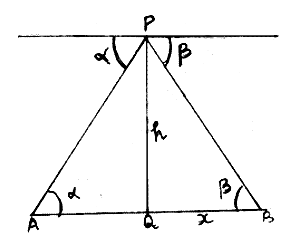
From an aeroplane vertically above a straight horizontal road, the angles of depression of two consecutive milestone on opposite sides of the aeroplane are observed to be $\alpha$, and $\beta$. Show that the height in miles of aeroplane above the road is $\frac{\tan \alpha \tan \beta}{\tan \alpha+\tan \beta}$.
Answer

Let $P Q$ be $h$
QB be $x$
Given: $A B=1$ mile
$
\begin{aligned}
& Q B=x \\
& A Q=(1-x) \text { mile } \\
& \text { in } \triangle P A Q \\
& \operatorname{Tan} \alpha=\frac{P Q}{A Q}
\end{aligned}
$
in $\triangle \mathrm{PAQ}$
$\operatorname{Tan} \alpha=\frac{\mathrm{PQ}}{\mathrm{AQ}}$
$\operatorname{Tan} \alpha=\frac{\mathrm{h}}{1-\mathrm{x}}$
$1-\mathrm{x}=\frac{\mathrm{h}}{\operatorname{Tan} \alpha}$$\ldots(1)$
$\operatorname{In} \triangle \mathrm{PQB}$
$
\begin{aligned}
& \operatorname{Tan} \beta=\frac{\mathrm{h}}{\mathrm{x}} \\
& \mathrm{x}=\frac{\mathrm{h}}{\operatorname{Tan} \beta}
\end{aligned}
$
Substitute for $\mathrm{x}$ in equation (1)
$
\begin{aligned}
& 1=\frac{\mathrm{h}}{\operatorname{Tan} \beta}+\frac{\mathrm{h}}{\operatorname{Tan} \alpha} \\
& 1=\mathrm{h}\left\{\frac{1}{\operatorname{Tan} \beta}+\frac{1}{\operatorname{Tan} \alpha}\right\} \\
& \frac{1}{\mathrm{~h}}=\frac{\operatorname{Tan} \beta+\operatorname{Tan} \alpha}{\operatorname{Tan} \beta \operatorname{Tan} \alpha}
\end{aligned}
$
Thus, the height in miles of aeroplane above the road is $\frac{\operatorname{Tan} \alpha \operatorname{Tan} \beta}{\operatorname{Tan} \alpha+\operatorname{Tan} \beta}$
View full question & answer
Question 35 Marks
If the angle of elevation of a cloud from a point $\mathrm{h} \mathrm{m}$ above a lake is $\alpha$, and the angle of depression of its reflection in the lake be $\beta$, prove that distance of the cloud from the point of observation is $\frac{2 \mathrm{~h} \sec \alpha}{\tan \alpha-\tan \beta}$.
Answer

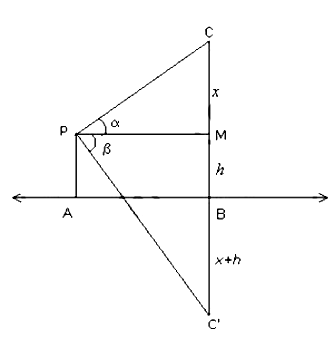
Let $A B$ be the surface of the lake and let $P$ be an point of observation such that $A P=h$ meters. Let $c$ be the position of the cloud and $C^{\prime}$ be its reflection in the lake. Then $\angle C P M=\alpha$ and $\angle M P C=\beta$. Let $\mathrm{CM}=\mathrm{x}$
Then, $\mathrm{CB}=\mathrm{CM}+\mathrm{MB}=\mathrm{CM}+\mathrm{PA}=\mathrm{x}+\mathrm{h}$
In $\triangle \mathrm{CPM}$,
$\tan \alpha=\frac{\mathrm{CM}}{\mathrm{PM}}$
$
\Rightarrow \tan \alpha=\frac{\mathrm{x}}{\mathrm{AB}}[\because \mathrm{PM}=\mathrm{AB}]
$
$\Rightarrow \mathrm{AB}=\mathrm{x} \cot \alpha \ldots(1)$
In $\triangle \mathrm{PMC}^{\prime}$,
$
\begin{aligned}
& \tan \beta=\frac{C \prime M}{P M} \\
& \Rightarrow \tan \beta=\frac{\mathrm{x}+2 \mathrm{~h}}{\mathrm{AB}} \\
& \Rightarrow \mathrm{AB}=(\mathrm{x}+2 \mathrm{~h}) \cot \beta\ldots(2)
\end{aligned}
$
From (1) and (2),
$x \cot \alpha=(x+2 h) \cot \beta$
$\Rightarrow \mathrm{x}\left(\frac{1}{\tan \alpha}-\frac{1}{\tan \beta}\right)=\frac{2 \mathrm{~h}}{\tan \beta}$
$\Rightarrow \mathrm{x}\left(\frac{\tan \beta-\tan \alpha}{\tan \alpha \tan \beta}\right)=\frac{2 \mathrm{~h}}{\tan \beta}$
$\Rightarrow \mathrm{x}=\frac{2 \mathrm{~h} \tan \alpha}{\tan \beta-\tan \alpha}$
Again, in $\triangle C P M$,
$\sin \alpha=\frac{\mathrm{CM}}{\mathrm{PC}}=\frac{\mathrm{x}}{\mathrm{PC}}$
$\Rightarrow \mathrm{PC}=\frac{\mathrm{x}}{\sin \alpha}$
$\Rightarrow \mathrm{PC}=\frac{2 \mathrm{~h} \tan \alpha}{\tan \beta-\tan \alpha} \times \frac{1}{\sin \alpha}$
$\Rightarrow \mathrm{PC}=\frac{2 \mathrm{~h} \sec \alpha}{\tan \beta-\tan \alpha}$
$
\text { Hence, the distance of the cloud from the point of observation is } \frac{2 \mathrm{~h} \sec \alpha}{\tan \beta-\tan \alpha} \text {. }
$
View full question & answer
Question 45 Marks
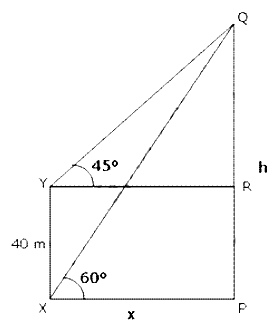
The angle of elevation of the top Q of a vertical tower PQ from a point X on the ground is 60°. At a point Y, 40m vertically above X, the angle of elevation is 45°. Find the height of the tower PQ and the distance XQ.
Answer


In the figure, $\mathrm{PQ}$ is the tower.
$
\begin{aligned}
& \ln \triangle \mathrm{PQX}, \\
& \therefore \frac{\mathrm{h}}{\mathrm{x}}=\tan 60^{\circ}=\sqrt{3} \\
& \Rightarrow \mathrm{h}=\sqrt{3} \mathrm{x} \quad \ldots(1)
\end{aligned}
$
In $\triangle \mathrm{QRY}$,
$
\begin{aligned}
& \frac{\mathrm{h}-40}{\mathrm{x}}=\tan 45^{\circ}=1 \\
& \Rightarrow \mathrm{h}=40+\mathrm{x} \quad \ldots(2)
\end{aligned}
$
$
\begin{aligned}
& \text { From (1) and (2), } \\
& \sqrt{3} \mathrm{x}=40+\mathrm{x} \\
& \Rightarrow(\sqrt{3}-1) \mathrm{x}=40 \\
& \Rightarrow \mathrm{x}=\frac{40}{\sqrt{3}-1}=\frac{40(\sqrt{3}+1)}{(\sqrt{3}-1)(\sqrt{3}+1)}=\frac{40}{2}(\sqrt{3}+1)=20(\sqrt{3}+1) \\
& \therefore \mathrm{h}=40+20(\sqrt{3}+1)=20 \sqrt{3}+60=20(\sqrt{3}+3)=20 \times 4.732=94.64
\end{aligned}
$
View full question & answer
Question 55 Marks
The angle of elevation of an aeroplane from a point on the ground is 45°. After 15 seconds, the angle of elevation changes to 30°. If the aeroplane is flying at a height of 3000 m, find the speed of the aeroplane.
Answer

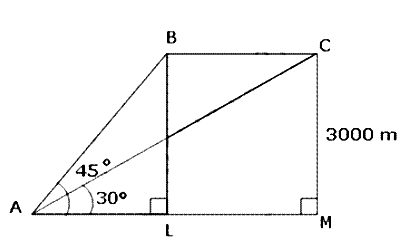
Let $A$ be the point of observation on the ground and $B$ and $C$ be the two positions of aeroplane. Let $B L=C M=3000 \mathrm{~m}$.
In $\triangle \mathrm{ALB}$,
$
\tan 45^{\circ}=\frac{\mathrm{BL}}{\mathrm{AL}}
$
$
\Rightarrow 1=\frac{3000}{\mathrm{AL}}
$
$
\Rightarrow \mathrm{AL}=3000
$
In $\triangle \mathrm{AMC}$,
$
\begin{aligned}
& \tan 30^{\circ}=\frac{\mathrm{MC}}{\mathrm{AM}} \\
& \Rightarrow \frac{1}{\sqrt{3}}=\frac{3000}{3000+\mathrm{LM}} \\
& \Rightarrow 3000 \sqrt{3}=(3000+\mathrm{LM}) \\
& \Rightarrow \mathrm{LM}=3000(\sqrt{3}-1) \\
& \therefore \mathrm{BC}=3000(\sqrt{3}-1)
\end{aligned}
$
Now , time taken to travel distance $\mathrm{BC}=15$ seconds
$
\therefore \text { Speed of the aeroplane }=\frac{\text { Distance }}{\text { Time }}=\frac{3000(\sqrt{3}-1)}{15}=200 \times 0.732=146.4
$
Thus, the speed of the aeroplane is $146.4 \mathrm{~m} / \mathrm{sec}$
$
=146.4 \times \frac{\frac{1}{1000}}{\frac{1}{3600}} \mathrm{~km} / \mathrm{hr}=146.4 \times 3.6 \mathrm{~km} / \mathrm{hr}=527.04 \mathrm{~km} / \mathrm{hr}
$
View full question & answer
Question 65 Marks
A man on the top of a tower observes a truck at an angle of depression $\propto$ where $\propto=\frac{1}{\sqrt{5}}$ and sees that it is moving towards the base of the tower. Ten minutes later, the angle of depression of the truck is found to $\beta=\sqrt{5}$. Assuming that the truck moves at a uniform speed, determine how much more ti me it will take to each the base of the tower?
Answer


In the figure, $A B$ is the tower. $A$ is the position of the man. $C$ and $D$ are the two positions of the truck.
Let the speed of the truck be $x \mathrm{~m} / \mathrm{sec}$
Distance CD $=$ Speed $\times$ time $=600 x$
In right triangle $A B C$,
$
\tan \alpha=\frac{\mathrm{h}}{\mathrm{BC}}
$
It is a given that $\tan \alpha=\frac{1}{\sqrt{5}}$
$
\mathrm{BC}=\mathrm{h} \sqrt{5}
$
In right triangle $A B D$,
$
\tan \beta=\frac{\mathrm{h}}{\mathrm{BD}}
$
It is given that $\tan \beta=\sqrt{5}$
$
\mathrm{h}=\sqrt{5} \mathrm{BD}
$
Now, $C D=B C-B D$
$
\begin{aligned}
& 600 x=5 B D-B D \\
& B D=150 x
\end{aligned}
$
Time taken $=\frac{150 \mathrm{x}}{\mathrm{x}}=150$ seconds
Thus, the time taken by the truck to reach the tower is $150 \mathrm{sec}=2 \mathrm{~min} 30 \mathrm{sec}$.
View full question & answer
Question 75 Marks
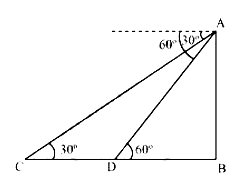
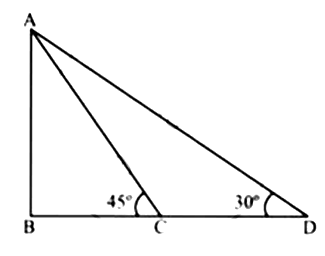
A man standing on a cliff observes a ship at an angle of depression of the ship is 30°, approaching the shore just beneath him. Three minutes later, the angle of depression of the ship is 60°. How soon will it reach the shore?
Answer

Let $A B$ be the tower.
Initial position of ship is $C$, which changes to $D$ after 3 minutes.
$\ln \triangle \mathrm{ADB}$
$
\begin{aligned}
& \frac{\mathrm{AB}}{\mathrm{DB}}=\tan 60^{\circ} \\
& \frac{\mathrm{AB}}{\mathrm{DB}}=\sqrt{3}
\end{aligned}
$
$
\mathrm{DB}=\frac{\mathrm{AB}}{\sqrt{3}}
$
$
\begin{aligned}
& \operatorname{In} \triangle \mathrm{ABC} \\
& \frac{\mathrm{AB}}{\mathrm{BC}}=\tan 30^{\circ} \\
& \frac{\mathrm{AB}}{\mathrm{BD}+\mathrm{DC}}=\frac{1}{\sqrt{3}} \\
& \mathrm{AB} \sqrt{3}=\mathrm{BD}+\mathrm{DC} \\
& \mathrm{AB} \sqrt{3}=\frac{\mathrm{AB}}{\sqrt{3}}+\mathrm{DC} \\
& \mathrm{DC}=\mathrm{AB} \sqrt{3}-\frac{\mathrm{AB}}{\sqrt{3}}=\mathrm{AB}\left(\sqrt{3}-\frac{1}{\sqrt{3}}\right) \\
& =\frac{2 \mathrm{AB}}{\sqrt{3}}
\end{aligned}
$
Time taken by car to travel DC distance $\left(\right.$ i.e. $\left.\frac{2 \mathrm{AB}}{\sqrt{3}}\right)=3$ minutes
Time taken by car to travel DB distance (i.e. $\frac{\mathrm{AB}}{\sqrt{3}}$ )
$
=\frac{3}{\frac{2 A B}{\sqrt{3}}} \times \frac{\mathrm{AB}}{\sqrt{3}}=\frac{3}{2}=1 \mathrm{~min} 30 \text { secs }
$
Thus the total time taken is 3 minutes +1 minute 30 seconds $=$ minutes 30 seconds.
View full question & answer
Question 85 Marks
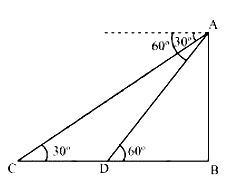
The angle of depression of a boat moving towards a diff is 30°. Three minutes later the angle of depression of the boat is 60°. Assuming that the boat is sailing at a uniform speed, determine the time it will take to reach the shore. Also, find the speed of the boat in m/second if the cliff is 450m high.
Answer


Let $A B$ be the diff. Then, $A B=450 \mathrm{~m}$
Initial position of boat is $C$, which changes to $D$ after 3 minutes.
$
\begin{aligned}
& \operatorname{In} \triangle \mathrm{ADB} \\
& \frac{\mathrm{AB}}{\mathrm{DB}}=\tan 60^{\circ} \\
& \frac{450}{\mathrm{DB}}=\sqrt{3} \\
& \mathrm{DB}=\frac{450}{\sqrt{3}}
\end{aligned}
$
$
\begin{aligned}
& \ln \triangle \mathrm{ABC} \\
& \frac{\mathrm{AB}}{\mathrm{BC}}=\tan 30^{\circ} \\
& \frac{450}{\mathrm{BD}+\mathrm{DC}}=\frac{1}{\sqrt{3}} \\
& 450 \sqrt{3}=\mathrm{BD}+\mathrm{DC} \\
& 450 \sqrt{3}=\frac{450}{\sqrt{3}}+\mathrm{DC} \\
& \mathrm{DC}=450 \sqrt{3}-\frac{450}{\sqrt{3}}=450\left(\sqrt{3}-\frac{1}{\sqrt{3}}\right) \\
& =\frac{900}{\sqrt{3}}=\frac{900}{\sqrt{3}} \times \frac{\sqrt{3}}{\sqrt{3}}=300 \sqrt{3}
\end{aligned}
$
Time taken by car to travel DC distance (i.e., $300 \sqrt{3}$ ) $=3$ minutes
Time taken by car to travel DB distance (i.e. $\frac{450}{\sqrt{3}}$ )
$
=\frac{3}{300 \sqrt{3}} \times \frac{450}{\sqrt{3}}=\frac{450}{300}=1.5
$
Thus, the time it will take to reach the shore is $1 \mathrm{~min} 30$ secs.
$
\begin{aligned}
& \text { Speed of the boat }=\frac{\text { Distance }}{\text { Time }} \\
& =\frac{300 \sqrt{3}}{3}=100 \sqrt{3}=100 \times 1.732=173.2 \mathrm{~m} / \mathrm{min} \\
& =\frac{173.2}{60} \mathrm{~m} / \mathrm{sec}=2.9 \mathrm{~m} / \mathrm{sec}
\end{aligned}
$
View full question & answer
Question 95 Marks
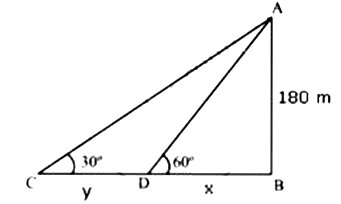
A man in a boat rowing away from a lighthouse 180 m high takes 2 minutes to change the angle of elevation of the top of the lighthouse from 60° and 30°. Find the speed of the boat.
Answer


Let $A B$ be the lighthouse.
Initial position of boat is $C$, which changes to $D$ after 2 minutes.
In $\triangle \mathrm{ADB}$
$
\begin{aligned}
& \frac{\mathrm{AB}}{\mathrm{DB}}=\tan 60^{\circ} \\
& \frac{180}{\mathrm{x}}=\sqrt{3} \\
& \mathrm{x}=\frac{180}{\sqrt{3}}
\end{aligned}
$
$
\begin{aligned}
& \operatorname{In} \triangle \mathrm{ABC} \\
& \frac{\mathrm{AB}}{\mathrm{BC}}=\tan 30^{\circ} \\
& \frac{180}{\mathrm{x}+\mathrm{y}}=\frac{1}{\sqrt{3}} \\
& 180 \sqrt{3}=\mathrm{x}+\mathrm{y} \\
& 180 \sqrt{3}=\frac{180}{\sqrt{3}}+\mathrm{y} \\
& \mathrm{y}=180\left(\sqrt{3}-\frac{1}{\sqrt{3}}\right)=180\left(\frac{2}{\sqrt{3}}\right)=\frac{360}{\sqrt{3}}
\end{aligned}
$
Time taken by car to travel DC distance $\left(\right.$ i.e. $\left.\frac{360}{\sqrt{3}}\right)=2$ minutes $=120$ seconds
Speed of the boat $=\frac{\text { Distance }}{\text { Time }}=\frac{\frac{360}{\sqrt{3}}}{120}=\frac{3}{\sqrt{3}}=\frac{3}{\sqrt{3}} \times \frac{\sqrt{3}}{\sqrt{3}}=\frac{3 \sqrt{3}}{3}=\sqrt{3}=1.732$
Thus, the speed of the boat is $1.732 \mathrm{~m} / \mathrm{sec}$.
View full question & answer
Question 105 Marks
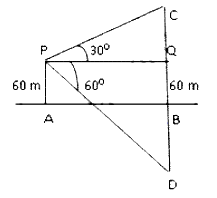
The angle of elevation of a cloud from a point 60m above a lake is 30° and the angle of depression of its reflection in the lake is 60°. Find the height of the cloud.
Answer


Let $C$ be the cloud and $D$ be its reflection. Let the height of the cloud is $h$ metres .
$
\begin{aligned}
& B C=B D=h \\
& B Q=A P=60 m \\
& \therefore C Q=h-60 \text { and } D Q=h+60 \\
& \ln \Delta C Q P \\
& \frac{P Q}{C Q}=\cot 30^{\circ} \\
& \Rightarrow \frac{P Q}{h-60}=\sqrt{3} \\
& \Rightarrow P Q=\sqrt{3}(h-60) \text {....(i) }
\end{aligned}
$
In $\triangle \mathrm{DQP}$,
$
\begin{aligned}
& \frac{\mathrm{PQ}}{\mathrm{DQ}}=\cot 60^{\circ} \\
& \Rightarrow \frac{\mathrm{PQ}}{\mathrm{h}+60}=\frac{1}{\sqrt{3}} \\
& \Rightarrow \mathrm{PQ}=\frac{1}{\sqrt{3}}(\mathrm{~h}+60)\ldots(ii)
\end{aligned}
$
From (i) and (ii),
$
\begin{aligned}
& \Rightarrow \sqrt{3}(h-60)=\frac{1}{\sqrt{3}}(h+60) \\
& \Rightarrow 3 h-180=h+60 \\
& \Rightarrow 2 h=240 \\
& \Rightarrow h=120
\end{aligned}
$
Thus, the height of the cloud is $120 \mathrm{~m}$.
View full question & answer
Question 115 Marks
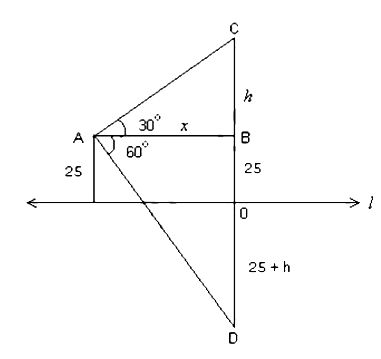
The angle of elevation of a stationary cloud from a point 25m above a lake is 30° and the angle of depression of its reflection in the lake is 60°. What is the height of the cloud above the lake-level?
Answer
Let $C$ be the position of the cloud, I be the surface of the lake and $D$ be the reflection of the cloud. Let $C B=h$, then $O D=25+h$

$
\begin{aligned}
& \operatorname{In} \triangle A B C \\
& \tan 30^{\circ}=\frac{B C}{A B} \\
& \Rightarrow \frac{1}{\sqrt{3}}=\frac{h}{x} \\
& \Rightarrow \sqrt{3} \mathrm{~h}=\mathrm{x}\ldots(1)
\end{aligned}
$
$
\begin{aligned}
& \ln \triangle \mathrm{ABD} \\
& \tan 60^{\circ}=\frac{\mathrm{BD}}{\mathrm{AB}}=\frac{25+25+\mathrm{h}}{\mathrm{x}} \\
& \sqrt{3} \mathrm{x}=50+\mathrm{h} \ldots(2)
\end{aligned}
$
From (1) and (2),
$
\sqrt{3}(\sqrt{3} \mathrm{~h})=50+\mathrm{h}
$
$
\begin{aligned}
& 2 \mathrm{~h}=50 \\
& \mathrm{~h}=25
\end{aligned}
$
Thus, the height of the cloud above the lake-level is $\mathrm{OC}=50 \mathrm{~m}$.
View full question & answer
Question 125 Marks
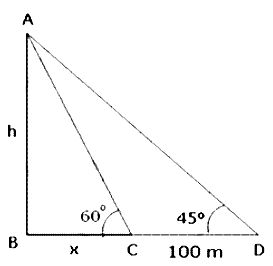
A parachutist is descending vertically and makes angles of elevation of 45° and 60° from two observing points 100 m apart to his right. Find the height from which he falls and the distance of the point where he falls on the ground from the nearest observation pcint.
Answer

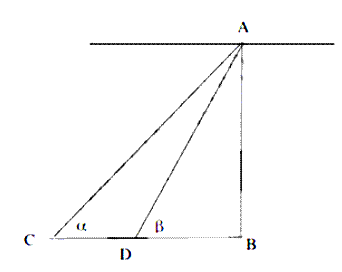
Let $\mathrm{A}$ be the position of the parachutist and $\mathrm{C}$ and $\mathrm{D}$ be the two observation points.
In $\triangle \mathrm{ABC}$,
$
\begin{aligned}
& \tan 60^{\circ}=\frac{\mathrm{AB}}{\mathrm{BC}} \\
& \Rightarrow \sqrt{3}=\frac{\mathrm{h}}{\mathrm{x}} \\
& \Rightarrow \mathrm{h}=\sqrt{3 \mathrm{x}}
\end{aligned}
$
In $\triangle \mathrm{ABD}$,
$
\begin{aligned}
& \tan 45^{\circ}=\frac{\mathrm{AB}}{\mathrm{BD}} \\
& \Rightarrow 1=\left(\frac{\mathrm{h}}{\mathrm{x}+100}\right) \\
& \Rightarrow \mathrm{x}+100=\mathrm{h} \\
& \Rightarrow \mathrm{x}+100=\sqrt{3} \mathrm{x} \\
& \Rightarrow \mathrm{x}(\sqrt{3}-1)=100 \\
& \Rightarrow \mathrm{x}=100 \times \frac{1}{\sqrt{3}-1} \times \frac{\sqrt{3}+1}{\sqrt{3}+1} \\
& \Rightarrow \mathrm{x}=100 \times \frac{(\sqrt{3}+1)}{3-1}=50(\sqrt{3}+1)=50 \times 2.732=136.6
\end{aligned}
$
Thus, the distance of the point where he falls on the ground from the nearest observation point (C) is $136.6 \mathrm{~m}$.
Height from which the parachutist fall
$
=\mathrm{h}=\sqrt{3} \mathrm{x}=1.732 \times 136.6=236.59 \approx 236.6 \mathrm{~m} .
$
View full question & answer
Question 135 Marks
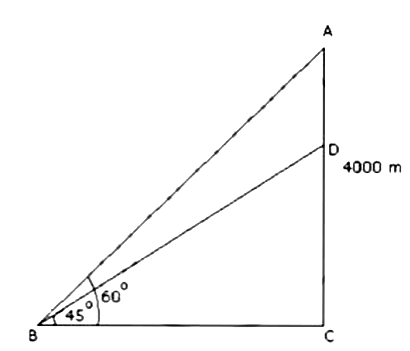
An aeroplane when flying at a height of 4km from the ground passes vertically above another aeroplane at an instant when the angles of the elevation of the two planes from the same point on the ground are 60° and 45° respectively. Find the vertical distance between the aeroplanes at that instant.
Answer


Let points $A$ and $D$ represent the position of the aeroplanes. Aeroplane A is flying $4 \mathrm{~km}=4000 \mathrm{~m}$ above the ground.
$
\angle \mathrm{ACB}=60^{\circ}, \angle \mathrm{DCB}=45^{\circ}
$
In $\triangle \mathrm{ABC}$,
$
\begin{aligned}
& \frac{\mathrm{AB}}{\mathrm{BC}}=\tan 60^{\circ} \\
& \Rightarrow \mathrm{BC}=\frac{4000}{\sqrt{3}}
\end{aligned}
$
$
\begin{aligned}
& \operatorname{In} \triangle \mathrm{DCB} \\
& \frac{\mathrm{DB}}{\mathrm{BC}}=\tan 45^{\circ} \\
& \Rightarrow \mathrm{DB}=\mathrm{BC}=\frac{4000}{\sqrt{3}} \\
& \therefore \mathrm{AD}=\mathrm{AB}-\mathrm{BD} \\
& =4000-\frac{4000}{\sqrt{3}}=4000\left(1-\frac{1}{\sqrt{3}}\right)=4000 \times \frac{\sqrt{3}-1}{\sqrt{3}}=4000 \times \frac{0.732}{1.732}=1690.53 \\
& =\mathrm{h}=\sqrt{3} \mathrm{x}=1.732 \times 136.6=236.59 \approx 236.6 \mathrm{~m}
\end{aligned}
$
View full question & answer
Question 145 Marks
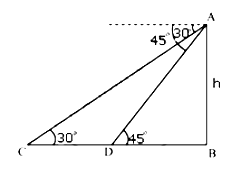
A man on the top of a tower observes that a car is moving directly at a uniform speed towards it. If it takes 720 seconds for the angle of depression to change from 30° to 45°, how soon will the car reach the observation tower?
Answer


Let $A B$ be the tower .
Initial position of car is C, which changes to D after 720 seconds.
$\ln \triangle \mathrm{ADB}$
$
\begin{aligned}
& \frac{\mathrm{AB}}{\mathrm{DB}}=\tan 45^{\circ} \\
& \frac{\mathrm{AB}}{\mathrm{DB}}=1 \\
& \mathrm{DB}=\mathrm{AB}
\end{aligned}
$
$\ln \triangle \mathrm{ABC}$
$
\begin{aligned}
& \frac{\mathrm{AB}}{\mathrm{BC}}=\tan 30^{\circ} \\
& \frac{\mathrm{AB}}{\mathrm{BD}+\mathrm{DC}}=\frac{1}{\sqrt{3}} \\
& \mathrm{AB} \sqrt{3}=\mathrm{BD}+\mathrm{DC} \\
& \mathrm{AB} \sqrt{3}=\mathrm{AB}+\mathrm{DC} \\
& \mathrm{DC}=\mathrm{AB} \sqrt{3}-\mathrm{AB}=\mathrm{AB}(\sqrt{3}-1)
\end{aligned}
$
Time taken by car to travel DC distance (i.e $\mathrm{AB}(\sqrt{3}-1))=720$ seconds Time taken by car to travel DB distance (i.e. AB)
$
\begin{aligned}
& =\frac{720}{\mathrm{AB}(\sqrt{3}-1)} \times \mathrm{AB}=\frac{720}{(\sqrt{3}-1)} \times \frac{\sqrt{3}+1}{\sqrt{3}+1} \\
& =\frac{720(\sqrt{3}+1)}{2}=360(\sqrt{3}+1)=360 \times 2.732=983.52
\end{aligned}
$
Thus, the required time taken is 983.52 seconds $=984$ seconds $=16$ mins 24 secs.
View full question & answer
Question 155 Marks
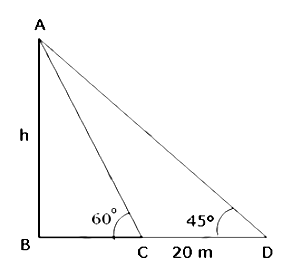
The angle of elevation of a tower from a point in line with its base is $45^{\circ}$. On moving $20 \mathrm{~m}$ towards the tower, the angle of elevation changes to $60^{\circ}$. Find the height of the tower.
Answer


Let the height of the tower (AB) be $h$.
$
\begin{aligned}
& \ln \triangle \mathrm{ABC} \\
& \tan 60^{\circ}=\frac{\mathrm{AB}}{\mathrm{BC}} \\
& \Rightarrow \sqrt{3}=\frac{\mathrm{h}}{\mathrm{BC}} \\
& \Rightarrow \mathrm{BC}=\frac{\mathrm{h}}{\sqrt{3}}
\end{aligned}
$
In $\triangle A B D$,
$
\begin{aligned}
& \tan 45^{\circ}=\frac{\mathrm{AB}}{\mathrm{BD}} \\
& \Rightarrow 1=\frac{\mathrm{h}}{\mathrm{BC}+20} \\
& \Rightarrow \mathrm{BC}+20=\mathrm{h} \\
& \Rightarrow \frac{\mathrm{h}}{\sqrt{3}}+20=\mathrm{h} \\
& \Rightarrow \mathrm{h}\left(1-\frac{1}{\sqrt{3}}\right)=20 \\
& \Rightarrow \mathrm{h}=20 \times \frac{\sqrt{3}}{\sqrt{3}-1} \\
& \Rightarrow \mathrm{h}=20 \times \frac{\sqrt{3}}{\sqrt{3}-1} \times \frac{\sqrt{3}+1}{\sqrt{3}+1} \\
& =20 \times \frac{\sqrt{3}(\sqrt{3}+1)}{3-1}=10(3+\sqrt{3})=10 \times 4.732=47.32
\end{aligned}
$
Thus, the height of the tower is $47.32 \mathrm{~m}$.
View full question & answer
Question 165 Marks
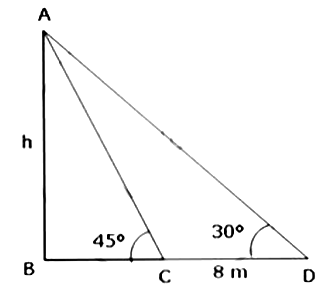
The length of the shadow of a statue increases by 8m, when the latitude of the sun changes from 45° to 30°. Calculate the height of the tower.
Answer


Let the height of the statue $(A B)$ be $h$.
In $\triangle \mathrm{ABC}$,
$\tan 45^{\circ}=\frac{\mathrm{AB}}{\mathrm{BC}}$
$
\Rightarrow \mathrm{BC}=\mathrm{h}
$
In $\triangle \mathrm{ABD}$,
$
\tan 30^{\circ}=\frac{\mathrm{AB}}{\mathrm{BD}}
$
$
\frac{1}{\sqrt{3}}=\frac{\mathrm{AB}}{\mathrm{BC}+\mathrm{CD}}
$
$h+8=\sqrt{3} h \quad(\because B C=h)$
$
\Rightarrow \mathrm{h}(\sqrt{3}-1)=8
$
$
\Rightarrow \mathrm{h}=\frac{8}{\sqrt{3}-1} \times \frac{\sqrt{3}+1}{\sqrt{3}+1}
$
$\Rightarrow \mathrm{h}=\frac{8(\sqrt{3}+1)}{2}=4(\sqrt{3}+1)=4 \times 2.732=10.928 \approx 10.93$
Thus, the height of the tower is $10.93 \mathrm{~m}$.
View full question & answer
Question 175 Marks
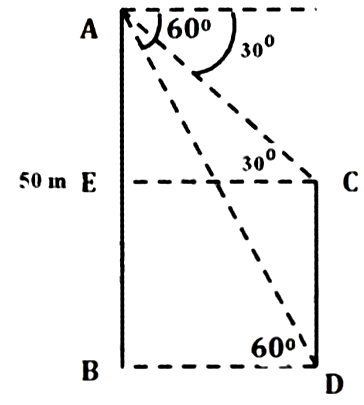
Of the two trees are on either side of a river, one of them is 50m high. From the top of this tree the angles of depression of the top and the foot of the other tree are 30° and 60° respectively. Find the width of the river and the height of the other tree.
Answer


Let $A B$ and $C D$ be the two trees.
$
\begin{aligned}
& \ln \triangle \mathrm{AEC}, \\
& \tan 30^{\circ}=\frac{\mathrm{EA}}{\mathrm{EC}} \\
& \Rightarrow \frac{1}{\sqrt{3}}=\frac{\mathrm{EA}}{\mathrm{EC}} \\
& \Rightarrow \mathrm{EC}=\sqrt{3} \mathrm{EA} \ldots .(1) \\
& \ln \triangle \mathrm{ABD}, \\
& \tan 60^{\circ}=\frac{\mathrm{AB}}{\mathrm{BD}}=\sqrt{3} \\
& \Rightarrow \frac{50}{\mathrm{BD}}=\sqrt{3} \\
& \Rightarrow \mathrm{BD}=\frac{50}{\sqrt{3}}
\end{aligned}
$
In $\triangle \mathrm{ABD}$,
$\tan 60^{\circ}=\frac{\mathrm{AB}}{\mathrm{BD}}=\sqrt{3}$
$\Rightarrow \frac{50}{\mathrm{BD}}=\sqrt{3}$
$\Rightarrow \mathrm{BD}=\frac{50}{\sqrt{3}}$
Thus, the width of the river is $\mathrm{BD}=\frac{50}{\sqrt{3}}=28.8 \mathrm{~m}$.
From (1),
$
\mathrm{EA}=\frac{\mathrm{EC}}{\sqrt{3}}=\frac{\mathrm{BD}}{\sqrt{3}}=\frac{50}{3}=16.67
$
Height of the other tree $=C D=50-E A=50-16.67=33.33 \mathrm{~m}$
View full question & answer
Question 185 Marks
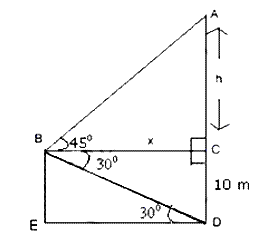
A man on the deck of a ship is 10 m above the water level. He observes that the angle of elevation of the top of a diff is 45° and the angle of depression of the base is 30°. Find the distance of the diff from the ship and the height of the cliff.
Answer
Let $\mathrm{B}$ be the position of the man, $\mathrm{D}$ the base of the cliff, $\mathrm{x}$ be the distance of cliff from the ship and $\mathrm{h}$ +10 be the height of the hill. $\angle \mathrm{ABC}=45^{\circ}$ and $\angle \mathrm{DBC}=30^{\circ}$
Therefore, $\angle \mathrm{BDE}=30^{\circ}$

$
\begin{aligned}
& \operatorname{In} \triangle \mathrm{ABC}, \\
& \tan 45^{\circ}=\frac{\mathrm{AC}}{\mathrm{BC}} \\
& \Rightarrow \frac{\mathrm{h}}{\mathrm{x}}=1 \\
& \Rightarrow \mathrm{h}=\mathrm{x} \text { (1) } \\
& \operatorname{In} \Delta \mathrm{BED}, \\
& \tan 30^{\circ}=\frac{\mathrm{BE}}{\mathrm{ED}} \\
& \Rightarrow \frac{1}{\sqrt{3}}=\frac{10}{\mathrm{x}} \\
& \Rightarrow \mathrm{x}=10 \sqrt{3}=10 \times 1.732=17.32
\end{aligned}
$
Thus, the distance of the diff from the ship is $17.32 \mathrm{~m}$.
From (1),
$
h=x=17.32
$
$\therefore$ Height of the diff $=17.32+10=27.32$
Thus, the height of the diff is $27.32 \mathrm{~m}$.
View full question & answer
Question 195 Marks
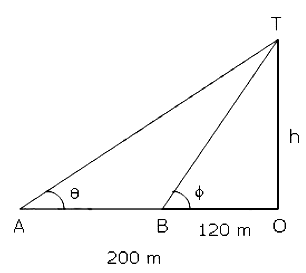
The angle of elevation of a tower from a point $200 \mathrm{~m}$ from its base is $\theta$, when $\tan \theta=\frac{2}{5}$. The angle of elevation of this tower from a point $120 \mathrm{~m}$ from its base is $\Phi$. Calculate the height of tower and the value of $\Phi$.
Answer

Let OT be the tower .
A and B be the two points from where the angle of elevation to the top of the tower is measured.
In $\triangle A O T$,
$
\begin{aligned}
& \frac{\mathrm{OT}}{\mathrm{OA}}=\tan \theta \\
& \Rightarrow \frac{\mathrm{h}}{200}=\frac{2}{5} \\
& \Rightarrow \mathrm{h}=80 \ldots(1)
\end{aligned}
$
Thus, the height of the tower is $80 \mathrm{~m}$.
In $\triangle \mathrm{BOT}$,
$
\begin{aligned}
& \frac{\mathrm{OT}}{\mathrm{OB}}=\tan \Phi \\
& \Rightarrow \frac{\mathrm{h}}{120}=\tan \Phi \\
& \Rightarrow \frac{80}{120}=\tan \Phi \quad \text { [Using (1)] } \\
& \Rightarrow \frac{2}{3}=\tan \Phi
\end{aligned}
$
From the table, we get $\Phi=34^{\circ}$.
View full question & answer
Question 205 Marks
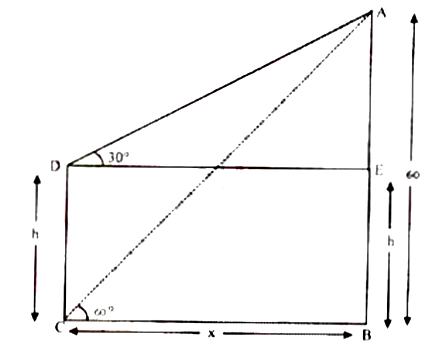
From the top of a 60m high building the angles of depression of the top and bottom of a lamp post are 30° and 60° respectively. Find the distance on the ground between the building and the lamp post and the difference in their heights.
Answer


Let $A B$ be the building. Then, $A B=60 \mathrm{~m}$.
Let the height of the lamp post (CD) be h.
Let the distance between the building and the lamp post be $x$. In $\triangle \mathrm{ACB}$,
$
\begin{aligned}
& \tan 60^{\circ}=\frac{\mathrm{AB}}{\mathrm{BC}} \\
& \therefore \sqrt{3}=\frac{60}{X} \\
& \therefore X=\frac{60}{\sqrt{3}}=20 \sqrt{3}=20 \times 1.732=34.64\ldots(1)
\end{aligned}
$
Thus, the distance between the building and the lamp post is $34.64 \mathrm{~m}$ In $\triangle \mathrm{ADE}$,
$
\tan 30^{\circ}=\frac{\mathrm{AE}}{\mathrm{DE}}
$
$
\therefore \frac{1}{\sqrt{3}}=\frac{60-h}{X}
$
$
\therefore X=\sqrt{3}(60-h)\ldots(2)
$
From (1) and (2):
$
\begin{aligned}
& \sqrt{3}(60-h)=20 \sqrt{3} \\
& 60-h=20 \\
& h=40
\end{aligned}
$
View full question & answer
Question 215 Marks
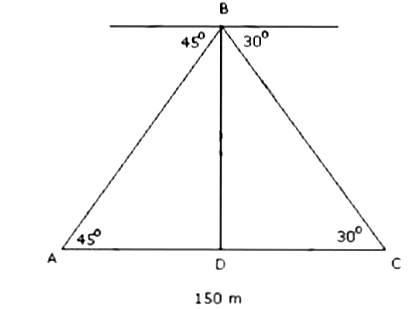
Two boats approaching a light house in mid sea from opposite directions observe the angle of elevation of the top of the light house as 30° and 45° respectively. If the distance between the two boats is 150m, find the height of the light house.
Answer

Let the position of the two boats be at points $A$ and $C$. Let BD be the lighthouse of height $h$. Let $A D=x$. Then, $C D=150-x$ In $\triangle B A D$,
$
\begin{aligned}
& \tan 45^{\circ}=\frac{\mathrm{BD}}{\mathrm{AD}} \\
& \Rightarrow 1=\frac{\mathrm{h}}{\mathrm{X}} \\
& \Rightarrow \mathrm{h}=\mathrm{X} \ldots(1) \\
& \ln \triangle \mathrm{BDC}, \\
& \tan 30^{\circ}=\frac{\mathrm{BD}}{\mathrm{DC}} \\
& \Rightarrow \frac{1}{\sqrt{3}}=\frac{\mathrm{h}}{150-X}
\end{aligned}
$
$
\Rightarrow 150-\mathrm{X}=\sqrt{3} \mathrm{~h}\ldots(2)
$
From (1) and (2),
$
\begin{aligned}
& 150-\mathrm{h}=\sqrt{3} \mathrm{~h} \\
& 150=(\sqrt{3}+1) \mathrm{h}
\end{aligned}
$
$\mathrm{h}=\frac{150}{\sqrt{3}+1} \times \frac{\sqrt{3}-1}{\sqrt{3}-1}$
$=\frac{150(\sqrt{3}-1)}{3-1}$
$=75(\sqrt{3}-1)$
$=75 \times 0.732=54.9$
Thus, the height of the light house is $54.9 \mathrm{~m}$.
View full question & answer
Question 225 Marks
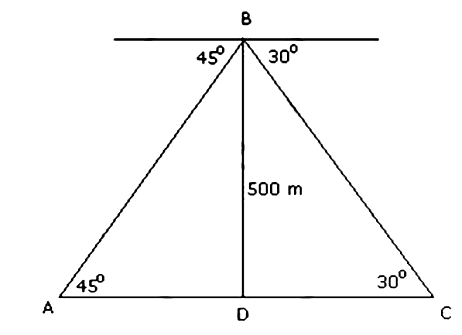
An observer point for ships moving in the sea 500m above the sea level. The person manning this point observes the angle of depression of twc boats as 45° and 30°. Find the distance between the boats when they are on the same side of the observation point and when they are on opposite sides of the observation point.
Answer
Case 1: When the boats are on same side of the observation point.

Let the position of the two ships be $\mathrm{C}$ and $\mathrm{D}$. Let $\mathrm{A}$ be the point of observation.
$
\begin{aligned}
& A B=500 m \\
& \text { In } \triangle B A C
\end{aligned}
$
$
\begin{aligned}
& \tan 45^{\circ}=\frac{\mathrm{AB}}{\mathrm{BC}} \\
& \Rightarrow 1=\frac{500}{\mathrm{BC}} \\
& \Rightarrow \mathrm{BC}=500 \ldots .(1)
\end{aligned}
$
In $\triangle A B D$,
$
\begin{aligned}
& \tan 30^{\circ}=\frac{\mathrm{AB}}{\mathrm{BD}} \\
& \Rightarrow \frac{1}{\sqrt{3}}=\frac{500}{\mathrm{BD}} \\
& \Rightarrow \mathrm{BD}=500 \sqrt{3}\ldots(2)
\end{aligned}
$
From (1) and (2),
Thus, in this case, the distance between the boats is 366 m.
Case 2: When the boats are on different side of the observation point.

Let the position of the two ships be A and C. Let B be the point of observation.
In $\triangle B A D$,
$\tan 45^{\circ}=\frac{\mathrm{BD}}{\mathrm{AD}}$
$
\Rightarrow 1=\frac{500}{\mathrm{AD}}
$
$
\begin{aligned}
& \Rightarrow \mathrm{AD}=500 \ldots(1) \\
& \operatorname{In} \triangle \mathrm{BDC} \\
& \tan 30^{\circ}=\frac{\mathrm{BD}}{\mathrm{DC}} \\
& \Rightarrow \frac{1}{\sqrt{3}}=\frac{500}{\mathrm{DC}} \\
& \Rightarrow \mathrm{DC}=500 \sqrt{3} \ldots .(2)
\end{aligned}
$
From (1) and (2),
$
\mathrm{AC}=\mathrm{AD}+\mathrm{DC}=500(1+\sqrt{3})=500 \times 2.732=1366
$
Thus, in this case, the distance between the boats is $1366 \mathrm{~m}$.
View full question & answer
Question 235 Marks
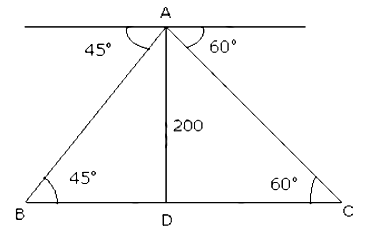
An aeroplane at an altitude of 200 m observes the angles of depression of opposite points on the two banks of a river to be 45° and 60°. Find the width of the river.
Answer

Let $A D$ be the height of the aeroplane and $B C=x \mathrm{~m}$ be the width of the nver.
Given: $A D=200 \mathrm{~m}$
In $\triangle \mathrm{ABD}$
$
\begin{aligned}
& \frac{A D}{B D}=\tan 45^{\circ} \\
& \Rightarrow \frac{A D}{B D}=1 \\
& \Rightarrow A D=B D \\
& \Rightarrow B D=200 m(\because A D=200 m)
\end{aligned}
$
Now,
In $\triangle \mathrm{ACD}$
$
\begin{aligned}
& \frac{\mathrm{AC}}{\mathrm{CD}}=\tan 60^{\circ} \\
& \Rightarrow \frac{\mathrm{AC}}{\mathrm{CD}}=\sqrt{3} \\
& \Rightarrow \mathrm{CD}=\frac{\mathrm{AC}}{\sqrt{3}}=\frac{200}{\sqrt{3}} \\
& \Rightarrow \mathrm{BC}=\mathrm{BD}+\mathrm{CD}=200+\frac{200}{\sqrt{3}}=200+115.47 \\
& \Rightarrow \mathrm{BC}=315.4 \mathrm{~m}
\end{aligned}
$
Thus, the width of the river is $315.4 \mathrm{~m}$.
View full question & answer
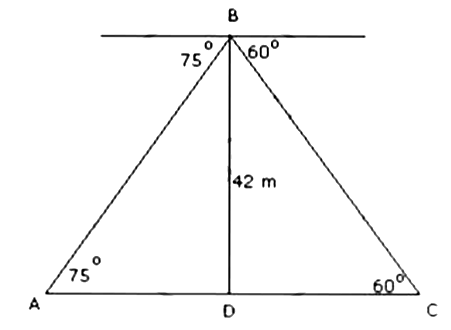
Question 245 Marks

The angles of depression of two cars on a straight road as observed from the top of a 42m high building are 60° and 75° respectively. Find the distance between the cars if they are on opposite sides of the building.

Answer


$
\text { Let the position of the two cars be } \mathrm{A} \text { and } \mathrm{C} \text {. Let } \mathrm{BO} \text { be the building of height } 42 \mathrm{~m} \text {. }
$
$
\begin{aligned}
& \tan 75^{\circ}=\frac{\mathrm{BD}}{\mathrm{AD}} \\
& \Rightarrow 3.7321=\frac{42}{\mathrm{AD}} \\
& \Rightarrow \mathrm{AD}=\frac{42}{3.7321} \\
& \Rightarrow \mathrm{AD}=11.25\ldots(1)
\end{aligned}
$
$
\begin{aligned}
& \operatorname{In} \triangle B D C \\
& \tan 60^{\circ}=\frac{B D}{D C} \\
& \Rightarrow \sqrt{3}=\frac{42}{D C} \\
& \Rightarrow D C=\frac{42}{1.732}=24.25\ldots(2) \\
& \therefore A C=A D+D C=11.25 \mathrm{~m}+24.25 \mathrm{~m}=35.5 \mathrm{~m}
\end{aligned}
$
Thus, the distance between the cars is $67.63 \mathrm{~m}$.
View full question & answer
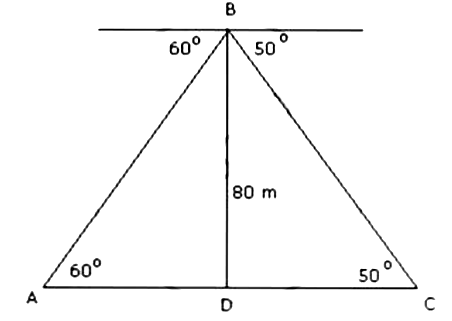
Question 255 Marks
Two persons standing on opposite sides of a tower observe the angles of elevation of the top of the tower to be 60° and 50° respectively. Find the distance between them, if the height of the tower is 80m.
Answer


Let the position of the two persons be A and C. Let BD be the tower of height $80 \mathrm{~m}$. In $\triangle \mathrm{BAD}$,
$
\begin{aligned}
& \tan 60^{\circ}=\frac{\mathrm{BD}}{\mathrm{AD}} \\
& \Rightarrow \sqrt{3}=\frac{80}{\mathrm{AD}} \\
& \Rightarrow \mathrm{AD}=\frac{80}{\sqrt{3}} \\
& \Rightarrow \mathrm{AD}=\frac{80 \sqrt{3}}{3}=\frac{80 \times 1.732}{3}=46.19\ldots(1)
\end{aligned}
$
$\ln \triangle B D C$
$\tan 50^{\circ}=\frac{\mathrm{BD}}{\mathrm{DC}}$
$
\begin{aligned}
& \Rightarrow 1.1918=\frac{80}{\mathrm{DC}} \\
& \Rightarrow \mathrm{DC}=\frac{80}{1.1918}=67.13\ldots(2)
\end{aligned}
$
$
\therefore A C=A D+D C=46.19 m+67.13 m=113.32 m
$
Thus, the horizontal distance between the two persons is $113.32 \mathrm{~m}$.
View full question & answer
Question 265 Marks
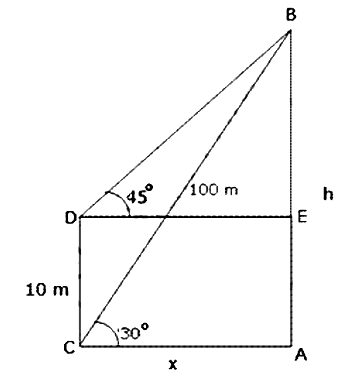
A boy is standing on the ground and flying a kite with 100m of sting at an elevation of 30°. Another boy is standing on the roof of a 10m high building and is flying his kite at an elevation of 45°. Both the boys are on opposite sides of both the kites. Find the length of the string that the second boy must have so that the two kites meet.
Answer


Let $C$ be the position of the first boy and $D$ be the position of the second boy who is standing on the roof of a $10 \mathrm{~m}$ high building.
Let $B$ be the position of the kites of both the boys.
Let $A B=h$ and $C A=x$.
$\ln \triangle \mathrm{ABC}$
$
\begin{aligned}
& \sin 30^{\circ}=\frac{\mathrm{h}}{100} \\
& \Rightarrow \frac{1}{2}=\frac{\mathrm{h}}{100} \\
& \Rightarrow \mathrm{h}=50 \ldots \text { (1) } \\
& \ln \triangle B D E_{,} \\
& \tan 45^{\circ}=\frac{B E}{B D} \\
& \Rightarrow 1=\frac{\mathrm{h}-10}{\mathrm{X}} \\
& \Rightarrow \mathrm{X}=(\mathrm{h}-10) \ldots(2)
\end{aligned}
$
$
\begin{aligned}
& \text { From (1) and (2), } \\
& x=50-10=40
\end{aligned}
$
In $\triangle \mathrm{BDE}^{\prime}$
$
\begin{aligned}
& \sin 45^{\circ}=\frac{\mathrm{BE}}{\mathrm{BD}} \\
& \Rightarrow \frac{1}{\sqrt{2}}=\frac{\mathrm{h}-10}{\mathrm{BC}}
\end{aligned}
$
$
\Rightarrow \mathrm{BC}=\sqrt{2}(50-10)=40 \sqrt{2}
$
Thus, the required length of the string that the second boy must have $40 \sqrt{2} \mathrm{~m}$
View full question & answer
Question 275 Marks
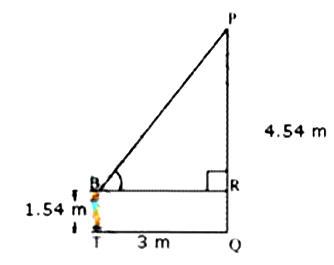
A boy is 1.54 m tall. Standing at a distance of 3m in front of a 4.54 m high wall he can just manage to see the sun. Find the angle of elevation of the sun.
Answer


Let the position of the boy be at point $\mathrm{T}$ and $\mathrm{P}$ be the position of the sun.
$
\begin{aligned}
& \mathrm{BR}=\mathrm{TQ}=3 \mathrm{~m} \\
& \mathrm{PQ}=4.54 \mathrm{~m} \\
& \mathrm{BT}=1.54 \mathrm{~m} \\
& \therefore \mathrm{PR}=4.54 \mathrm{~m}-1.54 \mathrm{~m}=3 \mathrm{~m}
\end{aligned}
$
In $\triangle \mathrm{PRB}$
$
\begin{aligned}
& \frac{\mathrm{PR}}{\mathrm{BR}}=\tan \theta \\
& \frac{3}{3}=\tan \theta \\
& \tan \theta=1
\end{aligned}
$
We know that $\tan 45^{\circ}=1$.
Thus, the angle of elevation is $\theta=45^{\circ}$.
View full question & answer
Question 285 Marks
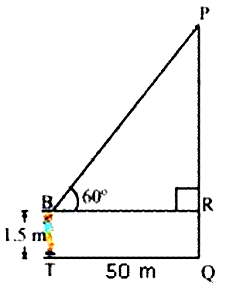
A 1.4m tall boy stands at a point 50m away from a tower and observes the angle of elevation of the top of the tower to be 60°. Find the height of the tower.
Answer


Let the position of the boy be at point $T$.
$
\begin{aligned}
& \mathrm{BR}=\mathrm{TQ}=50 \mathrm{~m} \\
& \mathrm{RQ}=\mathrm{BT}=1.5 \mathrm{~m}
\end{aligned}
$
In $\triangle \mathrm{PRB}$
$
\begin{aligned}
& \frac{\mathrm{PR}}{\mathrm{BR}}=\tan 60^{\circ} \\
& \frac{\mathrm{PR}}{50}=\sqrt{3} \\
& \mathrm{PR}=50 \sqrt{3}
\end{aligned}
$
Height of the tower
$
=\mathrm{PQ}=\mathrm{PR}+\mathrm{RQ}=50 \sqrt{3}+1.5=50 \times 1.732+1.5=86.6+1.5=88.1 \mathrm{~m}
$
Thus, the height of the tower is approximately $88 \mathrm{~m}$.
View full question & answer
Question 295 Marks
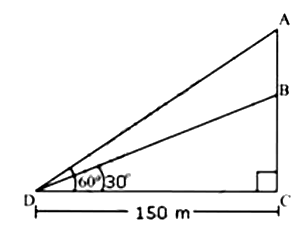
The angle of elevation of the top of an unfinished tower at a point 150 m from its base is 30°. How much higher must the tower be raised so that its angle of elevation at the same point may be 60°?
Answer


Let $B C$ be the length of unfinished tower. Let the tower be raised upto point $A$ so that the angle of elevation at point $\mathrm{A}$ is $60^{\circ}$. $\mathrm{D}$ is the point on ground from where elevation angles are measured.
In $\triangle B C D$
$
\begin{aligned}
& \frac{\mathrm{BC}}{\mathrm{CD}}=\tan 30^{\circ} \\
& \frac{\mathrm{BC}}{\mathrm{CD}}=\frac{1}{\sqrt{3}} \\
& \mathrm{BC}=\frac{\mathrm{CD}}{\sqrt{3}} \\
& \mathrm{BC}=\frac{150}{\sqrt{3}}
\end{aligned}
$
In $\triangle A C D$
$
\begin{aligned}
& \frac{\mathrm{AB}+\mathrm{BC}}{\mathrm{CD}}=\tan 60^{\circ} \\
& \Rightarrow \frac{\mathrm{AB}+\mathrm{BC}}{\mathrm{CD}}=\sqrt{3} \\
& \Rightarrow \frac{\mathrm{AB}+\frac{150}{\sqrt{3}}}{150}=\sqrt{3} \ldots(\text { Using (i) )) }
\end{aligned}
$
$
\begin{aligned}
& \Rightarrow \mathrm{AB}=150 \sqrt{3}-\frac{150}{\sqrt{3}}=\frac{150 \times 3-150}{\sqrt{3}} \\
& \Rightarrow \mathrm{AB}=\frac{300}{\sqrt{3}}=\frac{300}{1.732}=173.2 \mathrm{~m}
\end{aligned}
$
Thus, the required height is $300 \mathrm{~m}$.
View full question & answer
Question 305 Marks
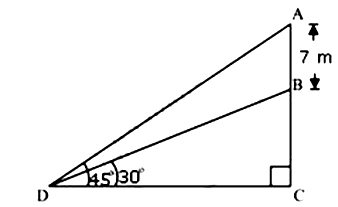
A vertical tow er stands on a horizontal plane and is surmounted by a flagstaff of height 7m. From a point on the plane the angle of elevation of the bottom of the flagstaff is 30° and that of the top of the ft agstaff is 45°. Find the height of the tower.
Answer


Let $A B$ be the flagstaff, $B C$ be the tower and $D$ be the point on ground from where elevation angles are measured.
$
\begin{aligned}
& \ln \triangle \mathrm{BCD} \\
& \frac{\mathrm{BC}}{\mathrm{CD}}=\tan 30^{\circ} \\
& \frac{\mathrm{BC}}{\mathrm{CD}}=\frac{1}{\sqrt{3}} \\
& \sqrt{3} \mathrm{BC}=\mathrm{CD} \\
& \ln \triangle \mathrm{ACD} \\
& \frac{\mathrm{AB}+\mathrm{BC}}{\mathrm{CD}}=\tan 45^{\circ} \\
& \frac{\mathrm{AB}+\mathrm{BC}}{\sqrt{3} \mathrm{BC}}=1 \\
& 7+\mathrm{BC}=\sqrt{3} \mathrm{BC}
\end{aligned}
$
$
\begin{aligned}
& \mathrm{BC}(\sqrt{3}-1)=7 \\
& \mathrm{BC}=\frac{(7)(\sqrt{3}+1)}{(\sqrt{3}-1)(\sqrt{3}+1)} \\
& =\frac{7(\sqrt{3}+1)}{(\sqrt{3})^2-(1)^2} \\
& =\frac{7(\sqrt{3}+1)}{2}=3.5(\sqrt{3}+1)=3.5 \times 2.732=9.562
\end{aligned}
$
Thus, the height of the tower is $9.562 \mathrm{~m}=9.56 \mathrm{~m}$.
View full question & answer
Question 315 Marks
A flagstaff stands on a vertical pole. The angles of elevation of the top and the bottom of the flagstaff from a point on the ground are found to be 60° and 30° respectively. If the height of the pole is 2.5m. Find the height of the flagstaff.
Answer


Let $A B$ be the building and $C D$ be the tower.
$\ln \triangle \mathrm{ABD}$
$
\begin{aligned}
& \frac{\mathrm{AB}}{\mathrm{BD}}=\tan 30^{\circ} \\
& \frac{12}{\mathrm{BD}}=\frac{1}{\sqrt{3}} \\
& \mathrm{BD}=12 \sqrt{3}
\end{aligned}
$
$\ln \triangle \mathrm{ACE}$
$
\begin{aligned}
& \mathrm{AE}=\mathrm{BD}=12 \sqrt{3} \\
& \frac{\mathrm{CE}}{\mathrm{AE}}=\tan 60^{\circ} \\
& \frac{\mathrm{CE}}{12 \sqrt{3}}=\sqrt{3} \\
& \mathrm{CE}=12 \sqrt{3} \times \sqrt{3}=12 \times 3=36 \\
& \mathrm{CD}=\mathrm{CE}+\mathrm{ED}=36+12=48
\end{aligned}
$
So, height of the tower is $48 \mathrm{~m}$ and its distance from the building is $12 \sqrt{3} \mathrm{~m}=12 \times 1.732 \mathrm{~m}=20.78$ m(approximately)
View full question & answer
Question 325 Marks
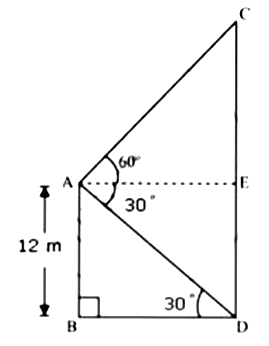
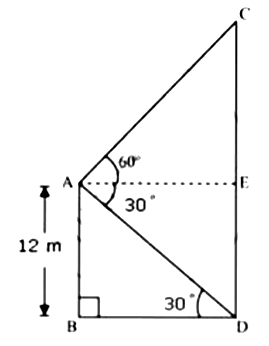
The angles of depression and elevation of the top of a 12m high building from the top and the bottom of a tower are 60° and 30° respectively. Find the height of the tower, and its distance from the building.
Answer


Let $A B$ be the building and $C D$ be the tower.
$\ln \triangle \mathrm{ABD}$
$
\begin{aligned}
& \frac{\mathrm{AB}}{\mathrm{BD}}=\tan 30^{\circ} \\
& \frac{12}{\mathrm{BD}}=\frac{1}{\sqrt{3}} \\
& \mathrm{BD}=12 \sqrt{3}
\end{aligned}
$
$\ln \triangle \mathrm{ACE}$
$
\begin{aligned}
& \mathrm{AE}=\mathrm{BD}=12 \sqrt{3} \\
& \frac{\mathrm{CE}}{\mathrm{AE}}=\tan 60^{\circ} \\
& \frac{\mathrm{CE}}{12 \sqrt{3}}=\sqrt{3} \\
& \mathrm{CE}=12 \sqrt{3} \times \sqrt{3}=12 \times 3=36 \\
& \mathrm{CD}=\mathrm{CE}+\mathrm{ED}=36+12=48
\end{aligned}
$
So, height of the tower is $48 \mathrm{~m}$ and its distance from the building is $12 \sqrt{3} \mathrm{~m}=12 \times 1.732 \mathrm{~m}=20.78$ m(approximately)
View full question & answer
Question 335 Marks
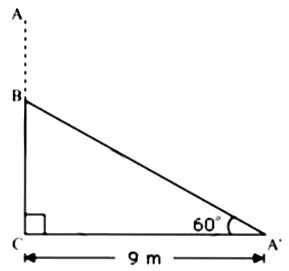
The top of a palm tree having been broken by the wind struck the ground at an angle of 60° at a distance of 9m from the foot of the tree. Find the original height of the palm tree.
Answer

Let $\mathrm{AC}$ was original tree. It was broken into two parts. The broken part $\mathrm{A}^{\prime} \mathrm{B}$ is making $60^{\circ}$ with ground. $\ln \triangle A^{\prime} B C$
$
\begin{aligned}
& \frac{\mathrm{BC}}{\mathrm{A}^{\prime} \mathrm{C}}=\tan 60^{\circ} \\
& \frac{\mathrm{BC}}{9}=\sqrt{3} \\
& B C=9 \sqrt{3} \\
& \frac{\mathrm{A}^{\prime} \mathrm{C}}{\mathrm{A}^{\prime} \mathrm{B}}=\cos 60^{\circ} \\
& \frac{9}{\mathrm{~A}^{\prime} \mathrm{B}}=\frac{1}{2} \\
& A^{\prime} B=18
\end{aligned}
$
Height of tree $=A^{\prime} B+B C$
$
=9 \sqrt{3}+18=9 \times 1.732+18=15.588+18=33.588
$
Hence, the height of tree was $33.588 \mathrm{~m}=33.6 \mathrm{~m}$ (approximately).
View full question & answer
Question 345 Marks
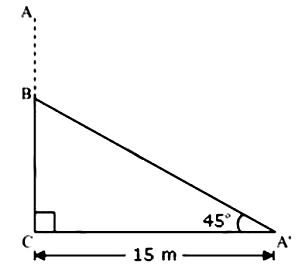
Due to a heavy storm, a part of a banyan tree broke without separating from the main. The top of the tree touched the ground 15 m from the base making an angle of 45° with the ground. Calculate the height of the tree before it was broken.
Answer


Let $\mathrm{AC}$ was original tree. Due to storm it was broken into two parts. The broken part $\mathrm{A}^{\prime} \mathrm{B}$ is making $45^{\circ}$ with ground.
In $\triangle A^{\prime} B C$
$
\begin{aligned}
& \frac{\mathrm{BC}}{\mathrm{A}^{\prime} \mathrm{C}}=\tan 45^{\circ} \\
& \frac{\mathrm{BC}}{15}=1 \\
& \mathrm{BC}=15 \\
& \frac{\mathrm{A}^{\prime} \mathrm{C}}{\mathrm{A}^{\prime} \mathrm{B}}=\cos 45^{\circ} \\
& \frac{15}{\mathrm{~A}^{\prime} \mathrm{B}}=\frac{1}{\sqrt{2}} \\
& A^{\prime} B=15 \sqrt{2}
\end{aligned}
$
Height of tree $=A \prime B+B C=15+15 \sqrt{2}=15(1+\sqrt{2})=15 \times 2.414=36.21$
Hence, the height of tree was $36.21 \mathrm{~m}$.
View full question & answer
Question 355 Marks
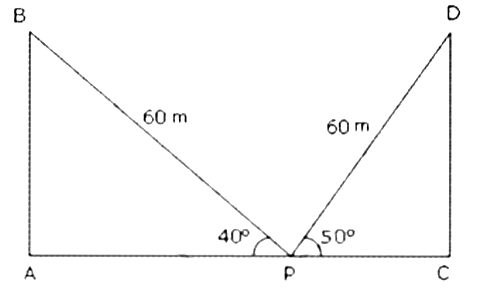
A ladder rests against a tree on one side of a street. The foot of the ladder makes an angle of 50° with the ground. When the ladder is turned over to rest against another tree on the other side of the street it makes an angle of 40° with the ground. If the length of the ladder is 60m, find the width of the street.
Answer


Let $A B$ and $C D$ be two trees and $P$ be a point on the street $A C$ between the two trees.
PD and $\mathrm{PB}$ denotes the ladder at the two instants.
$\ln \triangle \mathrm{PCD}$
$
\begin{aligned}
& \cos 50^{\circ}=\frac{P C}{P D} \\
& 0.6428=\frac{P C}{60} \\
& \Rightarrow P C=0.6428 \times 60=38.568
\end{aligned}
$
$\ln \triangle \mathrm{ABP}$
$\cos 40^{\circ}=\frac{\mathrm{AP}}{\mathrm{BP}}$
$
\Rightarrow 0.7660=\frac{\mathrm{AP}}{60}
$
$
\Rightarrow \mathrm{AP}=0.7660 \times 60=45.96
$
$
\therefore A C=A P+P C=38.568 \mathrm{~m}+45.96 \mathrm{~m}=84.528 \mathrm{~m} \approx 84.53 \mathrm{~m} .
$
Thus, the width of the street is $84.53 \mathrm{~m}$.
View full question & answer
Question 365 Marks
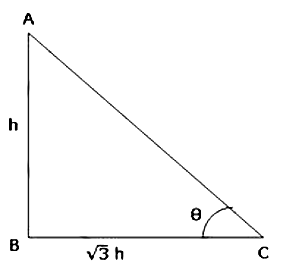
The distance of the gate of a temple from its base is $\sqrt{3}$ times it height. Find the angle of elevation of the top of the temple.
Answer


Let $A B$ be the temple and $C$ be the position of its gate.
Let $\mathrm{h}$ be the height of the temple. Then,
$
A B=h
$
$B C=$ Distance of the gate of temple from its base $=\sqrt{3} \mathrm{~h}$
In $\triangle A B C$,
$
\tan \theta=\frac{\mathrm{AB}}{\mathrm{BC}}
$
$
\Rightarrow \tan \theta=\frac{h}{\sqrt{3} h}=\frac{1}{\sqrt{3}}
$
But, $\tan 30^{\circ}=\frac{1}{\sqrt{3}}$
$
\therefore \theta=30^{\circ}
$
Thus, the angle of elevation of the top of the temple is $30^{\circ}$.
View full question & answer
[5 marks sum] - Mathematics STD 10 Questions - Vidyadip