Questions

[2 Mark Question Answer]

🎯

Test yourself on this topic

15 questions · timed · auto-graded

Question 12 Marks
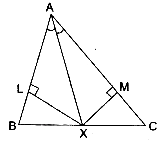
In ΔABC, the bisector AX of ∠A intersects BC ar X. XL ⊥ AB and XM ⊥ AC are drawn (Fig.) is XL = XM? why or why not?
Answer
Since, every point on the bisectors of the angles between two interesting lines is equidistant from the lines. Here, X lies on the bisector of ∠BAC. Therefore, X is equidistant from AB and AC. It is given that XL ⊥ AB and XM ⊥ AC. Therefore, distance of X from AB and AC are XL and XM respectively.
Hence, XL = XM.
View full question & answer
Question 22 Marks
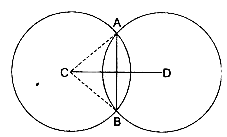
Prove that the common chord of two intersecting circles is bisected at right angles by the line of centres.
Answer
Given: Two interesting circles with centres C &D.
AB is their common chord.
To prove: AB bisected by CD at right angles.

Proof : CA = CB ...(radii)
∴ C lies on the right bisector of AB.
Similarly, D lies on the right bisector of AB.
Therefore, CD is the right bisector of AB.
Hence proved.
View full question & answer
Question 32 Marks
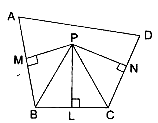
The bisector of ∠ B and ∠C of a quadrilateral ABCD intersect in P, show that P is equidistant from the opposite sides AB and CD.
Answer
Given: A quadrilateral ABCD. Bisectors of ∠B and ∠C meet in P. PM ⊥ AB and PN ⊥ CD.
To prove that : PM = PN ...(1)
Construction: Draw PL ⊥ BC
Proof : P lies on bisector or of ∠B

∴ PM = PL
P lies on bisector of ∠C
PL = PN ...(2)
From (1) and (2), we have
PM = PN.
Hence proved.
View full question & answer
Question 42 Marks
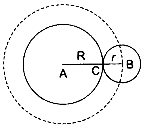
Find the locus of the centre of a circle of radius r touching externally a circle of radius R.
Answer
Let a circle of radius r (with centre B) touch a circle of radius R at C. Then ACB is a straight line and
AB = AC + CB = R + r

Thus, B moves such that its distance from fixed point. A remains constant and is equal to R + r.
Hence, the locus of B is a circle whose centre is A and radius equal to R + r.
View full question & answer
Question 52 Marks
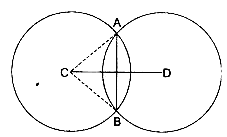
Prove that the common chord of two intersecting circles is bisected at right angles by the line of centres.
Answer
Given: Two interesting circles with centres C &D.
AB is their common chord.
To prove: AB bisected by CD at right angles.

Proof : CA = CB ...(radii)
∴ C lies on the right bisector of AB.
Similarly, D lies on the right bisector of AB.
Therefore, CD is the right bisector of AB.
Hence proved.
View full question & answer
Question 62 Marks
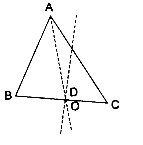
Given a Δ ABC with unequal sides. Find a point which is equidistant from B and C as well as from AB and AC.
Answer
Draw the angular bisector of ∠A and perpendicular bisector od side BC of Δ ABC.
Let these two bisectors meet at point O. Hence'O' is our required point.
Proof: Since, O lies on the right bisector of BC.
∴ O is equidistant from B and C.

Again, since O lies on the bisector of ∠A, formed by AB and AC.
So O is equidistant from AB and AC.
View full question & answer
Question 72 Marks
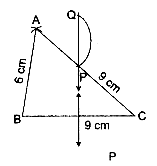
Construct a Δ ABC, with AB = 6 cm, AC = BC = 9 cm; find a point 4 cm from A and equidistant from B and C.
Answer
Construct the ΔABC with given measurements. Draw perpendicular bisector of BC.

With A as centre and 4 cm as radius, draw an arc to intersect perpendicular bisector at P and Q.
Then the points P and Q are the requisite points.
View full question & answer
Question 82 Marks
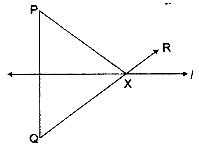
l is the perpendicular bisector of line segment PQ and R is a point on the same side of l as P. The segment QR intersects l at X. Prove that PX + XR = QR.
Answer
Since, line 1 is the perpendicular bisector of PQ and X lies on 1. Therefore, X is equidistant from P and Q.

i.e., PX = QX
⇒ PX + XR = QX + XR
⇒ PX + XR = QR.
Hence proved.
View full question & answer
Question 92 Marks
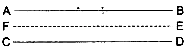
State and draw the locus of a point equidistant from two given parallel lines.
Answer

The locus of a point equidistant from two given parallel lines AB and CD is the line EF parallel to AB or CD exactly mid-way between AB and CD.
View full question & answer
Question 102 Marks
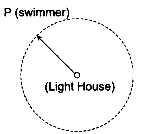
State and draw the locus of a swimmer maintaining the same distance from a lighthouse.
Answer

Proof: The locus of the swimmer will be a circle with light house as the centre and the same distance between the light house and the swimmer as radius.
View full question & answer
Question 112 Marks
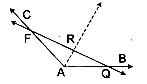
Given: ∠BAC, a line intersects the arms of ∠BAC in P and Q. How will you locate a point on line segment PQ, which is equidistant from AB and AC? Does such a point always exist?
Answer
Since, locus of points equidistant from AB and AC is the bisector of ∠BAC. Draw the bisector of ∠BAC intersecting PQ at R.

Since,R is on the bisector, so it is equidistant from AB and AC.
Yes, such a point always exists as there will be definitely a point where angular bisector and line will intersect.
Hence, R is the required point.
View full question & answer
Question 122 Marks
Without using set squares or protractor.
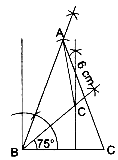
(i) Construct a ΔABC, given BC = 4 cm, angle B = 75° and CA = 6 cm.
(ii) Find the point P such that PB = PC and P is equidistant from the side BC and BA. Measure AP.
Answer
(i) Draw BC = 4 cm. Draw BA at B such that ∠ABC = 75°. Cut CA = 6 cm. Then ΔABC is the required Δ.

(ii) Draw single bisector of ∠B. Draw ⊥ bisector of BC. Their point of intersection (P) is the requisite point.
AP = 3·9 cm.
View full question & answer
Question 132 Marks
Without using set squares or protractor construct:
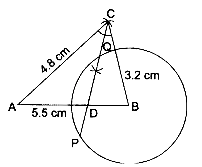
(i) Triangle ABC, in which AB = 5.5 cm, BC = 3.2 cm and CA = 4.8 cm.
(ii) Draw the locus of a point which moves so that it is always 2.5 cm from B.
(iii) Draw the locus of a point which moves so that it is equidistant from the sides BC and CA.
(iv) Mark the point of intersection of the loci with the letter P and measure PC.
Answer
(i) Draw a triangle by given measurements.
(ii) The locus of a point which moves so that it is always 2·5 cm from B is a circle as shown in the figure.
(iii) The locus of a point is bisector of ∠ACB.

(iv) The circle and bisector intersect in two points PD = 0·9 cm and PC = 3.4 cm.
View full question & answer
Question 142 Marks
Without using set squares or protractor construct a triangle ABC in which AB = 4 cm, BC = 5 cm and ∠ABC = 120°.
(i) Locate the point P such that ∠BAp = 90° and BP = CP.
(ii) Measure the length of BP.
Answer
(i) Draw ⊥ bisector of BC. Draw AP at A such that ∠PAB = 90°. The point of intersection P of bisector and AP is the required point.
(ii) BP = 6·5 cm.
View full question & answer
Question 152 Marks
Using only a ruler and compass construct ∠ABC = 120°, where AB = BC = 5 cm.
(i) Mark two points D and E which satisfy the condition that they are equidistant from both ABA and BC.
(ii) In the above figure, join AD, DC, AE and EC. Describe the figures:
(a) AECB, (b) ABD, (c) ABE.
Answer
(i) and (ii)

(a) A quadrilateral
(b) A triangle
(c) A triangle.
View full question & answer
[2 Mark Question Answer] - Mathematics STD 10 Questions - Vidyadip