Questions

[2 Mark Question Answer]

🎯

Test yourself on this topic

17 questions · timed · auto-graded

Question 12 Marks
Describe the locus for questions 1 to 13 given below:

The locus of the centres of all circles passing through two fixed points.

Answer
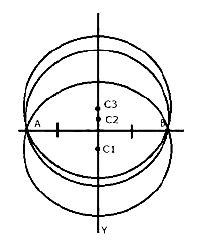
The locus of the centre of all the circles which pass through two fixed points will be the perpendicular bisector of the line segment joining the two given fixed points.
View full question & answer
Question 22 Marks
Describe the locus for questions 1 to 13 given below:

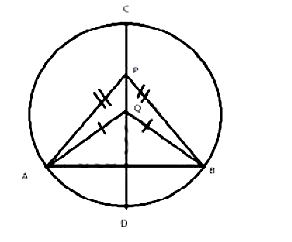
The locus of points inside a circle and equidistant from two fixed points on the circumference of the circle.

Answer

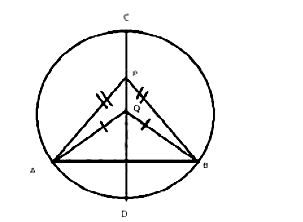
The locus of the points inside the circle which are equidistant from the fixed points on the circumference of a circle will be the diameter which is perpendicular bisector of the line joining the two fixed points on the circle.
View full question & answer
Question 32 Marks
Describe the locus for questions 1 to 13 given below:

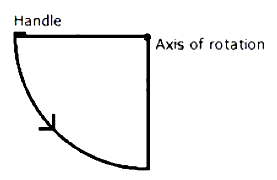
The locus of the door handle, as the door opens .

Answer

The locus of the door handle will be the circumference of a circle with centre at the axis of rotation of the door and radius equal to the distance between the door handle and the axis of rotation of the door.
View full question & answer
Question 42 Marks
Describe the locus for questions 1 to 13 given below:

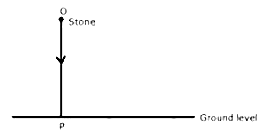
The locus of a stone dropped from the top of a tower.

Answer

The locus of a stone which is dropped from the top of a tower will be a vertical line through the point from which the stone is dropped.
View full question & answer
Question 52 Marks
Describe the locus for questions 1 to 13 given below:

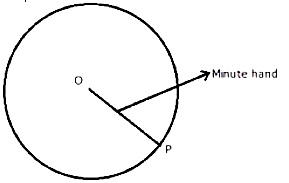
The locus of the moving end of the minute hand of a clock.

Answer

The locus of the moving end of the minute hand of the clock will be a circle where radius will be the length of the minute hand
View full question & answer
Question 62 Marks
Describe the locus for questions 1 to 13 given below:

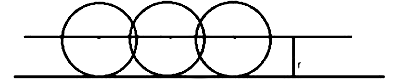
The locus of the centre of a wheel of a bicycle going straight along a level road.

Answer

The locus of the centre of a wheel, which is going straight along a level road will be a straight line parallel to the road at a distance equal to the radius of the wheel.
View full question & answer
Question 72 Marks
Describe the locus for questions 1 to 13 given below:
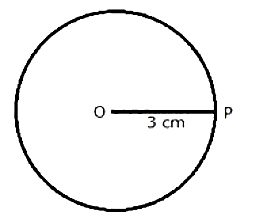
1. The locus of a point at a distant 3 cm from a fixed point.
Answer

The locus of a point which is 3 cm away from a fixed point is circumference of a circle whose radius is 3 cm and the fixed point is the centre of the circle.
View full question & answer
Question 82 Marks
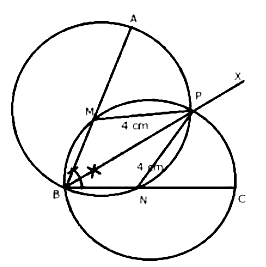
Angle ABC = 60° and BA = BC = 8 cm. The mid points of BA and BC are M and N respectively. Draw and describe the locus of a point which is:
(i) Equidistant from BA and BC.
(ii) 4 cm from M
(iii) 4 cm from N
Mark the point P, which is 4 cm from both M and N, and equidistant from BA and BC. Join MP and NP, and describe the figure BMPN.
Answer

i) Draw an angle of 60° with AB = BC = 8 cm
ii) Draw the angle bisector BX of ∠ABC
iii) With centre M and N, draw circles of radius equal to 4 cm, which intersects each other at P. P is the required point.
iv) Join MP, NP
BMPN is a rhombus since MP = BM = NB = NP = 4 cm.
View full question & answer
Question 92 Marks
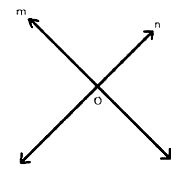
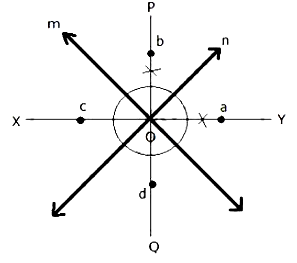
In the given figure, obtain all the points equidistant from lines m and n; and 2.5 cm from O.
Answer

Draw an angle bisector PQ and XY of angles formed by the lines m and n. From O, draw arcs with radius 2.5 cm, which intersect the angle bisectors at a, b, c and d respectively.
Hence, a, b, c and d are the required four points.
View full question & answer
Question 102 Marks
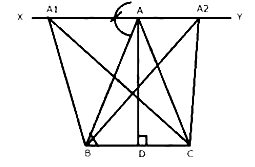
Sketch and describe the locus of the vertices of all triangles with a given base and a given altitude.
Answer

Draw a line XY parallel to the base BC from the vertex A.
This line is the locus of vertex A of all the triangles which have the base BC and length of altitude equal to AD.
View full question & answer
Question 112 Marks
Describe:

The locus of points within a circle that are equidistant from the end points of a given chord.

Answer
The locus of the points within a circle which are equidistant from the end points of a given chord is the diameter which is perpendicular bisector of the given chord.
View full question & answer
Question 122 Marks
Describe:

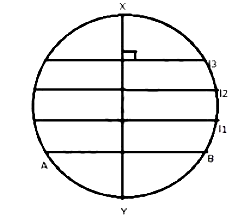
The locus of the mod-points of all chords parallel to a given chord of a circle.

Answer
The locus of the mid-points of the chords which are parallel to a given chords is the diameter perpendicular to the given chords.
View full question & answer
Question 132 Marks
Describe:

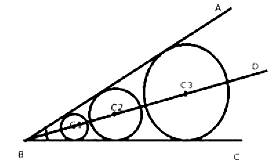
The locus of the centres of all circles that are tangent to both the arms of a given angle.

Answer
The locus of the centre of all circles whose tangents are the arms of a given angle is the bisector of that angle.
View full question & answer
Question 142 Marks
Describe:

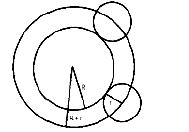
The locus of the centres of a given circle which rolls around the outside of a second circle and is always touching it.

Answer
The locus is the circumference of the circle concentric with the second circle whose radius is equal to the sum of the radii of the two given circles.
View full question & answer
Question 152 Marks
Describe the locus for questions 1 to 13 given below:

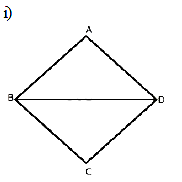
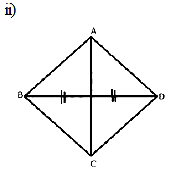
The locus of a point in rhombus ABCD, so that it is equidistant from
(i) AB and BC; (ii) B and D .

Answer

The locus of the point in a rhombus ABCD which is equidistant from AB and BC will be the diagonal BD.
The locus of the point in a rhombus ABCD which is equidistant from B and D will be the diagonal AC.
View full question & answer
Question 162 Marks
Describe the locus for questions 1 to 13 given below:
The locus of a point P, so that:
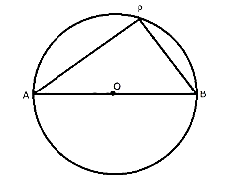
$A B^2=A P^2+B P^2$,
Where A and B are two fixed points.
Answer

The locus of the point P is the circumference of a circle with AB as diameter and satisfies the condition $A B^2=A P^2+B P^2$
View full question & answer
Question 172 Marks
Describe the locus for questions 1 to 13 given below:

The locus of vertices of all isosceles triangles having a common base.

Answer

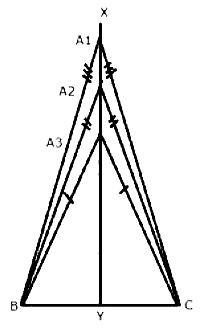
The locus of vertices of all isosceles triangles having a common base will be the perpendicular bisector of the common base of the triangles.
View full question & answer
[2 Mark Question Answer] - Mathematics STD 10 Questions - Vidyadip