Questions

[3 marks sum]

🎯

Test yourself on this topic

24 questions · timed · auto-graded

Question 13 Marks
Describe the locus for questions 1 to 13 given below:

The locus of a runner, running round a circular track and always keeping a distance of 1.5 m from the inner edge.

Answer
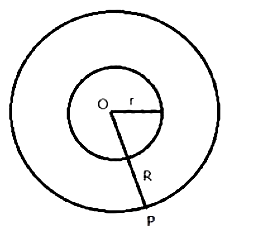
The locus of the runner, running around a circular track and always keeping a distance of 1.5 m from the inner edge will be the circumference of a circle whose radius is equal to the radius of the inner circular track plus 1.5 m.
View full question & answer
Question 23 Marks
Describe the locus for questions 1 to 13 given below:

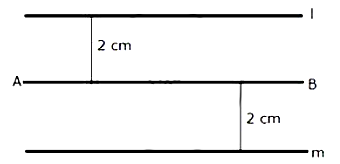
The locus of points at a distance 2cm from a fixed line.

Answer

The locus of a point at a distance of 2 cm from a fixed line AB is a pair of straight lines l and m which are parallel to the given line at a distance of 2 cm.
View full question & answer
Question 33 Marks
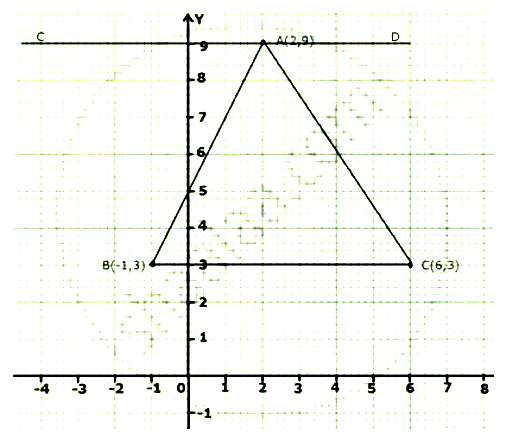
Plot the points A(2, 9), B(-1, 3) and C (6, 3) on graph paper. On the same graph paper draw the locus of point A so that the area of ΔABC remains the same as A moves.
Answer

Steps of construction:
i) Plot the given points on graph paper.
ii) Join AB, BC and AC.
iii) Draw a line parallel to BC at A and mark it as CD.
CD is the required locus of point A where area of triangle ABC remains same on moving point A
View full question & answer
Question 43 Marks
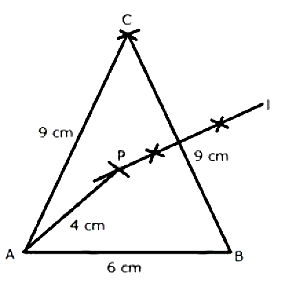
Construct a triangle ABC, with AB = 6 cm, AC = BC = 9cm. Find a point 4 cm from A and equidistant from B and C.
Answer

Steps of Construction:
i) Draw a line segment AB = 6 cm
ii) With A and B as centers and radius 9 cm, draw two arcs which intersect each other at C.
iii) Join AC and BC.
iv) Draw the perpendicular bisector of BC.
v) With A as centre and radius 4 cm, draw an arc which intersects the perpendicular bisector of BC at P.
P is the required point which is equidistant from B and C and at a distance of 4 cm from A.
View full question & answer
Question 53 Marks
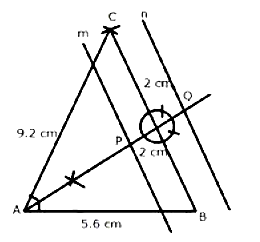
Construct a triangle ABC, with AB = 5.6 cm, AC = BC = 9.2 cm. Find the points equidistant from AB and AC; and also 2 cm from BC. Measure the distance between the two points obtained.
Answer

Steps of Construction:
i) Draw a line segment AB = 5.6 cm
ii) From A and B, as centers and radius 9.2 cm, make two arcs which intersect each other at C.
iii) Join CA and CB.
iv) Draw two lines n and m parallel to BC at a distance of 2 cm
v) Draw the angle bisector of ∠BAC which intersects m and n at P and Q respectively.
P and Q are the required points which are equidistant from AB and AC.
On measuring the distance between P and Q is 4.3 cm.
View full question & answer
Question 63 Marks
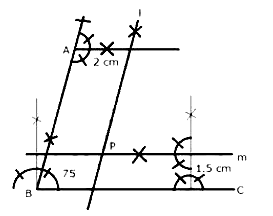
Draw an angle ABC = 75°. Find a point P such that P is at a distance of 2 cm from AB and 1.5 cm from BC.
Answer

Steps of Construction:
i) Draw a ray BC.
ii) At B, draw a ray BA making an angle of 75° with BC.
iii) Draw a line l parallel to AB at a distance of 2 cm
iv) Draw another line m parallel to BC at a distance of 1.5 cm which intersects line l at P.
P is the required point.
View full question & answer
Question 73 Marks
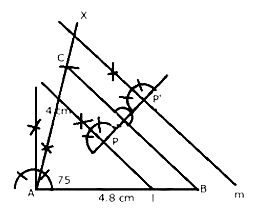
Construct a triangle ABC, having given AB = 4.8 cm, AC = 4cm, and ∠A = 75°.
Find a point P.
(i) Inside the triangle ABC.
(ii) outside the triangle ABC
Equidistant from B and C; and at a distance of 1.2 cm from BC.

Answer

Steps of Construction:
i) Draw a line segment AB = 4.8 cm
ii) At A, draw a ray AX making an angle of 75°
iii) Cut off AC = 4 cm from AX
iv) Join BC.
ABC is the required triangle.
v) Draw two lines l and m parallel to BC at a distance of 1.2 cm
vi) Draw the perpendicular bisector of BC which intersects l and m at P and P’
P and P’ are the required points which are inside and outside the given triangle ABC.
View full question & answer
Question 83 Marks
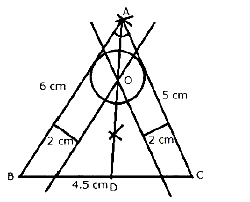
Draw a triangle ABC in which AB = 6cm, BC = 4.5 cm and AC = 5cm. Draw and label:
(i) the locus of the centres of all circles which touch AB and AC,
(ii) the locus of the centres of all the circles of radius 2 cm which touch AB.
Hence, construct the circle of radius 2cm which touches AB and AC .
Answer

Steps of Construction:
i) Draw a line segment BC = 4.5 cm
ii) With B as centre and radius 6 cm and C as centre and radius 5 cm, draw arcs which intersect each other at A.
iii) Join AB and AC.
ABC is the required triangle.
iv) Draw the angle bisector of ∠BAC
v) Draw lines parallel to AB and AC at a distance of 2 cm, which intersect each other and AD at O.
vi) With centre O and radius 2 cm, draw a circle which touches AB and AC.
View full question & answer
Question 93 Marks
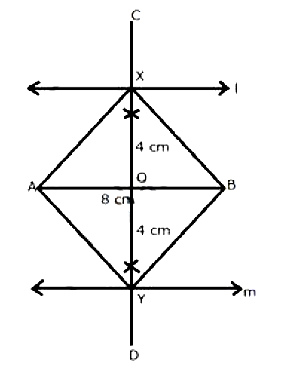
A straight line AB is 8cm long. Draw and describe the locus of a point which is:
(i) always 4 cm from the line AB.
(ii) equidistant from A and B.
Mark the two points X and Y, which are 4cm from AB and equidistant from A and B. describe the figure AXBY.
Answer

(i)Draw a line segment AB = 8 cm.
(ii)Draw two parallel lines l and m to AB at a distance of 4 cm.
(iii)Draw the perpendicular bisector of AB which intersects the parallel lines l and m at X and Y respectively then, X and Y are the required points.
(iv)Join AX, AY, BX and BY.
The figure AXBY is a square as its diagonals are equal and intersect at 90°.
View full question & answer
Question 103 Marks
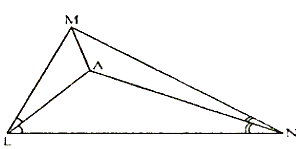
In triangle LMN, bisectors of interior angles at L and N intersect each other at point A. prove that:
(i) Point A is equidistant from all the three sides of the triangle.
(ii) AM bisects angle LMN.
Answer

Construction: Join AM
Proof:
∵ A lies on bisector of ∠N
∴ A is equidistant from MN and LN.
Again, A lies on bisector of ∠L
∴ A is equidistant from LN and LM.
Hence, A is equidistant from all sides of the triangle LMN.
∴ A lies on the bisector of ∠M
View full question & answer
Question 113 Marks
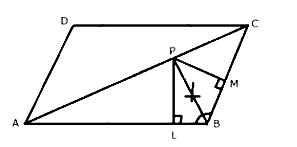
In parallelogram ABCD, side AB is greater than side BC and P is a point in AC such that PB bisects angle B.
Prove that P is equidistant from AB and BC.
Answer

Construction: From P, draw PL ⊥ AB and PM ⊥ BC
Proof: In ΔPLB and ΔPMB
∠PLB = ∠PMB (each = 90°)
∠PBL = ∠PBM (Given)
PB = PB (Common)
∴ By Angle – angle side criterion of congruence,
ΔPLB ≅ ΔPMB (AAS postulate)
The corresponding parts of the congruent triangles are congruent
∴ PL = PM (CPCT)
Hence, P is equidistant from AB and BC
View full question & answer
Question 123 Marks
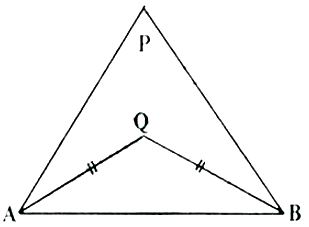
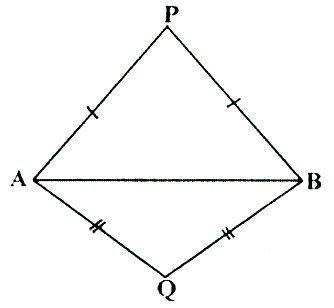
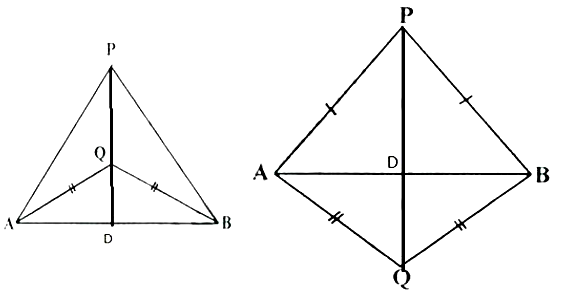
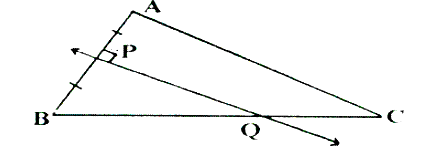
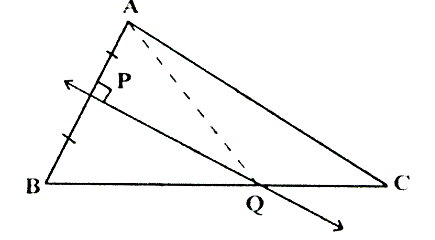
In each of the given figures; PA = PB and QA = QB.


Prove, in each case, that PQ (produce, if required) is perpendicular bisector of AB. Hence, state the locus of the points equidistant from two given fixed points.
Answer
Construction: Join PQ which meets AB in D.

Proof: P is equidistant from A and B.
∴ P lies on the perpendicular bisector of AB.
Similarly, Q is equidistant from A and B.
∴ Q lies on perpendicular bisector of AB.
∴ P and Q both lie on the perpendicular bisector of AB.
∴ PQ is perpendicular bisector of AB.
Hence, locus of the points which are equidistant from two fixed points, is a perpendicular bisector of the line joining the fixed points.
View full question & answer
Question 133 Marks
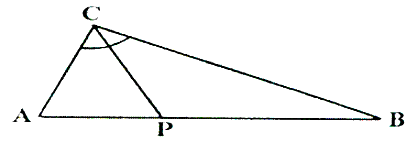
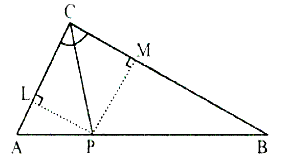
Given: CP is bisector of angle C of ΔABC.

Prove: P is equidistant from AC and BC.
Answer

Construction: From P, draw PL ⊥ AB and PM ⊥ CB
Proof: In ΔLPC and ΔMPC,
∠PLC = ∠PMC (Each = 90°)
∠PCL = ∠MCP (Given)
PC = PC (Common)
∴ By angle- side angle criterion of congruence,
ΔLPC ≅ ΔMPC (AAS postulate)
The corresponding parts of the congruent triangles are congruent
∴ PL = PM (CPCT)
Hence, P is equidistant from AC and AB
View full question & answer
Question 143 Marks
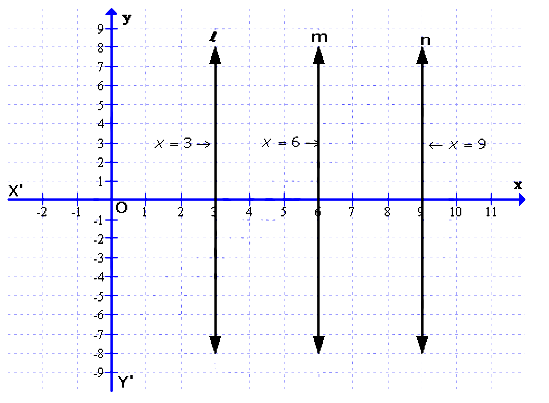
On a graph paper, draw the line x = 6. Now, on the same graph paper, draw the locus of the point which moves in such a way that its distantce from the given line is always equal to 3 units
Answer

On the graph, draw axis XOX’ and YOY’
Draw a line l, x = 6 which is parallel to y-axis
Take points P and Q which are at a distance of 3 units from the line l.
Draw lines m and n from P and Q parallel to l
With locus = 3, two lines can be drawn x = 3 and x = 9.
View full question & answer
Question 153 Marks
Given: PQ is perpendicular bisector of side AB of the triangle ABC.

Prove: Q is equidistant from A and B.
Answer

Construction: Join AQ
Proof: In ΔAQP and ΔBQP
AP = BP (given)
∠QPA = ∠QPB (Each = 90°)
PQ = PQ (Common)
By side – Angle – side criterion of congruence, we have
ΔAQP ≅ ΔBQP (SAS postulate)
The corresponding parts of the triangle are congruent
∴ AQ = BQ (CPCT)
Hence Q is equidistant from A and B.
View full question & answer
Question 163 Marks
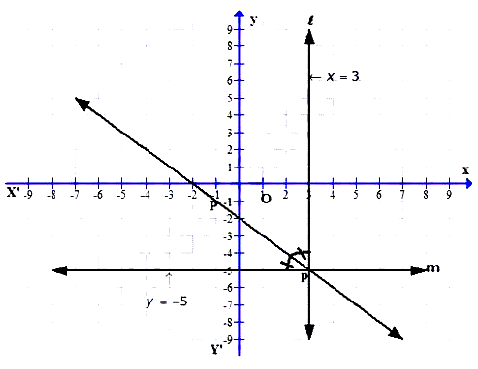
On a graph paper, draw the lines x = 3 and y = - 5. Now, on the same graph paper, draw the locus of the point which is equidistant from the given lines.
Answer

On the graph, draw axis XOX’ and YOY’
Draw a line l, x = 3 which is parallel to y-axis
And draw another line m, y = -5, which is parallel to x-axis
These two lines intersect each other at P.
Now draw the angle bisector p of angle P.
Since p is the angle bisector of P, any point on P is equidistant from l and m.
Therefore, this line p is equidistant from l and m.
View full question & answer
Question 173 Marks
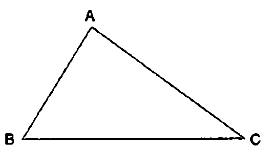
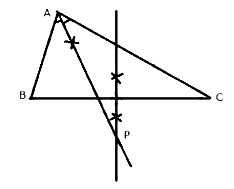
In the given triangle ABC, find a point P equidistant from AB and AC; and also equidistant from B and C.
Answer

Steps of Construction:
i) In the given triangle, draw the angle bisector of ∠BAC.
ii) Draw the perpendicular bisector of BC which intersects the angle bisector at P.
P is the required point which is equidistant from AB and AC as well as from B and C.
Since P lies on angle bisector of ∠BAC,
It is equidistant from AB and AC.
Again, P lies on perpendicular bisector of BC,
Therefore, it is equidistant from B and C.
View full question & answer
Question 183 Marks
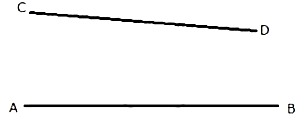
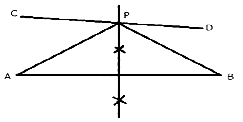
In the figure given below, find a point P on CD equidistant from points A and B.
Answer

Steps of Construction:
i) AB and CD are the two lines given.
ii) Draw a perpendicular bisector of line AB which intersects CD in P.
P is the required point which is equidistant from A and B.
Since P lies on perpendicular bisector of AB; PA = PB.
View full question & answer
Question 193 Marks
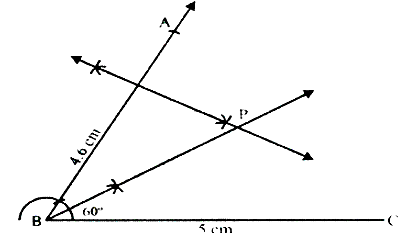
Draw an ∠ABC = 60°, having AB = 4.6 cm and BC = 5cm. Find a point P equidistant from AB and BC; and also equidistant from A and B.
Answer

Steps of Construction:
i) Draw a line segment BC = 5 cm
ii) At B, draw a ray BX making an angle of 60° and cut off BA = 4.6 cm.
iii) Draw the angle bisector of ∠ABC.
iv) Draw the perpendicular bisector of AB which intersects the angle bisector at P.
P is the required point which is equidistant from AB and BC, as well as from A and B.
View full question & answer
Question 203 Marks
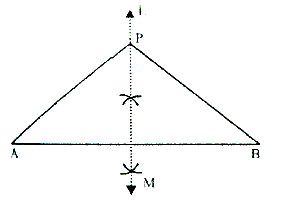
Draw a line AB = 6 cm. Draw the locus of all the points which are equidistant from A and B.
Answer

Steps of construction:
(i) Draw a line segment AB of 6 cm.
(ii) Draw perpendicular bisector LM of AB. LM is the required locus.
(iii) Take any point on LM say P.
(iv) Join PA and PB. Since, P lies on the right bisector of line AB. Therefore, P is equidistant from A and B.
i.e. PA = PB Hence, Perpendicular bisector of AB is the locus of all points which are equidistant from A and B.
View full question & answer
Question 213 Marks
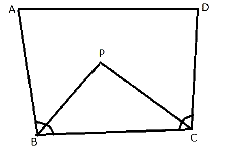
The bisectors of ∠B and ∠C of a quadrilateral ABCD intersect each other at point P. Show that P is equidistant from the opposite sides AB and CD.
Answer

Since P lies on the bisector of angle B,
therefore, P is equidistant from AB and BC .... (1)
Similarly, P lies on the bisector of angle C,
therefore, P is equidistant from BC and CD .... (2)
From (1) and (2),
Hence, P is equidistant from AB and CD.
View full question & answer
Question 223 Marks
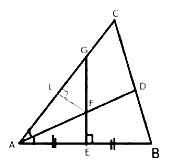
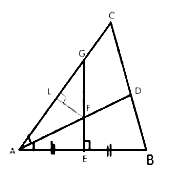
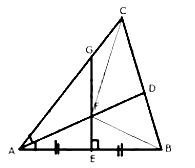
The given figure shows a triangle ABC in which AD bisects angle BAC. EG is perpendicular bisector of side AB which intersects AD at point F.
Prove that:

(ii) F is equidistant from AB and AC.
Answer

Construction: Draw LF ⊥ AC
Proof: In Δ AFL and ΔAFE,
∠FEA = ∠FLA (Each = 90°)
∠LAF = FAE (AD bi sects ∠BAC)
AF = AF (common)
∴ By angle – Angle side criterion of congruence,
ΔAFL ≅ AFE (AAS postulate)
The corresponding parts of the congruent triangles are congruent.
∴ FE = FL (CPCT)
Hence, F is equidistant from AB and AC.
View full question & answer
Question 233 Marks
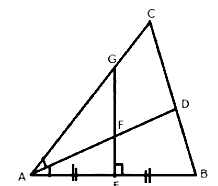
The given figure shows a triangle ABC in which AD bisects angle BAC. EG is perpendicular bisector of side AB which intersects AD at point F.
Prove that:

F is equidistant from A and B.
Answer

Construction: Join FB and FC
Proof: In ΔAFE and ΔFBE,
AE = EB (E is the mid-point of AB)
∠FEA = ∠FEB (Each = 90°)
FE = FE (Common)
∴ By side Angle side criterion of congruence,
ΔAFE ≅ ΔFBE (SAS Postulate)
The corresponding parts of the congruent triangles are congruent.
∴ AF = FB (CPCT)
Hence, F is equidistant from A and B.
View full question & answer
Question 243 Marks
Use ruler and compasses only for this question.
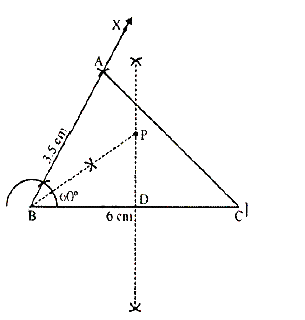
(i) Construct ΔABC, where AB = 3.5 cm, BC = 6cm and ∠ABC = 60°.
(ii) Construct the locus of points inside the triangle which are equidistant from BA and BC.
(iii) Construct the locus of points inside the triangle which are equidistant from B and C.
(iv) Mark the point P which is equidistant from AB, BC and also equidistant from B and C. measure and record the length of PB.
Answer
Steps of construction:
i) Draw line BC = 6 cm and an angle CBX = 60°. Cut off AB = 3.5. Join AC, triangle ABC is the required triangle.
ii) Draw perpendicular bisector of BC and bisector of angle B
iii) Bisector of angle B meets bisector of BC at P.
⟹ BP is the required length, where, PB = 3.5 cm
iv) P is the point which is equidistant from BA and BC, also equidistant from B and C.

PB = 3.6 cm
View full question & answer