Questions

[3 marks sum]

🎯

Test yourself on this topic

5 questions · timed · auto-graded

Question 13 Marks
Draw two intersecting lines to include an angle of 30°. Use ruler and compasses to locate points which are equidistant from these Iines and also 2 cm away from their point of intersection. How many such points exist?
Answer
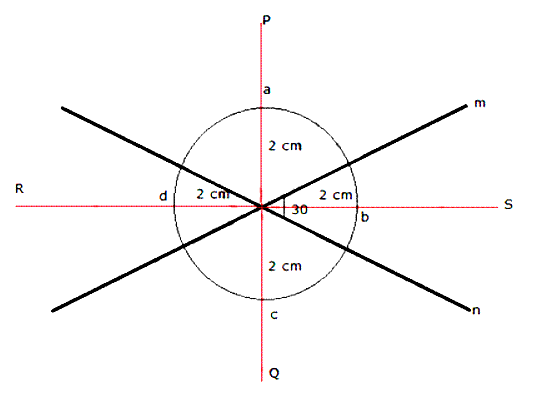
Draw an angle bisectcr PQ and RS of angles formed by the lines m and n. From centre draw a circle with radius 2 cm, whidi intersect the angle bisectors at a, b, c and d respectively.
Hence, a, b, c and d are the required four points.
View full question & answer
Question 23 Marks
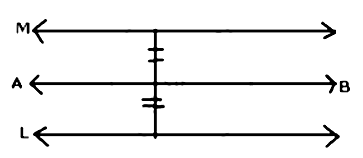
State the locus of a point moving so that its perpendicular distances from two given lines is always equal.
Answer

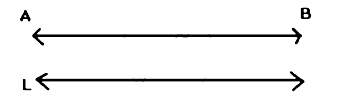
The locus of a point so lhat its perpendiOJlar distance from two given lines is always equal is a line AB parallel to given lines L and M.
View full question & answer
Question 33 Marks
A point moves such that its distance from a fixed line AB is always the same. What is the relation between AB and the path travelled by the point?
Answer

The locus of a point which moves so that its distance from a fixed straight line is same is a pair of straight lines parallel to the given line, one on each side of it and at the given distance from it.
View full question & answer
Question 43 Marks
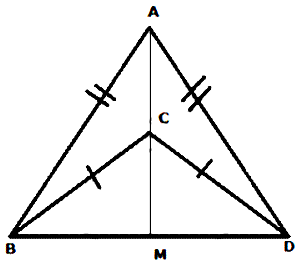
In given figure 1 ABCD is an arrowhead. AB = AD and BC = CD. Prove th at AC produced bisects BD at right angles at the point M
Answer
A is equidistant from B and 0 . Therefore, A lies on perpendicular bisector of BO.
C is equidistant from Band 0. Therefore, C lies on perpendicular bisector of BO.
A and C both lie on perpendicular bisector of BO.
Hence, AC is perpendicular bisector of BO.
Since AC is perpendicular bisector of BO so ∠ AMB = ∠ AMO = right angle.
View full question & answer
Question 53 Marks
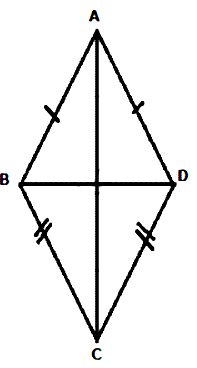
In given figure, ABCD is a kite. AB = AD and BC =CD. Prove that the diagona AC is the perpendirular bisector of the diagonal BD.
Answer
A is equidistant from B and D. Therefore, A lies on perpendicular bisector of BD.
C is equidistant from Band D. Therefore, C lies on perpendicular bisector ofBD.
A and C both lie on perpendicular bisector of BD.
Hence, AC is perpendicular bi sector of BD.
View full question & answer
[3 marks sum] - Mathematics STD 10 Questions - Vidyadip