Questions

[4 marks sum]

🎯

Test yourself on this topic

29 questions · timed · auto-graded

Question 14 Marks
The mean monthly income of $10$ persons is Rs $8,670.$ If a new member with a monthly income of Rs $9, 000$ joins the group, find the new monthly income.
Answer
Mean monthly salary of 10 people $=$ Rs 8,670
$ n =10$
$\bar{x}=\frac{x_1+x_2+x_3+\ldots .+x_n}{n}$
$\text { Rs. } 8670=\frac{\Sigma x_n}{10}$
$\Rightarrow \Sigma x_n=\text { Rs.86, } 700 $
Salary of new person $=$ Rs 9000
$ \Sigma x_n=\text { Rs. }(86,700+9,000)$
$\Sigma x_n=\text { Rs. } 95,700$
$n =11$
$\bar{x}=\frac{x_1+x_2+x_3+\ldots .+x_n}{n}$
$\Rightarrow \bar{x}=\frac{\operatorname{Rs} .95,700}{11}$
$\Rightarrow \bar{x}=\text { Rs.8, } 700 $
The new mean monthly inoome $= Rs.8,700$
View full question & answer
Question 24 Marks
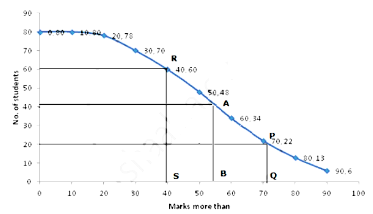
Estimate the median, the lower quartile and the upper quartile of the following frequency distribution by drawing an ogive: 
Marks(more than) 90 80 70 60 50 40 30 20 10 0
No. of students 6 13 22 34 48 60 70 78 80 80
View full question & answer
Question 34 Marks
Estimate the median, the lower quartile and the upper quartile of the following frequency distribution by drawing an ogive: 
Age( in yrs)  Under $10$ Under $20$ Under $30$ Under $40$ Under $50$ Under $60$
No. of male $6$ $10$ $25$ $32$ $43$ $50$
Answer
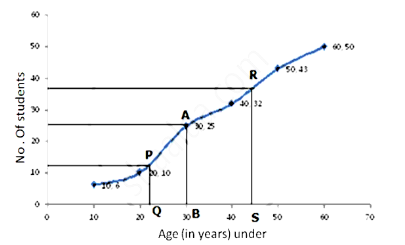
Given data is cumulative data , so draw the ogive as it is .
Age $($ in yrs $)$ Under No. of males $(f)$
$10$ $6$
$20$ $10$
$30$ $25$
$40$ $32$
$50$ $43$
$60$ $50$
Take a graph paper and draw both the axes.
On the $x-$axis, take a scale of $1 cm =10$ to represe the Age $($in yrs$)$ under.
On the $y-$axis, take a scale of $1 cm =10$ to represe the no. of males.
Now , plot the points $(10,6),(20,10),(30,25),(40,3$ $(50,43),(60,5)$.
Join them by a smooth curve to get the ogive.
Image
$ \text { No. of terms }=50$
$\therefore \text { Median }=\frac{25+26}{2}=25.5^{\text {th }} \text { term } $
Through mark of $25.5$ on $y-$axis draw a line parallel to $x-$axis which meets the curve at $A$.
From $A$, draw a perpendicular to $x-$axis which meets it at $B$.
The value of $B$ is the median which is $30 .$
Lower Quartile $\left( Q _1\right)=\frac{n}{4}=\frac{50}{4}=12.5^{\text {th }}$ term
Through mark of $12.5$ on $y-$axis draw a line parallel to $x-$axis which meets the curve at $P$.
From a perpendicular to $x$-axis which meets it at $Q$.
The value of $Q$ is the lower quartile which is $22 .$
Upper Quartile $\left( Q _3\right)=\frac{n \times 3}{4}=\frac{50 \times 3}{4}=37.5^{\text {th }}$ term
Through mark of $37.5$ on $y-$axis draw a line parallel to $x-$axis which meets the curve at $R$.
From $R$, draw a perpendicular to $x-$axis which meets it at $S$.
The value of $S$ is the upper quartile which is $44 .$
View full question & answer
Question 44 Marks
Estimate the median, the lower quartile and the upper quartile of the following frequency distribution by drawing an ogive: 
Marks (less than) 10 20 30 40 50 60 70 80
No. of students 5 15 30 54 72 86 94 100
View full question & answer
Question 54 Marks
Estimate the median, the lower quartile and the upper quartile of the following frequency distribution by drawing an ogive: 
Marks  30-40 40-50 50-60 60-70 70-80 80-90 90-100
No. of boys  10 12 14 12 9 7 6
View full question & answer
Question 64 Marks
Find the lower quartile, the upper quartile, the interquartile range and the semi-interquartile range for the following frequency distributions: 
Variate  10 11 12 13 14 15 16 17 18 19 20
Frequency 1 2 3 1 2 4 2 1 1 2 1
View full question & answer
Question 74 Marks
Find the lower quartile, the upper quartile, the interquartile range and the semi-interquartile range for the following frequency distributions: 
Marks  25 30 35 40 45 50
No. of students 6 15 12 10 18 9
Answer
Marks  No. of students (f)  Cumulative frequency 
25 6 6
30 15 21
35 12 33
40 10 43
45 18 61
50 9 70
No. of terms $=70$
Lower Quartile $\left( Q _1\right)=\frac{n}{4}=\frac{70}{4}=17.5^{\text {th }}$ term $=30$
Upper Quartile $\left( Q _3\right)=\frac{n \times 3}{4}=\frac{70 \times 3}{4}=52.5^{\text {th }}$ term $=45$
Interquartile range $=Q_3-Q_1=45-30=15$
Semi-Interquartile range $=$$ \frac{Q_3-Q_1}{2}=\frac{45-30}{2}=7.5 $
Hence, Lower quartile $=30$, upper quartile $=45$, interquartile range $=15$, semi -interquartile range $=$ 7.5
View full question & answer
Question 84 Marks
Find the lower quartile, the upper quartile, the interquartile range and the semi-interquartile range for the following frequency distributions: 
Shoe size  5 6 7 8 9 10 11
Frequency 8 1 7 14 11 5 4
Answer
Shoe size  Frequency (f) Cumulative frequency
5 8 8
6 1 9
7 7 16
8 14 30
9 11 41
10 5 46
11 4 50
No. of terms $=50$
Lower Quartile $\left( Q _1\right)=\frac{n}{4}=\frac{50}{4}=12.5^{\text {th }}$ term $=7$
Upper Quartile $\left( Q _3\right)=\frac{n \times 3}{4}=\frac{50 \times 3}{4}=37.5^{\text {th }}$ term $=9$
Interquartile range $=Q_3-Q_1=9-7=2$
Semi-interquartile range $=\frac{Q_3-Q_1}{2}=\frac{9-7}{2}=1$
Hence, Lower quartile $=7$, upper quartile $=9$, interquartile range $=2$, semi-interquartile range $=1$
View full question & answer
Question 94 Marks
The frequency distribution table below shows the height of 50 students of grade 10. 
Heights (in cm)  138 139 140 141 142
Frequency  6 11 16 10 7
Find the median, the upper quartile and the lower quartile of the heights. 
View full question & answer
Question 104 Marks
Find the median of the following frequency distribution : 
Salarv fin Rs)  3500  4000 4500 5000 5500 6000
No. of people  9 17 23 15 6 5
Answer
Salary (in Rs)  No. of students (f) Cumulative frequency
3500 9 9
4000 17 26
4500 23 49
5000 15 64
5500 6 70
6000 5 75
No. of terms $=75$
$ \text { median }=\frac{75+1}{2}=38^{\text {th }} \text { term } $
$38^{\text {th }}$ term lies under 4500
Hence, Median $=4500$
View full question & answer
Question 114 Marks
Find the median of the following frequency distribution : 
Weight(kg)  36 38 40 42 44
No. of students  11 26 29 24 10
Answer
Weight (kg)  No. of students 
(f)
Cumulative frequency 
36 11 11
38 26 37
40 29 66
42 24 90
44 10 100
No. of terms $=100$
The mean of $50^{\text {th }}$ and $51^{\text {st }}$ term is the median<> $50^{\text {th }}$ and $51^{\text {st }}$ terms lay under 40 and 40
$ \text { median }=\frac{40+40}{2}=40 $
Hence, Median $=40$

View full question & answer
Question 124 Marks
Find the mean of all natural numbers from $32$ to $46.$ Find the new mean when each number is diminished by $5. $
Answer
The numbers are:
$ 32,33,34,35,36,37,38,39,40,41,42,43,44,45,46$
$\bar{x}=\frac{x_1+x_2+x_3+\ldots+x_n}{n}$
$n =15$
$\Rightarrow \bar{x}=\frac{32+33+34+35+36+37+38+39+40+41+42+43+44+45+46}{15}$
$\Rightarrow \bar{x}=\frac{585}{15}$
$\Rightarrow \bar{x}=39 $
Therefore, Mean of natural numbers from $32$ to $46=39$
If numbers are diminished by $5 ,$ the numbers are:
$ 27,28,29,30,31,32,33,34,35,36,37,38,39,40,41$
$\bar{x}=\frac{x_1+x_2+x_3+\ldots+x_n}{n}$
$n =15$
$\Rightarrow \bar{x}=\frac{27+28+29+30+31+32+33+34+35+36+37+38+39+40+41}{15}$
$\Rightarrow \bar{x}=\frac{510}{15}$
$\Rightarrow \bar{x}=34 $
Therefore, Mean of odd numbers from $5$ to $20$ when diminished by $5=34$
View full question & answer
Question 134 Marks
Find the mean of all odd numbers from $5$ to $20$. Find the new mean when each number is multiplied by $4. $
Answer
The numbers are:
$ 5,7,9,11,13,15,17,19$
$\bar{x}=\frac{x_1+x_2+x_3+\ldots+x_n}{n}$
$n =8$
$\Rightarrow \bar{x}=\frac{5+7+9+11+13+15+17+19}{8}$
$\Rightarrow \bar{x}=\frac{96}{8}$
$\Rightarrow \bar{x}=12 $
Therefore, Mean of odd numbers from $5$ to $20=12$
If numbers are multiplied by $4$ , the numbers are:
$ 20,28,36,44,52,60,68,76$
$\bar{x}=\frac{x_1+x_2+x_3+\ldots+x_n}{n}$
$n =8$
$\Rightarrow \bar{x}=\frac{20+28+36+44+52+60+68+76}{8}$
$\Rightarrow \bar{x}=\frac{384}{8}$
$\Rightarrow \bar{x}=48 $
Therefore, Mean of odd numbers from $5$ to $20$ when multiplied by $4=48$
View full question & answer
Question 144 Marks
Draw a histogram for the following distribution and estimate the mode: 
Marks% 30-39 40-49 50-59 60-69 70-79 80-89 90-99
No. of students 14 26 40 92 114 78 36
Answer
Marks % No. of students 
29.5-39.5 14
39.5-49.5  26
49.5-59.5  40
59.5-69.5  92
69.5-79.5  114
79.5-89.5  78
89.5-99.5  36
Image
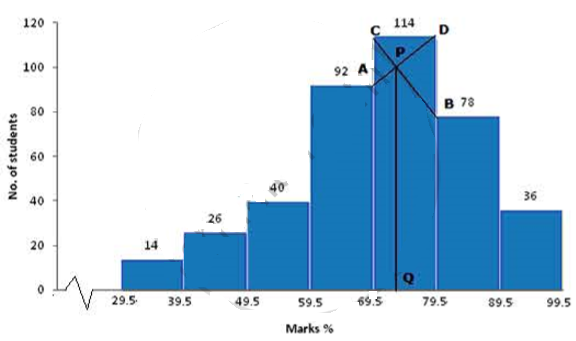
(a) Take 1cm = 1 unit and plot marks % on x-axis and no. of students on y-axis. 
(b) Draw a bar graph for the given data. 
(c) From the histogram it is clear that class 69.5-79.5 has highest frequency i.e. 114 
(d) Join the ends of the corresponding frequencies which meet at P and drop a perpendicular on the x-axis from P to Q. Q is the mode. Therefore, Mode = 73
View full question & answer
Question 154 Marks
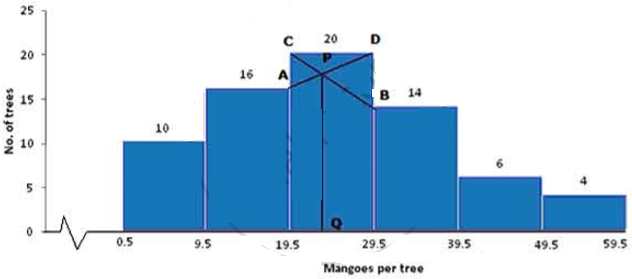
Draw a histogram for the following distribution and estimate the mode: 
Mangoes 0-9 10-19 20-29 30-39 40-49 50-59
No. of trees 10 16 20 14 6 4
Answer
Mangoes per tree No. of trees
0.5-9.5  10
9.5-19.5  16
19.5-29.5  20
29.5-39.5 14
39.5-49.5  6
49.5-59.5  4
Image
(a) Take 1cm = 1 unit and plot mangoes on x-axis and no. of trees on y-axis. 
(b) Draw a bar graph for the given data. 
(c) From the histogram it is clear that class 19.5-29.5 has highest frequency i.e. 20 
(d) Join the ends of the corresponding frequencies which meet at P and drop a perpendicular on the x-axis from P to Q. Q is the mode. 
Therefore, Mode = 23 .5 
View full question & answer
Question 164 Marks
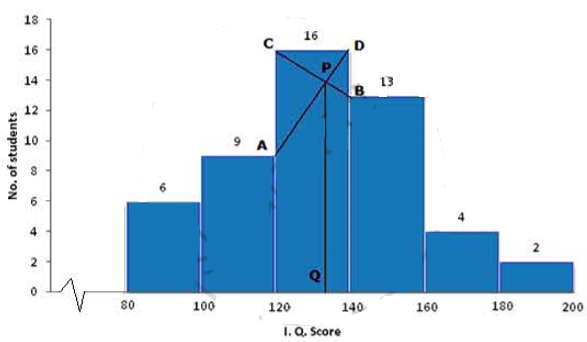
Draw a histogram for the following distribution and estimate the mode: 
I.Q. Score 80-100 100-120 120-140 140-160 160-180 180-200
No. of Students 6 9 16 13 4 2
Answer
Image
(a) Take 1cm = 1 unit and plot I. Q. Score on x-axis and no. of students on y axis. 
(b) Draw a bar graph for the given data. 
(c) From the histogram it is clear that class 120-140 has highest frequency i.e. 16 
(d) Join the ends of the corresponding frequencies which meet at P and drop a perpendicular on the x-axis from P to Q. Q is the mode. 
Therefore, Mode = 134 
View full question & answer
Question 174 Marks
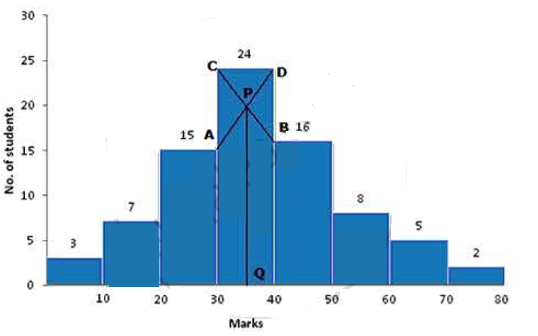
Draw a histogram for the following distribution and estimate the mode: 
Marks 0-10 10-20 20-30 30-40 40-50 50-60 60-70 70-80
No. of students 3 7 15 24 16 8 5 2
Answer
Image
(a) Take 1cm = 1 unit and plot marks on x-axis and no. of students on y-axis. 
(b) Draw a bar graph for the given data. 
(c) From the histogram it is clear that class 30-40 has highest frequency i.e. 24 
( d) Join the ends of the corresponding frequencies which meet at P and drop a perpendicular on the x-axis from P to Q. Q is the mode. Therefore, Mode = 35 
View full question & answer
Question 184 Marks
Find the mean of the following frequency distribution by the step deviation method : 
Class  $0-20$ $20-40$ $40-60$ $60-80$ $80-100$ $100-120$ $120-140$
Frequency  $12$ $24$ $52$ $88$ $66$ $42$ $16$
Answer
Class Interval $x_i$ $f_i$ $ A =70 , u =\frac{ x - A }{ h _i}$ $f_i u$
$0-20 $ $10$ $12$ $-3$ $-36$
$20-40$ $30$ $24$ $-2$ $-48$
$40-60$ $50$ $52$ $-1$ $-52$
$60-80$ $A = 70$ $88$ $0$ $0$
$80-100$ $90$ $66$ $1$ $66$
$100-120$ $110$ $42$ $2$ $84$
$120-140$ $130$ $16$ $3$ $48$
Total   $300$   $62$
$ A =70 $ and $h _{ i }=20$
$\bar{x}= A + h \times \frac{\Sigma f_i u }{\Sigma f_i}$
$\bar{x}=70+20 \times \frac{62}{300}$
$\bar{x}=70+4.13$
$\bar{x}=74.13$
$\therefore \text { Mean }=74.13$
View full question & answer
Question 194 Marks
Find the mean of the following frequency distribution by the short cut method : 
Class  $1-10$ $11-20$ $21-30$ $31-40$ $41-50$ $51-60$ $61-70$
Frequency  $7$ $10$ $14$ $17$ $15$ $11$ $6$
Answer
Class Interval $x_i$ $f_i$ $A = 35.5 \
d = x - A$
$f_id$
$1-10$ $5.5$ $7$ $-30$ $-210$
$11-20$ $15.5$ $10$ $20$ $-200$
$21-30$ $25.5$ $14$ $-10$ $-140$
$31-40$ $A = 35.5$ $17$ $0$ $0$
$41-50$ $45.5$ $15$ $10$ $150$
$51-60$ $55.5$ $11$ $20$ $220$
$61-70$ $65.5$ $6$ $30$ $180$
Total   $80$   $0$
$\bar{x}=A+\frac{\Sigma f_i d}{\Sigma f_i}$
$\bar{x}=35.5+\frac{0}{80}$
$\bar{x}=35.5+0$
$\bar{x}=35.5$
$\therefore \text { Mean }=35.5$
View full question & answer
Question 204 Marks
Find the mean of the following frequency distribution by the short cut method : 
Class  $0-10$ $10-20$ $20-30$ $30-40$ $40-50$
Frequency $9$ $12$ $15$ $10$ $14$
Answer
Class Interval $x_i$ $f_i$ $A = 25
d = x - A$
$f_{id}$
$0-10$ $5$ $9$ $-20$ $-180$
$10-20$ $15$ $12$ $-10$ $-120$
$20-30$ $A = 25$ $15$ $0$ $0$
$30-40$ $35$ $10$ $10$ $100$
$40-50$ $45$ $14$ $20$ $280$
Total   $60$   $80$
$\bar{x}=A+\frac{\Sigma f_i d}{\Sigma f_i}$
$\bar{x}=25+\frac{80}{60}$
$\bar{x}=25+1.33$
$\bar{x}=26.33$
$\therefore \text { Mean }=26.33$
View full question & answer
Question 214 Marks
The mean of the following frequency distribution is $25.8$ and the sum of all the frequencies is $50$. Find $x$ and $y$. 
$\text{Class}$ $0-10 $ $10-20 $ $20-30 $ $30-40 $ $40-50 $
$\text{Frequency}$ $7$ $x$ $15$ $y$ $10$
Answer
$\text{Class Interval}$ $x_i$ $f_i$ $f_ix_i$
$0-10$ $5$ $7$ $35$
$10-20$ $15$ $x$ $15x$
$20-30$ $25$ $15$ $375$
$30-40$ $35$ $y$ $35y$
$40-50$ $45$ $10$ $450$
$\text{Total}$   $50$ $860 + 15x + 35y$
$ \Sigma f_i=x_1+x_2+\ldots . .+x_n$
$50=7+ x +15+ y +10$
$\Rightarrow x + y +32=50$
$\Rightarrow x + y =18 \ldots \ldots \ldots . . \text { (i) }$
$\bar{x}=\frac{\Sigma f_i x_i}{\Sigma f}$
$25.8=\frac{860+15 x+35 y}{50}$
$\Rightarrow 15 x +35 y +860=1290$
$\Rightarrow 15 x +35 y =430$
$\Rightarrow 3 x +7 y =86 \ldots \ldots \ldots . . . \text { (ii) } $
Multiplying $(i)$ by $3$ and subtracting from $(ii)$
$ 4 y=32$
$\Rightarrow y=8$
Putting value of $y$ in $(i)$
$ x+8=18$
$x=10$
Therefore$, x=10$ and $y=8$
View full question & answer
Question 224 Marks
Find the mean of the following frequency distribution : 
$\text{Class}$ $101-110 $ $111-120 $ $121-130 $ $131-140 $ $141-150 $ $151-160 $
$\text{Frequency}$ $11$ $16$ $20$ $30$ $14$ $9$
Answer
$\text{Class Interval}$ $x_i$ $f_i$ $f_ix_i$
$101-110$ $105.5$ $11$ $1160.5$
$111-120$ $115.5$ $16$ $1848$
$121-130$ $125.5$ $20$ $2510$
$131-140$ $135.$ $30$ $4065$
$141-150$ $145.5$ $14$ $2037$
$151-160$ $155.5$ $9$ $1399.5$
$\text{Total}$   $100$ $13020$
$\bar{x}=\frac{\Sigma f_i X_i}{\sum ff }$
$\bar{x}=\frac{13020}{100}$
$\bar{x}=130.2$
$\therefore$ Mean $=130.2$
View full question & answer
Question 234 Marks
Find the mean of the following frequency distribution : 
$\text{Class}$ $1-10 $ $11-20 $ $21-30 $ $31-40 $ $41-50 $
$\text{Frequency}$ $9$ $12$ $15$ $10$ $14$
Answer
$\text{Class Interval}$ $x_i$ $f_i$ $f_ix_i$
$1-10$ $5.5$ $9$ $49.5$
$11-20$ $15.5$ $12$ $186$
$21-30$ $25.5$ $15$ $382.5$
$31-40$ $35.5$ $10$ $355$
$41-50$ $45.5$ $14$ $637$
$\text{Total}$   $60$ $1610$
$\bar{x}=\frac{\Sigma f_i X_i}{\sum f }$
$\bar{x}=\frac{1610}{60}$
$\bar{x}=26.83$
$\therefore \text { Mean }=26.83$
View full question & answer
Question 244 Marks
Find the mean of the following frequency distribution : 
$\text{Class}$ $50-60 $ $60-70 $ $70-80 $ $80-90 $ $90-100 $
$\text{Frequency}$ $8$ $6$ $12$ $11$ $13$
Answer
$\text{Class Interval}$ $X_i$ $f_i$ $f_iX_i$
$50-60$ $55$ $8$ $440$
$60-70$ $65$ $6$ $390$
$70-80$ $75$ $12$ $900$
$80-90$ $85$ $11$ $935$
$90-100$ $95$ $13$ $1235$
$\text{Total}$   $50$ $3900$
$\bar{x}=\frac{\Sigma f_i X_i}{\sum f }$
$\bar{x}=\frac{3900}{50}$
$\bar{x}=78$
$\therefore \text { Mean }=78$
View full question & answer
Question 254 Marks
Find the mean of the following frequency distribution : 
$\text{Class} $ $25-35 $ $35-45 $ $45-55$ $55-65$ $65-75$
$\text{Frequency}$ $6$ $10$ $8$ $12$ $4$
Answer
$\text{Class interval}$ $X_i$ $f_i$ $f_ix_i$
$25-35 $ $30$ $6$ $180$
$35-45$ $40$ $10$ $400$
$45-55$ $50$ $8$ $400$
$55-65$ $60$ $12$ $720$
$65-75$ $70$ $4$ $280$
$\text{Total}$   $40$ $1980$
$\bar{x}=\frac{\Sigma f_i X_i}{\sum f }$
$\bar{x}=\frac{1980}{40}$
$\bar{x}=49.5$
$\therefore \text { Mean }$
$=49.5$
View full question & answer
Question 264 Marks
Find the mean of the following frequency distribution : 
$\text{class} $ $0-6 $ $6-12 $ $12-18 $ $18-24 $ $24-30 $
$\text{Frequency}$ $7$ $5$ $10$ $12$ $6$
Answer
$\text{Class Interval }$ $X_i $ $f_i $ $f_iX_i$
$0-6$ $3$ $7$ $21$
$6-12$ $9$ $5$ $45$
$12-18$ $15$ $10$ $150$
$18-24$ $21$ $12$ $252$
$24-30$ $27$ $6$ $162$
$\text{Total}$   $40$ $630$
$\bar{x}=\frac{\sum f_i X_i}{\sum f }$
$\bar{x}=\frac{630}{40}$
$\bar{x}=15.75$
$\therefore \text { Mean }=15.75$
View full question & answer
Question 274 Marks
Find the mean of the following frequency distribution : 
$\text{Class} $ $0-10 $ $10-20 $ $20-30 $ $30-40 $ $40-50 $ $50-60 $ $60-70 $
$\text{Frequency}$ $4$ $4$ $7$ $10$ $12$ $8$ $5$
Answer
$\text{Class Interval}$ $X_i$ $f_i$ $f_ix_i$
$0-10$ $5$ $4$ $20$
$10-20$ $15$ $4$ $60$
$20-30$ $25$ $7$ $175$
$30-40$ $35$ $10$ $350$
$40-50$ $45$ $12$ $540$
$50-60$ $55$ $8$ $440$
$60-70$ $65$ $5$ $325$
$\text{Total}$   $50$ $1910$
$\bar{x}=\frac{\Sigma f_i X_i}{\Sigma f }$
$\bar{x}=\frac{1910}{50}$
$\bar{x}=38.2$
$\therefore \text { Mean }=38.2$
View full question & answer
Question 284 Marks
Find the mean of the following frequency distribution : 
$\text{Class} $ $0-10 $ $10-20 $ $20-30 $ $30-40 $ $40-50 $
$\text{Frequency} $ $4$ $7$ $6$ $3$ $5$
Answer
$\text{Class Interval}$ $X_{i }$ $f_i $ $f_iX_i$
$0-10$ $5$ $4$ $20$
$10-20$ $15$ $7$ $105$
$20-30$ $25$ $6$ $150$
$30-40$ $35$ $3$ $105$
$40-50$ $45$ $5$ $225$
$\text{Total}$ $
$
$25$ $605$
$\bar{x}=\frac{\sum f_i X_i}{\sum f }$
$\bar{x}=\frac{605}{25}$
$\bar{x}=24.2$
$\therefore \text { Mean }=24.2$
View full question & answer
Question 294 Marks
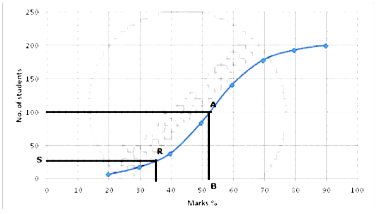
The marks obtained by 200 students in an examination are given below : 
Marks  0-10 10-20 20-30 30-40 40-50 50-60 60-70 70-80 80-90 90-100
No.of students 5 10 11 20 27 38 40 29 14 6
Using a graph paper, draw an Ogive for the above distribution. Use your Ogive to estimate:
(i) the median;
(ii) the lower quartile;
(iii) the number of students who obtained more than 80% marks in the examination and
(iv) the number of students who did not pass, if the pass percentage was 35.
Use the scale as 2 cm = 10 marks on one axis and 2 cm = 20 students on the other axis.
Answer
We construct cumulative frequency table of the given distribution : 
Marks  No. of students (f)  Cumulative Frequency 
0-10 5 5
10-20 10 15
20-30 11 26
30-40 20 46
40-50 27 73
50-60 38 111
60-70 40 151
70-80 29 180
80-90 14 194
90-100 6 200
Take a graph paper and draw both the axes.
On the $x$ - axis, take a scale of $1 cm =20$ to represent the marks.
On the $y$ - axis, take a scale of $1 cm =50$ to represent the no. of students.
Now, plot the points $(10,5),(20,15),(30,26),(40,46),(50,73),(60,111).(80,180),(90,194),(100,200) .
Join them by a smooth curve to get the ogive.
Image
(i) No. of terms $=200$
$ \therefore \text { Median }=\frac{100+101}{2}=100.5^{\text {th }} \text { term } $
Through mark of 100.5 on $y$-axis draw a line parallel to $x$-axis which meets the curve at $A$. From $A$, draw a perpendicular to $x$-axis which meets it at $B$.
The value of $B$ is the median which is 58.5 .
(ii) Lower Quartile $\left( Q _1\right)=\frac{n}{4}=\frac{200}{4}=50^{\text {th }}$ term
Through mark of 50 on $y$-axis draw a line parallel to xaxis which meets the curve at P. From P, draw a perpendicular to x-axis which meets it at $Q$.
The value of $Q$ is the lower quartile which is 41 .
(iii) From marks $=80$ draw a line parallel to $y$-axis and meet the curve at R. From R, Draw a perpendicular on $y$-axis which meets it at $S$. The difference of the value obtained when subtracted from 200 gives the number of students who scored more than $80 \%$.
$ \Rightarrow 200-180=20 $
20 students scored more than $80 \%$
View full question & answer