Question 13 Marks
A circus tent is cylindrical to a height of $3$ meters and conical above it. If its diameter is $105$ m and the slant height of the conical portion is $53 m$ calculate the length of the canvas which is $5m$ wide to make the required tent.
Answer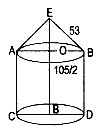
Cylindrical area = 2πrh
$=2 \times \frac{22}{7} \times \frac{105}{2} \times 3 m ^2$
and conical area = πrl
$=\frac{22}{7} \times \frac{105}{2} \times 53 m ^2$
Area of canvas = $=2 \times \frac{22}{7} \times \frac{105}{2} \times 3+\frac{22}{7} \times \frac{105}{2} \times 53$
$= 15 \times 11( 2 \times 3 + 53)$
$= 15 \times 11 \times 59$
$= 165 \times 59 m^3$
Lenght of canvas = $\frac{165 \times 59}{5} m$
$= 33 \times 59 m$
$= 1947 m.$ View full question & answer→Question 23 Marks
A conical tent is accommodate to $11$ persons each person must have $4$ sq. metre of the space on the ground and $20$ cubic metre of air to breath. Find the height of the cone.
AnswerArea of the base = $11 \times 4 = 44 m^2$
and Volume of the cone = $11 \times 20 = 220 m^3$
$\frac{1}{3} \times \pi R^2 h=220 m^3$
Area of the base $=\pi R^2$
$ \therefore \pi R^2=44$
$\therefore R^2=\frac{44}{22} \times 7$
$\therefore R^2=14$
$\therefore R=\sqrt{14} $
By equation (i) and (ii), we get
$\frac{1}{3} \times \frac{22}{7} \times \sqrt{14} \times \sqrt{14} \times h=220$
$h =\frac{220 \times 3}{22 \times 2}$
$h =\frac{30}{2}=15 cm .$
View full question & answer→Question 33 Marks
A vessel in the form of an inverted cone is filled with water to the brim: Its height is $20\ cm$ and the diameter is $16.8\ cm.$ Two equal solid cones are dropped in it so that they are fully submerged. As a result, one-third of the water in the original cone overflows. What is the volume of each of the solid cones submerged?
Answer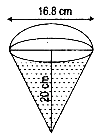
Height $= 20\ cm,$ diameter $= 16.8\ cm$ or radius = $\frac{16.8}{2}=8.4\ cm$
Volume of water in bigger cone = $\frac{1}{3} \pi r^2 h$
$=\frac{1}{3} \times \frac{22}{7} \times 8.4 \times 8.4 \times 20 $
$= 1478.4\ cm^3$
Volume of water overflows when two equal cone is submerged $=\frac{1}{3} \times 1478.4 = 492.8\ cm^3$
$\therefore$ Volume of two equal cones $= 492.8$
So volume of each cone = $\frac{1}{2} \times 492.8=246.4 cm ^3$. View full question & answer→Question 43 Marks
The radius of two right circular cylinder are in the ratio of $2 : 3$ and their heights are in the ratio of $5: 4$ calculate the ratio of their curved surface areas and also the ratio of their volumes.
AnswerLet the radii of two cylinders be 2r and 3r respectively and their heights be 5h and 4h respectively.
Let $S_1$ and $S_2$ be Curved Surface Area of the two cylinders and $V_1$ and $V_2$ be their volumes.
Then, $S_1$ = Curved surface area of the cylinders of height 5h and radius 2r.
⇒ 2π x 2r x 5h = 20πrh sq. units.
$S_2$ = Curved surface area of the cylinders of height 4h and radius 3r.
⇒ 2π x 3r x 4h = 24πrh sq. units.
$\frac{S_1}{S_2}=\frac{20 \pi r h}{24 \pi r h}=\frac{5}{6}$
$S_1: S_2 = 5: 6$
$V_1$ = Volume of cylinder of height 5h and radius 2r
$= \pi \times (2r)^2 \times 5h = 20\pi r^2h$ cubic units.
$V_2$ = Volume of the cylinder of height 4h and radius 3r.
$= \pi \times (3r)^2 \times 4h = 36\pi r^2h$ cubic units.
$\therefore \frac{V_1}{V_2}=\frac{20 \pi r^2 h}{36 \pi r^2 h}=\frac{5}{6}$
$V_1: V_2 = 5: 9$.
View full question & answer→Question 53 Marks
A metallic cylinder has a radius of 3 cm and a height of 5 cm. It is made of metal A. To reduce its weight, a conical hole is drilled in the cylinder, as shown and it is completely filled with a lighter metal B. The conical hole has a radius of $\frac{3}{2}$ cm and its depth is $\frac{8}{9}$ cm. Calculate the ratio of the volume of the metal A to the volume of metal B in the solid.
Answer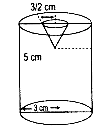
Volume of metal $A =$ Volume of the cylinder $-$ Volume of the cone
$=\pi(3)^2 x 5-\frac{1}{3} \pi\left(\frac{3}{2}\right)^2 \frac{8}{9}$
$=\pi\left(45-\frac{2}{3}\right)$
$=\frac{133}{3} \pi cm ^3$
Volume of metal $B =$ Volume of the conical cavity
$=\frac{1}{3} \times\left(\frac{3}{2}\right)^2 \cdot \frac{8}{9}=\frac{2}{3} \pi$
Hence, ratio of the volume of the metal A to the volume of the metal B.
$=\frac{\frac{133}{3} \pi}{\frac{2}{3} \pi}=\frac{133}{2}$
$=66.5: 1 .$ View full question & answer→Question 63 Marks
The surface area of a solid metallic sphere is $616\ cm^2.$ It is melted and recast into smaller spheres of diameter $3.5\ cm.$ How many such spheres can be obtained?
AnswerThe surface area of sphere $= 4\pi r^2$
$4\pi r^2= 616$
$r^2=\frac{616 \times 7}{4 \times 22}$
$r=49$
$r=\sqrt{49}$
$r=7 cm $
Volume of big sphere $=\frac{4}{3} \pi r^3=\frac{4}{3} \times \frac{22}{7} \times(7)^3$
Volume of small sphere $=\frac{4}{3} \pi\left(\frac{3.5}{2}\right)^3$
$\therefore$ No of smaller sphere $=\frac{\text { Volume of big sphere }}{\text { Volume of small sphere }}$
$=\frac{\frac{4}{3} \pi(7)^3}{\frac{4}{3} \pi\left(\frac{3.5}{2}\right)^3} $
$ =64 .$
View full question & answer→Question 73 Marks
The radius of the internal and external surfaces of a hollow spherical shell are $3 cm$ and $5 cm$ respectively! If it is melted and recast into a solid cylinder of height $\frac{8}{3}$ cm, find the diameter of the cylinder.
AnswerInternal radius of hollow spherical shell = $r_1 = 3 cm$.
External radius of hollow spherical = $r_2 = 5 cm$
Volume of hollow spherical = $\frac{4}{3} \pi\left(r_2^3-r_1^3\right)$
$=\frac{4}{3} \pi\left[(5)^3-(3)^3\right]$
$=\frac{4}{3} \pi(125-127)$
$=\frac{4 \pi \times 98}{3}$
$=\frac{392 \pi}{3} cm ^3$
Volume of cylinder = $\pi r^2h$
$=\pi r^2 \times \frac{8}{3}$
$=\frac{8 \pi r^2}{3} cm ^3$
Volume of cylinder = Volume of hallow sphere
$\frac{8 \pi r^2}{3}=\frac{392 \pi}{3}$
$r^2=\frac{392 \pi \times 3}{8 \pi \times 3}$
$r^2=49$
$r=\sqrt{49}$
$r=7 cm .$
The diameter of cylinder $= 2r = 2 \times 7 = 14\ cm.$
View full question & answer→Question 83 Marks
A bucket is raised from a well by means of a rope which is wound round a wheel of diameter $77\ cm.$ Given that the ascends in $1$ minute $28$ seconds with a uniform speed of $1.1\ m/sec,$ calculate the number of complete revolutions the wheel makes in raising the bucket. (Take $\pi =22/7$)
AnswerDistance moved by the bucket $=$ speed $\times$ Time
$= [ 1.1 \times 88 ]$ metre ...$[ \because 1$ min $28$ sec $= 60 + 28 = 88$ sec.$]$
$= 96.8$ metres
Circumference of wheel $= 2\pi r$
$=2 \times \frac{22}{7} \times \frac{77}{2} cm \quad \ldots\left(\because r=\frac{d}{2}=\frac{77}{2} cm \right) $
$=242 cm $
$=2.42 \text { metres }$
$\therefore$ Number of complete revolutions the wheel makes in rising the bucket
$=\frac{\text { Distance }}{\text { Circumference }} $
$ =\left(\frac{96.8}{2.42}\right)=40 .$
View full question & answer→Question 93 Marks
In the given figure, find the area of the unshaded portion within the rectangle. (Take $\pi = 22/7$).
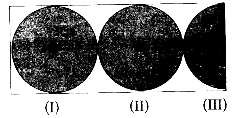
AnswerIn the given figure
Radius of circle $= 3\ cm$
Length of rectangle $= 15\ cm$
Breadth of rectangle $= 6\ cm$
The area of the unshaded portion within the rectangle
$=$ Area of rectangle - [ Area of I + II + $\frac{1}{2}$ III ] circles
$=15 \times 6-\left[\text { Area of } 2 \frac{1}{2} \text { circles ] }\right.$
$=90-\frac{5}{2} \times \pi r^2$
$=90-\frac{5}{2} \times 3.14 \times 3^2$
$= 90 - 70.65$
$= 19.35\ cm^2.$
View full question & answer→Question 103 Marks
In the adjoining figure, the crescent is formed by two circles which touch at the point A. $O$ is the centre of bigger circle. If $CB = 9 cm$ and $DE = 5 cm$, find the area of the shaded portion.
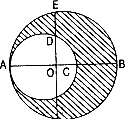
AnswerLet R and r be the radii of two circles. Then, $2(R - r) = 9$.
Join AD and CD,
ΔAOB ∼ ΔDOC
$\therefore \frac{ OD }{ OC }=\frac{ OA }{ OD }$
$\Rightarrow OD^2 = OA.OC$
$\Rightarrow (R - 5)^2 = R(R - 9)$
$\Rightarrow R^2 + 25 - 10R = R^2 - 9R$
$\therefore R = 25$
So, $2(25 - r) = 9$
$\therefore r = 20.5 cm$
Area of the shaded portion $= \pi R^2 - \pi r^2$
$= \pi [ (25)^2 - (20.5)^2 ] cm^2$
$=\frac{22}{7}[625-420.25] cm ^2$
$=\frac{22}{7} \times 204.75 cm ^2$
$=643.5 cm ^2 .$
View full question & answer→Question 113 Marks
In the given figure, $AB$ is the diameter of a circle with center $O$ and $OA = 7\ cm.$ Find the area of the shaded region.
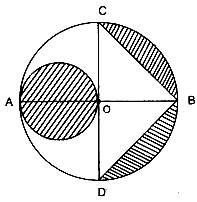
AnswerGiven $OA = 7\ cm.$
Area of small circle $= \pi r^2$
Where, $r = \frac{7}{2}$
$\therefore$ Area of circle = $\frac{22}{7} \times \frac{7}{2} \times \frac{7}{2}$
$=\frac{77}{2}=38.5 sq . cm$.
Area of two shaded segments = Area of big semicircle - Area of Δ CBD
$=\frac{1}{2} \pi \times 7^2-\frac{1}{2} \times 7 \times 14$
$=\frac{1}{2} \times \frac{22}{7} \times 49-7 \times 7$
$=11 \times 7-7 \times 7$
$=77-49$
$=28 \text { sq. } cm $
$\therefore$ Total shaded area $= 38.5 + 25 = 66.5$ sq.cm.
View full question & answer→Question 123 Marks
The boundary of the shaded region in the given diagram consists of three semicircular areas, the smaller ones being equal and it’s diameter $5$ cm, if the diameter of the larger one is $10$ cm,
calculate:
(i) The length of the boundary,
(ii) The area of the shaded region. (Take $\pi = 3.14$)
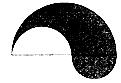
Answer(i) Diameter = 10 cm
∴ Radius (r) = $\frac{10}{2} cm =5 cm$
Length of the boundary = π(5) + π(2.5) + π(2.5)
$=10 \pi$
= 10 x 3.14 cm
= 31.4 cm
(ii) Area of the shaded region
$=\frac{1}{2} \pi(5)^2-\frac{1}{2} \pi(2.5)^2+\frac{1}{2} \pi(2.5)^2$
$=\frac{25}{2} \pi=\frac{25}{2} \times 3.14$
$= 25 x 1.57 = 39.25 cm^2.$
View full question & answer→Question 133 Marks
A metal container in the form of a cylinder is surmounted by a hemisphere of the same radius. The internal height of the cylinder is $7\ m$ and the internal radius is $3.5\ m.$ Calculate: the total area of the internal surface, excluding the base.
Answer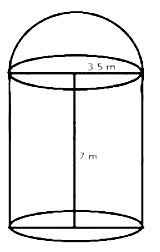
Radius of the cylinder $= 3.5\ m$
Height $= 7\ m$
Total surface area of container excluding the base $=$ Curved
surface area of the cylinder $+$ area of hemisphere
$=2 \pi rh +2 \pi r ^2$
$=\left(2 \times \frac{22}{7} \times 3.5 \times 7\right)+\left(2 \times \frac{22}{7} \times 3.5 \times 3.5\right)$
$= 154 + 77 m^2$
$= 231\ m^2$ View full question & answer→Question 143 Marks
Calculate the area of the shaded region, if the diameter of the semi-circle is equal to 14 cm. (Take π = 22/7).
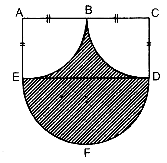
AnswerAC = DE = 14 cm ...(Given)
AB = BC = 7 cm ...(Given)
Area of the shaded region = Area of rectangle ACDE + Area of semicircle DEF - 2 x Area of quadrant
∴ Area of rectangle = Length x Breadth
Area of semicircle = $\frac{1}{2} \pi r^2$
2 x Area of quadrant = $\frac{\pi}{4}\left(r^2\right)$
$\therefore$ Area of the shaded region $=14 \times 7+\frac{\pi}{2}(7)^2-2 \times \frac{\pi}{4}(7)^2$
$=98+\frac{49 \pi}{2}-\frac{49 \pi}{2}$
$=98 cm ^2$
View full question & answer→Question 153 Marks
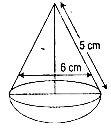
The given figure represents a hemisphere surmounted by a conical block of wood. The diameter of their bases is $6$ cm each and the slant height of the cone is $5$ cm. Calculate:
(i) the height of the cone.
(ii) the vol. of the solid.
Answer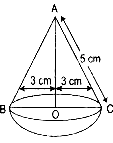
(i) In Δ ADC,
$AC^2 = AO^2 + OC^2$
$25 = AO^2 + 9$
$AO^2= 25 - 9$
$AO = 4 cm$
∴ Height of cone = 4 cm
(ii) Volume of solid = Volume of cone + Volume of hemisphere
$=\frac{1}{3} \pi r^2 h+\frac{\frac{4}{3} \pi r^3}{2}$
$=\frac{1}{3} \pi r^2 h+\frac{2}{3} \pi r^3$
$=\frac{1}{3} \times \frac{22}{7} \times(3)^2 \times 4+\frac{2}{3} \times \frac{22}{7} \times(3)^3$
$= 37.68 + 56.52$
$= 94.20 cm^3$ View full question & answer→Question 163 Marks
A doorway is decorated as shown in the figure. There are four semi-circles. $BC,$ the diameter of the larger semi-circle is of length $84\ cm.$ Centres of the three equal semicircles lie on $BC. ABC$ is an isosceles triangle with $AB = AC.$ If $BO = OC,$ find the area of the shaded region. (Take $\left.\pi=\frac{22}{7}\right)$
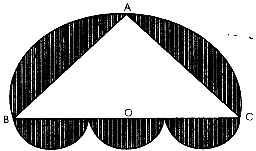
AnswerHere, the radius of larger semicircle = $\frac{84}{2}=42\ cm$
And, the radius of smaller semi-circle = $\frac{84}{3 \times 2}=14\ cm$
Area of the shaded region = $\frac{\pi(42)^2}{2}+3 \times \frac{\pi(14)^2}{2}-\frac{1}{2} \times 84 \times 42$
$=\frac{22}{7}[21 \times 42+3 \times 14 \times 7]-42 \times 42$
$=22[3 \times 42+42]-42 \times 42$
$=42 \times[88-42]$
$=1932 cm ^2$v
View full question & answer→Question 173 Marks
In the equilateral Δ ABC of side 14 cm, side BC is the diameter of a semicircle as shown in the figure below. Find the area of the shaded region. (Take π = 22/7 and √3 = 1.732)
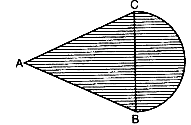
AnswerArea of shaded part = Area of equilateral Δ ABC + Area of semicircle
$=\frac{\sqrt{3}}{4} a^2+\frac{1}{2} \pi r^2$
Given a = 14 cm and r = $\frac{14}{2}=7 cm$
∴ Area of shaded part = $\frac{\sqrt{3}}{4} \times 14^2+\frac{1}{2} \times \frac{22}{7} \times 7 \times 7$
$=\frac{1.732 \times 14 \times 14}{4}+11 \times 7$
= 1.732 x 7 x 7 + 77
= 84.868 + 77
= 161.868 sq.cm
View full question & answer→Question 183 Marks
The circumference of the base of a $10 m$ high conical tent is $44$ metres. Calculate the length of canvas used in making the tent if the width of the canvas is $2m$. (Take $\pi = 22/7$)
AnswerLet r m be the radius of the base, h m be the height and l m be the slant height of the cone. Then,
Circumference = 44 metres
$\Rightarrow 2 \pi r=44$
$\Rightarrow 2 \times \frac{22}{7} \times r=44$
$\Rightarrow r=7 \text { metres }$
It is given that h = 10 metres
$\therefore l^2 = r^2 + h^2$
$\Rightarrow \mid=\sqrt{r^2+h^2}$
$\mid=\sqrt{49+100}=\sqrt{149}=12.2 m $
Now, Surface area of the tent = πrl m2
$=\frac{22}{7} \times 7 \times 12.2 m ^2$
$=268.4 m ^2$
∴ Area of the canvas used = $268.4 m^2$
It is given that the width of the canvas is 2 m.
∴ Length of the canvas used = $\frac{\text { Area }}{\text { Width }}$
$=\frac{268.4}{2}$
= 134.2 metres
View full question & answer→Question 193 Marks
Two-cylinder have bases of the same size. The diameter of each is $14\ cm$. One of the cones is $10\ cm$ high and the other is $20\ cm$ high. Find the ratio between their volumes.
Answer
| |
Cone I |
Cone II |
| Base diameter |
$14\ cm$ |
$14\ cm$ |
| Base radius |
$r_1 = 7\ cm$ |
$r_2 = 7\ cm$ |
| Height |
$h_1 = 10\ cm$ |
$h_2 = 20\ cm$ |
| Volume |
$V_1 = \pi r_1^2h_1$ |
$V_2 = \pi r_2^2h_2$ |
Volume $= V_1 = \pi r_1^2h_1: V_2= \pi r_2^2h_2$
Volume $= \pi \times (7)^2 \times 10\ cm^3 : \pi \times (7)^2 \times 20\ cm^3$
Volume $= 490 \pi\ cm^3: 980 \pi\ cm^3$
$\therefore \frac{V_1}{V_2}=\frac{490 \pi}{980 \pi}=\frac{1}{2}$
$\therefore V_1 : V_2 = 1 : 2.$ View full question & answer→Question 203 Marks
How many spherical bullets can be made out of a solid cube of lead whose edge measures $44\ cm,$ each bullet being $4\ cm$ in diameter?
AnswerLet the total number of bullets be $x.$
Radius of a spherical bullet $=\frac{4}{2}=2 cm$
Now,
Volume of a spherical bullet = $\frac{4}{3} \pi \times(2)^3=\frac{4}{3} \times \frac{22}{7} \times 8$
$\therefore$ Volume of x spherical bullets = $\frac{4}{3} \times \frac{22}{7} \times 8 \times x cm ^3$
Volume of the solid cube $= (44)^3\ cm^3$
Clearly,
Volume of x spherical bullets $=$ volume of the cube
$\frac{4}{3} \times \frac{22}{7} \times 8 \times x=44 \times 44 \times 44$
$x=\frac{44 \times 44 \times 44 \times 7 \times 3}{4 \times 22 \times 8}$
$x = 2541$
Hence, total number of spherical bullets are $2541.$
View full question & answer→Question 213 Marks
A hollow sphere of internal and external radii $6\ cm$ and $8\ cm$ respectively is melted and recast into small cones of base radius $2\ cm$ and height $8\ cm.$ Find the number of cones.
AnswerExternal radius of a hollow sphere, $R = 8\ cm$
And, internal radius, $r = 6\ cm$
$\therefore$ Volume of hollow sphere = $\frac{4}{3} \pi\left(R^3-r^3\right)$
$=\frac{4}{3} \pi\left(8^3-6^3\right)$
$=\frac{4}{3} \pi(512-216)$
$=\left(\frac{4}{3} \pi \times 296\right) cm^3$
Radius of cone $= 2\ cm,$ height $= 8\ cm$
$\therefore$ Volume of cone = $\frac{1}{3} \pi(2)^2 \times 8=\left(\frac{32}{3} \pi\right) cm ^3$
Thus number of cone formed $=\frac{\text { Volume of hollow sphere }}{\text { volume of cone }}$
$=\frac{\frac{4}{3} \pi \times 296}{\frac{32}{3} \pi}$
$=37$
View full question & answer→Question 223 Marks
The radius of two spheres are in the ratio of $1 : 3.$ Find the ratio between their volume.
AnswerLet the radius of two sphere number is $r_1$ and $r_2$.
$\because \frac{r_1}{r_2}=\frac{1}{3}$
Volumes of spheres,
$V _1=\frac{4}{3} \pi r_1^3$
and $V _2=\frac{4}{3} \pi r_2^3$
Now,
$\frac{V_1}{V_2}=\frac{r_1^3}{r_2^3}=\left(\frac{r_1}{r_2}\right)^3$
$=\left(\frac{1}{3}\right)^3=\frac{1}{27}$
$\therefore V_1 : V_2 = 1: 27$
Hence, the volume of two spheres are in the ratio of $1: 27.$
View full question & answer→Question 233 Marks
A solid sphere of radius $15\ cm$ is melted and recast into solid right circular cones of radius $2.5\ cm$ and height $8\ cm.$ Calculate the number of cones recast.
AnswerRadius of a solid sphere $= R = 15\ cm$
$\therefore$ Volume of sphere melted = $\frac{4}{3} \pi R ^3=\frac{4}{3} \times \pi \times 15 \times 15 \times 15$
Radius of each cone recasted $= r = 2.5\ cm$
Height of each cone recasted $= h = 8\ cm$
$\therefore$ Volume of each one cone recasted $= \frac{1}{3} \pi r ^2 h =\frac{1}{3} \times \pi \times 2.5 \times 2.5 \times 8$
$\therefore$ Number of cones recasted $=\frac{\text { Volume of sphre melted }}{\text { Volume of each cone formed }}$
$=\frac{\frac{4}{3} \times \pi \times 15 \times 15}{\frac{1}{3} \times \pi \times 2.5 \times 2.5 \times 8}$
$=270$
View full question & answer→Question 243 Marks
Marbles of diameter $1.4\ cm$ are dropped into a cylindrical beaker of diameter $7\ cm,$ containing some water. Find the number of marbles that should be dropped into the beaker so that the water level rises by $5.6\ cm.$
AnswerDiameter of each marble $= 1.4\ cm$
Radius of each marble $= 0.7\ cm$
Volume of each marble $=\frac{4}{3} \pi r^3=\frac{4}{3} \pi \times(0.7)^3 cm ^3$
The water rises as a cylindrical column.
Volume of cylindrical column filled with water
$=\pi r^2 h=\pi \times\left(\frac{7}{2}\right)^2 \times 5.6 cm ^3$
Total number of marbles
$=\frac{\text { Volume of cylindrical water column }}{\text { Volume of marble }}$
$=\frac{\pi \times\left(\frac{7}{2}\right)^2 \times 5.6}{\frac{4}{3} \pi \times(0.7)^3}$
$=\frac{7 \times 7 \times 5.6 \times 3}{2 \times 2 \times 4 \times 0.7 \times 0.7 \times 0.7}$
$= 150$
View full question & answer→