Questions

[4 marks sum]

🎯

Test yourself on this topic

12 questions · timed · auto-graded

Question 14 Marks
The radius of a sphere is $10\ cm.$ If we increase the radius $5\%$ then how many % will increase in volume?
Answer
Volume of sphere = $\frac{4}{3} \pi r^3$
$\therefore$ Radius $= r = 10\ cm$
$\therefore$ Volume of sphere = $\frac{4}{3} \pi \times 10 \times 10 \times 10$
$=\frac{4000 \pi}{3} cm ^3$
Now, increase the radius 5%
Radius of new sphere = $\frac{10 \times 105}{100}=\frac{21}{2} cm$
Volume of new sphere $=\frac{4}{3} \pi \times \frac{21}{2} \times \frac{21}{2} \times \frac{21}{2}$
$=\frac{9261 \pi}{6} cm ^3$
Increase volume = Volume of new sphere - Volume of sphere
$=\frac{9261 \pi}{6}-\frac{4000 \pi}{3}$
$=\frac{9261 \pi-8000 \pi}{6}$
$=\frac{1261 \pi}{6} cm $
Percentage of increasing volume = $\frac{\frac{1261 \pi}{6} \times 100}{\frac{4000 \pi}{3}}$
$=\frac{1261 \pi \times 100 \times 2}{4000 \pi \times 6}$
$=\frac{1261}{80} \%$
$=15 \frac{61}{80} \%$
View full question & answer
Question 24 Marks
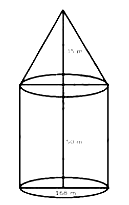
An exhibition tent is in the form of a cylinder surmounted by a cone. The height of the tent above the ground is $85$ m and height of the cylindrical part of $50$ m. If the diameter of the base is $168$ m, find the quantity of canvas required to make the tent. Allow $20\%$ extra for fold and for stitching. Give your answer to the nearest $m^2$.
Answer

Total height of the tent $= 85\ m$
Diameter of the base $= 168\ m$
Therefore, radius $(r) = 84\ m$
Height of the cylindrical part $= 50\ m$
Then height of the conical part $= (85 - 50) = 35\ m$
Slant height (1)= $\sqrt{r^2+h^2}=\sqrt{84^2+35^2}=\sqrt{7056+1225}=\sqrt{8281}=91 cm$
Total surface area of the tent $=2 \pi r h+\pi r l=\pi(2 h+l)$
$=\frac{22}{7} \times 84(250+91)$
$=264(100+91)$
$=264 \times 191$
$=50424 m ^2$
Since $20\%$ extra is needed for folds and stitching,
total area of canvas needed
$=50424 \times \frac{120}{100}$
$=60508.8$
$=60509 m ^2$
View full question & answer
Question 34 Marks
Water flows through a cylindrical pipe of internal diameter $7 cm$ at $36 km/hr$. Calculate the time in minutes it would take to fill the cylindrical tank, the radius of whose base is $35 cm$, and height is $1 m$.
Answer
Radius of pipe $=\frac{7}{2} cm$
Rate of water flow = 36 km/h
$=36 \times \frac{5}{18} m / s$
$=10 m / s$
$=10 \times 100 cm / s$
$=1000 cm / s $
∴ Volume of water flowing in 1 second = $\pi r^2h$
$=\pi \times \frac{7}{2} \times \frac{7}{2} \times 1000 cm ^3$
= π x 7 x 7 x 250 $cm^3$ ....(1)
Radius of tank (R) = 35 cm
Height of tank (H) = 1 m = 100 cm
∴ Volume of tank = $\pi r^2H$
= π x 35 x 35 x 100 $cm^3$ ...(2)
∴ Time taken to fill the tank = $\frac{\text { Volume of tank }}{\text { Volume of water flowing in } 1 \text { second }}$
$=\frac{\pi \times 35 \times 35 \times 100}{\pi \times 7 \times 7 \times 250} \text { seconds }$
$=10 \text { seconds }$
$=\frac{10}{60} \text { minute }$
$=\frac{1}{6} \text { minute. }$
View full question & answer
Question 44 Marks
A buoy is made in the form of a hemisphere surmounted by a right circular cone whose circular base coincides with the plane surface of the hemisphere. The radius of the base of the cone is $3.5 m$ and its volume is two-third the volume of hemisphere. Calculate the height of the cone and the surface area of the buoy, correct to two decimal places.
Answer
Radius of hemispherical part (r) = 3.5 m = $\frac{7}{2} m$
Therefore, Volume of hemisphere = $\frac{2}{3} \pi r^3$
$=\frac{2}{3} \times \frac{22}{7} \times \frac{7}{2} \times \frac{7}{2} \times \frac{7}{2}$
$=\frac{539}{6} m ^3$ Volume of conical part $=\frac{2}{3} \times \frac{539}{6} m^3$ (2/3 of hemisphere)
Let height of the cone = h
Then ,
$\frac{1}{3} \pi r^2 h=\frac{2 \times 539}{3 \times 6}$
$\Rightarrow \frac{1}{3} \times \frac{22}{7} \times \frac{7}{2} \times \frac{7}{2} \times h=\frac{2 \times 539}{3 \times 6}$
$\Rightarrow h=\frac{539 \times 2 \times 2 \times 7 \times 3}{3 \times 6 \times 22 \times 7 \times 7}$
$\Rightarrow h =\frac{14}{3} m =4 \frac{2}{3} m =4.67 m $
Surface area of buoy $=2 \pi r^2+\pi r l$
But $l=\sqrt{r^2+h^2}$
$ l=\sqrt{\left(\frac{7}{2}\right)^2+\left(\frac{14}{3}\right)^2}$
$=\sqrt{\frac{49}{4}+\frac{196}{9}}=\sqrt{\frac{1225}{36}}=\frac{35}{6} m $
Therefore , surface area = $=\left(2 \times \frac{22}{7} \times \frac{7}{2} \times \frac{7}{2}\right)+\left(\frac{22}{7} \times \frac{7}{2} \times \frac{35}{6}\right) m ^2$
$=\frac{77}{1}+\frac{385}{6}=\frac{847}{6}$
$=141.17 m ^2$
View full question & answer
Question 54 Marks
A spherical ball of radius 3 cm is melted and recast into three spherical balls. The radii of two of the balls are 1.5 cm and 2 cm. Find the diameter of the third ball.
Answer
The radius of spherical ball = 3 cm.
Volume of spherical ball = $\frac{4}{3} \pi r^3$
$=\frac{4}{3} \pi \times 3 \times 3 \times 3$
$=36 \pi cm ^3$
$\because $ Volume of spherical ball = Total volume of three small spherical ball
$\because $ The radii of the ball are 1.5 cm and 2 cm.
$\therefore $ Let the radius of third ball = r
$\therefore $ Volume of spherical ball = Total volume of three small spherical balls.
$36 \pi=\frac{4}{3} \pi\left(\frac{3}{2}\right)^3+\frac{4}{3} \pi(2)^3+\frac{4}{3} \pi r^3$
$36 \pi=\frac{4}{3} \pi \times \frac{27}{8}+\frac{4}{3} \pi \times 8+\frac{4}{3} \pi r^3$
$36 \pi=\frac{4}{3} \pi\left(\frac{27}{8}+8+r^3\right)$
$\frac{36 \pi \times 3}{4 \pi}=\frac{27}{8}+8+r^3$
$27=\frac{27+64}{8}+r^3$
$27=\frac{91}{8}+r^3$
$27-\frac{91}{8}=r^3$
$\frac{216-91}{8}=r^3$
$\frac{125}{8}=r^3$
$r=\sqrt[3]{\frac{125}{8}}$
$r=\frac{5}{2} cm .$
The diameter of the third ball $=2 r =2 \times \frac{5}{2}=5 cm$.
View full question & answer
Question 64 Marks
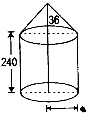
An iron pillar has some part in the form of a right circular cylinder and remaining in the form of a right circular cone. The radius of the base of each of cone and cylinder is $8 cm$. The cylindrical part is $240 cm$ high and the conical part is $36 cm$ high. Find the weight of the pillar if one cubic cm of iron weight is $7.8$ grams.
Answer

Let $r_1 cm$ and $r_2 cm$ denote the radii of the base of the cylinder and cone respectively.
Then, $r _1= r _2=8 cm$
Let $h_1$ and $h_2 cm$ be the height of the cylinder and the cone respectively. Then,
$h_1 = 240$ cm and $h_2 = 36 cm.$
Now, Volume of the cylinder = $\pi r_1^2 h_1 cm ^3$
$= (\pi x 8 x 8 x 240 ) cm^3$
$= (\pi x 64 x 240 ) cm^3​​​​​​​$​​​​​​​
Volume of the cone = $\frac{1}{3} \pi r_2^2 h_2 cm ^3$
$=\left(\frac{1}{3} \pi \times 8 \times 8 \times 36\right)^0 cm ^3$
$=\left(\frac{1}{3} \pi \times 64 \times 36\right) cm ^3$
$\therefore$ Total volume of iron = Volume of the cylinder + Volume of the cone
$=\left(\pi \times 64 \times 240+\frac{1}{3} \pi \times 64 \times 36\right) cm ^3$
$=\pi \times 64 \times(240+12) cm ^3$
$=\frac{22}{7} \times 64 \times 252 cm ^3$
$=22 \times 64 \times 36 cm ^3$
Hence, total weight of the pillar = Volume x weight per $cm^3$​​​​​​​
$= ( 22 x 64 x 36 ) x 7.8 gms$
$= 395366.4$ gms
$= 395.3664 kg.$
View full question & answer
Question 74 Marks
The diameter of the cross-section of a water pipe is $5 cm$ . Water flows through it at $10 km / hr$ into a cistern in the form of a cylinder. If the radius of the base of the cistern is $2.5 m$ , find the height to which the water will rise in the cistern in $24$ minutes.
Answer
Area of the cross-section of the water pipe $= \pi r^2$
$=3.142 \times \frac{5}{2} \times \frac{5}{2}$
Speed of the water = 10 km/hr
$=\frac{10 \times 1000 \times 100}{60} cm /$ minutes
$\therefore$ Quantity of water supplied in $24$ minutes
$=3.142 \times \frac{5}{2} \times \frac{5}{2} \times \frac{10,00,000}{6} \times 24$
$=78,55,000 cm ^3$
Let the height of water in the cistern be h cm.
The quantity of water collected in the cistern
$= 3.142 \times 250 \times 250 \times h cm^3$​​​​​​​
Both the above quantities must be equal
$\therefore 3.142 \times 250 \times 250 \times h = 78,55,000$
$h=78,55,000 \times \frac{1}{3.142 \times 250 \times 250}$
$h = 40 cm.$​​​​​​​
View full question & answer
Question 84 Marks
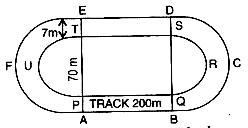
The figure shows a running track surrounding a grassed enclosure $PQRSTU$. The enclosure consists of a rectangle PQST with a semicircular region at each end, $PQ = 200 m; PT = 70 meters$.

(i) Calculate the area of the grassed enclosure in $m^2$.
(ii) Given that the track is of constant width $7 m$, calculate the outer perimeter ABCDEF of the track. (Take π = $\frac{22}{7}$)
Answer
(i) Area of the grassed enclosure
$=P Q \times P T+2 \times \frac{1}{2} \times \pi \times(35)^2 \quad \ldots\left(\because r=\frac{70}{2}=35 m \right)$
$=200 \times 70+\frac{22}{7} \times 35 m \times 35 m$
$=14000+22 \times 5 \times 35 m ^2$
$=[14000+110 \times 35] m ^2$
$=14000+3850=17850 m ^2$
(ii) $R =\left[\frac{70+14}{2}\right] m =\frac{84}{2}=42 m$
$=2 \times 200 m +2 \times \frac{22}{7} \times 42 m$
$=400 m +264 m$
$=664 m .$
View full question & answer
Question 94 Marks
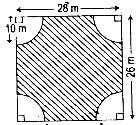
Find the perimeter and area of the shaded portion of the following diagram; give your answer correct to $3$ significant figures. (Take $\pi = 22/7).$
Answer

Area of rectangle $=28 m \times 26 m=728 m^2$
(i) Perimeter of the shaded position
$=2 \times 28+2 \times 26-4 \times 20+2 \times \frac{22}{7} \times 10)$
$=56+52-80+\frac{440}{7}$
$=108 - 80 + 62.85$
$= 170.85 - 80$
= 90.85 m. (ii) Area of one corner (unshaded) = $\frac{1}{4} \pi \times(10)^2$
$=\frac{1}{4} \times(3.14)\left(100 m ^2\right)=\frac{314}{4}$
$= 78.5 m^2$
$\therefore$ Area of 4 corners (unshaded) $=78.5 \times 4=314 m^2$
$\therefore$ Area of the shaded portion $=[728-314] m ^2=414 m^2$.
View full question & answer
Question 104 Marks
In the adjoining figure, the radius is $3.5\ cm.$ Find:
(i) The area of the quarter of the circle correct to one decimal place.
(ii) The perimeter of the quarter of the circle correct to one decimal place. ( Take π = $\frac{22}{7}$)
Answer
(i) $r =3.5 cm =\frac{7}{2} cm \quad$...(given)
Area of the quarter of the circle $=\frac{1}{4} \pi r^2$
$=\frac{1}{4} \times \frac{22}{7} \times\left(\frac{7}{2}\right)^2$
$=\frac{1}{4} \times \frac{22}{7} \times\left(\frac{7}{2} \times \frac{7}{2}\right)$
$=\frac{77}{8} cm^2$
$= 9.625$
$= 9.6\ cm^2$ ....(Correct to one decimal place)
(ii) Perimeter of the quarter of the circle
$=\frac{2 \pi r}{4}+r+r$
$=\frac{\pi r}{2}+2 r$
$=\frac{1}{2} \times \frac{22}{7} \times(3.5) cm +2 \times(3.5) cm $
$= ( 5.5 + 7 ) cm$
$= 12.5 cm.$
View full question & answer
Question 114 Marks
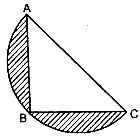
$ABC$ is an isosceles right-angled triangle with $\angle ABC = 90^\circ $. A semi-circle is drawn with $AC$ as the diameter. If $AB = BC = 7 cm$, find the area of the shaded region. [Take $\pi = 22/7]$​​​​​​​
Answer
In ΔABC, using Pythagoras theorem $AC^2 = AB^2 + BC^2$
$AC^2= (7)^2 + (7)^2$
$AC^2= 49 + 49$
$AC^2= 98$
$\Rightarrow AC =7 \sqrt{2}$
Radius of semi-circle $=\frac{ AC }{2}=\frac{7 \sqrt{2}}{2}$
$\therefore$ Area of the shaded region = Area of semi-circle – Area of ΔABC
Area of semi-circle = $\frac{1}{2} \pi r^2=\frac{1}{2} \pi\left(\frac{7 \sqrt{2}}{2}\right)^2$
$=\frac{98 \pi}{8}=\frac{49 \pi}{4}$
$=\frac{49}{4}$
$=\frac{49}{4} \times \frac{22}{7}$
$=\frac{77}{2} cm ^2$
Area of $\triangle ABC =\frac{1}{2} \times BC \times AB$
$=\frac{1}{2} \times 7 \times 7$
$=\frac{49}{2} cm ^2$
Thus, Area of the shaded region = $\frac{77}{2} cm ^2-\frac{49}{2} cm ^2=\frac{28}{2} cm ^2=14 cm ^2$.
View full question & answer
Question 124 Marks
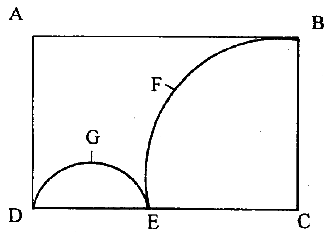
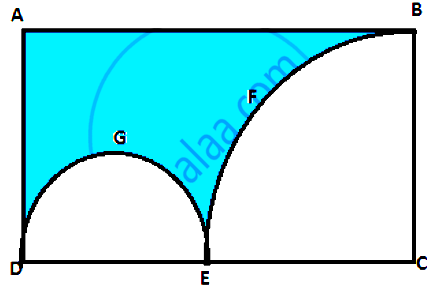
In the figure given below, ABCD is the rectangle. AB = 14 cm, BC = 7 cm. From the rectangle, a quarter circle BFEC and a semicircle DGE are removed. Calculate the area of the remaining piece of the rectangle. (Take $\left.\pi=\frac{22}{7}\right)$.
Answer
Considering the given figure:

Given dimensions of the rectangle: AB = 14 cm and BC = 7 cm
⇒ Radius of the quarter circle = 7 cm
Area of the quarter circle
$=\frac{1}{2} \times \frac{22}{7} \times 7^2 \text { sq. } cm$
$=\frac{77}{2} sq . cm $
Since EC = 7 cm and DC = 14 cm, we have
Therefore, radius of the semi circle = $\frac{7}{2} cm$
Area of the semi circle $=\frac{1}{2} \times \frac{22}{7} \times\left(\frac{7}{2}\right)^2$ sq. $cm$
$=\frac{77}{4}$ sq. $cm$
Now, are of rectangle ABCD = AB x BC = 14 x 7 = 98 sq. cm
∴ Required area = Area of rectangle ABCD - [Area(BCEF) + Area(DGE)]
$=98-\frac{77}{2}-\frac{77}{4}$
$=\frac{161}{4}$
$=40.25 \text { sq. } cm $
View full question & answer
[4 marks sum] - Mathematics STD 10 Questions - Vidyadip