Questions

[5 marks sum]

🎯

Test yourself on this topic

8 questions · timed · auto-graded

Question 15 Marks
A box contains some black balls and $30$ white balls. If the probability of drawing a black ball is two-fifths of a white ball, find the number of black balls in the box.
Answer
Number of white balls in the bag $= 30$
Let the number of black balls in the box be $x.$
$\therefore$ Total number of balls $= x + 30$
$P (\text { drawing a black ball })=\frac{x}{x+30}$
$P (\text { drawing a white ball })=\frac{30}{x+30}$
It is given that, $P ($ drawing a black ball $)=$ $\frac{2}{5} \times P($ drawing a white ball $)$
$\Rightarrow \frac{x}{x+30}=\frac{2}{5} \times \frac{30}{x+30} $
$ \Rightarrow \frac{x}{x+30}=\frac{12}{x+30}$
$ \Rightarrow x^2+30 x=12 x+360 $
$ \Rightarrow x^2+18 x-360=0 $
$\Rightarrow x^2+30 x-12 x-360=0 $
$ \Rightarrow x(x+30)-12(x+30)=0$
$\Rightarrow(x+30)(x-12)=0 $
$ \Rightarrow x=-30 \text { or } x=12$
Since number of balls cannot be negative, we reject $x = -30$
$\Rightarrow x=12$
Therefore, number of black balls in the box is $12.$

View full question & answer
Question 25 Marks
A box contains a certain number of balls. On each of $60\%$ balls, letter $A$ is marked. On each of $30\%$ balls, letter $B$ is marked and on each of remaining balls, letter $C$ is marked. A ball is drawn from the box at random. Find the probability that the ball drawn is:
$i$. marked $C$
$ii. A$ or $B$
$iii$. neither $B$ nor $C$
Answer
A box contains,
$60 \%$ balls, letter $A$ is marked.
$30 \%$ balls, letter $B$ is marked.
$10 \%$ balls, letter $C$ is marked.
$(i)$. Total number of all possible outcomes $=100$
Number of favourable outcomes $=10$
$\therefore \text { Required Probability }=\frac{\text { Number of favourable outcomes }}{\text { Total number of all possible outcomes }}=\frac{10}{100}=\frac{1}{10}$
$(ii)$ The probability that the ball drawn is marked $A=\frac{\text { Number of favourable outcomes }}{\text { Total number of all possible outcomes }}=\frac{60}{100}=\frac{6}{10}$
The probability that the ball drawn is marked $B=\frac{\text { Number of favourable outcomes }}{\text { Total number of all possible outcomes }}=\frac{30}{100}=\frac{3}{10}$
$(iii)$ The probability that the ball drawn is neither $B$ nor $C$
$=1-[P(B)+P(C)]$
$=1-\left[\frac{3}{10}+\frac{1}{10}\right]$
$=1-\frac{4}{10}$
$=\frac{6}{10}$
$=\frac{3}{5}$
View full question & answer
Question 35 Marks
Sixteen cards are labelled as a, b, c, ……………. m, n, o, p. They are put in a box and shuffled.a boy is asked to draw a card from the box. What is the probability that the card drawn is:
(1) a vowel
 (2) a consonant
(3) none of the letters of the word media
Answer
Outcomes: a, b, c, d, e, f, g, h, i, j, k, l, m, n, o, p
Total number of all possible outcomes 16
1) When the selected card has a vowel, the possible outcomes are $a, e, i, o$
Number of favourable outcomes 4
$\therefore$ Required probability $=\frac{4}{16}=\frac{1}{4}$
2) When the selected card has a consonant,
Number of favourable outcomes $16-4=12$
$\therefore$ Required probability $=\frac{12}{16}=\frac{3}{4}$
3) When the selected card has none of the letters from the word median
the possible outcomes are b, c, f, g, h, j, k, l, o, p.
Number of favourable outcomes 10
$\therefore$ Required probability $=\frac{10}{16}=\frac{5}{8}$
View full question & answer
Question 45 Marks
Answer
Given that the die has 6 faces marked by the given numbers as below:

Total number of outcomes = 6
1) For getting a positive integer, the favourable outcomes are 1, 2, 3
⇒ Number of favourable outcomes = 3
⇒ Required probability =$\frac{3}{6}=\frac{1}{2}$
2) For getting an integer greater than -3, the favourable outcomes are -2, -1, 1, 2, 3
⇒ Number of favourable outcomes = 5
⇒ Required probability = $\frac{5}{6}$
3) For getting the smallest integer, the favourable outcome is -2
⇒Number of favourable outcomes = 1
⇒ Required probability =$\frac{1}{6}$
View full question & answer
Question 55 Marks
A box contains some black balls and $30$ white balls. If the probability of drawing a black ball is two$-$fifths of a white ball, find the number of black balls in the box.
Answer
Number of white balls in the bag $= 30$
Let the number of black balls in the box be $x.$
$\therefore$ Total number of balls $= x + 30$
$P (\text { drawing a black ball })=\frac{x}{x+30}$
$P (\text { drawing a white ball })=\frac{30}{x+30}$
It is given that, $P ($ drawing a black ball $)=\frac{2}{5} \times P($ drawing a white ball $)$
$\Rightarrow \frac{x}{x+30}=\frac{2}{5} \times \frac{30}{x+30}$
$\Rightarrow \frac{x}{x+30}=\frac{12}{x+30}$
$\Rightarrow x^2+30 x=12 x+360$
$\Rightarrow x^2+18 x-360=0$
$\Rightarrow x^2+30 x-12 x-360=0$
$\Rightarrow x(x+30)-12(x+30)=0$
$\Rightarrow(x+30)(x-12)=0$
$\Rightarrow x=-30 \text { or } x=12$
Since number of balls cannot be negative, we reject $x = -30$
$\Rightarrow x=12$
Therefore, number of black balls in the box is $12.$
View full question & answer
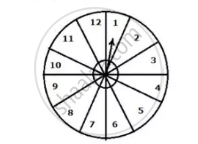
Question 65 Marks
Answer
Total number of possible outcomes =12
(1) Number of favorable outcomes for 6=1
P(the pointer will point a 6) =$\frac{1}{12}$
(2)favorable outcomes for an even number are 2,4,6,8,10,12
Number of favorable outcomes=6
P( the pointer will be at an even number)=$\frac{6}{12}=\frac{1}{2}$
(3) Favorable outcomes for a prime number are 2,3,5,7,11
Number of favorable outcomes=5
|p(the pointer will be at a prime number)=$\frac{5}{12}$
(4) Favourable outcomes for a number greater than 8 are 9,10,11,12
Number of favorable outcomes=4
P(the pointer will be at a number greater than 8 )
$=\frac{4}{12}=\frac{1}{3}$
(5) Favorable outcomes for a number less than or equal to are 1,2,,3,4,5,6,7,8,9
Number of favorable outcome =9
p(the pointer will be at a number less than or equal to 9)=
$\frac{9}{12}=\frac{3}{4}$
(6) Favorable outcomes for a number between 3 and 11 are 4,5,6,7,8,9,10
Number of favorable outcomes=7
P(the pointer will be at a number 3 and 11) =$\frac{7}{12}$

View full question & answer
Question 75 Marks
In a single throw of two dice, find the probability of:  an odd number on one dice and a number less than or equal to 4 on the other dice.   
Answer
The number of possible outcomes is$6 \times 6=36$We write them as given below:
1,11,21,,31,41,51,6
2,12,22,32,42,52,6
3,13,23,33,43,53,6
4,14,24,34,44,54,6
5,15,25,35,45,55,6
6,16,26,36,46,56,6
n(s)=36
E= Event of getting an odd number on dice 1 and a number less than or equal to 4 on dice 2=
{(1,1)(1,2)(1,3)(1,,4)(1,5)}
{(2,1)(2,3)(2,5)}
{(3,1)(3,2)(3,3)(3,4)(3,5)}
{(4,1)(4,3)(4,5)}
{(5,1)(5,2)(5,3)(5,4)}
Therefore total number of favorable ways=20=n(E)
Probability of getting an odd number on dice 1 and a number less than or equal to 4 on dice 2 = $\frac{n(E)}{n(s)}=\frac{20}{36}=\frac{5}{9}$
View full question & answer
Question 85 Marks
Answer
Number of possible outcomes= number of day in the month=31
n(s)=31
(1) E= event of selection of a Tuesday or a saturday ={1,8,15,22,29}
n(E)=5
Probability of selection of a wednesday=
$P(s)=\frac{n(E)}{n(s)}=\frac{5}{31}$
E=event of selection of a friday ={3,10,17,24,31}
n(E)=5
probability of selection of a friday =
$P(s)=\frac{n(E)}{n(s)}=\frac{5}{31}$
E=event of seletionn of a tuesday or a saturday ={4,7,11,14,18,21,25,28}
n(E)=8
Probability of selection of a Tuesday or a saturday
$=P(s)=\frac{n(E)}{n(S)}=\frac{8}{31}$
View full question & answer
[5 marks sum] - Mathematics STD 10 Questions - Vidyadip