Question 14 Marks
Sum of two natural numbers is 8 and the difference of their reciprocal is 2/15. Find the numbers.
AnswerLet $x$ and $y$ be two numbers
Given that, $x+y=8$....(1).
From equation (i), we have, $y=8-x$
Substituting the value of $y$ in equation (2),
we have,
$
\frac{1}{x}-\frac{1}{8-x}=\frac{12}{15}
$
$
\begin{aligned}
& \Rightarrow \frac{8-x-x}{x(8-x)}=\frac{2}{15} \\
& \Rightarrow \frac{8-2 x}{x(8-x)}=\frac{2}{15} \\
& \Rightarrow \frac{4-x}{x(8-x)}=\frac{1}{15} \\
& \Rightarrow 15(4-x)=x(8-x) \\
& \Rightarrow 60-15 x=8 x-x^2 \\
& \Rightarrow x^2-15 x-8 x+60=0 \\
& \Rightarrow x^2-23 x+60=0 \\
& \Rightarrow x^2-20 x-3 x+60=0 \\
& \Rightarrow x(x-20)-3(x-20)=0 \\
& \Rightarrow(x-3)(x-20)=0
\end{aligned}
$
Either $(x-3)=0$
or
$
(x-20)=0
$
$
\Rightarrow x =3
$
or
$
x=20
$
Since sum of two natural numbers is $8-x$
i.e. 8 - 20 cannot be equal to 20
Thus $x =3$
From equation (1), $y=8-x=8-3=5$
Thus the values of $x$ and $y$ are 3 and 5 respectively.
View full question & answer→Question 24 Marks
If twice the area of a smaller square is subtracted from the area of a larger square, the result is $14 cm^2$. However, if twice the area of the larger square is added to three times the area of the smaller square, the result is $203 cm^2$. Determine the sides of the two squares.
AnswerLet the side of smaller square $=x cm$
and side of bigger square $=y cm$
According to the condition,
$ y^2-2 x^2=14 ...(1)$
$\text { and } 2 y^2+3 x^2=203...(2)$
Multiply (1) by 2 and (2) by 1
$
\begin{aligned}
& 2 y^2-4 x^2=28 \\
& 2 y^2+3 x^2=203 \\
& -\quad-
\end{aligned}
$
Subtracting, we get, $-7 x^2=-175$
$\Rightarrow x^2=\frac{-175}{-7}=25$
$x^2-25=0$
$\Rightarrow(x+5)(x-5)=0$
Either $x+5=0$,
then $x=-5$,
but it is not possible
or
$x-5=0 \text {, }$
then $x=5$.
Substitute the value of $x$ in (1)
$ y^2-2(5)^2=14 $
$ \Rightarrow y^2=14+2 \times 25 $
$ y^2=14+50 $
$ =64 $
$ =(8)^2$
$ \therefore y=8$
Hence side of the smaller square $=5 cm$
and side of bigger square $=8 cm$.
View full question & answer→Question 34 Marks
Two years ago, a man’s age was three times the square of his daughter’s age. Three years hence, his age will be four times his daughter’s age. Find their present ages.
Answer2 years ago,
Let the age of daughter $=x$
age of $\operatorname{man}=3 x^2$
then present age of daughter $=x+2$
and mean $=3 x^2+2$
and 3 years hence, the age of
the daughter $=x+2+3=x+5$
and $\operatorname{man}=3 x^2+2+3=3 x^2+5$
According to the condition.
$
\begin{aligned}
& 3 x^2+5=4(x+5) \\
& \Rightarrow 3 x^2+5=4 x+20 \\
& \Rightarrow 3 x^2-4 x+5-20=0 \\
& \Rightarrow 3 x^2-4 x-15=0 \\
& \Rightarrow 3 x^2-9 x+5 x-15=0 \\
& \Rightarrow 3 x(x-3)+5(x-3)=0 \\
& \Rightarrow(x-3)(3 x+5)=0
\end{aligned}
$
Elther $x-3=0$,
then $x=3$
or
$3 x+5=0$,
then $3 x=-5$
$\Rightarrow x =\frac{-5}{3}$
Which is not possible, as age can't be negative
If $x =3$, then
Present age of man
$
\begin{aligned}
& =3 x^2+2 \\
& =3(3)^2+2 \\
& =27+2 \\
& =29 \text { years }
\end{aligned}
$
and age of daughter
$
\begin{aligned}
& =x+2 \\
& =3+2 \\
& =5 \text { years } .
\end{aligned}
$
View full question & answer→Question 44 Marks
The age of a man is twice the square of the age of his son. Eight years hence, the age of the man will be 4 years more than three times the age of his son. Find the present age.
AnswerLet the present age of the son $=x$ years
then, the present age of the man $=2 x^2$ years.
8 years hence,
The age of son will be $=(x+8)$ years and the
age of man $=\left(2 x^2+8\right)$ years
According to the problem,
$
\begin{aligned}
& 2 x^2+8=3(x+8)+4 \\
& \Rightarrow 2 x^2+8=3 x+24+4 \\
& \Rightarrow 2 x^2-3 x-24-4+8=0 \\
& \Rightarrow 2 x^2-3 x-20=0 \\
& \Rightarrow 2 x^2-8 x+5 x-20=0 \\
& \Rightarrow 2 x(x-4)+5(x-4)=0 \\
& \Rightarrow(x-4)(2 x+5)=0
\end{aligned}
$
Elther $x-4=0$,
then $x=4$
or
$
2 x+5=0 \text {, }
$
then $2 x=-5$
$
\Rightarrow x =-\frac{5}{2}
$
But, it is not possible.
Present age of the son $=4$ years
and present age of the man $=2 x^2$
$
\begin{aligned}
& =2(4)^2 \text { years } \\
& =32 \text { years }
\end{aligned}
$
View full question & answer→Question 54 Marks
Paul is $x$ years old and his father’s age is twice the square of Paul’s age. Ten years hence, the father’s age will be four times Paul’s age. Find their present ages.
AnswerAge of Paul $= x$ years
Father's age $= 2x^2$
10 years hence,
Age of Paul $= x + 10$
and father's age $= 2x^2 + 10$
According to the conditions,
$2x^2 + 10 = 4(x + 10)$
$\Rightarrow 2x^2+ 10 = 4x + 40$
$\Rightarrow 2x^2 + 10 - 4x - 40 = 0$
$\Rightarrow 2x^2 - 4x - 30 = 0$
$\Rightarrow x^2- 2x - 15 = 0 ...(Dividing by 2)$
$\Rightarrow x^2- 5x + 3x - 15 = 0$
$\Rightarrow x(x - 5) + 3(x - 5) = 0$
$\Rightarrow (x - 5)(x + 3) = 0$
Either $x - 5 = 0,$
then $x = 5$
or
$x + 3 = 0,$
then $x = -3,$
but it is not possible as it is in negative.
$\therefore$ Age of Paul $= 5$ years.
and his father's age
$= 2x^2$
$= 2(5)^2$
$= 2 x 25$
$= 50$ years.
View full question & answer→Question 64 Marks
Ritu bought a saree for Rs. 60 x and sold it for Rs. (500 + 4x) at a loss of x%. Find the cost price.
AnswerThe cost price of saree $=$ Rs. $60 x$
and selling price $=$ Rs. $(500+4 x)$
Loss $= x \%$
Now according to the condition
$
\begin{aligned}
& \text { S.P. }=\text { C.P. } x \frac{100-\text { Loss } \%}{100} \\
& 500+4 x=\frac{60 x(100-x)}{100} \\
& \Rightarrow 50000+400 x=6000 x-60 x^2 \\
& \Rightarrow 60 x^2-6000 x+400 x+50000=0 \\
& \Rightarrow 60 x^2-5600 x+50000=0 \\
& \Rightarrow 3 x^2-280 x+2500=0 \ldots(\text { Dividing by } 20) \\
& \Rightarrow 3 x^2-30 x-250 x+2500=0 \\
& \Rightarrow 3 x(x-10)-250(x-10)=0 \\
& \Rightarrow(x-10)(3 x-250)=0
\end{aligned}
$
Either $x-10=0$,
then $x=10$
or
$
3 x-250=0 \text {, }
$
then $3 x=250$
$
\Rightarrow x =\frac{250}{3}
$
But it is not possible
$\therefore$ Loss $=10 \%$
Cost price $=60 x$
$
\begin{aligned}
& =60 \times 10 \\
& =\text { Rs. } 600 .
\end{aligned}
$
View full question & answer→Question 74 Marks
A person was given Rs. 3000 for a tour. If he extends his tour programme by 5 days, he must cut down his daily expenses by Rs. 20. Find the number of days of his tour programme.
AnswerLet the number of days of tour programme $=x$
Amount $=$ Rs. 3000
$\therefore$ Express for each day $=\frac{3000}{x}$
In second case, no of days $=x+5$
then expenses of each day $=\frac{3000}{x+5}$
Now according to the condition,
$
\begin{aligned}
& \frac{3000}{x}-\frac{3000}{x+5}=20 \\
& \Rightarrow 3000\left(\frac{1}{x}-\frac{1}{x+5}\right)=20 \\
& \Rightarrow 3000 \frac{(x+5-x)}{x^2+5 x}=20 \\
& \Rightarrow 3000 \times 5=20 x^2+100 x \\
& \Rightarrow 20 x^2+100 x-15000=0 \\
& \Rightarrow x^2+5 x-750=0 \ldots(\text { Dlviding by } 20) \\
& \Rightarrow x^2-25 x+30 x-750=0 \\
& \Rightarrow x(x-25)(x+30)=0 \\
& \Rightarrow(x-25)(x+30)=0
\end{aligned}
$
Elther $x-25=0$,
then $x=25$
or
$
x+30=0 \text {, }
$
then $x=-30$,
but it is not possible as it is in negative.
$\therefore$ Number days $=25$.
View full question & answer→Question 84 Marks
The hotel bill for a number of people for an overnight stay is Rs. 4800. If there were 4 more, the bill each person had to pay would have reduced by Rs. 200. Find the number of people staying overnight.
AnswerLet the number of people $=x$
Amount of bill $=$ Rs. 4800
Then bill for each person $=$ Rs. $\frac{4800}{x}$
In second case,
the number of people $=x+4$
then bill of each person $=\frac{4800}{x+4}$
According to the condition,
$
\begin{aligned}
& \frac{4800}{x}-\frac{4800}{x+4}=200 \\
& \Rightarrow 4800\left(\frac{1}{x}-\frac{1}{x+4}\right)=200 \\
& \Rightarrow 4800\left(\frac{x+4-x}{x(x+4)}\right)=200 \\
& \Rightarrow \frac{4800 \times 4}{x(x+4)}=200 \\
& \Rightarrow 19200=200 x^2+800 x \\
& \Rightarrow 200 x^2+800 x-19200=0 \\
& \Rightarrow x^2+4 x-96=0 \ldots(\text { Dividing by } 200) \\
& \Rightarrow x^2+12 x-8 x-96=0 \\
& \Rightarrow x(x+12)-8(x+12)=0 \\
& \Rightarrow(x+12)(x+8)=0
\end{aligned}
$
Either $x+12=0$,
then $x=-12$,
but it is not possible as it is in negative or
$
x-8=0 \text {, }
$
then $x =8$
$\therefore$ No. of people $=8$.
View full question & answer→Question 94 Marks
Rs. 6500 is divided equally among a certain number of persons. Had there been 15 more persons, each would have got Rs. 30 less. Find the original number of persons.
AnswerTotal amount $=$ Rs. 6500
Let number of persons in first case $=x$
Then share of each person $=$ Rs, $\frac{6500}{x}$
Number of person increased $=15$
$\therefore$ Total number $x +15$
Now share of each person $=\frac{6500}{x+15}$
According to the condition,
$
\frac{6500}{x}-\frac{6500}{x+15}=30
$
$\Rightarrow 6500\left[\frac{1}{x}-\frac{1}{x+15}\right]=30$
$\Rightarrow 6500\left[\frac{x+15-x}{x(x+15)}\right]=30$
$\Rightarrow \frac{6500 \times 15}{x^2+15 x}=30$
$\Rightarrow 6500 \times 15=30\left( x ^2+15 x \right)$
$\Rightarrow 3250= x ^2+15 x$...(Dividing by 30 )
$\Rightarrow x ^2+15 x -3250=0$
$\Rightarrow x ^2+65 x -50 x -3250=0$
$\Rightarrow x(x+65)-50(x+65)=0$
$\Rightarrow( x +65)( x -50)=0$
Elther $x+65=0$,
then $x=-65$
which is not possible being negative or
$
x-50=0 \text {, }
$
then $x=50$
$\therefore$ No. of persons in the beginning $=50$.
View full question & answer→Question 104 Marks
Two pipes running together can fill a tank in $11 \frac{1}{9}$ minutes. If one pipe takes 5 minutes more than the other to fill the tank, find the time in which each pipe would/fill the tank.
AnswerLet the time taken by one pipe $= x$ minutes
Then time taken by second pipe $=(x+5)$ minutes
Time taken by both pipes $=11 \frac{1}{9}$ minutes
Now according to the condition.
$
\begin{aligned}
& \frac{1}{x}+\frac{1}{x 5}=\frac{9}{100} \\
& \Rightarrow \frac{(x+5)+x}{x(x+5)}=\frac{9}{100} \\
& \Rightarrow \frac{x+5+x}{x^2+5 x}=\frac{9}{100} \\
& \Rightarrow \frac{2 x+5}{x^2+5 x}=\frac{9}{100} \\
& \Rightarrow 9 x^2+45 x=200 x+500 \\
& \Rightarrow 9 x^2+45 x-200 x-500=0 \\
& \Rightarrow 9 x^2-155 x-500=0 \\
& \Rightarrow 9 x^2-180 x+25 x-500=0 \\
& \Rightarrow 9 x(x-20)+25(x-20)=0 \\
& \Rightarrow(x-20)(9 x+25)=0
\end{aligned}
$
Either $x-20=0$,
$
\text { then } x=20 \text {. }
$
or
$
9 x+25=0
$
then $9 x=-25$
$
\Rightarrow x =\frac{-25}{9}
$
but is not possible as it is in negative.
$
x =20
$
Hence the first pipe can fill the tank in 20 minutes
and second pipe can do the same in $20+5=25$ minutes.
View full question & answer→Question 114 Marks
A boat can cover $10 \ km$ up the stream and $5 \ km$ down the stream in $6$ hours. If the speed of the stream is $1.5 \ km/hr.$ find the speed of the boat in still water.
AnswerDistance up stream $=10 \ km$
and down stream $=5 \ km$
Total time is taken $=6$ hours
Speed of stream $=1.5 \ km / hr$
Let the speed of a boat in still water $=x \ km / hr$
According to the condition,
$
\frac{10}{x-1.5}+\frac{5}{x+1.5}=6$
$ \Rightarrow 10 x+15+5 x+5 x-7.5=6(x-15)(x+15)$
$ \Rightarrow 15 x+7.5=6\left(x^2-2.25\right)$
$ \Rightarrow 15 x+7.5=6 x^2-13.5$
$ \Rightarrow 6 x^2-15 x-13.5-7.5$
$ \Rightarrow 6 x^2-15 x-21=0$
$ \Rightarrow 2 x^2-5 x-7=0 \ldots(\text { Dividing by } 3)$
$ \Rightarrow 2 x^2-7 x+2 x-7=0 \ldots
2 \times(-7)=14$
$-14=-7 \times 2$
$-5=-7+2$
$ \Rightarrow x(2 x-7)+1(2 x-7)=0$
$ \Rightarrow(2 x-7)(x+1)=0$
Either $2 x-7=0$,
then $2 x=7$
$\Rightarrow x =\frac{7}{2}$
or
$x+1=0 \text,$
then $x=-1$
But it is not possible being negative
$\therefore x=\frac{7}{2}=3.5$
$\therefore$ Speed of boat $=3.5 \ km / hr$.
View full question & answer→Question 124 Marks
A school bus transported an excursion party to a picnic spot 150 km away. While returning, it was raining and the bus had to reduce its speed by 5 km/hr, and it took one hour longer to make the return trip. Find the time taken to return.
AnswerDistance $=150 km$
Let the speed of bus $= x km / hr$
$\therefore$ Time taken $=\frac{150}{x}$ hour
On returning speed of the bus $=(x-5) km / hr$.
$\therefore$ Time taken $=\frac{150}{x-5}$
According to the condition
$
\begin{aligned}
& \frac{150}{x-5}-\frac{150}{x}=1 \\
& \Rightarrow 150\left(\frac{1}{x-5}-\frac{1}{x}\right)=1 \\
& \Rightarrow 150\left(\frac{x-x+5}{x(x-5)}\right)=1 \\
& \Rightarrow \frac{1500 \times 5}{x^2-5 x}=1 \\
& \Rightarrow x^2-5 x=750 \\
& \Rightarrow x^2-5 x-750=0 \\
& \Rightarrow x^2-30 x+25 x-750=0 \\
& \Rightarrow x(x-30)+25(x-30)=0 \\
& \Rightarrow(x-30)(x+25)=0
\end{aligned}
$
Either $x-30=0$,
then $x=30$
or
$
x+25=0 \text {, }
$
then $x=-25$,
but it is bot possible as it is negative.
$\therefore$ Speed of bus $=30 km$ and time taken while returning
$
\begin{aligned}
& =\frac{150}{x-5} \\
& =\frac{150}{30-5} \\
& =\frac{150}{25} \\
& =6 \text { hours. }
\end{aligned}
$
View full question & answer→Question 134 Marks
An aeroplane flying with a wind of 30 km/hr takes 40 minutes less to fly 3600 km, than what it would have taken to fly against the same wind. Find the planes speed of flying in still air.
AnswerLet the speed of the plane in still air $=x km / hr$
Speed of wind $=30 km / hr$
Distance $=3600 km$
$\therefore$ Time taken with the wind $=\frac{3600}{x+30}$
and time taken against the wind $=\frac{3600}{x-30}$
According to the condition,
$\frac{3600}{x-30}-\frac{3600}{x+30}=40$ mnutes $=\frac{2}{3}$ hour
$
\Rightarrow 3600\left(\frac{1}{x-30}-\frac{1}{x+30}\right)=\frac{2}{3}
$
$\Rightarrow 3600\left(\frac{x+30-x+30}{(x-30)(x+30)}\right)=\frac{2}{3}$
$\Rightarrow \frac{3600 \times 60}{x^2-900}=\frac{2}{3}$
$\Rightarrow 2 x ^2-1800=3 \times 3600 \times 60$
$\Rightarrow 2 x ^2-1800=648000$
$\Rightarrow 2 x ^2-1800-648000=0$
$\Rightarrow 2 x ^2-649800=0$
$\Rightarrow x ^2-324900=0$..(Dividing by 2 )
$\Rightarrow x ^2-(570) 2=0$
$\Rightarrow( x +570)( x -570)=0$
Either $x+570=0$,
then $x=-570$
which is not possible as it is negative
or
$
x-570=0 \text {, }
$
then $x=570$
Hence speed of plane in still air $=570 km / hr$.
View full question & answer→Question 144 Marks
An aeroplane travelled a distance of 400 km at an average speed of x km/hr. On the return journey, the speed was increased by 40 km/hr. Write down an expression for the time taken for
(i)the onward journey,
(ii) the return journey.
If the return journey took 30 minutes less than the onward journey, write down an equation in x and find its value.
AnswerDistance $=400 km$
Speed of aeroplane $=x km / hr$
(i) $\therefore$ Time taken $=\frac{400}{x}$ hours
On increasing the speed by $40 km / hr$,
on the return journey, the speed $=(x+40) km / hr$.
(ii) Time taken $=\frac{400}{x+40}$ hours
Now according to the condition,
$
\begin{aligned}
& \frac{400}{x}-\frac{400}{x+40}=30 \text { minutes }=\frac{1}{2} \\
& 400\left[\frac{1}{x}-\frac{1}{x+40}\right]=\frac{1}{2} \\
& \Rightarrow 400\left[\frac{x+40-x}{x(x+40)}\right] \\
& \Rightarrow \frac{400 \times 40}{x^2+40 x}=\frac{1}{2} \\
& \Rightarrow x^2+40 x=400 \times 40 \times 2 \\
& \Rightarrow x^2+40 x-32000=0 \\
& \Rightarrow x^2+200 x-160 x-32000=0 \\
& \Rightarrow x(x+200)-160(x+200)=0 \\
& \Rightarrow(x+200)(x-160)=0
\end{aligned}
$
Either $x+200=0$,
then $x=-200$,
which is not possible as it is negative.
or
$x-160=0$,
then $x=160$.
View full question & answer→Question 154 Marks
Find two consecutive odd integers such that the sum of their squares is $394.$
AnswerLet first odd integer $= 2x + 1$
Then second odd integer $= 2x + 3$
According to the condition,
$(2x + 1)^2 + (2x + 3)^2 = 394$
$\Rightarrow 4x^2 + 4x + 1 + 4x^2 + 12x + 9 = 394$
$\Rightarrow 8x^2 + 16x - 394 + 10 = 0$
$\Rightarrow 8x^2 + 16x - 384 = 0$
$\Rightarrow x^2 + 2x - 48 = 0 ..$.(Dividing by $8$)
$\Rightarrow x^2 + 8x - 6x - 48 = 0$
$\Rightarrow x(x + 8) -6(x + 8) = 0$
$\Rightarrow (x + 8)(x - 6) = 0$
EIther $x + 8 = 0,$
then $x = -8$
or
$x - 6 = 0,$
then $x = 6$
(i) If x = -8, then first odd integer $= 2x + 1$
$= 2 x (-8) + 1$
$= -16 + 1$
$= -15$
(ii) If x = 6, then first odd integer $= 2x + 1$
$= 2 x 6 + 1 = 13$
and second integer $= 13 + 2 = 15$
∴ Required integers are $-15, -13, or 13, 15.$
View full question & answer→Question 164 Marks
If the sum of two smaller sides of a right – angled triangle is 17cm and the perimeter is 30cm, then find the area of the triangle.
AnswerThe perimeter of the triangle = 30cm.
Let one of the two small sides = x
then, other side = 17 – x
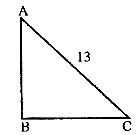
$
\begin{aligned}
& \therefore \text { Length of hypotenuse } \\
& =\text { perimeter }- \text { sum of other two sides } \\
& =30 cm -17 cm \\
& =13 cm . \\
& x^2+(17-x)^2=(13)^2 \ldots \text { (Pythagoras theorem) } \\
& \Rightarrow x^2+289+x^2-34 x=169 \\
& \Rightarrow 2 x^2-34 x+289-169=0 \\
& \Rightarrow 2 x^2-34 x+120=0 \\
& \Rightarrow x^2-17 x+60=0 \quad \ldots(\text { Dividing by } 2) \\
& \Rightarrow x^2-12 x-5 x+60=0 \\
& \Rightarrow x(x-12)-5(x-12)=0 \\
& \Rightarrow(x-12)(x-5)=0
\end{aligned}
$
Either $x-12=0$,
$
\text { then } x=12
$
or
$
x-5=0 \text {, }
$
then $x=5$
(i) when $x=12$, then first side $=12 cm$
and second side $=17-12=5 cm$
(ii) When $x=5$, then first side $=5$
and second side $=17-5=12$
$\therefore$ Sides are $5 cm .12 cm$
Now, area of the triangle
$
\begin{aligned}
& =\frac{5 \times 12}{60^2} \\
& =\frac{60}{2} \\
& =30 cm ^2 .
\end{aligned}
$ View full question & answer→Question 174 Marks
The length of a rectangle exceeds its breadth by $5 \ m$ . If the breadth were doubled and the length reduced by $9 m$ , the area of the rectangle would have increased by $140 m^2$. Find its dimensions.
AnswerLet length of the rectangle $=x m$
then width $=(x-5) m$
Area $=x(x-5)$ sq.m
In second case,
Length of the second rectangle $= x - 9$
and width $= 2(x - 5)m$
Area
$= (x - 9)2(x - 5)$
$= 2(x - 9)(x - 5)$sq.m
According to the condition,
$2(x - 9)(x - 5) = x(-5) + 140$
$\Rightarrow 2(x^2 - 14x + 45) = x^2 - 5x + 140$
$\Rightarrow 2x^2 - 28x + 90 = x^2 - 5x + 140$
$\Rightarrow 2x^2 - 28x + 90 - x^2 + 5x - 140 = 0$
$\Rightarrow x^2 - 23x - 50 = 0$
$\Rightarrow x^2 - 25x + 2x - 50 = 0$
$\Rightarrow x(x - 25) +2(x - 25) = 0$
$\Rightarrow (x - 25)(x + 2) = 0$
Either $x - 25 = 0,$
then$ x = 25$
or
$x + 2 = 0,$
then $x = -2,$
but it is not possible as it is negative.
$\therefore$ Length of the rectangle $= 25m$
and width $= 25 - 5 = 20m.$
View full question & answer→Question 184 Marks
Harish made a rectangular garden, with its length $5$ metres more than its width. The next year, he increased the length by $3$ metres and decreased the width by $2$ metres. If the area of the second garden was $119$ sq m, was the second garden larger or smaller ?
AnswerIn first case,
Let length of the garden $= x m$
then width $= (x – 5) m$
Area $= l x b = x(x – 5)$ sq. m
In second case,
Length $= (x + 3)m$
and width $= x - 5 - 2 = (x - 7)m$
According to the condition,
$(x + 3)(x - 7) = 119$
$\Rightarrow x^2 - 7x + 3x - 21 = 119$
$\Rightarrow x^2 - 4x - 21 - 119 = 0$
$\Rightarrow x^2- 4x - 140 = 0$
$\Rightarrow x^2 - 14x + 10x - 140 = 0$
$\Rightarrow x(x - 14) + 10(x - 14) = 0$
$\Rightarrow (x - 14)(x + 10) = 0$
Either $x - 14 = 0,$
then $x = 14$
or
$x + 10 = 0$,
then $x = -10,$
but it is not possible as it is negative.
$\therefore$ Length of first garden $= 14m$
and width $= 14 - 5 = 9m$
Area
$= l x b$
$= 14 x 9$
$= 126m^2$
Difference of areas of two rectangles
$= 126 - 119$
$= 7sq.m.$
∴ Area of second garden is smaller than the area of the first garden by $7$ sq.m.
View full question & answer→Question 194 Marks
The sum of the numerator and denominator of a certain positive fraction is 8. If 2 is added to both the numerator and denominator, the fraction is increased by$\frac{4}{35}$ Find the fraction.
AnswerLet the denominator of a positive fraction $=x$
then numerator $=8-x$
$\therefore$ Fraction $=\frac{8-x}{x}$
According to the condition.
$\frac{8-x+2}{x+2}=\frac{8-x}{x}+\frac{4}{35}$
$\Rightarrow \frac{10-x}{x+2}=\frac{8-x}{x}+\frac{4}{35}$
$\Rightarrow \frac{10-x}{x+2}-\frac{8-x}{x}=\frac{4}{35}$
$\Rightarrow \frac{10 x-x^2-8 x+x^2-16+2 x}{x(x+2)}=\frac{4}{35}$
$\Rightarrow \frac{4 x-16}{x^2+2 x}=\frac{4}{35}$
$\Rightarrow 4 x ^2+8 x =140 x -560$
$\Rightarrow 4 x ^2+8 x -140 x +560=0$
$\Rightarrow 4 x ^2-132 x +560=0$
$\Rightarrow x ^2-33 x +140=0$
$\Rightarrow x ^2-28 x -5 x +140=0$
$\Rightarrow x ( x -28)-5( x -28)=0$
$\Rightarrow( x -28)( x -5)=0$
Either $x-28=0$,
then $x=28$,
but it is not possible as sum of numberator and denominator is 8
or
$x-5=0$
then $x=5$
$\therefore$ Fraction $=\frac{8-x}{x}=\frac{8-5}{5}=\frac{3}{5}$.
View full question & answer→Question 204 Marks
Find the values of k for which each of the following quadratic equation has equal roots: $x^2– 2kx + 7k – 12 = 0$
Also, find the roots for those values of k in each case.
Answer$x^2-2 k x+7 k-12=0$
$\text { Here } a=1, b=-2 k, c=7 k-12$
$\therefore D=b^2-4 a c$
$=(-2 k)^2-4 \times 1 \times(7 k-12)$
$=4 k^2-4(7 k-12)$
$=4 k^2-28 k+48$
$\because$ Roots are equal
$\therefore D=0$
$\Rightarrow 4 k^2-28 k+48=0$
$\Rightarrow k^2-7 k+12=0$
$\Rightarrow k^2-3 k-4 k+12=0$
$\Rightarrow k(k-3)-4(k-3)=0$
$\Rightarrow(k-3)(k-4)=0$
Either $k-3=0$,
then $k=3$
or
$k-4=0 \text {, }$
then $k=4$
(a) If $k=3$, then
$x=\frac{-b \pm \sqrt{D}}{2 a}$
$=\frac{4 k \pm \sqrt{10}}{2 \times 1}$
$=\frac{4 \times 3}{2}$
$=\frac{12^2}{2}$
$=6$
$x=6,6$
(b) If $k=4$, then
$x=\frac{-b \pm \sqrt{D}}{2 a}$
$=\frac{-(-2 \times 4) \pm \sqrt{0}}{2 \times 1}$
$=\frac{ \pm 8}{2}$
$=4$
$\therefore x=4,4 \text {. }$
View full question & answer→Question 214 Marks
Find the values of k for which each of the following quadratic equation has equal roots: $9x^2 + kx + 1 = 0$ Also, find the roots for those values of k in each case.
Answer$9 x^2+k x+1=0$
$\text { Here } a=9, b=k$
$\therefore D=b^2-4 a c$
$=k^2-4 \times 9 \times 1$
$=k^2-36$
Here $a=9, b=k, c=1$
$\therefore D=b^2-4 a c$
$=k^2-4 \times 9 \times 1$
$=k^2-36$
$\because$ Roots are equal.
$\therefore D=0$
$\Rightarrow k^2-36=0$
$\Rightarrow(k+6)(k-6)=0$
Either $k+6=0$, then $k=-6$
$k-6=0 \text {, then } k=6$
$\therefore k=6,-6$
(a) If $k=6$, then
$9 x ^2+6 x +1=0$
$\Rightarrow(3 x )^2+2 \times 3 \times \times 1+(1)^2=0$
$\Rightarrow(3 x +1)^2=0$
$\therefore 3 x +1=0$
$\Rightarrow 3 x =-1$
$x =-\frac{1}{3}, \frac{1}{3}$
(b) If $k=-6$, then
$9 x^2-6 x+1=0$
$\Rightarrow(3 x)^2-2 \times 3 \times \times 1+(1)^2=0$
$\Rightarrow(3 x-1)^2=0$
$\Rightarrow 3 x-1=0$
$\Rightarrow 3 x=1$
$\Rightarrow x=\frac{1}{3}$
$x=\frac{1}{3}, \frac{1}{3} .$
View full question & answer→Question 224 Marks
Solve for $x: 2\left(\frac{2 x-1}{x+3}\right)-3\left(\frac{x+3}{2 x-1}\right)=5, x \neq-3, \frac{1}{2}$
Answer$
\begin{aligned}
& x: 2\left(\frac{2 x-1}{x+3}\right)-3\left(\frac{x+3}{2 x-1}\right)=5 \\
& \text { Let } \frac{2 x-1}{x+3}=y \text { then }\left(\frac{x+3}{2 x-1}\right)=\frac{1}{y} \\
& \therefore 2 y-\frac{3}{y}=5 \\
& 2 y^2-3=5 y \\
& \Rightarrow 2 y^2-5 y-3=0 \\
& \text { Here } a=2, b=-5, c=-3 \\
& b^2-4 a c \\
& =(-5)^2-4 \times 2 \times(-3) \\
& =25+24 \\
& =49
\end{aligned}
$
Now, $y =\frac{-b \pm \sqrt{b^2-4 a c}}{2 a}$
$
\begin{aligned}
& =\frac{-(-5) \pm \sqrt{49}}{2 \times 2} \\
& =\frac{5 \pm 7}{4} \\
& y=\frac{5+7}{4} \\
& =\frac{12}{4} \\
& =3
\end{aligned}
$
or
$
\begin{aligned}
& y=\frac{5-7}{4} \\
& =\frac{-2}{4} \\
& =\frac{-1}{2}
\end{aligned}
$
$
\therefore y=3, \frac{-1}{2}
$
When $y =3$,
then $\frac{2 x-1}{x+3}=3$
$
\begin{aligned}
& \Rightarrow 3 x +9=2 x -1 \\
& \Rightarrow 3 x -2 x =-1-9 \\
& \Rightarrow x =-10
\end{aligned}
$
When $y=\frac{-1}{2}$, then
or
$
\begin{aligned}
& \frac{2 x-1}{x+3}=\frac{-1}{2} \\
& 4 x-2=-x-3 \\
& 4 x+x=-3+2 \\
& \Rightarrow 5 x=-1 \\
& x=\frac{-1}{5} \\
& \therefore x=-10, \frac{-1}{5} .
\end{aligned}
$
View full question & answer→Question 234 Marks
Solve the following equation by using formula :
$
\frac{1}{x-2}+\frac{1}{x-3}+\frac{1}{x-4}=0
$
Answer$\begin{aligned} & \frac{1}{x-2}+\frac{1}{x-3}+\frac{1}{x-4}=0 \\ & \Rightarrow \frac{1}{x-2}+\frac{1}{x-3}=-\frac{1}{x-4} \\ & \Rightarrow \frac{x-3+x-2}{(x-2)(x-3)}=-\frac{1}{x-4} \\ & \Rightarrow \frac{2 x-5}{x^2-5 x+6}=\frac{-1}{x-4} \\ & (2 x-5)(x-4)=-1\left(x^2-5 x+6\right) \\ & \Rightarrow 2 x^2-8 x-5 x+20=-x^2+5 x-6 \\ & \Rightarrow 2 x^2-8 x-5 x+20+x^2-5 x+6=0 \\ & \Rightarrow 3 x^2-18 x+26=0\end{aligned}$
$\begin{aligned} & \text { Here, } a=3, b=-18, c=26 \\ & \therefore x=\frac{-b \pm \sqrt{b^2-4 a c}}{2 a} \\ & =\frac{-(-18) \pm \sqrt{(-18)^2-4 \times 3 \times 26}}{2 \times 3} \\ & =\frac{18 \pm \sqrt{324-312}}{6} \\ & =\frac{18 \pm \sqrt{12}}{6} \\ & =\frac{18 \pm 2 \sqrt{3}}{6} \\ & =\frac{9 \pm \sqrt{3}}{3} \ldots(\text { Dividing by } 2) \\ & \therefore x=\frac{9+\sqrt{3}}{3}, \frac{9-\sqrt{3}}{3} \\ & =3+\frac{\sqrt{3}}{3}, 3-\frac{\sqrt{3}}{3} \\ & =3+\frac{1}{\sqrt{3}}, 3-\frac{1}{\sqrt{3}} .\end{aligned}$
View full question & answer→Question 244 Marks
Use the substitution $y = 3x + 1$ to solve for $x : 5(3x + 1 )^2 + 6(3x + 1) – 8 = 0$
Answer$y=3 x+1$
Now, $5(3 x+1)^2+6(3 x+1)-8=0$
Substituting the value of $3 x+1$, we get
$5 y^2+6 y-8=0$
$\Rightarrow 5 y^2+10 y-4 y-8=0$
$\therefore 5 \times(-8)=-40$
$\therefore-40=10 \times(-4)$
$6=10-4$
$\Rightarrow 5 y(y+2)-4(y+2)=0$
$\Rightarrow(y+2)(5 y-4)=0$
$\text { Either } y+2=0,$
$\text { then } y=-2$
or
$5 y-4=0$,
then $5 y=4$
$\Rightarrow y =\frac{4}{5}$
(i) If $y=-2$, then
$ 3 x+1=-2$
$ \Rightarrow 3 x=-2-1 $
$ \Rightarrow 3 x=-3$
$ \Rightarrow x=\frac{-3}{3}$
$ =-1$
(ii) If $y=\frac{4}{5}$, then
$ 3 x=1=\frac{4}{5}$
$ \Rightarrow 3 x=\frac{4}{5}-1 $
$ =\frac{-1}{5} $
$\Rightarrow x=\frac{-1}{5} \times \frac{1}{3} $
$ =\frac{-1}{15}$
Hence $x =-1, \frac{-1}{15}$.
View full question & answer→Question 254 Marks
Solve the following equation by factorization$\frac{x-3}{x+3}+\frac{x+3}{x-3}=2 \frac{1}{2}$
Answer$
\frac{x-3}{x+3}+\frac{x+3}{x-3}=2 \frac{1}{2}
$
Put $\frac{x-3}{x+3}=a$,
then $\frac{x+3}{x-3}=\frac{1}{a}$ $\therefore a+\frac{1}{a}=\frac{5}{2}$
$
2 a^2+2=5 a
$
$
\begin{aligned}
& \Rightarrow 2 a^2-5 a+2=0 \\
& \Rightarrow 2 a^2-a-4 a+2=0 \\
& \Rightarrow a(2 a-1)-2(2 a-1)=0 \\
& \Rightarrow(2 a-1)(a-2)=0
\end{aligned}
$
Either $2 a-1=0$,
$
\text { then } a =\frac{1}{2}
$
or
$
a-2=0 \text {, }
$
then $a =2$
(a) When $a=\frac{1}{2}$, then
$
\begin{aligned}
& \frac{x-3}{x+3}=\frac{1}{2} \\
& \Rightarrow 2 x-6=x+3 \\
& \Rightarrow 2 x-x=3+6 \\
& \Rightarrow x=9
\end{aligned}
$
(b) when $a=2$, then
$
\begin{aligned}
& \frac{x-3}{x+3}=\frac{2}{1} \\
& 2 x+6=x-3 \\
& \Rightarrow 2 x-x=-3-6 \\
& \Rightarrow x=-9 \\
& \therefore x=9,-9 .
\end{aligned}
$
View full question & answer→Question 264 Marks
Solve the following equation by using formula :
$10ax^2 – 6x + 15ax – 9 = 0,a\neq 0$
Answer$10 a x^2-6 x+15 a x-9=0$
$\text { Here } a=10 a, b=-(6-15 a), c=-9$
$D=b^2-4 a c$
$=[-(6-15 a)]^2-4 \times 10 a(-9)$
$=36-180 a+225 a^2+360 a$
$=36+180 a+225 a^2=(6+15 a)^2$
$\therefore x=\frac{-b \pm \sqrt{D}}{2 a}$
$=\frac{-[-(6-15 a)] \pm \sqrt{(6+15 a)^2}}{2 \times 10 a}$
$=\frac{(6-15 a) \pm(6+15 a)}{20 a}$
$\therefore x_1=\frac{6-15 a+6+15 a}{20 a}$
$=\frac{12}{20 a}$
$=\frac{3}{5 a}$
$x_2=\frac{6-15 a-6-15 a}{20 a}$
$=\frac{-30 a}{20 a}$
$=\frac{-3}{2}$
(Hence $\left.x=\frac{3}{5} a\right), \frac{-3}{2}$.
View full question & answer→Question 274 Marks
Solve the following equation by using formula :
$\frac{3 x-4}{7}+\frac{7}{3 x-4}=\frac{5}{2}, x \neq \frac{4}{3}$
Answer$\frac{3 x-4}{7}+\frac{7}{3 x-4}=\frac{5}{2}, x \neq \frac{4}{3}$
let $\frac{3 x-4}{7}=y$, then
$y+\frac{1}{y}=\frac{5}{2}$
$\Rightarrow 2y^2 + 2 = 5y$
$\Rightarrow 2y^2 – 5y + 2 = 0$
$\Rightarrow 2y^2 – y – 4y + 2 = 0$
$\Rightarrow y(2y – 1) –2(2y – 1) = 0$
$\Rightarrow (2y – 1)(y – 2) = 0$
Either $2y – 1 = 0,$
then $2y = 1$
$\Rightarrow y=\frac{1}{2}$
or
$y – 2 = 0,$
then $y = 2$
When $y =\frac{1}{2}$, then $\frac{3 x-4}{7}=\frac{1}{2}$
$\Rightarrow 6x – 8 = 7$
$\Rightarrow 6x = 7 + 8$
$\Rightarrow 6x = 15$
$\Rightarrow x=\frac{15}{6}=\frac{5}{2}$
$y = 2$, then
$\frac{3 x-4}{7}=\frac{2}{1}$
$\Rightarrow 3 x-4=14$
$\Rightarrow 3 x=14+4=18$
$\Rightarrow x=\frac{18}{3}=6$
$\therefore x=6, \frac{5}{2} .$
View full question & answer→Question 284 Marks
A man spent Rs. 2800 on buying a number of plants priced at Rs x each. Because of the number involved, the supplier reduced the price of each plant by Rupee 1.The man finally paid Rs. 2730 and received 10 more plants. Find x.
AnswerAmount spent $=$ Rs. 2800
Price of each plant $=$ Rs. $x$
Reduced price $=$ Rs. $(x-1)$
No. of plants in first case $=\frac{2800}{x}$
No. of plants received in second case $=\frac{2800}{x}+10$
Amount paid $=$ Rs. 2730
According to the condition,
$
\begin{aligned}
& \left(\frac{2800}{x}+10\right)(x-1)=2730 \\
& \Rightarrow \frac{(2800+10 x)(x-1)}{x}=2730 \\
& \Rightarrow(2800+10)(x-1)=2730 x \\
& \Rightarrow 2800 x-2800+10 x^2-10 x-2730=0 \\
& \Rightarrow 10 x^2+2800 x-10 x-2730 x-2800=0 \\
& \Rightarrow 10 x^2+60 x-2800=0 \\
& \Rightarrow x^2+60 x-280=0 \ldots(\text { Dividing by } 10) \\
& \Rightarrow x^2+20 x-14 x-280=0 \\
& \Rightarrow x(x+20)-14(x+20)=0 \\
& \Rightarrow(x+20)(x-14)=0
\end{aligned}
$
Either $x+20=0$,
then $x =-20$,
but it is not possible as it is in negative.
or
$
x-14=0 \text {, }
$
then $x=14$.
View full question & answer→Question 294 Marks
The speed of a boat in still water is 11 km/ hr. It can go 12 km up-stream and return downstream to the original point in 2 hours 45 minutes. Find the speed of the stream
AnswerSpeed of a boat in still water $=11 km / hr$
Let the speed of stream $=x km / hr$.
Distance covered $=12 km$.
Time taken $=2$ hours 45 minutes
$
=2 \frac{3}{4}=\frac{11}{4} \text { hours }
$
Now according to the condition
$
\begin{aligned}
& \frac{12}{11-x}+\frac{12}{11+x}=\frac{11}{4} \\
& \Rightarrow \frac{12(11+x+11-x)}{(11-x)(11+x)}=\frac{11}{4} \\
& \Rightarrow \frac{12 \times 22}{121-x^2}=\frac{11}{4} \\
& \Rightarrow 1331-11 x^2=4 \times 12 \times 22=1056 \\
& \Rightarrow 1331-11 x^2=1056 \\
& \Rightarrow 1331-1056-11 x^2=0 \\
& \Rightarrow-11 x^2+275=0 \\
& \Rightarrow x^2-25=0 \ldots \text { (Dividing by -11) } \\
& \Rightarrow(x+5)(x-5)=0
\end{aligned}
$
Either $x+5=0$,
then $x=-5$,
but it is not possible as it is in negative.
or
$
x-5=0 \text {, }
$
then $x=5$
Hence speed of stream $=5 km / hr$.
View full question & answer→Question 304 Marks
Car A travels x km for every litre of petrol, while car B travels (x + 5) km for every litre of petrol.
(i) Write down the number of litres of petrol used by car A and car B in covering a distance of 400 km.
(ii) If car A uses 4 litres of petrol more than car B in covering 400 km. write down an equation, in A and solve it to determine the number of litres of petrol used by car B for the journey.
AnswerDistance travelled by $\operatorname{car} A$ in one litre $= x km$
and distance travelled by car $B$ in one litre $=(x+5) km$
(i) Consumption of car A in covering $400 km$
$
\begin{aligned}
& =\frac{400}{\frac{40}{4}} \text { litres and consumption of car } B \\
& =\frac{5}{x+5} \text { litres }
\end{aligned}
$
(ii) According to the conditions,
$
\begin{aligned}
& \frac{400}{x}-\frac{400}{x+5}=4 \\
& \frac{400(x+5-x)}{x(x+5)}=4 \\
& \Rightarrow \frac{400 \times 5}{x^2+5 x}=4 \\
& \Rightarrow 2000=4 x^2+20 x \\
& \Rightarrow 4 x^2+20 x-2000=0 \\
& \Rightarrow x^2+5 x-500=0 \ldots(\text { Dividing by } 2) \\
& \Rightarrow x^2+25 x-20 x-500=0 \\
& \Rightarrow x(x+25)-20(x+25)=0 \\
& \Rightarrow(x+25)(x-20)=0
\end{aligned}
$
Either $x+25=0$,
then $x=-25$,
but it is not possible as it is im negative.
or
$
x-20=0 \text {, }
$
then $x =20$
$\therefore$ Petrol used by car $B=20-4=16$ litres.
View full question & answer→Question 314 Marks
A wire ; $112 \ cm$ long is bent to form a right angled triangle. If the hypotenuse is $50 \ cm$ long, find the area of the triangle.
AnswerPerimeter of a right angled triangle $=112 cm$
Hypotenuse $=50 cm$
$\therefore$ Sum of other two sides $=112-50=62 cm$
Let the length of first side $=x$
and length of other side $=62-x$
According to the condition
$(x)^2 + (62 – x)^2 = (50)^2 ...$(By Pythagorus Theorem)
$\Rightarrow x^2 + 3844 – 124x + x^2 = 2500$
$\Rightarrow 2x^2 – 124x + 3844 – 2500 = 0$
$\Rightarrow 2x^2 – 124 + 1344 = 0$
$\Rightarrow x^2 – 62x + 672 = 0 ...$(Dividing by 2)
$\Rightarrow x^2 – 48x – 14x + 672 = 0$
$\Rightarrow x(x – 48) –14(x - 48) = 0$
$\Rightarrow (x – 48)(x – 14) = 0$
Either $x – 48 = 0,$
then $x = 48$
or
$x – 14 = 0,$
then $x=14$
(i) If $x=48$,
then one side $=48 cm$
and other side $=62-48=14 cm$
(ii) If $x=14$,
then one side $=14 cm$
and other side $=62-14=48$
Hence sides are $14 cm, 48 cm$.
View full question & answer→Question 324 Marks
Find the value(s) of k for which each of the following quadratic equation has equal roots: $(k + 4)x^2+ (k + 1)x + 1 =0$ Also, find the roots for that value (s) of k in each case.
Answer$(k+4) x^2+(k+1) x+1=0$
$\text { Here } a=k+4, b=k+1, c=1$
$\therefore D=b^2 4 a c$
$=(k+1)^2-4 x(k+4) \times 1$
$=k^2+2 k+1-4 k-16$
$=k^2-2 k-15$
$\because$ Root are equal
$ \therefore k^2-2 k-15=0$
$\Rightarrow k^2-5 k+3 k-15=0$
$\Rightarrow k(k-5)+3(k-5)=0$
$\Rightarrow(k-5)(k+3)=0$
Either $k-5=0$,
then $k=5$
or
$k+3=0 \text {, }$
then $k=-3$
(a) When $k=5$, then
$ x=\frac{-b \pm \sqrt{D}}{2 a}=\frac{-b}{2 a}$
$=\frac{-k-1}{2(k+4)}=\frac{-5-1}{2(5+4)}$
$=\frac{-6}{18}=\frac{-1}{3}$
$\therefore x=\frac{-1}{3}, \frac{-1}{3}$
(b) When $k=-3$, then
$x=\frac{-b \pm \sqrt{ D }}{2 a}=\frac{-b}{2 a}$
$=\frac{-k-1}{2(k+4)}=\frac{(-3)-1}{2(-3+4)}$
$=\frac{2}{2 \times 1}=1$
$\therefore x =1,1 .$
View full question & answer→Question 334 Marks
The length (in cm) of the hypotenuse of a right-angled triangle exceeds the length of one side by 2 cm and exceeds twice the length of another side by 1 cm. Find the length of each side. Also, find the perimeter and the area of the triangle.
AnswerLet the length of one side $=x cm$ and other side $=y cm$.
then hypotenues $=x+2$ and $2 y+1$
$
\begin{aligned}
& \therefore x+2=2 y+1 \\
& \Rightarrow x-2 y-2 \\
& \Rightarrow x-2 y=-1 \\
& \Rightarrow x=2 y-1
\end{aligned}
$
and using Pythagorous theorem,
$
\begin{aligned}
& x^2+y^2=(2 y+1)^2 \\
& \Rightarrow x^2+y^2=4 y^2+4 y+1 \\
& \Rightarrow(2 y-1)^2+y^2=4 y^2+4 y+1 \ldots[\text { From (i)] } \\
& \Rightarrow 4 y^2-4 y+1+y^2=4 y^2+4 y+1 \\
& \Rightarrow 4 y^2-4 y+1+y^2-4 y^2-4 y-1=0 \\
& \Rightarrow y^2-8 y=0 \\
& \Rightarrow y(y-8)=0
\end{aligned}
$
Either $y=0$,
but it is not possible
or
$y-8=0$,
then $y=8$
Substituting the value of $y$ in (i)
$
\begin{aligned}
& x=2(8)-1 \\
& =16-1 \\
& =15
\end{aligned}
$
$\therefore$ Length of one side $=15 cm$
and length of other side $=8 cm$
and hypotenuse
$
\begin{aligned}
& =x+2 \\
& =15+2 \\
& =17
\end{aligned}
$
$\therefore$ Perimeter
$
=15+8+17
$
$
=40 cm
$
and Area
$
\begin{aligned}
& =\frac{1}{2} \times \text { one side } x \text { other side } \\
& =\frac{1}{2} \times 15 \times 8 \\
& =60 cm ^2
\end{aligned}
$
View full question & answer→Question 344 Marks
A piece of cloth costs Rs. 300. If the piece was 5 metres longer and each metre of cloth costs Rs. 2 less, the cost of the piece would have remained unchanged. How long is the original piece of cloth and what is the rate per metre?
AnswerThe total cost of cloth piece $=$ Rs. 300
Let the length of the piece of cloth in the beginning $= x m$
Then cost of 1 metre $=$ Rs. $\frac{300}{x}$
In second case, length of cloth $=(x+5)$
Cost of 1 metre $=$ Rs, $\frac{300}{x+5}$
According to the condition,
$\frac{300}{x}-\frac{300}{x+5}=2$
$\Rightarrow 300\left(\frac{1}{x}-\frac{1}{x+5}\right)=2$
$\Rightarrow 300\left(\frac{x+5-x}{x(x+5)}\right)=2$
$\Rightarrow \frac{300 \times 5}{x(x+5)}=2$
$\Rightarrow \frac{150 \times 5}{x(x+5)}=1 \ldots$ (Dividing by 2 )
$750= x ^2+5 x$
$\Rightarrow x ^2+5 x -750=0$
$\Rightarrow x ^2+30 x -25 x -750=0$
$\Rightarrow( x +30)-25( x +30)=0$
$\Rightarrow( x +30)( x -25)=0$
Either $x+30=0$,
then $x=-30$
which is not possible being negative
or
$x-25=0$,
then $x=25$
$\therefore$ Length of cloth piece in the begining $=25$ metres
and rate per metre $=$ Rs. $\frac{300}{25}=$ Rs. 12 .
View full question & answer→Question 354 Marks
A shopkeeper buys a certain number of books for Rs 960. If the cost per book was Rs 8 less, the number of books that could be bought for Rs 960 would be 4 more. Taking the original cost of each book to be Rs x, write an equation in x and solve it to find the original cost of each book.
AnswerLet original cost $=R s x$
No. of books bought $=\frac{960}{x}$
New cost of books $=$ Rs $(x-8)$
$\therefore$ No. of books bought $=\frac{960}{x-8}$
If no. of books bought is 4 more then cost $=\frac{960}{x}+4$
$\therefore$ According to conditions,
$
\begin{aligned}
& \frac{960}{x-8}-\frac{960}{x}=4 \\
& \Rightarrow 960\left(\frac{1}{x-8}-\frac{1}{x}\right)=4 \\
& \Rightarrow \frac{x-(x-8)}{x(x-8)}=\frac{4}{960} \\
& \Rightarrow \frac{x-x+8}{x^2-8 x}=\frac{4}{960} \\
& \Rightarrow \frac{8}{x^2-8 x}=\frac{1}{960} \\
& \Rightarrow x^2-8 x=8 \times 240 \\
& \Rightarrow x^2-8 x-1920=0 \\
& x=\frac{-(-8) \pm \sqrt{(-8)^2-4(1)(-1920)}}{2} \\
& =\frac{8 \pm \sqrt{64+7680}}{2} \\
& =\frac{8 \pm \sqrt{7744}}{2} \\
& =\frac{8 \pm 88}{2} \\
& =\frac{8+88}{2}, \frac{8-88}{2} \\
& =\frac{96}{2}, \frac{-80}{2} \\
& =48,-40 \ldots(\text { rejecting) } \\
& \therefore \text { cost of book = ₹ } 48 .
\end{aligned}
$
View full question & answer→Question 364 Marks
Solve the following equation by factorisation :
$
\sqrt{3 x^2-2 x-1}=2 x-2
$
Answer$
\sqrt{3 x^2-2 x-1}=2 x-2
$
Squaring both sides
$
\begin{aligned}
& 3 x^2-2 x-1=(2 x-2)^2 \\
& \Rightarrow 3 x^2-2 x-1=4 x^2-8 x+4 \\
& \Rightarrow 4 x^2-8 x+4-3 x^2+2 x+1=0 \\
& \Rightarrow x^2-6 x+5=0 \\
& \Rightarrow x^2-5 x-x+5=0 \\
& \Rightarrow x(x-5)-1(x-5)=0 \\
& \Rightarrow(x-5)(x-1)=0
\end{aligned}
$
Either $x-5=0$,
$
\text { then } x=5
$
or
$
x-1=0
$
then $x=1$
Check:
$
\begin{aligned}
& \text { (i) If } x=5 \text {, then } \\
& \text { L.H.S. }=\sqrt{3 x^2-2 x-1} \\
& =\sqrt{3 \times(5)^2-2 \times 5-1} \\
& =\sqrt{3 \times 25-10-1} \\
& =\sqrt{75-10-1} \\
& =\sqrt{64} \\
& =8 \\
& \text { R.H.S. }=2 x-2 \\
& =2 \times 5-2 \\
& =10-2 \\
& =8 \\
& \because \text { L.H.S. }=\text { R.H.S. }
\end{aligned}
$
$\therefore x=5$ is a root
$
\begin{aligned}
& \text { (ii) If } x =1 \text {, then } \\
& \text { L.H.S. }=\sqrt{3 x^2-2 x-1} \\
& =\sqrt{3(1)^2-2(1)-1} \\
& =\sqrt{3 \times 1-2-1} \\
& =\sqrt{3-2-1} \\
& =0 \\
& \text { R.H.S. }=2 x-2 \\
& =2 \times 1-2 \\
& =2-2 \\
& =0 \\
& \because \text { L.H.S. }=\text { R.H.S. }
\end{aligned}
$
$\therefore x =1$ is also its root
Hence $x=5,1$.
View full question & answer→Question 374 Marks
Solve the following equation by factorisation :
$
\sqrt{x+15}=x+3
$
Answer$
\begin{aligned}
& \sqrt{x+15}=x+3 \\
& \text { Squaring on both sides } \\
& x+15=(x+3)^2 \\
& \Rightarrow x^2+6 x+9-x-15=0 \\
& \Rightarrow x^2+5 x-6=0 \\
& \Rightarrow x^2+6 x-x-6=0 \\
& \Rightarrow x(x+6)-1(x+6)=0 \\
& \Rightarrow(x+6)(x-1)=0 \\
& \text { Either } x+6=0 \\
& \text { then } x=-6 \\
& \text { or } \\
& x-1=0, \\
& \text { then } x=1 \\
& \therefore x=-6,1
\end{aligned}
$
Check:
(i) If $x=-6$ then
$
\begin{aligned}
& \text { L.H.S. }=\sqrt{x+15} \\
& =\sqrt{-6+15} \\
& =\sqrt{9} \\
& =3 \\
& \text { R.H.S. }=x+3 \\
& =-6+3 \\
& =-3 \\
& \because \text { L.H.S. } \neq \text { R.H.S. }
\end{aligned}
$
$
\therefore x=-6 \text { is not a root }
$
(ii) If $x =1$, then
$
\begin{aligned}
& \text { L.H.S. }-\sqrt{x+15} \\
& =\sqrt{1+15} \\
& =\sqrt{16} \\
& =4
\end{aligned}
$
$
\begin{aligned}
& \text { R.H.S. }=x+3 \\
& =1+3 \\
& =4
\end{aligned}
$
$\because$ L.H.S. $=$ R.H.S.
$\therefore x=1$ is a root of this equation
Hence $x=1$.
View full question & answer→Question 384 Marks
A farmer wishes to grow a $100 m^2$ rectangular vegetable garden. Since he has with him only $30\ m$ barbed wire, he fences three sides of the rectangular garden letting compound wall of his house act as the fourth side fence. Find the dimensions of his garden.
AnswerArea of rectangular garden $=100 \ cm ^2$
Length of barbed wire $=30 m$
Let the length of the side opposite to wall $= x$
and length of other each side $=\frac{30-x}{2}$
According to the condition,
$\frac{x(30-x)}{2}=100$
$ \Rightarrow x (30- x )=200$
$ \Rightarrow 30 x - x ^2=200$
$ \Rightarrow x ^2-30 x +200=0$
$ \Rightarrow x ^2-20 x -10 x +200=0$
$ \Rightarrow x ( x -20)-10( x -20)=0$
$ \Rightarrow( x -20)( x -10)=0$
Either $x-20=0,$
then $x=20$
or
$x-10=0 \text {, }$
then $x=10$
$(i)$ If $x=20$,
then side opposite to the wal $=20 m$
and other side
$=\frac{30-20}{2}$
$ =\frac{10^2}{2}$
$ =5 m$
$(ii)$ If $x=10,$
then side opposite to wall $=10 m$
and other side
$=\frac{30-10}{2}$
$ =\frac{20}{2}$
$ =10 m$
$\therefore$ Sides are $20 m , 5 m$ or $10 m$.
View full question & answer→