Questions · Page 2 of 2

[3 marks sum]

Question 513 Marks
If $x=\frac{2}{3}$ is a solution of the quadratic equation $7 x^2+m x-3=0$;
Find the value of m.
Answer
$7 x^2+m x-3=0$
Given $x=\frac{2}{3}$ is the solution of the given equation.
Put given value of x in the given equation
$7\left(\frac{2}{3}\right)^2+m\left(\frac{2}{3}\right)-3=0$
$\Rightarrow \frac{28}{9}+\frac{2 m}{3}-3=0 $
$\Rightarrow 28+6 m-27=0 $
$ \Rightarrow 6 m=-1 $
$ \Rightarrow m=\frac{-1}{6}$
View full question & answer
Question 523 Marks
Without solving the quadratic equation $6x^2 – x – 2=0,$ find whether $x = 2/3$ is a solution of this equation or not.
Answer
Consider the equation, $6 x^2-x-2=0$
Put $x=\frac{2}{3}$ in LHS
$LHS =6\left(\frac{2}{3}\right)^2-\left(\frac{2}{3}\right)-2$
$=\frac{24}{9}-\frac{2}{3}-2$
$=\frac{24-6-18}{9}=0=\text { RHS }$
Since LHS $=$ RHS, Then $x=\frac{2}{3}$ is a solution of the given equation
View full question & answer
Question 533 Marks
Use the substitution $y= 2x +3$ to solve for x, if $4(2x+3)^2 – (2x+3) – 14 =0.$
Answer
$4(2 x+3)-(2 x+3)-14=0$
Put $2x + 3 = y$
$4 y^2-y-14=0$
$\Rightarrow 4 y^2-8 y+7 y-14=0$
$\Rightarrow 4 y(y-2)+7(y-2)=0$
if $y - 2 = 0$ or $4y + 7 = 0$
then $2x = 3 -2 = 0$ or $4(2x + 3) + 7 = 0$
$\Rightarrow 2x = -1$ or $8x = -19$
$\Rightarrow x=\frac{-1}{2}$ or $x=\frac{-19}{8}$
View full question & answer
Question 543 Marks
Find the value of $x$, if $a+7=0 ; b+10=0$ and $12 x^2=a x-b$.
Answer
If $a + 7 =0$, then $a = -7$
and $b + 10 =0$, then $b = - 10$
Put these values of a and b in the given equation.
$12x2 = (-7)x - (-10)$
$\Rightarrow 12x2 + 7x - 10 = 0$
$\Rightarrow 12x2 + 15x - 8x - 10 = 0$
$\Rightarrow 3x( 4x + 5) -2( 4x + 5) = 0$
$\Rightarrow (4x + 5) (3x - 2) = 0$
$If 4x + 5=0$ or $3x - 2= 0$
then $x=\frac{-5}{4}$ or $x=\frac{2}{3}$
View full question & answer
Question 553 Marks
Solve the equation $9 x^2+\frac{3 x}{4}+2=0$ if possible for real values of $x$
Answer
$9 x^2+\frac{3 x}{4}+2=0$
$\Rightarrow \frac{36 x ^2+3 x +8}{4}=0$
$ \Rightarrow 36 x ^2+3 x +8=0$
Here $a = 36, b = 3$ and $c = 8$
$\therefore x=\frac{-b \pm \sqrt{b^2-4 a c}}{2 a} $
$=\frac{-3 \pm \sqrt{(3)^2-4 \times 36 \times 8}}{2 \times 36} $
$=\frac{-3 \pm \sqrt{9-1152}}{72} $
$=\frac{-3 \pm \sqrt{-1143}}{72}$
Since $\sqrt{-1143}$ is not possible, we cannnot solve the given equation for $x$.
View full question & answer
Question 563 Marks
Solve:
$\frac{ x }{3}+\frac{3}{6- x }=\frac{2(6+ x )}{15} ;(x \neq 6)$
Answer
$\frac{ x }{3}+\frac{3}{6- x }=\frac{2(6+ x )}{15} ;(x \neq 6)$
$\Rightarrow \frac{ x (6- x )+3 \times 3}{3(6- x )}=\frac{12+2 x }{15}$
$\Rightarrow \frac{ x (6- x )+3 \times 3}{6- x }=\frac{12+2 x }{15}$
$\Rightarrow \frac{6 x - x ^2+9}{6- x }=\frac{12+2 x }{15}$
$\Rightarrow 30 x-5 x^2+45=72+12 x-12 x-2 x^2$
$\Rightarrow 30 x-5 x^2+45=72-2 x^2$
$\Rightarrow 3x^2 - 30x + 27$
$\Rightarrow x^2 - 10x + 9 = 0$
$\Rightarrow x^2 - 9x - x + 9 = 0$
$\Rightarrow x(x - 9) - 1(x - 9) = 0$
$\Rightarrow (x - 9) ( x - 1) = 0$
$\Rightarrow x - 9 = 0$ or $x - 1 = 0$
$\Rightarrow x = 9$ or $x = 1$
View full question & answer
Question 573 Marks
Solve equation using factorisation method:
$\frac{x-3}{x+3}+\frac{x+3}{x-3}=2 \frac{1}{2}$
Answer
$\frac{x-3}{x+3}+\frac{x+3}{x-3}=2 \frac{1}{2}$
$\Rightarrow \frac{( x -3)^2+( x +3)^2}{( x +3)( x -3)}=\frac{5}{2}$
$\Rightarrow \frac{ x ^2-6 x +9+ x ^2+6 x +9}{ x ^2-9}=\frac{5}{2}$
$\Rightarrow 2\left(2 x^2+18\right)=5\left(x^2-9\right)$
$\Rightarrow 4 x^2+36=5 x^2-45$
$\Rightarrow x^2-81=0$
$\Rightarrow x^2-9^2=0$
$\Rightarrow (x + 9) (x - 9) = 0$
If $x +9 = 0$ or $x - 9 = 0$
then $x = -9$ or $x = 9$
View full question & answer
Question 583 Marks
Solve equation using factorisation method:
$\frac{3 x-2}{2 x-3}=\frac{3 x-8}{x+4}$
Answer
$\frac{3 x-2}{2 x-3}=\frac{3 x-8}{x+4}$
$\Rightarrow(3 x-2)(x+4)=(2 x-3)(3 x-8) $
$\Rightarrow 3 x_2+12 x-2 x-8=6 x^2-16 x-9 x+24 $
$ \Rightarrow 3 x^2+10 x-8=6 x^2-25 x+24$
$\Rightarrow 3 x^2-35 x+32=0 $
$ \Rightarrow 3 x^2-32 x-3 x+32=0 $
$ \Rightarrow x(3 x-32)-1(3 x-32)=0 $
$ \Rightarrow(x-1)(3 x-32)=0$
If $x -1 = 0$ or $3x - 32 = 0$
$\Rightarrow x =1$ or $x =\frac{32}{3}=\frac{102}{3}$
View full question & answer
Question 593 Marks
Solve equation using factorisation method:
$4(2x - 3)^2 - (2x - 3) - 14 = 0$
Answer
$4(2 x-3)^2-(2 x-3)-14=0$
$\text { Let } 2 x-3=y$
$\text { then } 4 y^2-y-14=0$
$\Rightarrow 4 y 2-8 y+7 y-14=0$
$\Rightarrow 4 y(y-2)+7(y-2)=0$
$\Rightarrow(y-2)(4 y+7)=0$
$\text { If } y-2=0 \text { or } 4 y+7=0$
$\Rightarrow y=2 \text { or } y=\frac{-7}{4}$
$\Rightarrow 2 x-3=2 \text { or } 2 x-3=\frac{-7}{4}$
$\Rightarrow 2 x=5 \text { or } 2 x=\frac{5}{4}$
$\Rightarrow x=\frac{2}{5} \text { or } x =\frac{5}{8}$
View full question & answer
Question 603 Marks
Solve equation using factorisation method:
$(x - 3)^2 -4(x +3) -5 = 0$
Answer
$(x - 3)^2 -4(x +3) -5 = 0$
Let $x + 3 = y$
then $y^2 - 4y - 5 = 0$
$\Rightarrow y^2 - 5y + y - 5 = 0$
$\Rightarrow y(y - 5) + 1 (y -5) = 0$
$\Rightarrow ( y -5) (y +1) = 0$
if $y - 5 = 0$ or $y +1 = 0$
then $y = 5$ or $y =-1$
$⇒ x + 3 = 5$ or $x + 3 =-1$
$⇒ x =2$ or $x = -4$
View full question & answer
Question 613 Marks
Solve equation using factorisation method $:(x +1)(2x + 8) = (x + 7)(x +3)$
Answer
$(x +1)(2x + 8) = (x + 7)(x +3)$
$\Rightarrow 2x^2 + 8x + 2x + 8 = x2 + 3x + 7x + 21$
$\Rightarrow 2x^2 + 10x + 8 =x^2 + 10x + 21$
$\Rightarrow x2 - 13 =0$
$\Rightarrow x^2-(\sqrt{13})^2=0$
$\Rightarrow(x+\sqrt{13})(x-\sqrt{13})=0$
$\text { If } x+\sqrt{13}=0 \text { or } x-\sqrt{13}=0$
$\Rightarrow x=-\sqrt{13} \text { or } x=\sqrt{13}$
View full question & answer
Question 623 Marks
Find the value of m, if the following equation has equal roots : $(m – 2)x^2 – (5+m)x +16 =0$
Answer
$(m-2) x^2-(5+m) x+16=0$
Here $a = m - 2, b = -(5 + m)$ and $c = 16$
Given : equation has equal roots
Then $D = 0$
$\Rightarrow b ^2-4 ac =0$
$\Rightarrow[-(5+ m )]^2-4( m -2)(16)=0$
$\Rightarrow 25+ m ^2+10 m -64 m +128=0$
$\Rightarrow m ^2-54 m +153=0$
$\Rightarrow m ^2-51 m -3 m +153=0$
$ \Rightarrow>" m "(" m "-51)-3(" m "-51)=0$
$ \Rightarrow(m-51)(m-3)=0$
$ \text { then } m-51=0 \text { or } m-3=0$
$ \Rightarrow m=51 \text { or } m=3$
View full question & answer
Question 633 Marks
Find the value of 'p', if the following quadratic equations have equal roots :
$x^2 + (p - 3)x + p = 0$
Answer
$x^2 + (p - 3)x + p = 0$
Here, $a = 1, b = (p - 3), c = p$
Since, the roots are equal,
$\Rightarrow b^2- 4ac = 0$
$\Rightarrow (p - 3)^2- 4(1)(p) = 0$
$\Rightarrow p^2 + 9 - 6p - 4p = 0$
$\Rightarrow p^2- 10p + 9 = 0$
$\Rightarrow p^2-9p - p + 9 = 0$
$\Rightarrow p(p - 9) - 1(p - 9) = 0$
$\Rightarrow (p -9)(p - 1) = 0$
$\Rightarrow p - 9 = 0$ or $p - 1 = 0$
$\Rightarrow p = 9$ or $p = 1$
View full question & answer
Question 643 Marks
Find the value of p, if the following quadratic equation has equal roots: $4x^2 – (p – 2)x + 1 = 0$
Answer
$4 x^2-(p-2) x+1=0$
Here $a = 4, b = -(p - 2)$ and $c = 1$
Given: equation has equal roots
Then $D = 0$
$\Rightarrow b ^2-4 ac =0$
$\Rightarrow[-( p -2)]^2-4(4)(1)=0$
$\Rightarrow p ^2+4-4 p -16=0$
$\Rightarrow p ^2-4 p -12=0$
$\Rightarrow p ^2-6 p +2 p -12=0$
$\Rightarrow p(p-6)+2(p-6)=0$
then $p -6=0$ or $p +2=0$
$\Rightarrow p =6$ or $p =-2$
View full question & answer
Question 653 Marks
If $3$ and $-3$ are the solutions of equation $ax^2 + bx - 9 = 0.$ Find the values of $a$ and $b.$
Answer
For $x = 3$ and $x = -3$ to be solutions of the given quadratic equation it should satisfy the equation
So, substituting $x = 3$ and $x = -3$ in the given equation, we get
$a(3)^2 + b(3) - 9 = 0$
$\Rightarrow a(9) + b(3) - 9 = 0 \Rightarrow 9a + 3b - 9 = 0..(1)$
$a(-3)^2 + b(-3) - 9 = 0$
$\Rightarrow a(9) + b(3) - 9 = 0 \Rightarrow 9a - 3b - 9 = 0..(2)$
Solving equations (1) and (2) simultaneously,
$9a + 3b - 9 = 0....(1)$
$9a - 3b - 9 = 0....(2)$
$(1) + (2)$
$⇒ 18a - 18 = 0$
$⇒ a = 1$
Substitute in $(2)$
$⇒ b = 0$
View full question & answer
Question 663 Marks
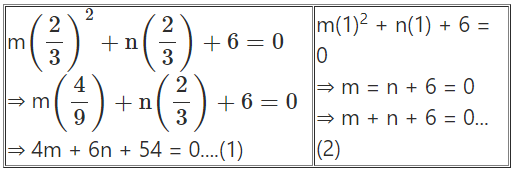
$\frac{2}{3}$ and 1 are the solutions of equation $m x^2+n x+6=0$.
Find the values of m and n.
Answer
For $x=\frac{2}{3}$ and $x=1$ to be solutions of the given quadratic equation it should satisfy the equationSo, substituting $x=$ and $x=\frac{2}{3} 1$ in the given equation, we get
Image
Solving equations (1) and (2) simultaneously,
4m + 6n + 54 = 0...(1)
m + n + 6 = 0....(2)
(1) - (2) x 6
⇒ -2m + 18 = 0
⇒ m = 9
Substitute in (2)
⇒ n = -15
View full question & answer
Question 673 Marks
If $\sqrt{\frac{2}{3}}$ is a solution of equation $3 x^2+m x+2=0$, find the value of $m$.
Answer
For $x=\sqrt{\frac{2}{3}}$ to be solution of the given quadratic equation it should satisfy the equationSo, substituting $x=\sqrt{\frac{2}{3}}$ in the given equation, we get
$3\left(\sqrt{\frac{2}{3}}\right)^2+ m \left(\sqrt{\frac{2}{3}}\right)+2=0 $
$\Rightarrow 3\left(\frac{2}{3}\right)+m\left(\sqrt{\frac{2}{3}}\right)+2=0 $
$\Rightarrow m =-4 \sqrt{\frac{3}{2}}=-2 \sqrt{6} $
$\therefore m =-2 \sqrt{6}$
View full question & answer
[3 marks sum] - Page 2 - Mathematics STD 10 Questions - Vidyadip