Questions

[4 marks sum]

🎯

Test yourself on this topic

9 questions · timed · auto-graded

Question 14 Marks
If $y =\frac{\sqrt{a+3 b}+\sqrt{a-3 b}}{\sqrt{a+3 b}-\sqrt{a-3 b}}$ show that $3by^2 - 2ay + 3b = 0.$
Answer
We have
$\frac{y}{1}=\frac{\sqrt{a+3 b}+\sqrt{a-3 b}}{\sqrt{a+3 b}-\sqrt{a-3 b}}$
Applying componendo and dividendo
$\frac{y+1}{y-1}=\frac{\sqrt{a+3 b}+\sqrt{a-3 b}+\sqrt{a+3 b}-\sqrt{a-3 b}}{\sqrt{a+3 b}+\sqrt{a-3 b}-\sqrt{a+3 b}+\sqrt{a-3 b}} $
$ \frac{y+1}{y-1}=\frac{2 \sqrt{a+3 b}}{2 \sqrt{a-3 b}}$
Squaring both side
$\frac{(y+1)^2}{(y-1)^2}=\frac{a+3 b}{a-3 b} $
$ \Rightarrow \frac{y^2+1+2 y}{y^2+1-2 y}=\frac{a+3 b}{a-3 b}$
Again applying componendo and dividendo
$\Rightarrow \frac{y^2+1+2 y+y^2+1-2 y}{y^2+1+2 y-y 62-1+2 y}=\frac{a+3 b+a-3 b}{a+3 b-a+3 b} $
$ \Rightarrow \frac{2\left(y^2+1\right)}{4 y}=\frac{2 a}{6 b}$
$ \Rightarrow 3 b y^2+3 b=2 a y $
$ \Rightarrow 3 b y^2-2 a y+3=0 .$
Hence proved.
View full question & answer
Question 24 Marks
If a, b, c, d are in continued proportion, prove that:
$\sqrt{a b}-\sqrt{b c}+\sqrt{c d}=\sqrt{(a-b+c)(b-c+d)}$
Answer
Since $a, b, c, d$ are in continued proportion then
$\frac{a}{b}=\frac{b}{c}=\frac{c}{d}=k $
$\Rightarrow a = bk ^2 b = ck , c = dk $
$\Rightarrow a = ck ^2 $
$\Rightarrow a = dk ^3, b = dk ^2 \text { and } c = dk $
$\text { L.H.S. } $
$=\sqrt{a b}-\sqrt{b c}+\sqrt{c d} $
$=\sqrt{d k^3 \cdot d k^2}-\sqrt{d k^2 \cdot d k}+\sqrt{d k \cdot d} $
$=d \cdot k^2 \sqrt{k}-d k \sqrt{k}+d \sqrt{k} $
$=\left(k^2-k+1\right) d \sqrt{k} .$
$\text { R.H.S. } $
$=\sqrt{(a-b+c)(b-c+d)} $
$=\sqrt{\left(d k^3-d k^2+d k\right)\left(d k^2-d k+d\right)} $
$=\sqrt{d \times d \times k\left(k^2-k+1\right)\left(k^2-k+1\right)} $
$=\left(k^2-k+1\right) d \sqrt{k} $
$\text { L.H.S. }=\text { R.H.S. }$
Hence proved.
View full question & answer
Question 34 Marks
If a, b, c, d are in continued proportion, prove that $(b-c)^2+(c-a)^2+(d-b)^2=(d-a)^2$
Answer
Since $a, b, c, d$ are in continued proportion, we have
$\frac{a}{b}=\frac{b}{c}=\frac{c}{d}= K \text { (say) } $
$\therefore c = dK , b = cK = dK ^2 \text { and } a = bK = dK ^3 . $
$\text { L.H.S. }$
$=(b-c)^2+(c-a)^2+(d-b)^2 $
$=\left(d K^2-d K\right)^2+\left(d K-d K^3\right)^2+\left(d-d K^2\right)^2 $
$=d^2 K^2(K-1)^2+d^2 K^2\left(1-K^2\right)^2+d^2\left(1-K^2\right)^2 $
$=d^2\left[K^2(K-1)^2+K^2\left(K^2-1\right)^2+d^2\left(k^2-1\right)^2\right] $
$=d^2\left[K^2(K-1)^2+K^2(K-1)^2(K+1)^2+(K-1)^2(K+1)^2\right] $
$=d^2(K-1)^2\left[K^2+K^2(K+1)^2+(K+1)^2\right] $
$=d^2(K-1)^2\left[K^2+K^2\left(K^2+2 K+1\right)+K^2+2 K+1\right] $
$=d^2(k-1)^2\left[K^4+2 K^3+3 K^2+2 K+1\right] $
$=d^2(K-1)^2\left(K^2+K+1\right)^2 $
$=d^2\left[(K-1)\left(K^2+K+1\right)^2\right] $
$=d^2\left(K^3-1\right)^2=\left(d K^3-d\right)^2=(a-d)^2=(d-a)^2=\text { R.H.S. }$
Hence, $(b-c)^2+(c-a)^2+(d-b)^2=(d-a)^2$.
View full question & answer
Question 44 Marks
if x =$\frac{\sqrt{a+1}+\sqrt{a-1}}{\sqrt{a+1}-\sqrt{a-1}}$ using properties of proportion show that $x^2-2 a x+1=0$
Answer
$\text { Consider } x=\frac{\sqrt{a+1}+\sqrt{a-1}}{\sqrt{a+1}-\sqrt{a-1}} $
$\Rightarrow \frac{x}{1}=\frac{\sqrt{a+1}+\sqrt{a-1}}{\sqrt{a+1}-\sqrt{a-1}}$
By using componando and dividendo, we have
$\Rightarrow \frac{x+1}{x-1}=\frac{(\sqrt{a+1}+\sqrt{a-1})+(\sqrt{a+1}-(\sqrt{a-1}))}{(\sqrt{a+1}+\sqrt{a-1})-(\sqrt{a+1}-\sqrt{a-1})} $
$ \Rightarrow \frac{x+1}{x-1}=\frac{2 \sqrt{a+1}}{2 \sqrt{a-1}}=\frac{\sqrt{a+1}}{\sqrt{a-1}}$
Squaring both sides we get
$\Rightarrow \frac{(x+1)^2}{(x-1)^2}=\frac{(\sqrt{a+1})^2}{(\sqrt{a-1})^2}$
$ \Rightarrow \frac{x^2+2 x+1}{x^2-2 x+1}=\frac{a+1}{a-1}$
Again using componando and dividendo, we get
$\Rightarrow \frac{\left(x^2+2 x+1\right)+\left(x^2-2 x+1\right)}{\left(x^2+2 x+1\right)-\left(x^2-2 x+1\right)}=\frac{(a+1)+(a-1)}{(a+1)-(a-1)}$
$ \Rightarrow \frac{2 x^2+2}{4 x}=\frac{2 a}{2} \Rightarrow \frac{x^2+1}{2 x}=\frac{a}{1} $
$ \Rightarrow x^2+1=2 a x$
$ \Rightarrow x^2-2 a x+1=0$
View full question & answer
Question 54 Marks
If y = $=\frac{(p+1)^{\frac{1}{3}}+(p-1)^{\frac{1}{3}}}{(p+1)^{\frac{1}{3}}-(p-1)^{\frac{1}{3}}}$ find that $y^3 - 3py^2 + 3y - p = 0.$
Answer
We have
$\frac{y}{1}=\frac{(p+1)^{\frac{1}{3}}+(p-1)^{\frac{1}{3}}}{(p+1)^{\frac{1}{3}}-(p-1)^{\frac{1}{3}}}$
Applying componendo and dividendo
$\frac{y+1}{y-1}=\frac{(p+1)^{\frac{1}{3}}+(p-1)^{\frac{1}{3}}+(p+1)^{\frac{1}{3}}-(p-1)^{\frac{1}{3}}}{(p+1)^{\frac{1}{3}}+(p-1)^{\frac{1}{3}}-(p+1)^{\frac{1}{3}}+(p-1)^{\frac{1}{3}}}$
$\Rightarrow \frac{y+1}{y-1}=\frac{2(p+1)^{\frac{1}{3}}}{2(p-1)^{\frac{1}{3}}}$
Cubing both side
$\frac{(y+1)^3}{(y-1)^3}=\frac{p+1}{p-1}$
$\Rightarrow \frac{y^3+1+3 y^2+3 y}{y^3-1-3 y^2+3 y}=\frac{p+1}{p-1}$
Again applying componendo and dividendo
$\Rightarrow \frac{y^3+1+3 y^2+3 y+y^3-1-3 y^2+3 y}{y^3+1+3 y^2+3 y-y^3+13 y^2-3 y} $
$=\frac{p+1+p-1}{p+1-p+1}$
$\Rightarrow \frac{2 y^3+6 y}{6 y^2+2}=\frac{2 p}{2}$
$\Rightarrow \frac{2\left(y^3+3 y\right)}{2\left(3 y^2+1\right)}=p$
$\Rightarrow y^3+3 y=3 p y^2+p $
$\Rightarrow y^3-3 p y^2+3 y-p=0 .$
Hence proved.
View full question & answer
Question 64 Marks
Find the value of
$\frac{x+\sqrt{3}}{x-\sqrt{3}}+\frac{x+\sqrt{2}}{x-\sqrt{2}}$, if $\quad x=\frac{2 \sqrt{6}}{\sqrt{3}+\sqrt{2}}$.
Answer
$\frac{2 \sqrt{6}}{\sqrt{3}+\sqrt{2}}$
or
$ x =\frac{2 \times \sqrt{3} \times \sqrt{2}}{\sqrt{3}+\sqrt{2}} $
$ \Rightarrow \frac{x}{\sqrt{3}}=\frac{2 \sqrt{2}}{\sqrt{3}+\sqrt{2}}$
Applying Componendo and Dividendo
$\frac{x+\sqrt{3}}{x-\sqrt{3}}=\frac{2 \sqrt{2}+\sqrt{3}+\sqrt{2}}{2 \sqrt{2}-\sqrt{3}-\sqrt{2}}$
$ =\frac{3 \sqrt{2}+\sqrt{3}}{\sqrt{2}-\sqrt{3}}$
$\frac{x+\sqrt{3}}{x-\sqrt{3}}=\frac{3 \sqrt{2}+\sqrt{3}}{-(\sqrt{3}-\sqrt{2})}$...(i)
Also $\frac{x}{\sqrt{2}}=\frac{2 \sqrt{3}}{\sqrt{3}+\sqrt{2}}$
Applying Componendo and Dividendo
$\frac{x+\sqrt{2}}{x+\sqrt{2}}=\frac{2 \sqrt{3}+\sqrt{3}+\sqrt{2}}{2 \sqrt{3}-\sqrt{3}-\sqrt{2}}$
$\frac{x+\sqrt{2}}{x-\sqrt{2}}=\frac{3 \sqrt{3}+\sqrt{2}}{\sqrt{3}-\sqrt{2}}$ ..(ii)
$\frac{x+\sqrt{3}}{x-\sqrt{3}}+\frac{x+\sqrt{2}}{x-\sqrt{2}}=\frac{-3 \sqrt{2}-\sqrt{3}+3 \sqrt{3}+\sqrt{2}}{\sqrt{3}-\sqrt{2}} $
$=\frac{-2 \sqrt{2}+2 \sqrt{3}}{\sqrt{3}-\sqrt{2}}$
$ =\frac{2(\sqrt{3}-\sqrt{2})}{(\sqrt{3}-\sqrt{2})}$
$ =2 .$
View full question & answer
Question 74 Marks
Solve for x :$\frac{1-p x}{1+p x}=\sqrt{\frac{1+q x}{1-q x}}$
Answer
$\frac{1-p x}{1+p x}=\sqrt{\frac{1-q x}{1+q x}} \ldots$ (Squaring both sides)
$\left(\frac{1-p x}{1+p x}\right)^2=\frac{1-q x}{1+q x}$
$\Rightarrow \frac{1+p^2 x^2-2 p x}{1+p^2 x^2+2 p x}=\frac{1-q x}{1+q x}$
Applying componendo and dividendo
$\frac{1+p^2 x^2-2 p x+1+p^2 x^2+2 p x}{1+p^2 x^2-2 p x-1-p^2 x^2-2 p x}=\frac{1-q x+1+q x}{1-q x-1-q x}$
$\Rightarrow \frac{2\left(1+p^2 x^2\right)}{2(-2 p x)}=\frac{2}{-2 p x}$
$\Rightarrow \frac{1+p^2 x^2}{2 p x}=\frac{1}{q x}$
$\Rightarrow q \times\left(1+p^2 x^2\right)=2 p x$
$\Rightarrow x\left(p^2 q x^2-2 p+q\right)=0$
$\text { Either } x=0$
or
$ p ^2 qx ^2=2 p - q $
$x ^2=\frac{2 p-q}{p^2 q} $
$ x =0 \text { or } x = \pm \frac{1}{p} \sqrt{\frac{2 p-q}{q}}$
View full question & answer
Question 84 Marks
if $\frac{x^2+y^2}{x^2-y^2}=\frac{17}{8}$ then find the value of :
$(1)\ x: y$
$(2)\ \frac{x^3+y^3}{x^3-y^3}$
Answer
It is given that:
$\frac{x^2+y^2}{x^2-y^2}=\frac{17}{8}$
Applying componendo-dividendo.
$\frac{x^2+y^2+x^2-y^2}{x^2+y^2-x^2+y^2}=\frac{17+8}{17-8}$
$\Rightarrow \frac{2 x^2}{2 y^2}=\frac{25}{9}$
$\Rightarrow \frac{x^2}{y^2}=\frac{25}{9}$
$\Rightarrow \frac{x}{y}= \pm \frac{5}{3}$
$\Rightarrow x: y=5: 3$
$\text { 2) } \frac{x}{y}= \pm \frac{5}{3}$
$\frac{x}{y}=\frac{5}{3}$
$\Rightarrow \frac{x^3}{y^3}=\frac{125}{27}$
Applying componendo-dividendo, we get
$\frac{x^3+y^3}{x^3-y^3}=\frac{125+27}{125-27}$
$ \Rightarrow \frac{x^3+y^3}{x^3-y^3}=\frac{152}{98} $
$ \Rightarrow \frac{x^3+y^3}{x^3-y^3}=\frac{76}{49}$
or
$\frac{x}{y}=-\frac{5}{3} $
$\frac{ x ^3}{ y ^3}=-\frac{125}{27}$
Applying componendo-dividendo, we get
$\frac{x^3+y^3}{x^3-y^3}=\frac{-125+27}{-125-27} $
$=\frac{-98}{-152}$
$=\frac{49}{76}$
View full question & answer
Question 94 Marks
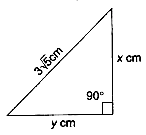
The hypotenuse of a right angled triangle is $3 \sqrt{5}$. If the smaller side is tripled and the larger side is doubled, the new hypotenuse will be $15 \ cm.$ Find the length of each side.
Answer
Let the smaller side of the right triangle be $x \ cm$ and the longer side by $y \ cm.$
Using Pythagoras theorem, we have
$x^2+y^2=(3 \sqrt{5})^2$
$\Rightarrow x^2+y^2=45 \ldots \text { (i) }$

If the smaller side is tripled and larger side is doubled, then
The smaller side $=3 x \ cm$
Larger side $=2 y\ cm$
New hypotenuse $=15 \ cm$
Then by Pythagoras theorem,
we have $\mid(3 x)^2+(2 y)^2=(15)^2$
$\Rightarrow 9 x^2+4 y^2=225 \ldots (ii)$
From $(i), y^2=45-x^2$ and putting in $(ii)$
we get $9 x^2+4\left(45-x^2\right)=225$
$\Rightarrow 9 x^2+180-4 x^2=225$
$\Rightarrow 5 x^2=225-180=45$
$\Rightarrow x^2=9$
$\Rightarrow x= \pm 3 .$
But $x = -3$ is not possible as length can't be $- ve.$
Then $x = 3 \ cm$ From $(i),$
we have $x^2+y^2=45$
$\Rightarrow 9+y^2=45$
$\Rightarrow y^2=36$
$\Rightarrow y= \pm 6$
Rejecting $- ve$ sign then $y = 6$
Hence, the length of the smaller side $= 3 \ cm$
The length of the longer side $= 6 \ cm.$
View full question & answer
[4 marks sum] - Mathematics STD 10 Questions - Vidyadip