Question 15 Marks
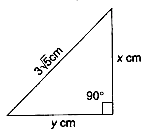
The hypotenuse of a right angled triangle is $3 \sqrt{5}$. If the smaller side is tripled and the larger side is doubled, the new hypotenuse will be 15 cm. Find the length of each side.
Answer
View full question & answer→Let the smaller side of the right triangle be x cm and the longer side by y cm.
Using Pythagoras theorem, we have
$x^2+y^2=(3 \sqrt{5})^2$
$\Rightarrow x^2+y^2=45 \ldots \text { (i) }$
If the smaller side is tripled and larger side is doubled, then
The smaller side $=3 x cm$
Larger side $=2 ycm$
New hypotenuse $=15 cm$
Then by Pythagoras theorem, we have
$\mid(3 x)^2+(2 y)^2=(15)^2$
$\Rightarrow 9 x^2+4 y^2=225 \ldots$ (ii)
From (i), $y 2=45-x 2$ and putting in (ii) we get
$ 9 x^2+4\left(45-x^2\right)=225$
$\Rightarrow 9 x^2+180-4 x^2=225$
$\Rightarrow 5 x^2=225-180=45$
$\Rightarrow x^2=9$
$\Rightarrow x= \pm 3 . $
But $x = -3$ is not possible as length can't be $- ve.$ Then $x = 3$ cm From (i), we have
$ x^2+y^2=45$
$\Rightarrow 9+y^2=45$
$\Rightarrow y^2=36$
$\Rightarrow y= \pm 6 $
Rejecting $- ve$ sign then $y = 6$
Hence, the length of the smaller side $= 3\ cm$
The length of the longer side $= 6\ cm.$
Using Pythagoras theorem, we have
$x^2+y^2=(3 \sqrt{5})^2$
$\Rightarrow x^2+y^2=45 \ldots \text { (i) }$
If the smaller side is tripled and larger side is doubled, then
The smaller side $=3 x cm$
Larger side $=2 ycm$
New hypotenuse $=15 cm$
Then by Pythagoras theorem, we have
$\mid(3 x)^2+(2 y)^2=(15)^2$
$\Rightarrow 9 x^2+4 y^2=225 \ldots$ (ii)
From (i), $y 2=45-x 2$ and putting in (ii) we get
$ 9 x^2+4\left(45-x^2\right)=225$
$\Rightarrow 9 x^2+180-4 x^2=225$
$\Rightarrow 5 x^2=225-180=45$
$\Rightarrow x^2=9$
$\Rightarrow x= \pm 3 . $
But $x = -3$ is not possible as length can't be $- ve.$ Then $x = 3$ cm From (i), we have
$ x^2+y^2=45$
$\Rightarrow 9+y^2=45$
$\Rightarrow y^2=36$
$\Rightarrow y= \pm 6 $
Rejecting $- ve$ sign then $y = 6$
Hence, the length of the smaller side $= 3\ cm$
The length of the longer side $= 6\ cm.$