Question 14 Marks
The polynomial $px^3 + 4x^2 – 3x + q$ is completely divisible by $x^2 – 1$; find the values of $p$ and $q$. Also, for these values of p and q factorize the given polynomial completely.
AnswerLet $f(x)=p x^3+4 x^2-3 x+q$
It is given that $f(x)$ is completely divisible by $\left(x^2-1\right)=(x+1)(x-1)$.
Therefore, f(1) = 0 and f(-1) = 0
$f(1)=p(1)^3+4(1)^2-3(1)+q=0$
$p+q+1=0 \ldots(i)$
$f(-1)=p(-1)^3+4(-1)^2-3(-1)+q=0$
-p + q + 7 = 0 …(ii)
Adding (i) and (ii), we get,
2q + 8 = 0
q = -4
Substituting the value of q in (i), we get,
p = -q – 1 = 4 – 1 = 3
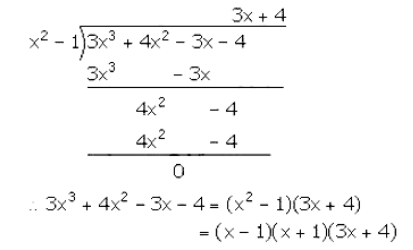
$\therefore f(x)=3 x^3+4 x^2-3 x-4$
Given that $f(x)$ is completely divisible by $\left(x^2-1\right)$.
View full question & answer→Question 24 Marks
Factorise $x^3 + 6x^2 + 11x + 6$ completely using factor theorem.
AnswerLet $f(x)=x^3+6 x^2+11 x+6$
$f \text { or }=x=-1$
$f(-1)=(-1)^3+6(-1)^2+11(-1)+6$
$=-1+6-11+6=12-12=0$
Hence, $(x+1)$ is a factory of $f(x)$
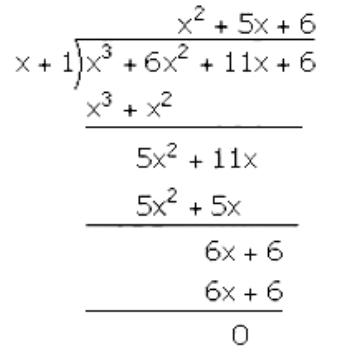
$\therefore x^3+6 x^2+11 x+6=(x+1)\left(x^2+5 x+6\right)$
$=(x+1)\left(x^2+2 x+3 x+6\right)$
$=(x+1)[x(x+2)+3(x+2)]$
$=(x+1)(x+2)(x+3)$ View full question & answer→Question 34 Marks
Using Remainder Theorem, factorise:
$x^3 + 10x^2 – 37x + 26$ completely
AnswerBy remainder theorem,
for $x=1,$ the value of the given expression is the remainder.
$x^3+10 x^2-37 x+26$
$=(1)^3+10(1)^2-37(1)+26$
$=1+10-37+26$
$=37-37$
$=0$
$x-1$ is a factor of $x^3+10 x^2-37 x+26$.
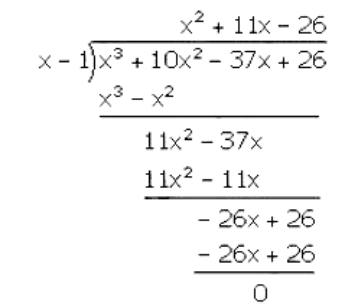
$\therefore x^3+10 x^2-37 x+26$
$=(x-1)\left(x^2+11 x-26\right)$
$=(x-1)\left(x^2+13 x-2 x-26\right)$
$=(x-1)[x(x+13)-2(x+13)]$
$=(x-1)(x+13)(x-2)$
$\therefore x^3+10 x^2-37+26=(x-1)(x+13)(x-2)$ View full question & answer→Question 44 Marks
When the polynomial $x^3+2 x^2-5 a x-7$ is divided by $(x-1)$, the remainder is $A$ and when the polynomial $x^3+a x^2-$ $12 x+16$ is divided by $(x+2)$, the remainder is $B$. Find the value of ' $a$ ' if $2 A+B=0$.
AnswerIt is given that when the polynomial $x^3 + 2x^2 – 5ax – 7$ is divided by $(x – 1)$, the remainder is A.
$\therefore (1)^3 + 2(1)^2 – 5a(1) – 7 = A$
$1 + 2 – 5a – 7 = A$
$– 5a – 4 = A …(i)$
It is also given that when the polynomial $x^3 + ax^2 – 12x + 16$ is divided by $(x + 2)$, the remainder is $B.$
$\therefore x^3 + ax^2 – 12x + 16 = B$
$(-2)^3 + a(-2)^2 – 12(-2) + 16 = B$
$-8 + 4a + 24 + 16 = B$
$4a + 32 = B …(ii)$
It is also given that $2A + B = 0$
Using (i) and (ii), we get,
$2(-5a – 4) + 4a + 32 = 0$
$-10a – 8 + 4a + 32 = 0$
$-6a + 24 = 0$
$6a = 24$
$a = 4$
View full question & answer→Question 54 Marks
If $x + a$ is a common factor of expressions $f(x)=x^2+p x+q$ and $g(x)=$ $x^2+m x+n$
show that : $a=\frac{n-q}{m-p}$
Answer$f(x)=x^2+p x+q$
it is given that $(x+a)$ is a factor of $f(x)$
$\therefore f(-a)=0$
$\Rightarrow(-a)^2+p(-a)+q=0$
$\Rightarrow a^2-p a+q=0$
$\Rightarrow a^2=p a-q \ldots \ldots . .(1)$
$g(x)=x^2+m x+n$
it is given thhat $(x+a)$ is a factor of $g (x).$
$\therefore g(-a)=0$
$\Rightarrow(-a)^2+m(-a)+n=0$
$\Rightarrow a^2-m a+n=0$
$\Rightarrow a^2=m a-n \text {.......(2) }$
from $(1)$ and $(2),$ we get,
$p a-q=m a-n $
$n-q=a(m-p)$
$ a=\frac{n-q}{m-p}$
Hence, proved.
View full question & answer→Question 64 Marks
Factorise the expression $f (x) = 2x^3 – 7x^2 – 3x + 18$. Hence, find all possible values of $x$ for which $f(x) = 0.$
Answer$f(x)=2 x^{\wedge} 3-7 x^{\wedge} 2-3 x+18$
for x =2,
$f(x)=f(2)=2(2)^3-7(2)^2-3(2)+18$
$=16-28-6+18=0$
Hence, $( x -2)$ is a factor of $f ( x )$
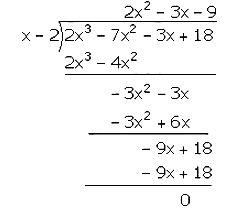
$\therefore 2 x^3-7 x^2-3 x+18=(x-2)\left(2 x^2-3 x-9\right)$
$=(x-2)\left(2 x^2-6 x+3 x-9\right)$
$=(x-2)[2 x(x-3)+3(x-3)]$
$=(x-2,(x-3)(2 x+3)$
now, $f(x)=0$
$\Rightarrow 2 x^3-7 x^2-3 x+18=0$
$\Rightarrow(x-2)(x-3)(2 x+3)=0$
$\Rightarrow x=2,3, \frac{-3}{2}$ View full question & answer→Question 74 Marks
Using the Remainder Theorem, factorise the expression $3x^3 + 10x^2 + x – 6$. Hence, solve the equation $3x^3 + 10x^2 + x – 6 = 0$.
AnswerLeft $f (x)=3 x^3+10 x^2+x-6$
$f$ or $x=-1$,
$f(x)=f(-1)=3(-1)^3+10(-1)^2+(-1)-6=-3+10-1-6=0$
Hence, $(x+1)$ is a factor of $f(x)$.
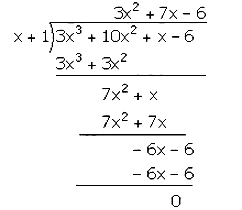
$\therefore 3 x^3+10 x^2+x-6=(x+1)\left(3 x^2+7 x-6\right)$
$=(x+1)\left(3 x^2+9 x-2 x-6\right)$
$=(x-1)[3 x(x-3)-2(x+3)]$
$=(x+1)(x+3)(3 x-2)$
now, $3 x^3+10 x^2+x-6=0$
$(x+1)(x+3)(3 x-2)=0$
$x=-1,-3, \frac{2}{3}$ View full question & answer→Question 84 Marks
Using the Remainder Theorem, factorise each of the following completely. $4x^3 + 7x^2 – 36x – 63$
Answer$f(x)=4 x^3+7 x^2-36 x-63$
$f$ or $x=3$
$f(x)=f(3)=4(3)^3+7(3)^2-36(3)-63$
$=108+63-108-63=0$
Hence,(x+3) is a factor of f(x)
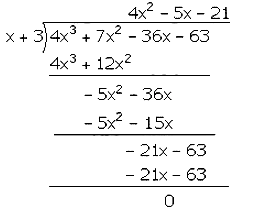
$ \begin{aligned} & 4 x^2-5 x-21 \\ & 4 x^2+(12+7) x+21 \\ & 4 x^2+12 x+7 x+21 \\ & 4 x(x+3)+7(x+3) \\ & (x+3)(4 x+7) \end{aligned} $
Hence, $(x-3)(x+3)(4 x+7)$ are the factor of given Polynomial. View full question & answer→Question 94 Marks
Using the Remainder Theorem, factorise each of the following completely. $3x^3 + 2x^2 – 23x – 30$
Answer$f(x)=3 x^3+2 x^2-23 x-30$
for $X=-2$
$f(x)=f(-2)=3(-2)^3+2(-2)^2-23(-2)-30$
$=-24+8+46-30=-54+54=0$
Hence,$(x + 2)$ is a facctor of $f(x)$
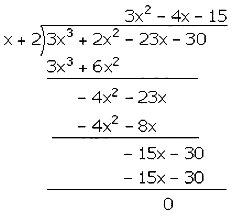
$\therefore 3 x^3+2 x^2-23 x-30=(x+2)\left(3 x^2-4 x-15\right)$
$=(x+2)\left(3 x^2+5 x-9 x-15\right)$
$=(x+2)[x(3 x+5)-3(3 x+5)]$
$=(x+2)(3 x+5)(x-3)$ View full question & answer→Question 104 Marks
$(3x + 2)$ is a factor of $3x^3 + 2x^2 – 3x – 2$. Hence, factorise the expression $3x^3 + 2x^2 – 3x – 2$ completely.
AnswerLet $f(x)=3 x^3+2 x^2-3 x-2$
$3 x+2=0 \Rightarrow x=\frac{-2}{3}$
$\therefore$ Remainder $= f \left(\frac{-2}{3}\right)$
$=3\left(\frac{-2}{3}\right)^3+2\left(\frac{-2}{3}\right)^2-3\left(\frac{-2}{3}\right)-2$
$=\frac{-8}{9}+\frac{8}{9}+2-2$
= 0
Hence,(3x+2) is a factor of f (x)
Now, we have:
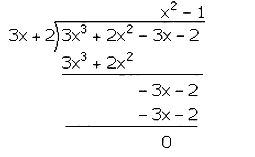
$\therefore 3 x^3+2 x^2-3 x-2=(3 x+2)\left(x^2-1\right)=(3 x+2)(x+1)(x-1)$ View full question & answer→Question 114 Marks
Find the values of m and n so that $x – 1$ and $x + 2$ both are factors of $x^3 + (3m + 1) x^2 + nx – 18$.
AnswerLeft $f(x)=x^3+(3 m+1) x^2+n x-18$
$x-1=0 \Rightarrow x =1$
$x-1$ is a factor of f(x). so remainder =0
$\therefore(1)^3+(3 m+1)(1)^2+n(1)-18=0$
$\Rightarrow 1+3 m+1+n-18=0$
$\Rightarrow 3 m+n-16=0 \ldots \ldots .(1)$
$x+2=0 \Rightarrow x=-2$
$x+2$ is a factor of f (x). so, remainder=0
$\therefore(-2)^3+(3 m+1)(-2)^2+n(-2)-18=0$
$ \Rightarrow-8+12 m+4-2 n-18=0 $
$ \Rightarrow 12 m-2 n-22=0$
$ \Rightarrow 6 m-n-11=0 \ldots \ldots (2)$
Adding $(1)$ and $(2),$ we get,
$9m-27=0$
$m=3$
putting the value of m in $(1),$ we get,
$3(3)+n-16=0$
$9+n-16=0$
$n=7$
View full question & answer→Question 124 Marks
Find the values of constants a and b when $x – 2$ and $x + 3$ both are the factors of expression $x^3 + ax^2 + bx – 12$.
AnswerLet $f(x)=x^3+a x^2+b x-12$
$x-2=0 \Rightarrow x =2$
$x-2$ is a factor of $f ( x )$. so, remainder $=0$
$\therefore(2)^3+a\left(2^2\right)+b(2)-12=0$
$8+4 a+2 b-12=0$
$\Rightarrow 4 a+2 b-4=0$
$\Rightarrow 2 a+b-2=0...(1)$
$x+3 = 0 \Rightarrow x = -3$
$x+3$ is a factor of f(x). so, remainder $=0$
$\therefore(-3)^3+a(-3)^2+b(-3)-12=0$
$\Rightarrow-27+9 a-3 b-12=0$
$\Rightarrow 9 a-3 b-39=0$
$\Rightarrow 3 a-b-13=0...(2)$
Adding $(1)$ and $(2),$ we get,
$5 a-15=0$
$\Rightarrow a=3$
putting the value of a in $(1),$ we get,
$6+b-2=0$
$\Rightarrow b=-4$
View full question & answer→Question 134 Marks
If $(x – 2)$ is a factor of the expression $2x^3 + ax^2 + bx – 14$ and when the expression is divided by $(x – 3),$ it leaves a remainder $52,$ find the values of $a$ and $b$
AnswerSince $( x -2)$ is a factor of polynomial $2 x^3+a x^2+b x-14$, we have
$2(2)^3+a(2)^2+b(2)-14=0$
$\Rightarrow 16+4 a+2 b-14=0$
$\Rightarrow 4 a+2 b+2=0$
$\Rightarrow 2 a+b+1=0$
$\Rightarrow 2 a+b=-1....(1)$
On dividing by $( x -3)$, the polynomial $2 x^3+a x^2+b x-14$ leaves remainder $52,$
$\Rightarrow 2(3)^3+a(3)^2+b(3)-14=52$
$\Rightarrow 54+9 a+3 b-14=52$
$\Rightarrow 9 a+3 b+40=52$
$\Rightarrow 9 a+3 b=12$
$\Rightarrow 3 a+b=4....(2)$
Subtracting $(1)$ and $(2),$ we get
$a=5$
substituting $a =5$ in $(1),$ we get
$2 \times 5+b=-1$
$ \Rightarrow 10+b=-1 $
$ \Rightarrow b=-11$
Hence, $a=5$ and $b=-11$.
View full question & answer→Question 144 Marks
If $(x + 1)$ and $(x – 2)$ are factors of $x^3 + (a + 1)x^2 – (b – 2)x – 6,$ find the values of $a$ and $b.$ And then, factorise the given expression completely.
AnswerLet $f(x)=x^3+(a+1) x^2-(b-2) x-6$
Since, $(x + 1)$ is a factor of $f(x).$
Remainder $= f(-1) = 0$
$(-1)^3+(a+1)(-1)^2-(b-2)(-1)-6=0$
$-1 + (a + 1) + (b – 2) – 6 = 0$
$a + b – 8 = 0 …(i)$
Since, $(x – 2)$ is a factor of $f(x).$
Remainder $= f(2) = 0$
$(2)^3+(a+1)(2)^2-(b-2)(2)-6=0$
$8 + 4a + 4 – 2b + 4 – 6 = 0$
$4a – 2b + 10 = 0$
$2a – b + 5 = 0 …(ii)$
Adding $(i)$ and $(ii),$ we get,
$3a – 3 = 0$
$a = 1$
Substituting the value of a in $(i), $ we get,
$1 + b – 8 = 0$
$b = 7$
$\therefore f(x)=x^3+2 x^2-5 x-6$
Now, $(x + 1)$ and $(x – 2)$ are factors of $f(x).$ Hence, $(x + 1) (x – 2) = x^2 – x – 2$ is a factor of $f(x).$
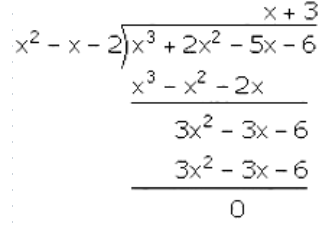
$f(x)=x^3+2 x^2-5 x-6=(x+1)(x-2)(x+3)$ View full question & answer→Question 154 Marks
$(3x + 5)$ is a factor of the polynomial $(a – 1)x^3 + (a + 1)x^2 – (2a + 1)x – 15.$ Find the value of $'a\ ',$ factorise the given polynomial completely.
AnswerLet $f(x)=(a-1) x^3+(a+1) x^2-(2 a+1) x-15$
it is given that $(3x + 5)$ is a factor of $f(x)$
$\therefore$ Remainder $= 0$
$f\left(\frac{-5}{3}\right)=0$
$(a-1)\left(-\frac{5}{3}\right)^3+(a+1)\left(\frac{-5}{3}\right)^2-(2 a+1)\left(\frac{-5}{3}\right)-15=0$
$(a-1)\left(\frac{-125}{27}\right)+(a+1)(a+1)\left(\frac{25}{9}\right)-(2 a+1)\left(\frac{-5}{3}\right)-15=0$
$\frac{-125(a-1)+75(a+1)+45(2 a+1)-405}{27}=0$
$-125 a+125+75 a+75+90 a+45-405=0$
$40 a-160=0$
$40 a=160$
$a=4$
$\therefore f(x)=(a-1) x^3+(a+1) x^2-(2 a+1) x-15$
$=3 x^3+5 x^2-9 x-15$
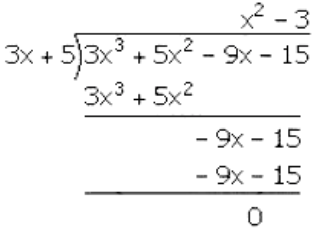
$ {r}\therefore 3 x^3+5 x^2-9 x-15=(3 x+5)\left(x^2-3\right)$
$=(3 x+5)(x+\sqrt{3})(x-\sqrt{3})$ View full question & answer→Question 164 Marks
The expression $4x^3 – bx^2 + x – c$ leaves remainders $0$ and $30$ when divided by $x + 1$ and $2x – 3$ respectively. Calculate the values of $b$ and $c.$ Hence, factorise the expression completely.
AnswerLet $f(x) = 4x^3- bx^2+ x-c$
it is given that when $f(x)$ is dividend by $(x+1)$, the remainder is $0$
$\therefore f(-1)=0$
$4(-1)^3-b(1)^2+(-1)-c=0$
$-4-b-1-c=0$
$b+c+5=0 \ldots \ldots . .(1)$
It is given that when $f(x)$ is divided by $(2x-3)$ the remainder is $30.$
$\therefore f\left(\frac{3}{2}\right)=30$
$4\left(\frac{3}{2}\right)^3-b\left(\frac{3}{2}\right)^2+\left(\frac{3}{2}\right)-c=30$
$\frac{27}{2}-\frac{9 b}{4}+\frac{3}{2}-c=30$
$54-9 b+6-4 c-120=0$
$9 b+4 c+60=0$ ...... $(2)$
Multiplying $(1)$ by $4$ and subtracting it from $(2),$ we get,
$5 b+40=0$
$b=-8$
Substituting the value of $b$ in $(1),$ we get,
$c=-5+8=3$
Therefore, $f(x)=4x^3+8 x^{x-3}$
Now, for $x-1$, wr get,
$f(x)=f(-1)=4(-1)^3+8(-1)^2+(-1)-3=-4+8-1-3=0$
Hence, $(x+1)$ is $a$ factor of $f (x)$
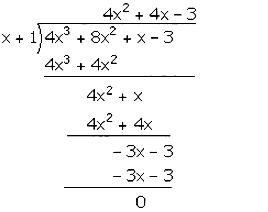
$\therefore 4 x^3+8 x^2+x-3=(x+1)\left(4 x^2+4 x-3\right)$
$=(x+1)\left(4 x^2+6 x-2 x-3\right)$
$=(x+1)[2 x(2 x+3)-(2 x+3)]$
$=(x+1)(2 x+3)(2 x-1)$ View full question & answer→Question 174 Marks
Using the Remainder Theorem, factorise each of the following completely. $3x^{3 }+ 2x^2 − 19x + 6$
AnswerFor $x=2,$ the value of the given
expression $3 x^3+2 x^2-19 x+6$
$=3(2)^3+2(2)^2-19(2)+6$
$=24+8-38+6$
$=0$
$\Rightarrow x-2$ is a factor of $3 x^3+2 x^2-19 x+6$
Now let us do long division
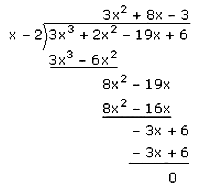
Thus we have ,
$3 x^3+2 x^2-19 x+6=(x-2)\left(3 x^2+8 x-3\right)$
$=(x-2)\left(3 x^2+9 x-x-3\right)$
$=(x-2)(3 x(x+3)-(x+3))$
$=(x-2)(3 x-1)(x+3)$ View full question & answer→Question 184 Marks
The expression $2x^3 + ax^2 + bx – 2$ leaves remainder $7$ and $0$ when divided by $2x – 3$ and $x + 2$ respectively. Calculate the values of $a$ and $b$
AnswerLeft $f(x)=2 x^3+a x^2+b x-2$
$2 x-3=0 \Rightarrow x=\frac{3}{2}$
on dividing $f(x)$ by $2x-3,$ it leaves a remainder $7$
$\therefore 2\left(\frac{3}{2}\right)^3++a\left(\frac{3}{2}\right)^2+b\left(\frac{3}{2}\right)-2=7$
$\frac{27}{4}+\frac{9 a}{4}+\frac{3 b}{2}=9$
$\frac{27+9 a+6 b}{4}=9$
$27+9 a+6 b=36$
$9 a+6 b-9=0$
$3 a+2 b-3=0....(1)$
$x+2=0 \Rightarrow x=-21$
On dividing $f(x)$ by $x+2,$ it leavves a remainder $0.$
$\therefore 2(-2)^3+a(-2)^2+b(-2)-2=0$
$-16+4 a-2 b-2=0$
$4 a-2 b-18=0...... (2)$
Adding $(1)$ and $(2),$ we get,
$7a-21=0$
$a=3$
Subsituting the value of $a$ in $(1),$ we get,
$3(3)+2b-3 =0$
$9+2b-3=0$
$2b=-6$
$b=-3$
View full question & answer→Question 194 Marks
If $x^3 + ax^2 + bx + 6$ has $x\ – 2$ as a factor and leaves a remainder $3$ when divided by $x – 3,$ find the values of $a$ and $b$.
AnswerLet $f(x)=x^3+a x^2+b x+6$
$\therefore x-2=0 \Rightarrow x =2$
$(2)^3+a(2)^2+b(2)+6=0$
$8+4 a+2 b+6=0$
$4 a+2 b+14=0$
$2(2 a+b+7)=0$
$2 a+b+7=\frac{0}{2}$
$2 a+b+7=0$
$2 a+b=-7 .... (i)$
$\therefore x-3=0 \Rightarrow x =3$
$(3)^3+a(3)^2+b(3)+6=3$
$27+9 a+3 b+6=3$
$9 a+3 b+33=3$
$9 a+3 b=3-33$
$9 a+3 b=-30$
$3(3 a+b)=-30$
$3 a+b=\frac{-30}{3}$
$3 a+b=-10....(ii)$
Subtracting $(i)$ from $(ii),$ we get,
$2 a+b=-7$
$3 a+b=-10$
$\frac{--\quad+}{-a=3}$
$\therefore a=-3$
Substituting the value of $a = -3$ in $(i),$ we get,
$2a + b = - 7$
$2(-3) + b = - 7$
$- 6 + b + 7 = 0$
$b = - 7 + 6$
$\therefore b = - 1$
View full question & answer→