Question 15 Marks
If $(x + 1)$ and $(x – 2)$ are factors of $x^3 + (a + 1)x^2 – (b – 2)x – 6$, find the values of a and b. And then, factorise the given expression completely.
Answer
View full question & answer→Let $f(x)=x^3+(a+1) x^2-(b-2) x-6$
Since, (x + 1) is a factor of f(x).
Remainder $= f(-1) = 0$
$(-1)^3+(a+1)(-1)^2-(b-2)(-1)-6=0$
$-1 + (a + 1) + (b – 2) – 6 = 0$
$a + b – 8 = 0 …(i)$
Since, (x – 2) is a factor of f(x).
Remainder $= f(2) = 0$
$(2)^3+(a+1)(2)^2-(b-2)(2)-6=0$
$8 + 4a + 4 – 2b + 4 – 6 = 0$
$4a – 2b + 10 = 0$
$2a – b + 5 = 0 …(ii)$
Adding (i) and (ii), we get,
$3a – 3 = 0$
$a = 1$
Substituting the value of a in (i), we get,
$1 + b – 8 = 0$
$b = 7$
$\therefore f(x)=x^3+2 x^2-5 x-6$
Now, $(x + 1)$ and $(x – 2)$ are factors of f(x).
Hence, $(x + 1) (x – 2) = x^2 – x – 2$ is a factor of $f(x).$
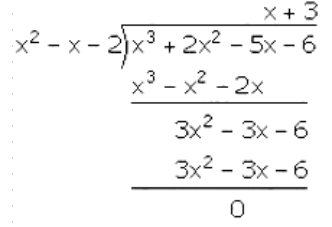
$f(x)=x^3+2 x^2-5 x-6=(x+1)(x-2)(x+3)$
Since, (x + 1) is a factor of f(x).
Remainder $= f(-1) = 0$
$(-1)^3+(a+1)(-1)^2-(b-2)(-1)-6=0$
$-1 + (a + 1) + (b – 2) – 6 = 0$
$a + b – 8 = 0 …(i)$
Since, (x – 2) is a factor of f(x).
Remainder $= f(2) = 0$
$(2)^3+(a+1)(2)^2-(b-2)(2)-6=0$
$8 + 4a + 4 – 2b + 4 – 6 = 0$
$4a – 2b + 10 = 0$
$2a – b + 5 = 0 …(ii)$
Adding (i) and (ii), we get,
$3a – 3 = 0$
$a = 1$
Substituting the value of a in (i), we get,
$1 + b – 8 = 0$
$b = 7$
$\therefore f(x)=x^3+2 x^2-5 x-6$
Now, $(x + 1)$ and $(x – 2)$ are factors of f(x).
Hence, $(x + 1) (x – 2) = x^2 – x – 2$ is a factor of $f(x).$
$f(x)=x^3+2 x^2-5 x-6=(x+1)(x-2)(x+3)$