Sample QuestionsSection and Mid- Point Formula questions
One sample from each question group in this chapter. Select any group above to see the full set with answer keys.
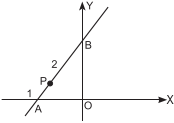
In the given figure, line APB meets the $x$-axis at A and $y$-axis at B . P is the point $(-4,2)$ and $AP : PB =1: 2$. Write down coordinates of A and B.
View full solution →If the points $A (6,1), B (8,2), C (9,4)$ and $D (p, 3)$ are the vertices of a parallelogram, taken in order, find the value of $p$.
View full solution →Find the ratio in which the $y$-axis divides the line segment joining the points $(5,-6)$ and $(-1,-4)$. Also, find the point of intersection.
View full solution →Find the coordinates of the points of trisection (i.e., points dividing into three equal parts) of the line segment joining the points $A (2,-2)$ and $B (-7,4)$
View full solution →In what ratio does the point $C \left(\frac{5}{5}, \frac{11}{5}\right)$ divide the line segment joining the points $A (3,5)$ and $B (-3,-2)$ ?
View full solution →The line segment joining the points $(3,-4)$, and $(1,2)$ is trisected at the points P and Q . If the coordinates of P and Q are $(p,-2)$ and $\left(\frac{5}{3}, q\right)$ respectively, find the values of $p$ and $q$.
View full solution →The line segment joining $P (-4,5)$ and $Q (3,2)$ intersects the $y$-axis at R . PM and QN are perpendiculars from P and Q on $x$-axis. Find:
(a) the ratio $PR : RQ$
(b) the coordinates of R
(c) the area of the quadrilateral PMNQ.
View full solution →Find the lengths of the medians of a triangle whose vertices are $A (7,-3), B (5,3)$ and $C (3,-1)$.
View full solution →P and Q are the points on the line segment joining the points $A (3,-1)$ and $B (-6,5)$ such that $AP = PQ = QB$. Find the co-ordinates of P and Q .
View full solution →The base BC of an equilateral triangle ABC lies on $y$-axis. The coordinates of point C are $(0,-3)$. If the origin is the mid-point of the base BC , find the coordinates of the points A and B .
View full solution →If $A (1,3), B (-1,2), C (2,5)$ and $D (x, y)$ are the vertices of a parallelogram ABCD , then the value of $x$ is:
- A
$3$
- B
$4$
- C
$0$
- D
$\frac{3}{2}$
View full solution →The vertices of a parallelogram in order are $A (1,2), B (4, y), C (x, 6), D (3,6)$. The value of $x$ and $y$ respectively are:
View full solution →The point which lies on the perpendicular bisector of the line segment joining the points $A (-2,-5)$ and $B (2,5)$ is:
- A
$(0,0)$
- B
$(0,2)$
- C
$(2,0)$
- D
$(-2,0)$
View full solution →If the coordinates of one end of a diameter of a circle are $(2,3)$ and the coordinates of its centre are $(-2,5)$, then the coordinates of the other end of the diameter are:
- A
$(-6,7)$
- B
$(6,-7)$
- C
$(6,7)$
- D
$(-6,-7)$
View full solution →If the mid-point of the line segment joining the points $P (6, b-2)$ and $Q (-2,4)$ is $(2,-3)$, then the value of $b=$
View full solution →Assertion (A) : If the points $A (p, 1), B (8,2), C (9,4)$ and $D (7,3)$ are the vertices of a parallelogram, taken in order, then the value of $p$ is 6 .
Reason (R) : Diagonals of a parallelogram bisect each other at right angles.
View full solution →View full solution →Assertion (A) : Points $(1,7),(4,2),(-1,-1)$ and $(-4,0)$ are the vertices of a square.
Reason (R) : If all the sides of a quadrilateral are equal and the diagonals are also equal, then the quadrilateral is a square.
View full solution →Assertion (A) : Coordinates of the mid-point of the line segment joining the points $(-4,5)$ and $(2,-1)$ are $(-1,2)$.
Reason (R) : The mid-point of a line segment divides it in the ratio $1: 1$.
View full solution →