Question 13 Marks
AB is a diameter of a circle with centre $C = (-2, 5).$ If $A = (3, -7),$ find
(i) the length of radius $AC$
(ii) the coordinates of $B.$
Answer
Radius $AC =\sqrt{(3+2)^2+(-7-5)^2}$
$=\sqrt{5^2+(-12)^2}$
$=\sqrt{25+144}$
$=\sqrt{169}$
$=13 \text { units }$
(ii) Let the co-ordinates of $B$ be $(x , y)$
Using mid – point formula, we have
$-2=\frac{3+x}{2} \text { and } 5=\frac{-7+y}{2}$
$\Rightarrow-4=3+x \text { and } 10=-7+y$
$\Rightarrow x=-7 \text { and } y=17$
Thus, the coordinates of $B$ are $(-7,17)$ View full question & answer→Question 23 Marks
In what ratio is the line joining $A(0, 3)$ and $B (4, -1)$ divided by the x-axis? Write the co-ordinates of the point where AB intersects the x-axis
AnswerLet the line segment AB intersects the x-axis by point $P (x, 0)$ in the ratio $k: 1.$
$\therefore(x, 0)=\left(\frac{k \times 4+1 \times 0}{k+1}, \frac{k \times(-1)+1 \times 3}{k+1}\right) $
$ \therefore(x, 0)=\left(\frac{4 k}{k+1}, \frac{-k+3}{k+1}\right)$
$\Rightarrow 0=\frac{-k+3}{k+1}$
$\Rightarrow k=3$
Thus, the required ratio in which P divides AB is $3: 1.$
Also, we have:
$x=\frac{4 k}{k+1}$
$ \Rightarrow x=\frac{4 \times 3}{3+1}=\frac{12}{4}=3$
Thus, the co-ordinates of point P are $(3, 0).$
View full question & answer→Question 33 Marks
A line segment joining $A(-1,5/3)$ and $B (a, 5)$ is divided in the ratio $1 : 3$ at P, the point where the line segment AB intersects the y-axis.(i) calculate the value of ‘a’
(ii) Calculate the co-ordinates of ‘P’.
AnswerSince, the line segment AB intersects the y-axis at point P, let the co-ordinates of point P be $(0, y).$
P divides AB in the ratio $1: 3.$
$\therefore(0, y)=\left(\frac{1 \times a+3 x(-1)}{1+3}, \frac{1 \times 5+3 \times \frac{5}{3}}{1+3}\right) $
$(0, y)=\left(\frac{a-3}{4}, \frac{10}{4}\right) $
$ 0=\frac{a-3}{4} \text { and } y=\frac{10}{4} $
$a=3 \text { and } y=\frac{5}{2}=2 \frac{1}{2}$
Thus, the value of a is $3$ and the co-ordinates of point P are $\left(0,2 \frac{1}{2}\right)$
View full question & answer→Question 43 Marks
Find the co-ordinates of points of trisection of the line segment joining the point $(6, -9)$ and the origin.
AnswerLet P and Q be the points of trisection of the line segment joining $A (6, -9)$ and $B (0, 0).$ P divides AB in the ratio $1: 2.$ Therefore, the co-ordinates of point P are
$\left(\frac{1 \times 0+2 \times 6}{1+2}, \frac{1 \times 0+2 \times(-9)}{2+1}\right)$
$ =\left(\frac{12}{3},-\frac{18}{3}\right) $
$ =(4,-6)$
Q divides AB in the ratio $2: 1$. Therefore, the co-ordinates of point Q are
$\left(\frac{2 \times 0+1 \times 6}{2+1}, \frac{2 \times 0+1 \times(-9)}{2+1}\right) $
$ =\left(\frac{6}{3},-\frac{9}{3}\right) $
$ =(2,-3)$
Thus, the required points are $(4, −6)$ and $(2, −3).$
View full question & answer→Question 53 Marks
A (-4,2)2, B(0,2) and C (-2,-4) are the vertices of a triangle ABC. A,Q and R are mid-Points of sides BC,CA and AB respectively.Show that the centroid of Δ PQR is the same as the centroid of Δ ABC.
Answer$A(-4,2), B(0,2)$ and $C(-2,-4)$ are the vertioes of $\triangle A B C$,
$\therefore$ Centroid of $\Delta ABC =\left(\frac{-4+0-2}{3}, \frac{2+2-4}{3}\right)=\left(\frac{-6}{3}, \frac{0}{3}\right)=(-2, 0 )$
P,Q and R are the mid-points of sides BC, CA and AB respectively.
$\therefore$ Coordinates of $P =\left(\frac{0-2}{2}, \frac{2-4}{2}\right)=\left(-\frac{2}{2},-\frac{2}{2}\right)=(-1,1)$
$\therefore \quad$ Coordinates of $Q =\left(\frac{-2-4}{2}, \frac{-4+2}{2}\right)=\left(\frac{-6}{2}, \frac{-2}{2}\right)=(-3,-1)$
$\therefore$ Coordinates of $R =\left(\frac{-4+0}{2}, \frac{2+2}{2}\right)=\left(\frac{-4}{2}, \frac{4}{2}\right)=(-2,2)$
$\therefore$ Coordinates of $\triangle PQR =\left(\frac{-1-3-2}{3}, \frac{-1-1+2}{3}\right)=\left(-\frac{6}{3}, \frac{0}{3}\right)=(-2,0)$
$\Rightarrow$ Centroid of $\triangle ABC =$ centroid of $\triangle P Q R$
View full question & answer→Question 63 Marks
Given a triangle ABC in which $A = (4, -4), B = (0, 5)$ and $C = (5, 10).$ A point P lies on BC such that $BP : PC = 3 : 2,$ Find the length of line segment AP.
AnswerGiven, $BP: PC = 3: 2$
Using section formula, the co-ordinates of point P are
$\left(\frac{3 \times 5+2 \times 0}{3+2}, \frac{3 \times 10+2 \times 5}{3+2}\right)$
$ =\left(\frac{15}{5}, \frac{40}{5}\right) $
$ =(3,8)$
Using distance formula, we have:
$A P=\sqrt{(3-4)^2+(8+4)^2}$
$ =\sqrt{1+144} $
$ =\sqrt{145} $
$=12.04$
View full question & answer→Question 73 Marks
If the abscissa of point P is $2.$ find the ratio in which this point divides the line segment joining the point $(-4,3)$ and $(6,3)$ Also find the co-ordinates of point P.
AnswerLet the point p divides the line segment joining the point
$A(4,3)$ and $B(6,3)$ in the ratio $k: 1$
Then, we have
$(2, y)=\left(\frac{6 k-4}{k+1}, \frac{3 k+3}{k+1}\right)$
$\Rightarrow \frac{6 k-4}{k+1}=2$
$\Rightarrow 4 k=6$
$\Rightarrow k=\frac{3}{2}$
$\therefore$ Required ratio is $3: 2$
$\text { Also } \frac{3 k+3}{k+1}=y$
$\Rightarrow \frac{3 \times \frac{3}{2}+3}{\frac{3}{2}+1}=v$
$\Rightarrow \frac{\frac{15}{2}}{\frac{5}{2}}=y$
$\Rightarrow y=3$
Hence, coordinates of point $P$ are $(2,3)$
View full question & answer→Question 83 Marks
Find the ratio in which the line $2x + y = 4$ divides th line segment joining the point $p(2,-2)$ and $Q(3,7)$.
AnswerLet the line $2 x++y=4$ divides the line segment joining the points $P(2,-2)$ and $Q(3,7)$ in the ratio $k: 1$.
Then, we have
$(x, y)=\left(\frac{3 k+2}{k+1}, \frac{7 k-2}{k+1}\right)$
Since $\left(\frac{3 k+2}{k+1}, \frac{7 k-2}{k+1}\right)$ lines on line $2 x+y=4$, we have
$2\left(3 k+\frac{2}{k}+1\right)+\frac{7 k-2}{k+1}=4 $
$ \Rightarrow 6 k+4+7 k-2=4 k+4 $
$\Rightarrow 13 k+2=4 k+4$
$\Rightarrow 9 k=2 $
$ \Rightarrow k=\frac{2}{9}$
Hence, required ratio is $2:9$
View full question & answer→Question 93 Marks
The mid point of the line segment joining $(2a, 4)$ and $(-2, 2b)$ is $(1, 2a + 1).$ Find the values of a and b.
AnswerMid-point of $(2a, 4)$ and $(−2, 2b)$ is $(1, 2a + 1),$ therefore using mid-point formula, we have:
$x=\frac{x_1+x_2}{2}$
$1=\frac{2 a-2}{2}$
$1=a-1$
$a=2$
$y=\frac{y_1+y_2}{2}$
$2 a+1=\frac{4+2 b}{2}$
$2 a+1=2+b$
$2 \times 2+1-2=b$
$b=5-2=3$
Therefore, $a = 2, b = 3.$
View full question & answer→Question 103 Marks
$P (-3, 2)$ is the mid-point of line segment $AB$ as shown in the given figure. Find the co-ordinates of points $A$ and $B.$
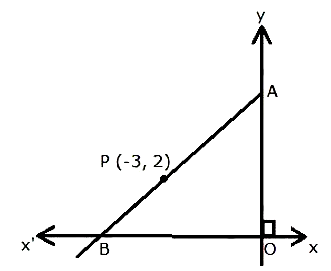
AnswerPoint $A$ lies on y-axis, so let its co-ordinates be $(0, y).$
Point $B$ lies on x-axis, so let its co-ordinates be $(x, 0).$
$P (-3, 2)$ is the mid-point of line segment $AB.$
$\therefore(-3,2)=\left(\frac{0+x}{2}, \frac{y+0}{2}\right)$
$\Rightarrow(-3,2)=\left(\frac{x}{2}, \frac{y}{2}\right)$
$\Rightarrow-3=\frac{x}{2} \text { and } 2=\frac{y}{2}$
$\Rightarrow-6=x \text { and } 4=y$
Thus, the co-ordinates of points $A$ and $B$ are $(0, 4)$ and $(−6, 0)$ respectively.
View full question & answer→Question 113 Marks
A (-1, 0), B (1, 3) and D (3, 5) are the vertices of a parallelogram ABCD. Find the co-ordinates of vertex C.
AnswerLet the co-ordinates of vertex C be (x, y).
ABCD is a parallelogram.
∴ Mid-point of AC = Mid-point of BD
$\left(\frac{-1+x}{2}, \frac{0+y}{2}\right)=\left(\frac{1+3}{2}, \frac{3+5}{2}\right)$
$\left(\frac{-1+x}{2}, \frac{y}{2}\right)=(2,4)$
$\frac{-1+x}{2}=2$ and $\frac{y}{2}=4$
$x=5$ and $\frac{y}{2}=4$
$x=5$ and $y=8$
Thus, the co-ordinates of vertex C is (5, 8).
View full question & answer→Question 123 Marks
In what ratio is the join of $(4, 3)$ and $(2, -6)$ divided by the x-axis. Also, find the co-ordinates of the point of intersection.
AnswerLet the point P $(x, 0)$ on x-axis divides the line segment joining A $(4, 3)$ and B $(2, -6)$ in the ratio $k: 1.$
Using section formula, we have:
$0=\frac{-6 k+3}{k+1} $
$ 0=-6 k+3 $
$ k=\frac{1}{2}$
Thus, the required ratio is $1: 2.$
Also, we have:
$x=\frac{2 k+4}{k+1} $
$ x=\frac{2 \times \frac{1}{2}+4}{\frac{1}{2}+1} $
$ x=\frac{10}{3}$
Thus, the required co-ordinates of the point of intersection are $\left(\frac{10}{3}, 0\right)$
View full question & answer→Question 133 Marks
In what ratio does the point $(a, 6)$ divide the join of $(-4, 3)$ and $(2, 8)?$ Also, find the value of a.
AnswerLet the point P $(a, 6)$ divides the line segment joining A $(-4, 3)$ and B $(2, 8)$ in the ratio $k: 1.$
Using section formula, we have:
$6=\frac{8 k+3}{k+1} $
$ \Rightarrow 6 k+6=8 k+3$
$ \Rightarrow 3=2 k $
$\Rightarrow k=\frac{3}{2}.....(1)$
$\Rightarrow a=\frac{2 k-4}{k+1}$
$ \Rightarrow a=\frac{2 \times \frac{3}{2}-4}{\frac{3}{2}+1} \quad \text { (from equation 1) }$
$\Rightarrow a=-\frac{2}{5}$
Hence, the required ratio is $3:2$ and the value of a is $-\frac{2}{5}$
View full question & answer→Question 143 Marks
In what ratio does the point $(1, a)$ divide the join of $(-1, 4)$ and $(4,-1)?$ Also, find the value of a.
Answer
Let the point P $(1, a)$ divides the line segment AB in the ratio $k: 1.$
Using section formula, we have:
$1=\frac{4 k-1}{k+1}$
$ \Rightarrow k+1=4 k-1 $
$\Rightarrow 2=3 k $
$\Rightarrow k=\frac{2}{3}....(1)$
$\Rightarrow a=\frac{-k+4}{k+1}$
$\Rightarrow a=\frac{-\frac{2}{3}+4}{\frac{2}{3}+1} \quad \text { (from 1) }$
$\Rightarrow a=\frac{10}{5}=2$
Hence, the required is $2 : 3$ and the value of a is $2.$ View full question & answer→Question 153 Marks
In what ratio is the line joining $(2, -4)$ and $(-3, 6)$ divided by the $y\ –$ axis.
AnswerLet the line joining points A $(2, -4)$ and B $(-3, 6)$ be divided by point P $(0, y)$ in the ratio $k : 1.$
$x=\frac{k x_2+x_1}{k+1}$
$ 0=\frac{k \times(-3)+1 \times 2}{k+1} $
$0=-3 k+2 $
$ k=\frac{2}{3}$
Thus, the required ratio is $2: 3.$
View full question & answer→Question 163 Marks
In the given figure line $APB$ meets the x-axis at point A and y-axis at point B. P is the point $(-4,2)$ and $AP : PB = 1 : 2.$ Find the co-ordinates of $A$ and $B$
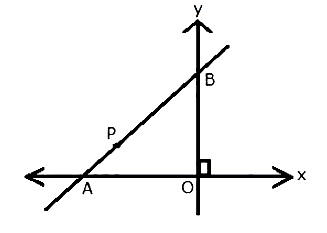
AnswerGiven, A lies on x-axis and $B$ lies on y-axis.
Let the co-ordinates of $A$ and $B$ be $(x, 0)$ and $(0, y)$ respectively.
Given, $P$ is the point $(-4, 2)$ and $AP: PB = 1: 2.$
Using section formula, we have:
$-4=\frac{1 \times 0+2 \times x}{1+2}$
$-4=2 \frac{x}{3}$
$x=\frac{-4 \times 3}{2}=-6$
Also,
$2=\frac{1 \times y+2 \times 0}{1+2}$
$2=\frac{y}{3}$
$y=6$
Thus, the co-ordinates of points $A$ and $B$ are $(-6, 0)$ and $(0, 6)$ respectively.
View full question & answer→Question 173 Marks
$A (-3, 4), B (3, -1)$ and $C (-2, 4)$ are the vertices of a triangle $ABC.$ Find the length of line segment AP, where point $P$ lies inside $BC,$ such that $BP : PC = 2 : 3$
Answer$BP: PC = 2: 3$
Co-ordinates of P are
$\left(\frac{2 \times(-2)+3 \times 3}{2+3}, \frac{2 \times 4+3 \times(-1)}{2+3}\right)$
$=\left(\frac{-4+9}{5}, \frac{8-3}{5}\right)$
$=(1,1) \quad \ldots \text { (i) }$
Using distance formula, we have:
$AP =\sqrt{\left(x_2-x_1\right)^2+\left(y_2-y_1\right)^2}$
Let $A(-3,4) x_1=-3, y_1=4$,
$(1, 1) x_2 = 1, y_2 = 1$ (from (i) we get)
$ AP =\sqrt{(1+3)^2+(1-4)^2}$
$=\sqrt{16+9}$
$=\sqrt{25}$
$=5 \text { units. }$
View full question & answer→Question 183 Marks
The line segment joining the points $M(5, 7)$ and $N(-3, 2)$ is intersected by the y-axis at point $L.$ Write down the abscissa of $L.$ Hence, find the ratio in which $L$ divides $MN.$ Also, find the co-ordinates of $L.$
AnswerSince, point $L$ lies on y-axis, its abscissa is $0.$
Let the co-ordinates of point $L$ be $(0, y).$ Let L divides MN in the ratio $k: 1.$ Using section formula, we have:
$x=\frac{k \times(-3)+1 \times 5}{k+1}$
$0=\frac{-3 k+5}{k+1}$
$-3 k+5=0$
$k=\frac{5}{3}$
Thus, the required ratio is 5 : 3.
Now, $y=\frac{k \times 2+1 \times 7}{k+1}$
$=\frac{\frac{5}{3} \times 2+7}{\frac{5}{3}+1}$
$=\frac{10+21}{5+3}$
$=\frac{31}{8}$
View full question & answer→Question 193 Marks
If $A = (-4, 3)$ and $B = (8, -6)$
(i) Find the length of $AB$
(ii) In what ratio is the line joining $A$ and $B,$ divided by the x-axis?
Answer(i) $A (-4,3)$ and $B (8, -6)$
$A B=\sqrt{\left(x_2-x_1\right)^2+\left(y_2-y_1\right)^2}$
$=\sqrt{(8+4)^2+(-6-3)^2}$
$=\sqrt{144+81}$
$=\sqrt{225}$
$=15 \text { units }$
(ii) Let $P$ be the point, which divides $AB$ on the x-axis in the ratio $k : 1.$
Therefore, y-co-ordinate of $P = 0.$
$\Rightarrow \frac{-6 k+3}{k+1}=0$
$\Rightarrow-6 k+3=0$
$\Rightarrow k=\frac{1}{2}$
$\therefore$ Required ratio is $1 : 2.$
View full question & answer→Question 203 Marks
Find the co-ordinates of the points of tri-section of the line joining the points $(-3, 0)$ and $(6, 6)$
AnswerLet P and Q be the point of trisection of the line segment joining the points A $(-3, 0)$ and B $(6,6).$
So, $AP = PQ = QB$
We have $AP: PB = 1 : 2$
Co-ordinates of the point P are
$\left(\frac{1 \times 6+2 \times(-3)}{1+2}, \frac{1 \times 6+2 \times 0}{1+2}\right) $
$ =\left(\frac{6-6}{3}, \frac{6}{3}\right) $
$ =(0,2)$
We have $AQ : QB = 2 : 1$
Co-ordinates of the point Q are
$\left(\frac{2 \times 6+1 \times(-3)}{1+2}, \frac{2 \times 6+1 \times 0}{1+2}\right) $
$ =\left(\frac{9}{3}, \frac{12}{3}\right)$
$ =(3,4)$
View full question & answer→Question 213 Marks
The point P (5, -4) divides the line segment AB, as shown in the figure, in the ratio 2 : 5. Find the co-ordinates of points A and B.
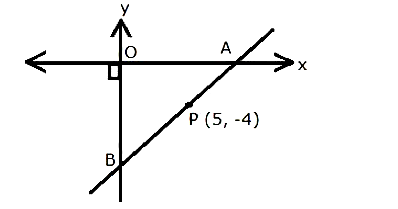
AnswerPoint A lies on x-axis. So, let the co-ordinates of A be (x, 0). Point B lies on y-axis. So, let the co-ordinates of B be (0, y).
View full question & answer→Question 223 Marks
Calculate the co-ordinates of the point P which divides the line segment joining: A $(-4, 6)$ and B $(3, -5)$ in the ratio $3 : 2$
AnswerLet the co-ordinates of the point P be (x, y).
$x=\frac{m_1 x_2+m_2 x_1}{m_1+m_2} $
$ x=\frac{3 \times 3+2 \times(-4)}{3+2} $
$x=\frac{1}{5}$
$y=\frac{m_1 y_2+m_2 y_1}{m_1+m_2}$
$y=\frac{3 \times(-5)+2 \times 6}{3+2} $
$ y=-\frac{3}{5}$
Thus, the co-ordinates of point $P$ are $\left(\frac{1}{5},-\frac{3}{5}\right)$
View full question & answer→Question 233 Marks
Calculate the co-ordinates of the point P which divides the line segment joining: A $(1, 3)$ and B $(5, 9)$ in the ratio $1 : 2$
AnswerLet the co-ordinates of the point P be $(x, y)$
$x=\frac{m_1 x_2+m_2 x_1}{m_1+m_2} $
$ =\frac{1 \times 5+2 \times 1}{1+2} $
$ =\frac{7}{3}$
$y=\frac{m_1 y_2+m_2-y_1}{m_1+m_2}$
$ =\frac{1 \times 9+2 \times 3}{1+2} $
$ =\frac{15}{3} $
$ =5$
Thus, the co-ordinates of point $P$ are $\left(\frac{7}{3}, 5\right)$
View full question & answer→