Questions

[2 Mark Question Answer]

🎯

Test yourself on this topic

31 questions · timed · auto-graded

Question 12 Marks
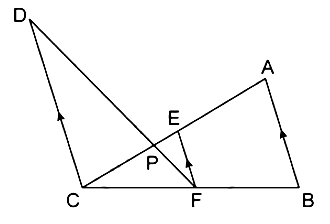
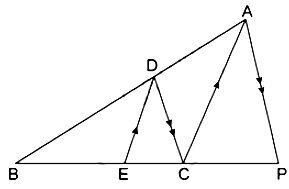
In the following figure, DE || Ac and DC || AP. Prove that:$\frac{B E}{E C}=\frac{B C}{C P}$
Answer
Since DE || AC,
$\frac{B E}{E C}=\frac{B D}{D A} \ldots$. By the Basic proportiona;ity theorem)
Since DC || AP,
$\frac{B C}{C P}=\frac{B D}{D A} \quad \ldots . .$. (By the Basic proportionality theorem)
Hence, $\frac{B E}{E C}=\frac{B C}{C P}$
View full question & answer
Question 22 Marks
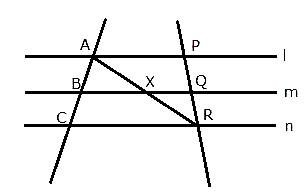
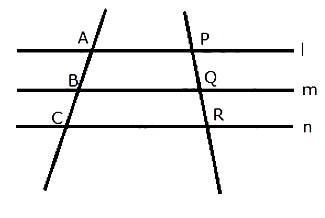
In the given figure, lines l, m and n are such that ls ∥ m ∥ n. Prove that:
$\frac{A B}{B C}=\frac{P Q}{Q R}$
Answer
Join AR.

In ΔACR, BX || CR. By Basic Proportionality theorem,
$\frac{A B}{B C}=\frac{A X}{X R}......(1)$.
In ∆APR, XQ || AP. By Basic Proportionality theorem,
$\frac{P Q}{Q R}=\frac{A X}{X R}.......(2)$
From (1) and (2), we get,
$\frac{A B}{B C}=\frac{P Q}{Q R}$
View full question & answer
Question 32 Marks
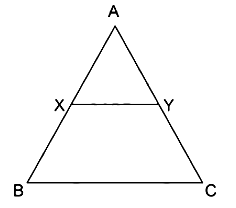
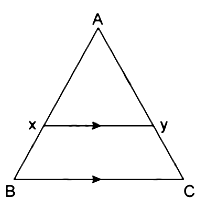
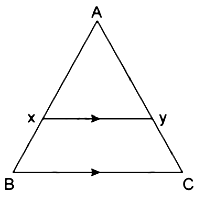
In the following figure, ∠AXY = ∠AYX. If $\frac{B X}{A X}=\frac{C Y}{A Y}$ show that triangle ABC is isoscele
Answer
Given that ∠AXY = ∠AYX
So, AX = AY .....(Sides opposite equal angles are equal)
Also, $\frac{B X}{A X}=\frac{C Y}{A Y}.......$(By the Basic proportionality theorem)
So, BX = CY
Thus, AX + BX = AY + CY
$\Rightarrow$AB = AC
Hence, ΔAbc is an isosoeles triangle.
View full question & answer
Question 42 Marks
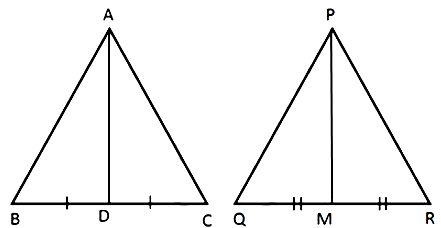
Triangle ABC is similar to triangle PQR. If AD and PM are altitudes of two triangles, Prove that :
$\frac{A B}{P Q}=\frac{A D}{P M}$
Answer

Given that ΔABC ∼ ΔPQR.
∠ABC = ∠PQR, that is, ∠ABD = ∠PQM
Also, ∠ADM = ∠PMQ ...(both are right angles)
So, ΔABC ∼ ΔPQM ...(AA criterion for similarity)
$\Rightarrow \frac{A B}{P Q}=\frac{A D}{P M}$
View full question & answer
Question 52 Marks
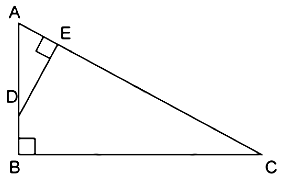
ABC is a right angled triangle with ∠ABC = 90°. D is any point on AB and DE is perpendicular to AC. Prove that

ΔADE ~ ΔACB.
Answer
In ΔADE and ΔACB.∠AED = ∠ABC ...(both are right angles)
∠DAE = ∠CAB ....(common angles)
ΔADE ∼ ΔACB ...(AA criterion for similarity)
View full question & answer
Question 62 Marks
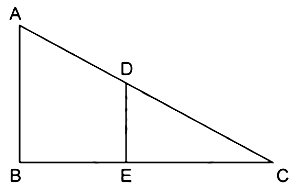
In the given figure, AB and DE are perpendiculars to BC.
If AB = 6 cm, DE = 4 cm and AC = 15 cm. Calculate CD.
Answer
In ΔABC and ΔDEC,
∠ABC = ∠DEC ...(both are right angles)
∠ACB = ∠DCE ....(common angles)
ΔABC ∼ ΔDEC ...(AA criterion for similarity)
$\begin{array}{c}\Rightarrow \frac{A B}{D E}=\frac{A C}{C D} \\ \Rightarrow \frac{6}{4}=\frac{15}{C D}\end{array}$
$\Rightarrow$ CD = 10 cm
View full question & answer
Question 72 Marks
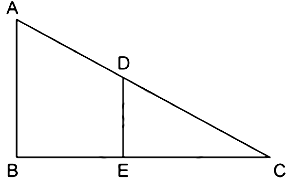
In the given figure, AB and DE are perpendiculars to BC.
Prove that : ΔABC ~ ΔDEC
Answer
In ΔABC and ΔDEC,

∠ABC = ∠DEC ...(both are right angles)
∠ACB = ∠DCE ....(common angles)

ΔABC ∼ ΔDEC ...(AA criterion for similarity)

View full question & answer
Question 82 Marks
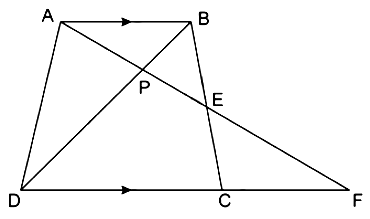
In the following figure, ABCD to a trapezium with AB ‖ DC. If AB = 9 cm, DC = 18 cm, CF= 13.5,cm, AP = 6 cm and BE = 15 cm, Calculate: EC
Answer
In $\triangle AEB$ and $\triangle FEC,$
$\angle AEB = \angle FEC ..$(Vertically opposite angles)
$\angle BAE = \angle CFE ....$(Since AB || DC)
$\triangle AEB \sim \triangle AFEC ....$(AA criterion for similarity)
$\Rightarrow \frac{A E}{F E}=\frac{B E}{C E}=\frac{A B}{F C}$
$\Rightarrow \frac{15}{C E}=\frac{9}{13.5}$
$\Rightarrow$ CE = 22.5 cm
View full question & answer
Question 92 Marks
The two similar triangles are equal in area. Prove that the triangles are congruent.
Answer
Let us assume two similar triangles as ΔABC ~ ΔPQR
Now $\frac{\operatorname{area}(\triangle ABC )}{\operatorname{area}(\triangle PQR )}=\left(\frac{ AB }{ PQ }\right)^2=\left(\frac{ BC }{ QR }\right)^2=\left(\frac{ AC }{ PR }\right)^2$
Since area (∆ABC) = area (∆PQR)
Therefore, AB = PQ
BC = QR
AC = PR
So, respective sides of two similar triangles
Are also of same length
So, ∆ABC ≅ ∆PQR (by SSS rule)
View full question & answer
Question 102 Marks
In the following figure, $XY$ is parallel to $BC, AX = 9 cm, XB = 4.5 cm$ and $BC = 18 cm.$

$\frac{Y C}{A C}$
Answer
Given that $XY \| BC.$
So, $\triangle AXY \sim \triangle ABC.$
$\Rightarrow \frac{A X}{A B}=\frac{A Y}{A C}$
$\Rightarrow \frac{9}{13.5}=\frac{A Y}{A C}$
$\Rightarrow \frac{Y C}{A C}=\frac{4.5}{13.5}=\frac{1}{3}$
View full question & answer
Question 112 Marks
In the following figure, $XY$ is parallel to $BC, AX = 9 cm, XB = 4.5 cm$ and $BC = 18 cm.$

$\frac{A Y}{Y C}$
Answer
Given that $XY \| BC$
So, $\triangle AXY \sim \triangle ABC$
$\Rightarrow \frac{A X}{A B}=\frac{A Y}{A C}$
$\Rightarrow \frac{9}{13.5}=\frac{A Y}{A C}$
$\Rightarrow \frac{A Y}{Y C}=\frac{2}{1}$
View full question & answer
Question 122 Marks
In the figure given below, AB ‖ EF ‖ CD. If AB = 22.5 cm, EP = 7.5 cm, PC = 15 cm and DC = 27 cm. Calculate : EF
Answer
In ΔPCD and ΔPEF,
∠CPD = ∠EPF .....(vertically opposite angles)
∠DCE = ∠FEP ...(since DC || EF)
ΔPCD ∼ ΔPEF ...(AA criterion for similarity)
$\Rightarrow \frac{27}{E F}=\frac{15}{7.5}$
$\Rightarrow$ EF = 13.5 cm
View full question & answer
Question 132 Marks
The dimensions of the model of a multistorey building are 1.2 m x 75 cm x 2 m. If the scale factor is 1 : 30; find the actual dimensions of the building.
Answer
The ratio of the lengths of two corresponding sides of two similar triangles.
The scale factor is 1 : 30
The actual dimension of the buiding = $\frac{30}{1}$(dimensions of the model of the building)
$\Rightarrow$ the actual dimension of the building = $\frac{30}{1}\left(1.2 \times \frac{75}{100} \times 2\right)$
$\Rightarrow$ The actual dimension of the building = 36 m x 22.5 m x 60 m
View full question & answer
Question 142 Marks
A triangle ABC is enlarged, about the point 0 as centre of enlargement, and the scale factor is 3. Find : OA, if OA' = 6 cm.
Answer
Given that ABC is enlarged and the scale factor m = 3 to the triangle A'B'C'.
OA' = 6cm
So, OA(3) = OA'
$\Rightarrow$ OA(3) = 6
$\Rightarrow$ OA = 2cm
View full question & answer
Question 152 Marks
A triangle ABC is enlarged, about the point 0 as centre of enlargement, and the scale factor is 3. Find : BC, if B' C' = 15 cm.
Answer
Given that ABC is enlarged and the scale factor m = 3 to the triangle A'B'C'.
B'C' = 15 cm
So, BC(3) = B'C'
$\Rightarrow$ BC(3) = 15
$\Rightarrow$ BC = 5cm
View full question & answer
Question 162 Marks
A triangle ABC is enlarged, about the point O as centre of enlargement, and the scale factor is 3. Find : A' B', if AB = 4 cm.
Answer
Given that ABC is enlarged and the scale factor m = 3 to the triangle A'B'C'.
AB = 4
So, Ab(3) = A'B'
$\Rightarrow$ (4)(3) = A'B'
$\Rightarrow$ A'B' = 12 cm
View full question & answer
Question 172 Marks
A triangle LMN has been reduced by scale factor 0.8 to the triangle L' M' N'. Calculate: the length of LM, if L' M' = 5.4 cm.
Answer
Given that LMN is a triangle that has been reduced by scale factor m = 0.8 to the triangle L' M' N'
L' M' = 5.4 cm
So, LM(0.8) = L'M'
$\Rightarrow$ LM (0.8) = L'M'
$\Rightarrow$ LM(0.8) = 5.4
$\Rightarrow$ LM = 6.75 cm
View full question & answer
Question 182 Marks
A triangle LMN has been reduced by scale factor 0.8 to the triangle L' M' N'. Calculate: the length of M' N', if MN = 8 cm.
Answer
Given that LMN is a triangle that has been reduced by scale factor m = 0.8 to the triangle L' M' N'
MN = 6cm
So, MN(0.8) = M' N'
$\Rightarrow$ (8)(0.8) = M'N'
$\Rightarrow$M' N' = 6.4 cm
View full question & answer
Question 192 Marks
A triangle ABC has been enlarged by scale factor m = 2.5 to the triangle A' B' C' Calculate : the length of C' A' if CA = 4 cm.
Answer
Given that ABC is a triangle that has been enlarged by scale factor m = 2.5 to the triangle A' B' C'
A' B' = 6cm
So, AB(2.5) = A' B'
$\Rightarrow$ AB(2.5) = 6
$\Rightarrow$ AB = 2.4 cm
If CA = 4cm.
So, CA(2.5) = C' A'
$\Rightarrow$ (4) (2.5) = C' A'
$\Rightarrow$ C' A' = 10cm
View full question & answer
Question 202 Marks
The perimeter of two similar triangles are $30\ cm$ and $24\ cm.$ If one side of the first triangle is $12\ cm,$ determine the corresponding side of the second triangle.
Answer
Let $\triangle ABC \sim \triangle DEF$
Then, $\frac{A B}{D E}=\frac{B C}{E F}=\frac{A C}{D F}=\frac{A B+B C+A C}{D E+E F+D F}$
$\Rightarrow \frac{\text { Perimeter of ABC }}{\text { Perimeter of DEF }}$
$\Rightarrow \frac{\text { Perimeter of ABC }}{\text { Perimeter of DEF }}=\frac{A B}{D E}$
$\Rightarrow \frac{30}{24}=\frac{12}{D E}$
$\Rightarrow D E=9.6 cm $
View full question & answer
Question 212 Marks
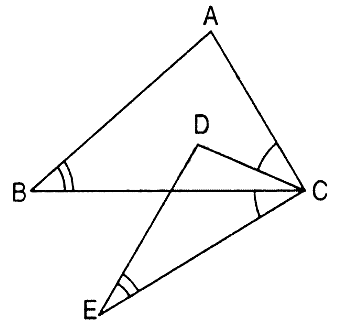
In the given figure, ∠B = ∠E, ∠ACD = ∠BCE, AB = 10.4cm and DE = 7.8 cm. Find the ratio
between areas of the ∆ABC and ∆ DEC
Answer
Given, ∠ACD = ∠BCE
∠ACD + ∠BCD = ∠BCE + ∠BCD
∠ACB = ∠DCE
Also, given ∠B = ∠E
∴∆ABC ~ ∆DEC
$\frac{\operatorname{ar}(\Delta ABC )}{\operatorname{ar}(\Delta DEC )}=\left(\frac{ AB }{ DE }\right)^2=\left(\frac{10.4}{7.8}\right)^2=\left(\frac{4}{3}\right)^2=\frac{16}{9}$
View full question & answer
Question 222 Marks
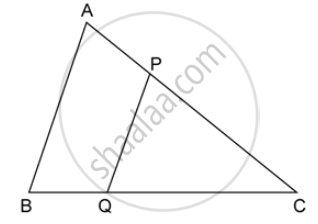
In the given figure, $PQ ‖ AB; CQ = 4.8\ cm\ QB = 3.6\ cm$ and $AB = 6.3\ cm.$ Find :
$PQ$
Answer
In $\triangle CPQ$ and $\triangle CAB,$
$\angle PCQ = \angle ACB ........($ Since $PQ || AB,$ so the angles are corresponding angles$)$
$\angle C = \angle C ......($ common angle $)$
$\therefore \triangle CPQ \sim \triangle CAB .....$ (AA criterion for similarity)
$\Rightarrow \frac{P Q}{A B}=\frac{C Q}{C B}$
$\Rightarrow \frac{P Q}{6.3}=\frac{4.8}{8.4}$
So, $PQ = 3.6$
View full question & answer
Question 232 Marks
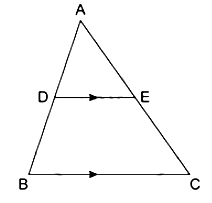
In the following figure, point $D$ divides $AB$ in the ratio $3 : 5.$ Find : $\frac{A E}{E C}$
Answer
Given that $\frac{A D}{D B}=\frac{3}{5}$
Now, $DE$ is parallel to $BC.$
Then, by Basic proportionality theorem, we have
$\frac{A D}{D B}=\frac{A E}{E C}$
$\Rightarrow \frac{A E}{E C}=\frac{3}{5}$
View full question & answer
Question 242 Marks
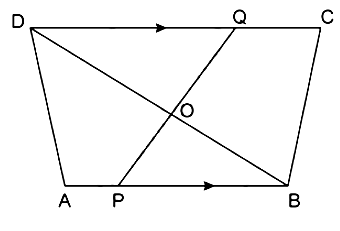
In the given figure, $AB ‖ DC, BO = 6 \ cm$ and $DQ = 8 \ cm;$ find: $BP \times DO.$
Answer
In $\triangle DOQ$ and $\triangle BOP$,
$\angle QDO =\angle PBO . .. ($Since $AB \| DC$ that is, $PB \| DQ )$
So, $\angle DOQ =\angle BOP ... ($vertically opposite angles$)$
$\Rightarrow \triangle DOQ \sim \triangle BOP . . .( AA$ criterion for similarity$)$
$\Rightarrow \frac{D O}{B O}=\frac{D Q}{B P}$
$\Rightarrow \frac{D O}{6}=\frac{8}{B P}$
$\Rightarrow BP \times DO = 48 \ cm^2$
View full question & answer
Question 252 Marks
In the given figure, $AD = AE$ and $AD^2 = BD x EC$.
Prove that: triangles $ABD$ and $CAE$ are similar.
Answer
In ΔABD and ΔCAE,
∠ADE = ∠AED ...(Angles opposite equal sides are equal)
So, $\angle ADB = \angle AEC ......($  Since $\angle ADB = \angle ADE = 180^\circ$ and $\angle AEC = \angle AED = 180^\circ)$
Also, $AD^2 = BD x EC$
$\Rightarrow \frac{A D}{B D}=\frac{E C}{A D}$
$\Rightarrow \frac{A D}{B D}=\frac{E C}{A E}$
$\Rightarrow \triangle ABD \sim \triangle CAE ...$(SAS criterion for similarity)
View full question & answer
Question 262 Marks
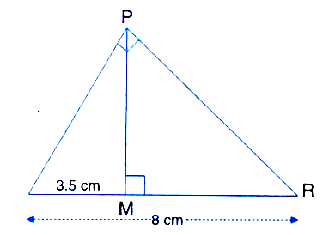
In the right-angled triangle $QPR, PM$ is an altitude.
Given that $QR = 8cm$ and $MQ = 3.5 cm$, calculate the value of $PR.$
Answer
We have
$\angle QPR = \angle PMR = 90^\circ$
$\angle PRQ = \angle PRM$ (common)
$\triangle PQR ~ \triangle MPR$ (AA similarity)
$\therefore \frac{Q R}{P R}=\frac{P R}{M R}$
$PR^2 = 8 \times 4.5 = 36$
$PR = 6 cm$
View full question & answer
Question 272 Marks
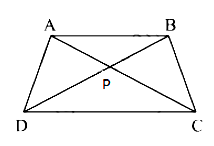
In a trapezium ABCD, side AB is parallel to side DC; and the diagonals AC and BD intersect each other at point P. Prove that : Δ APB is similar to Δ CPD.

Answer

In ΔAPB and ΔCPD,
∠APB = ∠CPD .......(vertically opposite angles)
∠ABP = ∠CDP ....(alternate angles since AC || DC)
ΔAPB ∼ ΔCPD .....(AA criterion for similarity)
View full question & answer
Question 282 Marks
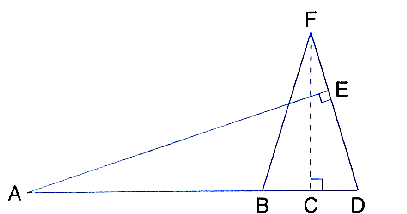
Given: $FB = FD, AE \perp FD$ and $FC \perp AD$
Prove: $\frac{ FB }{ AD }=\frac{ BC }{ ED }$
Answer
Given,$FB = FD$
$\therefore \angle FDB = \angle FBD ……….(1)$
In $\triangle AED = \triangle FCB,$
$\angle ADE = \angle FBC$ (using (1))
$\triangle AED \sim \triangle FCB$ ( By AA similarity)
$\frac{ AD }{ FB }=\frac{ ED }{ BC }$
$\frac{ FB }{ AD }=\frac{ BC }{ ED }$
View full question & answer
Question 292 Marks
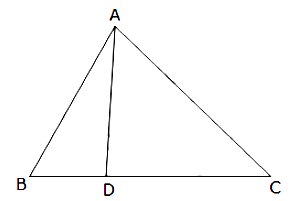
$D$ is a point on the side $BC$ of triangle $ABC$ such that angle $ADC$ is equal to angle $BAC$. Prove
that: $CA^2= CB \times CD$
Answer
In $\triangle A D C$ and $\triangle B A C$,
$\angle ADC =\angle BAC (Given) $
$\angle ACD =\angle ACB (Common) $
$\therefore \triangle ADC \sim \triangle BAC$
$\therefore \frac{C A}{C B}=\frac{C D}{C A}$
Hence, $CA ^2= CB \times CD$
View full question & answer
Question 302 Marks
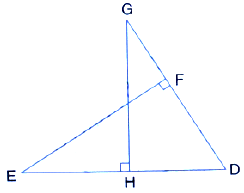
Given:
$\angle GHE = \angle DFE = 90 ,$
$DH = 8, DF = 12,$
$DG = 3x – 1$ and $DE = 4x + 2.$

Find: the lengths of segments $DG$ and $DE$
Answer
In $\triangle DHG$ and $\triangle DFE$,
$\angle GHD =\angle DFE =90$
$\angle D=\angle D(\text { Common })$
$\therefore \Delta DHG \sim \Delta DFE \Rightarrow \frac{ DH }{ DF }=\frac{ DG }{ DE }$
$\Rightarrow \frac{8}{12}=\frac{3 x-1}{4 x+2}$
$\Rightarrow 32 x+16=36 x-12$
$\Rightarrow 28=4 x$
$\Rightarrow x=7$
$\therefore DG =3 \times 7-1=20$
$DE =4 \times 7+2=30$
View full question & answer
Question 312 Marks
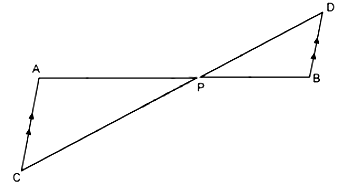
In the figure, given below, straight lines AB and CD intersect at P; and AC ‖ BD. Prove that: ΔAPC and ΔBPD are similar.
Answer
In ΔAPC and ΔBPD,

∠APC = ∠BPD .......(vertically opposite angles)

∠ACP = ∠BDP ....(alternate angles since AC || BD)

ΔAPC ∼ ΔBPD .....(AA criterion for similarity)

View full question & answer
[2 Mark Question Answer] - Mathematics STD 10 Questions - Vidyadip