Question 13 Marks
Triangle ABC is similar to triangle PQR. If bisector of angle BAC meets BC at point D and bisector of angle QPR meets QR at point M, prove that $\frac{A B}{P Q}=\frac{A D}{P M}$
Answer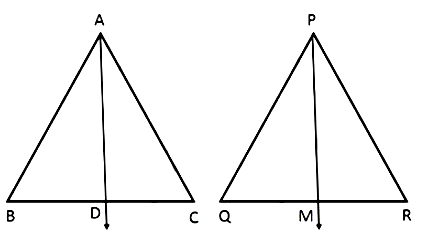
Given that ΔABC ∼ ΔPQR.
$\Rightarrow$ ∠BAC = ∠QPR,
$\Rightarrow \frac{1}{2} \angle B A C=\frac{1}{2} \angle Q P R$
$\Rightarrow$ ∠BAD = ∠QPM,
∠ABC = ∠PQR, that is, ∠ABD = ∠PQM
So, ΔABD ∼ ΔPQM ......(AA criterion for similarity)
$\Rightarrow \frac{A B}{P Q}=\frac{A D}{P M}$ View full question & answer→Question 23 Marks
Triangle ABC is similar to triangle PQR. If AD and PM are corresponding medians of the two triangles, prove that:
$\frac{A B}{P Q}=\frac{A D}{P M}$
Answer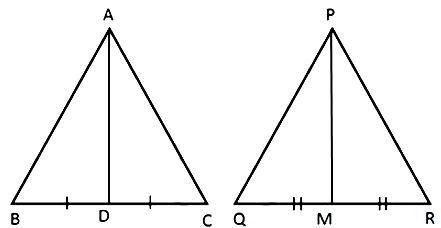
$\Rightarrow \frac{A B}{P Q}=\frac{A D}{P M}$
Given that ΔABC ∼ ΔPQR.
∠ABC = ∠PQR, that is, ∠ABD = ∠PQM
Also, ∠ADM = ∠PMQ ...(both are right angles)
So, ΔABC ∼ ΔPQM ...(AA criterion for similarity)
$\Rightarrow \frac{A B}{P Q}=\frac{A D}{P M}$ View full question & answer→Question 33 Marks
Given $: AB || DE$ and $BC || EF.$ Prove that:
$\frac{A D}{D G}=\frac{C F}{F G}$
$\Delta DFG \sim \Delta ACG$
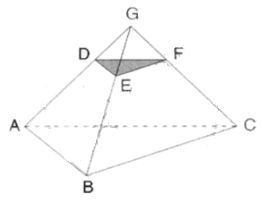
Answer(i) In $\triangle AGB, DE || AB ,$ by Basic proportionality theorem
$\frac{G D}{D A}=\frac{G H}{E B}.......(1)$.
In $\triangle GBC , EF || BC$, by Basic proportionality theorem,
$\frac{G E}{E B}=\frac{G H}{F C}......(2)$
From (1) and (2), we get
$\frac{G D}{D A}=\frac{G F}{F C}$
$\frac{A D}{D G}=\frac{C F}{F G}$
(ii) From (i), we have:
$\frac{A D}{D G}=\frac{C F}{F G}$
$\angle DGF =\angle AGC \quad \text { (Common) }$
$\therefore \Delta DFG \sim \Delta ACG \quad \text { (SAS similarity) }$
View full question & answer→Question 43 Marks
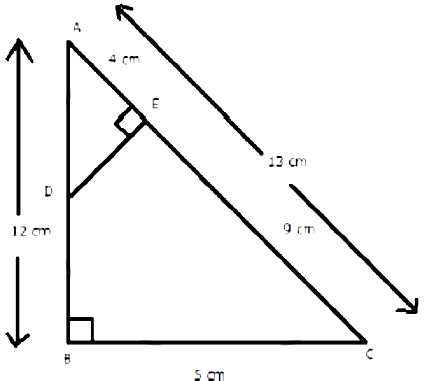
$ABC$ is a right angled triangle with $\angle ABC = 90^\circ. D$ is any point on $AB$ and $DE$ is perpendicular to $AC.$ Prove that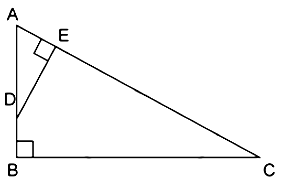
Find, area of $\triangle ADE :$ area of quadrilateral $BCED.$ AnswerWe need to find the area of $\square ADE$ and quadrilateral $BCED$
Area of $\triangle ADE =\frac{1}{2} \times A E X X D E=\frac{1}{2} \times 4 \times \frac{5}{3}=\frac{10}{3} cm ^3$
Area of $\quad.BCED =$ Area of $ΔABC$ Area of $ΔADE$
$=\frac{1}{2} \times B C \times A B-\frac{10}{3}$
$=\frac{1}{2} \times 5 \times 12-\frac{10}{3}$
$=30-\frac{10}{3}$
$=\frac{80}{3} cm ^2$
Thus ratio of areas of $ADE$ to quadrilateral $BCED =\frac{\frac{10}{3}}{\frac{80}{3}}=\frac{1}{8}$
View full question & answer→Question 53 Marks
$ABC$ is a right angled triangle with $\angle ABC = 90^\circ. D$ is any point on $AB$ and $DE$ is perpendicular to $AC.$ Prove that
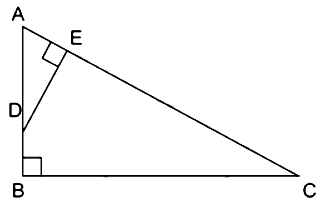
If $AC = 13\ cm, BC = 5\ cm$ and $AE = 4\ cm.$ Find $DE$ and $AD.$ AnswerSince $\triangle ADE \sim \triangle ACB,$ their sides are proportional
$\Rightarrow \frac{A E}{A B}=\frac{A D}{A C}=\frac{D E}{B C} \ldots$...(1)
In $\triangle ABC,$ by Pythagoras Theorem, we have
$A B^2+B C^2=A C^2$
$\Rightarrow A B^2+5^2=13^2$
$\Rightarrow A B=12 cm $
From equation $1$ we have
$\frac{4}{12}=\frac{A D}{13}=\frac{D E}{5}$
$\Rightarrow \frac{52}{12}=(A D)$
$\Rightarrow A D=4 \frac{1}{3} cm $
Also $\frac{4}{12}=\frac{D E}{5}$
$\Rightarrow D E=\frac{20}{12}=\frac{5}{3}=1 \frac{2}{3} cm$
View full question & answer→Question 63 Marks
In the given figure, $AB$ and $DE$ are perpendiculars to $BC.$
Find the ratio of the area of a $\triangle ABC :$ area of $\triangle DEC.$
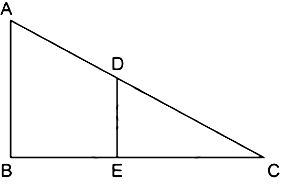
AnswerIn $\triangle ABC$ and $\triangle DEC,$
$\angle ABC = \angle DEC ...$ (both are right angles)
$\angle ACB = \angle DCE ....$ (common angles)
$\triangle ABC \sim \triangle DEC ...$ (AA criterion for similarity)
$\Rightarrow \frac{\operatorname{ar}(\triangle A B C)}{\operatorname{ar}(\triangle D E C)}=\frac{A B^2}{D E^2}=\frac{6^2}{4^2}=\frac{36}{16}$
$\Rightarrow \frac{\operatorname{ar}(\triangle A B C)}{\operatorname{ar}(\triangle D E C)}=\frac{9}{4}$
View full question & answer→Question 73 Marks
In the given figure, $ABC$ is a right angled triangle with $\angle BAC = 90^\circ.$
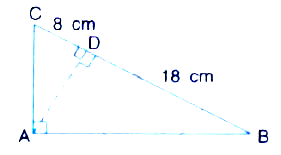
(i) Prove $\triangle ADB \sim \triangle CDA.$
(ii) If $BD = 18\ cm$ and $CD = 8\ cm,$ find $AD.$
(iii) Find the ratio of the area of $\triangle ADB$ is to area of $\triangle CDA.$ Answer(i) let $\angle CAD = x$
$\Rightarrow m \angle dab = 90^\circ - x$
$\Rightarrow m \angle DBA = 180^\circ - (90^\circ + 90^\circ - x) = x$
$\Rightarrow \angle CDA = \angle DBA ……… (1)$
In $\triangle ADB$ and $\triangle CDA,$
$\angle ADB = \angle CDA …… ($ each $90^\circ)$
$\angle ABD = \angle CAD …… $ (From (1))
$\therefore \triangle ADB \sim \triangle CDA …….. $ (By A.A)
(ii) Since the corresponding sides of similar triangles are proportional, we have.
$\frac{B D}{A D}=\frac{A D}{C D}$
$\Rightarrow \frac{18}{A D}=\frac{A D}{8}$
$\Rightarrow A D^2=18 \times 8=144 \Rightarrow A D=12 cm $
(iii) The ratio of the areas of two similar triangles is equal to the ratio of the square of their corresponding sides.
$\Rightarrow \frac{A r(\Delta A D B)}{A r(\Delta C D A)}=\frac{A D^2}{C D^2}=\frac{12^2}{8^2}=\frac{144}{64}=\frac{9}{4}=9: 4$
View full question & answer→Question 83 Marks
In the give figure, $ABC$ is a triangle with $\angle EDB = \angle ACB.$ Prove that $\triangle ABC \sim \triangle EBD.$ If $BE =6 cm, EC = 4cm, BD = 5cm$ and area of $\triangle BED = 9 cm^2.$ Calculate the:
(i) length of AB)
(ii) area of $\triangle ABC$
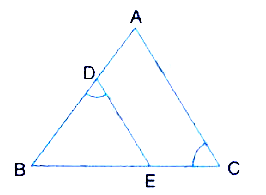
AnswerIn $\triangle ABC$ and $\triangle EBD,$
$\angle ACB = \angle EDB$ (given)
$\angle ABC = \angle EBD$ (common)
$\triangle ABC \sim \triangle EBD$ (by AA – similarity)
(i) we have, $\frac{A B}{B E}=\frac{B C}{B D} \Rightarrow A B=\frac{6 \times 10}{5}=12 cm$
$\frac{\text { Area of } \Delta ABC }{\text { Area of } \triangle BED }=\left(\frac{A B}{B E}\right)^2$
$\Rightarrow \text { Area of } \Delta BED =\left(\frac{12}{6}\right)^2 \times 9 cm ^2$
$=4 \times 9 cm ^2=36 cm ^2$
View full question & answer→Question 93 Marks
The following figure shows a triangle ABC in which AD and BE are perpendiculars to BC and AC respectively.
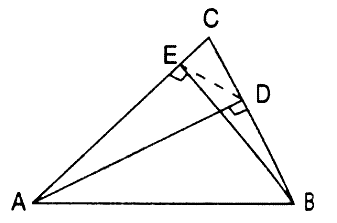
Show that;
(i) ΔADC ~ ΔBEC
(ii) CA × CE = CB × CD
(iii) ΔABC ~ ΔDEC
(iv) CD × AB = CA × DE
Answer(i) ∠ADC = ∠BEC = 90°
∠ACD = ∠BCE (Common)
ΔADC ~ ΔBEC (AA similarity)
(ii) From part (i),
$\frac{A C}{B C}=\frac{C D}{E C}.......(1)$.
$\Rightarrow C A \times C E=C B \times C B$
(iii) In ΔABC and ΔDEC,
From (1),
$\frac{A C}{B C}=\frac{C D}{E C} \Rightarrow \frac{A C}{C D} \times \frac{B C}{E C}$
∠DCE = ∠BCA (Common)
ΔABC ~ ΔDEC (SAS similarity)
(iv) From part (iii),
$\frac{A C}{D C}=\frac{A B}{D E}$
$\Rightarrow C D \times A B=C A \times D E$
View full question & answer→Question 103 Marks
In ΔABC, AP : PB = 2 : 3. PO is parallel to BC and is extended to Q so that CQ is parallel to BA.
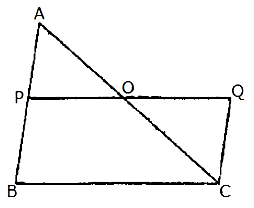
Find
:
(i) area ΔAPO : area Δ ABC.
(ii) area ΔAPO : area Δ CQO.
AnswerIn triangle ABC, PO || BC. Using Basic proportionality theorem,
$\frac{A P}{P B}=\frac{A O}{O C}$
$\Rightarrow \frac{A O}{O C}=\frac{2}{3}......(1)$
(i) ∠PAO = ∠BAC (common)
∠APO = ∠ABC (Corresponding angles)
ΔAPO ~ ΔABC (AA similarity)
$\therefore \frac{A r(\Delta A P O)}{A r(\Delta) A B C}=\left(\frac{A O}{A C}\right)^2=\left(\frac{2}{2+3}\right)^2=\left(\frac{2}{5}\right)^2=\frac{4}{25}$
(ii) ∠POA = ∠COQ (vertically opposite angles)
∠PAO = ∠QCO (alternate angles)
∆AOP ~ ∆COQ (AA similarity)
$\therefore \frac{A r(\Delta A O P)}{A r(\Delta C O Q)}=\left(\frac{A O}{C O}\right)^2=\left(\frac{2}{3}\right)^2=\frac{4}{9}$
View full question & answer→Question 113 Marks
In the following figure, $ABCD$ to a trapezium with $AB ‖ DC.$ If $AB = 9 cm, DC = 18 cm, CF= 13.5,cm, AP = 6 cm$ and $BE = 15 cm,$ Calculate $: AF$
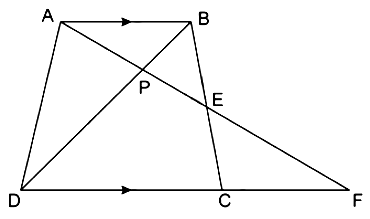
AnswerIn $\triangle APB$ and $\triangle FPD$
$\angle APB = \angle FPD .....$ (vertically opposite angles)
$\angle BAP = \angle DFP ...($ Since $AB || DF)$
$\triangle APB \sim \triangle FPD ...$ (AA criterion for similarity)
$\Rightarrow \frac{A P}{F P}=\frac{A B}{F D}$
$\Rightarrow \frac{6}{F P}=\frac{9}{31.5}$
$\Rightarrow FP = 21 cm$
SO $AF = AP + PF = 6 + 21 = 27 cm$
View full question & answer→Question 123 Marks
A triangle $ABC$ with $AB = 3\ cm, BC = 6\ cm$ and $AC = 4\ cm$ is enlarged to $\triangle DEF$ such that the longest side of $\triangle DEF = 9 cm.$ Find the scale factor and hence, the lengths of the other sides of $\triangle DEF.$
AnswerTriangle $ABC$ is enlarged to $DEF.$ So, the two triangles will be similar.
$\therefore \frac{A B}{D E}=\frac{B C}{E F}=\frac{A C}{D F}$
Longest side in $\triangle ABC = BC = 6\ cm$
Corresponding longest side in $\triangle DEF = EF = 9\ cm$
Scale factor $=\frac{E F}{B C}=\frac{9}{6}=\frac{3}{2}=1.5$
$\therefore \frac{A B}{D E}=\frac{B C}{E F}=\frac{A C}{D F}=\frac{2}{3}$
$D E=\frac{3}{2}(A B)=\frac{9}{2}=4.5 cm$
$D F=\frac{3}{2} A C=\frac{12}{2}=6 cm $
View full question & answer→Question 133 Marks
In a triangle PQR, L and M are two points on the base QR, such that ∠LPQ = ∠QRP and ∠RPM
= ∠RQP. Prove that:
(i) $\triangle P Q L$ and $\triangle R M P$
(ii) $Q L \times R M=P L \times P M$
(iii) $P Q^2=Q R \times Q L$
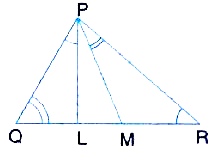
AnswerIn ΔPQL and ΔRMP
∠LPQ = ∠QRP (Given)
∠RQP = ∠RPM (Given)
ΔPQL ~ ΔRMP (AA similarity)
(ii) As ΔPQL ~ ΔRMP (proved above)
$\frac{P Q}{R P}=\frac{Q L}{P M}=\frac{P L}{R M}$
$\Rightarrow Q L \times R M \times P L \times P M$
(iii) ∠LPQ = ∠QRP (Given)
∠Q = ∠Q (Common)
∆PQL ~ ∆RQP (AA similarity)
$=\frac{P Q}{R Q}=\frac{Q L}{Q P}=\frac{P L}{P R}$
$\Rightarrow P Q^2=Q R \times Q L$
View full question & answer→Question 143 Marks
The dimensions of the model of a multistoreyed building are $1$ m by $60$ cm by $1.20$ m. if the scale factor is $1 : 50$, find the actual dimensions of the building.
Also find:
(i) the floor area of a room of the building, if the floor area of the corresponding room in the model is $50$ sq. cm
(ii) the space (volume) inside a room of the model, if the space inside the corresponding room of the building is $90 m ^3$
AnswerThe dimensions of the building are calculated as below.
Length = 1 × 50 m = 50 m
Breadth = 0.60 × 50 m = 30 m
Height = 1.20 × 50 m = 60 m
Thus, the actual dimensions of the building are 50 m × 30 m × 60 m.
(i) Floor area of the room of the building =
$50 \times\left(\frac{50}{1}\right)^2=125000 cm ^2=\frac{125000}{100 \times 100}=12.5 m ^2$
Volume of the model of the building
$90\left(\frac{1}{50}\right)^3=90 \times\left(\frac{1}{50}\right) \times\left(\frac{1}{50}\right) \times\left(\frac{1}{50}\right)=90 \times\left(\frac{100 \times 100 \times 100}{50 \times 50 \times 50}\right) cm ^2$
$= 720 cm^3$
View full question & answer→Question 153 Marks
The ratio between the areas of two similar triangles is 16 : 25, Find the ratio between their:
(i) perimeters (ii) altitudes (iii) medians
AnswerThe ratio between the areas of two similar triangles is same as the square of the ratio between their corresponding sides.
So, the ratio between the sides of the two triangles = 4 : 5
(i) The ratio between the perimeters of two similar triangles is same as the ratio between their sides.
∴ Required ratio = 4 : 5
(ii) The ratio between the altitudes of two similar triangles is same as the ratio between their sides.
∴ Required ratio = 4 : 5
(iii) The ratio between the medians of two similar triangles is same as the ratio between their sides.
∴Required ratio = 4 : 5
View full question & answer→Question 163 Marks
The ratio between the altitudes of two similar triangles is 3 : 5; write the ratio between their:
(i) medians (ii) perimeters (iii) areas
AnswerThe ratio between the altitudes of two similar triangles is same as the ratio between their sides.
(i) The ratio between the medians of two similar triangles is same as the ratio between their sides.
∴ Required ratio = 3 : 5
(ii) The ratio between the perimeters of two similar triangles is same as the ratio between their sides.
∴ Required ratio = 3 : 5
(iii) The ratio between the areas of two similar triangles is same as the square of the ratio between
their corresponding sides.
∴ Required ratio = (3)2 : (5)2 = 9 : 25
View full question & answer→Question 173 Marks
In the following figure, $XY$ is parallel to $BC, AX = 9 cm, XB = 4.5 cm$ and $BC = 18 cm.$
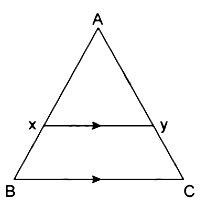
XY AnswerIn $\triangle s AXY$ and $ABC,$
$\angle XAY = \angle BAC$ (common angle)
$\angle AXY = \angle ABC$ (corresponding angles for parallel lines,$XY || BC$)
$\angle AYX = \angle ACB$ (corresponding angles for parallel lines, $XY || BC$)
Thus,$ \triangle AXY \sim \triangle ABC$
Hence, $\frac{A X}{A B}=\frac{X Y}{B C}$ (Using similar triangle property)
$\frac{A X}{A X+X B}=\frac{X Y}{18}$
$\frac{9}{9+4.5}=\frac{X Y}{18}$
$X Y=\frac{18 \times 9}{13.5}$
$X Y=12$
View full question & answer→Question 183 Marks
In the figure given below, $AB ‖ EF ‖ CD.$ If $AB = 22.5\ cm, EP = 7.5\ cm, PC = 15\ cm$ and $DC = 27\ cm.$ Calculate $ : AC$
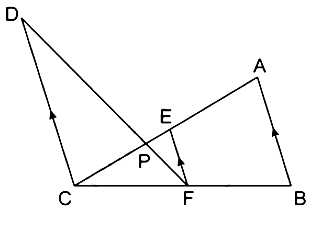
AnswerIn $\triangle PCD$ and $\triangle PEF,$
$\angle CPD = \angle EPF .....$ (vertically opposite angles)
$\angle DCE = \angle FEP ...$ (since DC || EF)
$\triangle PCD \sim \triangle PEF ...$ (AA criterion for similarity)
$\Rightarrow \frac{27}{E F}=\frac{15}{7.5}$
$\Rightarrow EF = 13.5 cm$
Since $EF || AB, \triangle CEF \sim \triangle CAB$
$\Rightarrow \frac{E C}{A C}=\frac{E F}{A B}$
$\Rightarrow \frac{22.5}{A C}=\frac{13.5}{22.5}$
$\Rightarrow AC =37.5 cm $
View full question & answer→Question 193 Marks
A model of a ship is made to a scale $1 : 300$.
(i) The length of the model of the ship is $2 m$. Calculate the length of the ship.
(ii) The area of the deck of the ship is $180,000 m^2$. Calculate the area of the deck of the model.
(iii). The volume of the model is $6.5 m^3$. Calculate the volume of the ship.
Answer(i) Scale factor k = $\frac{1}{300}$
Length of the model of the ship = k x Length of the ship
$\Rightarrow 2=\frac{1}{300} \times$ Length of the ship
$\Rightarrow$ Length of the ship = 600 m
(ii) Area of the deck of the model = $k^2$ x Area of the deck of the ship
$\Rightarrow$ Area of the deck of the model = $\left(\frac{1}{300}\right)^2 \times 180,000$
$=\frac{1}{90000} \times 180,000$
$=2 m^2$
(iii) Volume of the model $=k^3 \times$ Volume of the ship
$\Rightarrow 6.5=\left(\frac{1}{300}\right)^3 \times$ Volume of the ship
$\Rightarrow$ Volume of the ship $=6.5 \times 27000000=17,55,00,000 m ^3$
View full question & answer→Question 203 Marks
A triangle ABC is enlarged, about the point 0 as centre of enlargement, and the scale factor is 3. Find : OC', if OC = 21 cm
Also, state the value of : (a) $\frac{O B \prime}{O B}$
(b) $\frac{C^{\prime} A \prime}{C A}$
AnswerGiven that triangle ABC is enlarged and the scale factor is m = 3 to the triangle A'B'C'.
OC = 21 cm
So, (OC)3 = OC'
i.e. 21 x 3 = OC'
i.e. OC' = 63 cm
The ratio of the lengths of two Corresponding sides of two similar triangles
(a) Given that ABC is enlarged and the scale factor m = 3 to the triangle A'B'C'.
$\Rightarrow \frac{O B \prime}{O B}=3$
(b) Given that ABC is enlarged and the scale factor m = 3 to the triangle A'B'C'
$\Rightarrow \frac{C^{\prime} A \prime}{C A}=3$
View full question & answer→Question 213 Marks
A line $P Q$ is drawn paral el to the base $B C$ of $\triangle A B C$ which meets sides $A B$ and $A C$ at points $P$ and $Q$ respectively. If $AP =\frac{1}{3} PB$; find the value of:
1) $\frac{\text { Area of } \triangle ABC }{\text { Area of } \triangle APQ }$
2) $\frac{\text { Area of } \triangle APQ }{\text { Area of trapeziumPBCQ }}$
Answer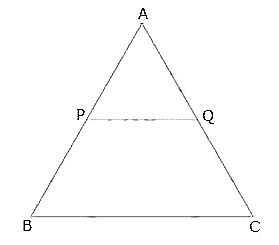
(i) $A P=\frac{1}{3} P B \Rightarrow \frac{A P}{P B}=\frac{1}{3}$
In ΔAPQ and ΔABC,
As PQ ∥ BC, corresponding angles are equal
∠APQ = ∠ABC
∠AQP = ∠ACB
∆APQ ~ ∆ABC
$\frac{\text { Are of } \Delta ABC }{\text { Area of } \Delta APQ }=\frac{A B^2}{A P^2}$
$=\frac{4^2}{1^2}=16: 1$
$\left(\frac{A P}{P B}=\frac{1}{3} \Rightarrow \frac{A B}{A P}=\frac{4}{1}\right)$
$\frac{\text { Area of APQ }}{\text { Area of trapeziumPBCQ }}$
$\frac{\text { Area of APQ }}{\text { Area of } \triangle ABC -\text { Area of } \triangle APQ }$
$=\frac{1}{16-1}=\frac{1}{15}=1: 15$ View full question & answer→Question 223 Marks
In the figure, given below, PQR is a right-angle triangle right angled at Q. XY is parallel to QR, PQ = 6 cm, PY = 4 cm and PX : XQ = 1 : 2. Calculate the lengths of PR and QR.
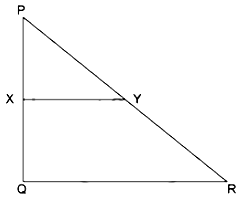
AnswerGiven that $\frac{P X}{X Q}=\frac{1}{2}$ and $XY \| QR$
So, $\frac{P X}{X Q}=\frac{P Y}{Y R}=\frac{1}{2}$
Since PY = 4cm, YR = 8cm.
Hence, PR = 12 cm
Since ΔPQR is a right-angled triangle
By Pythagoras theorem,
$Q R^2=P R^2-P Q^2$
$\Rightarrow Q R^2=12^2-6^2$
$\Rightarrow Q R^2=144-36$
$\Rightarrow Q R^2=108$
$\Rightarrow QR =10.39 cm$
View full question & answer→Question 233 Marks
$A$ line segment $DE$ is drawn parallel to base $BC$ of $\triangle ABC$ which cuts $AB$ at point $D$ and $AC$ at point $E.$ If $AB = 5BD$ and $EC = 3.2\ cm,$ find the length of $AE.$
Answer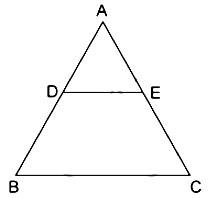
Since $DE \| BC, \triangle ADE \sim \triangle ABC$
$\Rightarrow \frac{A D}{B D}=\frac{A E}{E C}$
$\Rightarrow \frac{A B-B D}{B D}=\frac{A E}{E C}$
$\Rightarrow \frac{5 B D-B D}{B D}=\frac{A E}{E C}$
$\Rightarrow \frac{4 B D}{B D}=\frac{A E}{3.2}$
$\Rightarrow AE = 4 x 3.2 = 12.8 cm$ View full question & answer→Question 243 Marks
In $\triangle ABC, D$ and $E$ are the points on sides $AB$ and $AC$ respectively.
Find whether $DE ‖ BC,$ if $AB = 6.3 cm, EC = 11.0 cm, AD =0.8 cm$ and $EA = 1.6 cm.$
Answer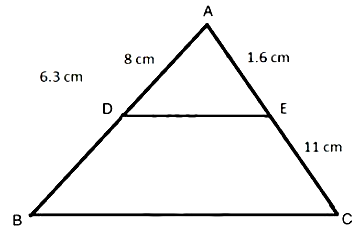
In $\triangle ADE$ and $\triangle ABC,$
$\frac{A E}{E C}=\frac{1.6}{11}=\frac{0.8}{5.5}$
$\frac{A D}{B D}=\frac{0.8}{6.3-8}=\frac{0.8}{5.5}$
So, $\frac{A E}{E C}=\frac{A D}{B D}$
$\therefore DE || BC ...$ (By the Converse of Mid-point theorem) View full question & answer→Question 253 Marks
In $\triangle ABC, D$ and $E$ are the points on sides $AB$ and $AC$ respectively.
Find whether $DE ‖ BC,$ if
$AB = 9cm, AD = 4cm, AE = 6cm$ and $EC = 7.5cm.$
Answer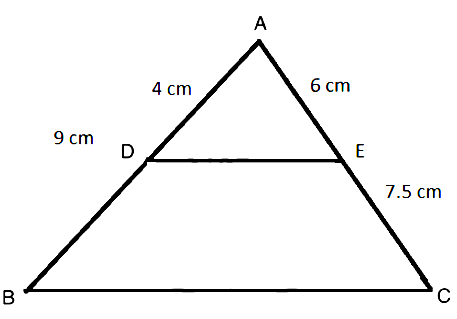
In $\triangle ADE$ and $\triangle ABC,$
$\frac{A E}{E C}=\frac{6}{7.5}=\frac{4}{5}$
$\frac{A D}{B D}=\frac{4}{5} \ldots . .(\text { Since } AB =9 cm \text { and } AD =4 cm )$
So, $\frac{A E}{E C}=\frac{A D}{B D}$
$\therefore DE || BC ...$ (By the Converse of Mid-point theorem) View full question & answer→Question 263 Marks
$A$ line $PQ$ is drawn parallel to the side $BC$ of $\triangle ABC$ which cuts side $AB$ at $P$ and side $AC$ at $Q.$ If $AB = 9.0 cm, CA = 6.0 cm$ and $AQ = 4.2 cm,$ find the length of AP.
Answer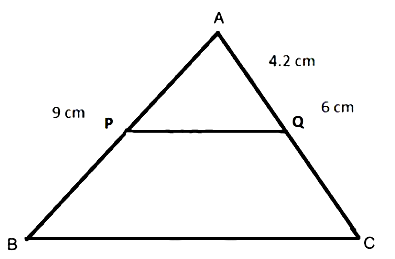
In $\triangle APQ$ and $\triangle ABC,$
$\angle ACQ = \angle ABC ........$ (Since $PQ || BC,$ so the angles are corresponding angles)
$\angle PAQ = \angle BAC ...$(common angle)
$\triangle APQ \sim \triangle ABC ........$ (AA criterion for similarity)
$\Rightarrow \frac{A P}{A B}=\frac{A Q}{A C}$
$\Rightarrow \frac{A P}{9}=\frac{4.2}{6}$
$\Rightarrow AP = 6.3 cm$ View full question & answer→Question 273 Marks
In the given figure, $PQ ‖ AB; CQ = 4.8\ cm\ QB = 3.6\ cm$ and $AB = 6.3 cm.$ Find :
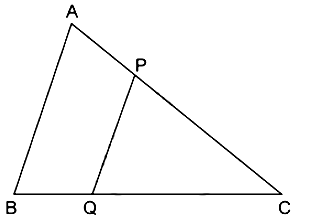
If $AP = x,$ then the value of $AC$ in terms of $x.$ AnswerIn $\triangle CPQ$ and $\triangle CAB,\angle PCQ$
$\angle ACB ........$ (Since $PQ || AB,$ so the angles are corresponding angles)
$\angle C = \angle C ......$ (common angle)
$\therefore \triangle CPQ \sim \triangle CAB .....$ (AA criterion for similarity)
$\Rightarrow \frac{C P}{A C}=\frac{C Q}{C B}$
$\Rightarrow \frac{C P}{A C}=\frac{4.8}{8.4}=\frac{4}{7}$
So, if $AC$ is $7$ parts, and $CP$ is $4$ parts, then PA is $3$ parts.
Thus, $AC =\frac{7}{3} P A=\frac{7}{3} x$
View full question & answer→Question 283 Marks
In the given figure, $PQ ‖ AB; CQ = 4.8\ cm\ QB = 3.6\ cm$ and $AB = 6.3 cm.$ Find : $\frac{C P}{P A}$
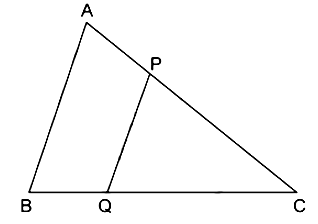
AnswerIn $\triangle CPQ$ and $\triangle CAB,$
$\angle PCQ = \angle ACB ........$ (Since $PQ || AB,$ so the angles are corresponding angles)
$\angle C = \angle C ......$ (common angle)
$\therefore \triangle CPQ \sim \triangle CAB .....$ (AA criterion for similarity)
$\Rightarrow \frac{C P}{C A}=\frac{C Q}{C B}$
$\Rightarrow \frac{C P}{C A}=\frac{4.8}{8.4}=\frac{4}{7}$
So, $\frac{C P}{P A}=\frac{4}{3}$
View full question & answer→Question 293 Marks
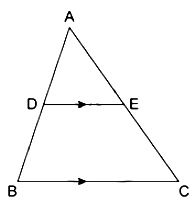
In the following figure, point $D$ divides $AB$ in the ratio $3 : 5.$ Find :
$BC = 4.8\ cm,$ find the length of $DE.$
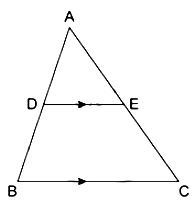
AnswerGiven that $\frac{A D}{D B}=\frac{3}{5}$
So, $\frac{A D}{A B}=\frac{3}{8}$
In $\triangle ADE$ and $\triangle ABC,$
$\angle ADE = \angle ABC.....$ (Since DE || BC, so the angles are corresponding angles)
$\angle A = \angle A.....$ (common angle)
$\therefore \triangle ADE \sim \triangle ABC ....$ (AA criterion for similarity)
$\Rightarrow \frac{A D}{A B}=\frac{D E}{B C}$
$\Rightarrow \frac{3}{8}=\frac{D E}{4.8}$
$\Rightarrow DE = 1.8 cm$
View full question & answer→Question 303 Marks
In the following figure, point $D$ divides $AB$ in the ratio $3 : 5.$ Find :
$DE = 2.4\ cm,$ find the length of $BC.$
AnswerGiven that $\frac{A D}{D B}=\frac{3}{5}$
So, $\frac{A D}{A B}=\frac{3}{8}$
In ΔADE and ΔABC,
∠ADE = ∠ABC.....(Since DE || BC, so the angles are corresponding angles)
∠A = ∠A.....(common angle)
∴ ΔADE ∼ ΔABC ....(AA criterion for similarity)
$\Rightarrow \frac{A D}{A B}=\frac{D E}{B C}$
$\Rightarrow \frac{3}{8}=\frac{2.4}{B C}$
$\Rightarrow BC =6.4 cm $
View full question & answer→Question 313 Marks
In the following figure, point $D$ divides $AB$ in the ratio $3 : 5.$ Find :$\frac{A E}{A C}$
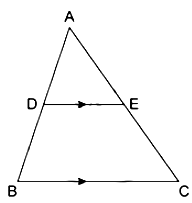
AnswerGiven that $\frac{A D}{D B}=\frac{3}{5}$
So, $\frac{A D}{A B}=\frac{3}{8}$
In $\triangle ADE$ and $\triangle ABC,$
$\angle ADE = \angle ABC ......$ (Since DE || BC, so the angles are corresponding angles)
$\angle A = \angle A .....$ (common angle)
$\therefore \triangle ADE \sim \triangle ABC ....$ (AA criterion for similarity)
$\Rightarrow \frac{A D}{A B}=\frac{A E}{A C}$
$\Rightarrow \frac{A E}{A C}=\frac{3}{8}$
View full question & answer→Question 323 Marks
In the given figure, DE ‖ BC, AE = 15 cm, EC = 9 cm, NC = 6 cm and BN = 24 cm.
Write all possible pairs of similar triangles.
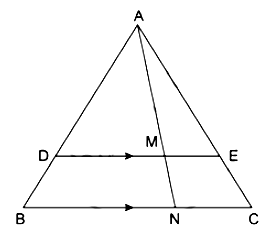
AnswerIn ΔAME and ΔANC,
∠AME = ∠ANC ......(((Since DE || BC that is, ME || NC)
∠MAE = ∠NAC....(common angle)
$\Rightarrow$ ΔAME and ΔANC ....(AA criterion for similarity)
In ΔADM and ΔABN,
∠ADM = ∠ABN ......(((Since DE || BC that is, ME || BN)
∠DAM = ∠BAN....(common angle)
$\Rightarrow$ ΔADM and ΔABN ....(AA criterion for similarity)
In ΔADE and ΔABN,
∠ADE = ∠ABC ......(((Since DE || BC that is, ME || NC)
∠AED = ∠ACB....(Since DE || BC)
$\Rightarrow$ ΔADE and ΔABC ....(AA criterion for similarity)
View full question & answer→Question 333 Marks
In ΔABC; BM ⊥ AC and CN ⊥ AB; show that:
$\frac{A B}{A C}=\frac{B M}{C N}=\frac{A M}{A N}$
Answer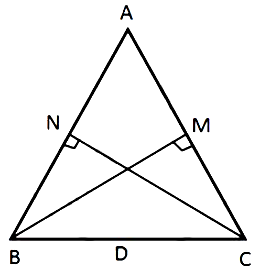
In ΔABM and ΔACN,
∠AMB = ∠ANC ...(Bm ⊥ AC and CN ⊥ AB)
∠BAM = ∠CAN ....(common angle)
$\Rightarrow$ ΔABM ∼ ΔACN ....(AA criterion for similarity)
$\Rightarrow \frac{A B}{A C}=\frac{B M}{C N}=\frac{A M}{A N}$ View full question & answer→Question 343 Marks
In Δ ABC, angle ABC is equal to twice the angle ACB, and bisector of angle ABC meets the opposite side at point P. Show that : CB : BA = CP : PA
Answer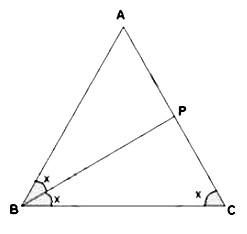
In ΔABC,
∠ABC = 2∠ACB
Let ∠ACB = x
=> ∠ABC = 2∠ACB = 2x
Given BP is bisector of ∠ABC.
Hence ∠ABP = ∠PBC = x
Using the angle bisector theorem,
That is the bisector of an angle divides the side opposite to it in the ratio of other two sides
Hence, CB : BA = CP : PA
View full question & answer→Question 353 Marks
In quadrilateral ABCD, the diagonals AC and BD intersect each other at point O. If AO = 2CO and BO = 2DO; show that : OA x OD = OB x OC.
Answer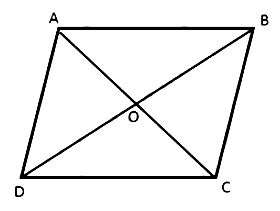
Since AO = 2CO and BO = 2DO,
$\frac{A O}{C O} \frac{2}{1}=\frac{B O}{D O}$
So, OA x OD = OB x OC View full question & answer→Question 363 Marks
In quadrilateral ABCD, the diagonals AC and BD intersect each other at point O. If AO = 2CO and BO = 2DO; show that : Δ AOB is similar to Δ COD
Answer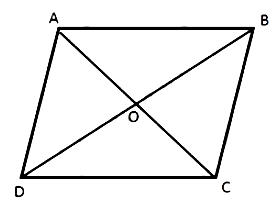
Since AO = 2CO and BO = 2DO,
$\frac{A O}{C O}=\frac{2}{1}=\frac{B O}{D O}$
Also, ∠AOB = ∠DOC ...(vertically opposite angles)
So, ΔAOB ∼ ΔCOD ...(SAS criterion for similarity) View full question & answer→Question 373 Marks
P is a point on side BC of a parallelogram ABCD. If DP produced meets AB produced at point L, prove that : DL : DP = AL : DC.
Answer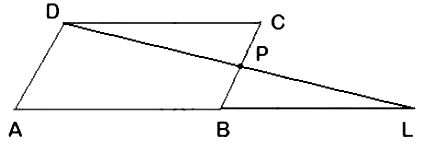
Since AD || BC, that is, AD || BP,
be the Basic proportionality theorem, we get
$\frac{D P}{D P}=\frac{A L}{A B}$
Since ABCD is a parallelogram, AB = DC
So, $\frac{D L}{D P}=\frac{A L}{D C}$ View full question & answer→Question 383 Marks
P is a point on side BC of a parallelogram ABCD. If DP produced meets AB produced at point L, prove that : DP : PL = DC : BL.
Answer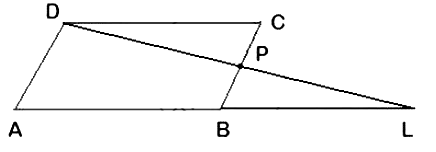
Since AD || BC, that is, AD || BP,
be the Basic proportionality theorem, we get
$\frac{D P}{P L}=\frac{A B}{B L}$
Since ABCD is a parallelogram, AB = DC
So, $\frac{D P}{P L}=\frac{D C}{B L}$ View full question & answer→Question 393 Marks
In the given figure, QR is parallel to AB and DR is parallel to AB and DR is parallel to QB.
Prove that:
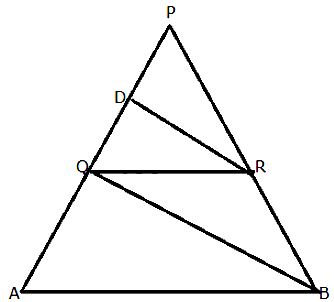
$P Q^2=P D \times P A$ AnswerGiven, QR is parallel to AB. Using Basic proportionality theorem,
$\Rightarrow \frac{P Q}{P A}=\frac{P R}{P B}......(1)$
Also, DR is parallel to QB. Using Basic proportionality theorem,
$\Rightarrow \frac{P D}{P A}=\frac{P R}{P B}......(2)$
From (1) and (2), we get,
$\frac{P Q}{P A}=\frac{P D}{P Q}$
$P Q^2=P D \times P A$
View full question & answer→Question 403 Marks
In a trapezium ABCD, side AB is parallel to side DC; and the diagonals AC and BD intersect each other at point P. Prove that : PA x PD = PB x PC.
Answer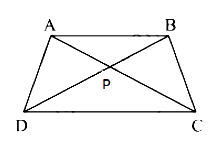
In ΔAPB and ΔCPD,
∠APB = ∠CPD .......(vertically opposite angles)
∠ABP = ∠CDP ....(alternate angles since AC || DC)
ΔAPB ∼ ΔCPD .....(AA criterion for similarity)
$\Rightarrow \frac{P A}{P C}=\frac{P B}{P D} \ldots .$. (Since corresponding sides of similar triangles are equal)
$\Rightarrow PA \times PD = PB \times PC$ View full question & answer→Question 413 Marks
Given: ABCD is a rhombus, DRP and CBR are straight lines.
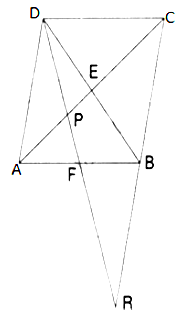
Prove that:
$DP \times CR = DC \times PR$ AnswerIn $\triangle DPA$ and $\triangle RPC,$
$\angle DPA = \angle RPC$ (Vertically opposite angles)
$\angle PAD = \angle PCR$ (Alternate angles)
$\triangle DPA \sim \triangle RPC$
$\therefore \frac{ DP }{ PR }=\frac{ AD }{ CR }$
$\frac{ DP }{ PR }=\frac{ AD }{ CR }$
(AD = DC, as ABCD is rhombus)
Hence, $DP \times CR = DC \times PR$
View full question & answer→Question 423 Marks
Given: RS and PT are altitudes of ΔPQR. Prove that:
(i) Δ PQT ~ ΔQRS
(ii) PQ × QS = RQ × QT
Answer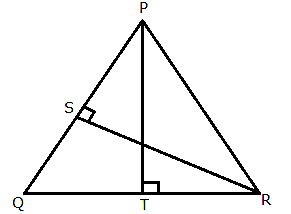
(i)
In ∆PQT and ∆QRS,
∠PTQ = ∠RSQ = 90° (Given)
∠PQT = ∠RQS (Common)
∆PQT ~ ∆ RQS (By AA similarity)
(ii)
Since, triangle PQT and RQS are similar
$\therefore \frac{ PQ }{ RQ }=\frac{ QT }{ QS }$
$\Rightarrow$ PQ × QS = RQ × QT View full question & answer→Question 433 Marks
In the figure, given below, straight lines AB and CD intersect at P; and AC ‖ BD. Prove that :
If $BD = 2.4 cm, AC = 3.6 cm, PD = 4.0$ cm and $PB = 3.2$ cm; find the lengths of $PA$ and $PC.$
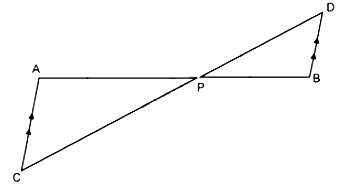
AnswerIn $\triangle APC$ and $\triangle BPD,$
$\angle APC = \angle BPD .......$(vertically opposite angles)
$\angle ACP = \angle BDP ........$(alternate angles since AC || BD)
$\therefore \triangle APC \sim \triangle BPD .......$(AA criterion for similarity)
$\text { So, } \frac{P A}{P B}=\frac{P C}{P D}=\frac{A C}{B D}$
$\Rightarrow \frac{P A}{3.2}=\frac{P C}{4}=\frac{3.6}{2.4}$
$\text { So, } \frac{P A}{3.2}=\frac{3.6}{2.4} \text { and } \frac{P C}{4}=\frac{3.6}{2.4}$
$\Rightarrow P A=\frac{3.6 \times 3.2}{2.4}=4.8 cm $
and $P C=\frac{3.6 \times 4}{2.4}=6 cm$
Hence, $PA = 4.8 cm$ and $PC = 6 cm$
View full question & answer→