Questions

[4 marks sum]

🎯

Test yourself on this topic

35 questions · timed · auto-graded

Question 14 Marks
In the following figure, $AB, CD$ and $EF$ are perpendicular to the straight line $BDF.$
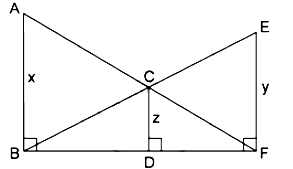
If $AB = x; CD = z$ unit and $EF = y$ unit, prove that:
$\frac{1}{x}+\frac{1}{y}=\frac{1}{z}$
Answer
In $\triangle FDC$ and $\triangle FBA,$
$\angle FDC = \angle FBA ...$ (Since DC || AB)
$\angle DFC = \angle BFA ....$ (common angle)
$\triangle FDC \sim \triangle FBA ....$ (AA criterion for similarity)
$\Rightarrow \frac{D C}{A B}=\frac{D F}{B F}$
$\Rightarrow \frac{ z }{ x }=\frac{D F}{B F} \ldots \text {.(i) }$
In $\triangle BDC$ and $\triangle BFE,$
$\angle BDC = \angle BFE ...$ (Since DC || FE)
$\angle DBC = \angle FBE ....$ (common angle)
$\triangle BDC \sim \triangle BFE ....$ (AA criterion for similarity)
$\Rightarrow \frac{B D}{B F}=\frac{D C}{E F}$
$\Rightarrow \frac{B D}{B F}=\frac{ z }{ y } \ldots \text {.(ii) }$
Adding (i) and (ii), we get
$\frac{B D}{B F}+\frac{D F}{B F}=\frac{ z }{ y }+\frac{ z }{ x }$
$\Rightarrow 1=\frac{ z }{ y }+\frac{ z }{ x }$
$\Rightarrow \frac{1}{ z }=\frac{1}{ x }+\frac{1}{ y }$
Hence proved.
View full question & answer
Question 24 Marks
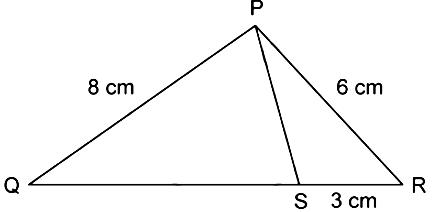
PQR is a triangle. S is a point on the side QR of ΔPQR such that ∠PSR = ∠QPR. Given QP = 8 cm, PR = 6 cm and SR = 3 cm.1.
1. i. ProveΔPQR∼ Δ
2. Find the lengths of QR and PS.
3. $\frac{\text { Area of } \triangle P Q R}{\text { area of } \triangle S P R}$
Answer
i. In $\triangle PQR$ and $\triangle SPR,$
$\angle PSR = \angle QPR …$ given
$\angle PRQ = \angle PRS …$ common angle
$\Rightarrow \triangle PQR \sim \triangle SPR$ (AA Test)
ii. Find the lengths of $QR$ and $PS.$
Since $\triangle PQR \sim \triangle SPR …$ from (i)
$\Rightarrow \frac{P Q}{S P}=\frac{Q R}{P R}=\frac{P R}{S R} \ldots$...(a)
$\frac{Q R}{P R}=\frac{P R}{S R} \ldots . . \text { from (a) }$
$\Rightarrow \frac{Q R}{6}=\frac{6}{3}$
$\Rightarrow Q R=\frac{6 \times 6}{3}=12 cm $
$\frac{P Q}{S P}=\frac{P R}{S R} \ldots$ from (a)
$\Rightarrow \frac{8}{S P}=\frac{6}{3}$
$\Rightarrow S P=\frac{8 \times 3}{6}=4 cm $
iii. $\frac{\text { area of } \triangle P Q R}{\text { area of } \triangle S P R}=\frac{P Q^2}{S P^2}=\frac{8^2}{4^2}=\frac{64}{16}=4$
View full question & answer
Question 34 Marks
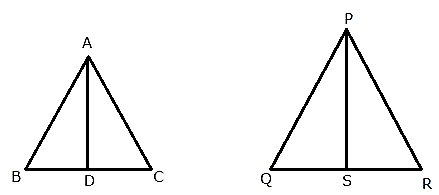
Two isosceles triangles have equal vertical angles. Show that the triangles are similar.If the ratio between the areas of these two triangles is $16 : 25,$ find the ratio between their corresponding altitudes.
Answer

Let ABC and PQR be two isosceles triangles.
Then $\frac{A B}{A C}=\frac{1}{1}$ And $\frac{P Q}{P R}=\frac{1}{1}$
Also, $\angle A = \angle P$ (Given)
$\therefore \triangle ABC ~ \triangle PQR$ (SAS similarity)
Let AD and PS be the altitude in the respective triangles.
We know that the ratio of areas of two similar triangles is equal to the square of their corresponding altitudes.
$\frac{A r(\triangle A B C)}{A r(\triangle P Q R)}=\left(\frac{A D}{P S}\right)^2$
$\frac{16}{25}=\left(\frac{A D}{P S}\right)^2$
$\frac{A D}{P S}=\frac{4}{5}$
View full question & answer
Question 44 Marks
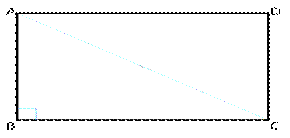
On a map, drawn to a scale of $1 : 20000,$ a rectangular plot of land $ABCD$ has $AB = 24\ cm$ and $BC = 32\ cm.$ Calculate:(i) the diagonal distance of the plot in kilometer
(ii) the area of the plot in sq.km
Answer
Scale $:- 1 : 20000$
1 cm represents 20000 cm $=\frac{20000}{1000 \times 100}=0.2 km$

$A C^2=A B^2+B C^2$
$ =24^2+32^2$
$ =576+1024=1600 $
$AC =40 cm $
Actual length of diagonal $= 40 \times 0.2 km = 8 km$
(ii) 1 cm represents 0.2 km
$1 cm^2$ represents $0.2 \times 0.2 km^2$
The area of the rectangle $ABCD = AB \times BC$
$= 24 \times 32 = 768 cm^2$
Actual area of the plot $= 0.2 \times 0.2 \times 768 km^2 = 30.72 km^2$​​​​​​​
View full question & answer
Question 54 Marks
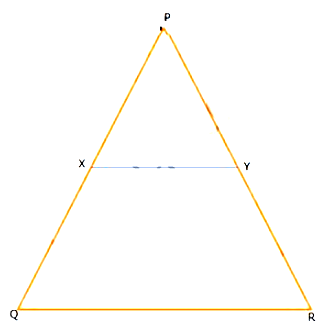
The following figure shows a triangle PQR in which XY is parallel to QR. If $PX : XQ = 1 : 3$ and $QR = 9$ cm. find the length of XY.

Further, if the area of $\triangle PXY =x cm^2$; find, in terms of x the area of:
(i) triangle PQR (ii) trapezium XQRY
Answer
In ΔPXY and ΔPQR, XY is parallel to QR, so corresponding angles are equal.
∠PXY = ∠PQR
∠PYX = ∠PRQ
Hence, ΔPXY ~ ΔPQR (By AA similarity criterion)
$\frac{P X}{P Q}=\frac{X Y}{Q R}$
$\Rightarrow \frac{1}{4}=\frac{ XY }{ QR }( PX : XQ =1: 3 \Rightarrow PX : PQ =1: 4)$
$\Rightarrow \frac{1}{4}=\frac{ XY }{9}$
⇒ XY=2.25 cm
(i) We know that the ratio of areas of two similar triangles is equal to the ratio of the squares of their corresponding sides.
$\frac{A r(\Delta PXY )}{A r(\Delta PQR )}=\left(\frac{ PX }{ PQ }\right)^2$
$\frac{ X }{\operatorname{Ar}(\Delta PQR )}=\left(\frac{1}{4}\right)^2=\frac{1}{16}$
Ar (Δ PQR) = 16x cm2
(ii) Ar (trapezium XQRY) = Ar (ΔPQR) - Ar (ΔPXY)
$= (16x – x) cm^2$
$= 15 \times cm^2$
View full question & answer
Question 64 Marks
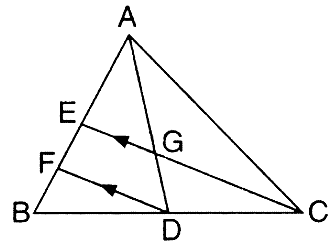
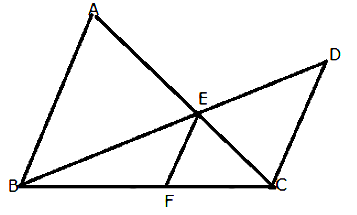
In the following figure, AD and CE are medians of ΔABC. DF is drawn parallel to CE. Prove that :
(i) EF = FB,
(ii) AG : GD = 2 : 1
Answer
(i) In ∆BFD and ∆BEC,
∠BFD = ∠BEC (Corresponding angles)
∠FBD = ∠EBC (Common)
∆BFD ~ ∆BEC (AA Similarity)
$\therefore \frac{B F}{B E}$=$\frac{B D}{B C}$
$\frac{ BF }{ BE }=\frac{1}{2}$ (As $D$ is the mid - point of $BC$ )
BE = 2BF
BF = FE = 2BF
Hence, EF = FB
(ii) In ΔAFD, EG || FD. Using Basic Proportionality theorem,
("AE")/("EF")=("AG")/("GD")........................(1)
Now, AE = EB (as E is the mid-point of AB)
AE = 2EF (Since, EF = FB, by (i))
From (1),
Hence, AG : GD = 2 : 1
View full question & answer
Question 74 Marks
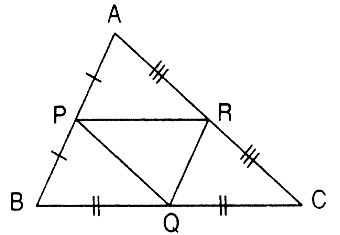
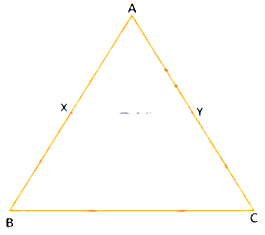
In the given triangle P, Q and R are the mid points of sides AB, BC and AC respectively. Prove that triangle PQR is similar to triangle ABC.
Answer
In ∆ABC, PR || BC. By Basic proportionality theorem,
$\frac{ AP }{ PB }=\frac{ AR }{ RC }$
Also, in ∆PAR and ∆ABC,
∠PAR = ∠BAC (common)
∠APR = ∠ABC (Corresponding angles)
∆PAR ~ ∆BAC(AA similarity)
$\frac{ PR }{ RC }=\frac{ AP }{ AR }$
$\frac{P R}{B C}=\frac{1}{2} \quad(A s P$ is the mid-point of $A B)$
$\frac{ PR }{ BC }=\frac{1}{2} BC$
Similarity, $PQ =\frac{1}{2} AC$
$RQ =\frac{1}{2} AB$
Thus, $\frac{ PR }{ BC }=\frac{ PQ }{ AC }=\frac{ RQ }{ AB }$
⟹ ∆QRP ~ ∆ABC (SSS similarity)
View full question & answer
Question 84 Marks

On a map drawn to a scale of 1 : 2,50,000; a triangular plot of land has the following measurements : AB = 3 cm, BC = 4 cm and ∠ABC = 90°.

Calculate : the actual lengths of AB and BC in km.

Answer
The ratio of the length of two corresponding sides of two similar triangles.
The scale factor is 1 : 2,50,000.
The length of AB on the map = $\frac{1}{2,50,000}$ (the actual length of AB)
$\Rightarrow 3=\frac{1}{2,50,000}$ (the actual length of $A B$ )
the actual length of AB = 3 x 2,50,000
$\Rightarrow$ the actual length of AB = 7,50,000 = 7.5 km
$\Rightarrow$ The length of BC on the map = $\frac{1}{2,50,000}$(the actual length of BC)
$\Rightarrow 4=\frac{1}{2,50,000}$ (the actual length of $B C$ )
$\Rightarrow$ the actual length of BC = 4 x 2,50,000
$\Rightarrow$ the actual length of BC = 1,00,000 = 10 km
View full question & answer
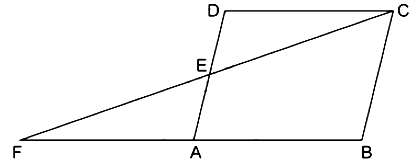
Question 94 Marks
In the given figure, $BC$ is parallel to $DE.$ Area of triangle $ABC = 25 cm^2,$ Area of trapezium $BCED = 24 cm^2$ and $DE = 14cm.$
Calculate the length of $BC.$ Also, find the area of triangle $BCD.$
Answer
In $\triangle ABC$ and $\triangle ADE,$
As BC ∥ DE, corresponding angles are equal
$\angle ABC = \angle ADE$
$\angle ACB = \angle AED$
$\triangle ABC \sim \triangle ADE$
$\therefore \frac{\operatorname{ar}(\triangle A B C)}{\operatorname{ar}(\triangle A D E)}=\frac{(B C)^2}{(D E)^2}$
$\frac{25}{49}=\frac{B C^2}{14^2}$
(ar (∆ADE) = ar(∆ABC) + ar(trapezium BCED))
$B C^2=100$
$B C=10 cm $
In trapezium $BCED,$
Area $=\frac{1}{2}($ Sum of parallel sides $) \times h$
Given : Area of trapezium $BCED =24 cm ^2, BC =10 cm , DE =14 cm$
$\therefore 24=\frac{1}{2}(10+14) \times h$
$\Rightarrow h=\frac{48}{10+14}$
$\Rightarrow h=\frac{48}{24}$
$\Rightarrow h=2$
Area of $\triangle B C D=\frac{1}{2} \times$ base $\times$ height
$=\frac{1}{2} \times BC \times h$
$=\frac{1}{2} \times 10 \times 2$
$\therefore $ Area of $∆BCD = 10 cm^2$
View full question & answer
Question 104 Marks
The given diagram shows two isosceles triangles which are similar also. In the given diagram,
$PQ$ and $BC$ are not parallel; $PC = 4, AQ = 3, QB = 12, BC = 15$ and $AP = PQ$

Calculate:
(i) the length of AP,
(ii) the ratio of the areas of triangle APQ and triangle ABC.
Answer
(i) Given, $\triangle AQP \sim \triangle ACB$
$\Rightarrow \frac{A Q}{A C}=\frac{A P}{A B}$
$\Rightarrow \frac{3}{4+A P}=\frac{A P}{3+12}$
$\Rightarrow A P^2+4 A P-45=0$
$\Rightarrow(A P+9)(A P-5)=0$
$\Longrightarrow AP =5$ units (as length cannot be negative)
(ii) Since, $\triangle AQP \sim \triangle ACB$
$\therefore \frac{\operatorname{ar}(\triangle A P Q)}{\operatorname{ar}(\triangle A C B)}=\frac{P Q^2}{B C^2}$
$\Rightarrow \frac{\operatorname{ar}(\triangle A P Q)}{\operatorname{ar}(\triangle A B C)}=\frac{P Q^2}{B C^2}(P Q=A P)$
$\Rightarrow \frac{\operatorname{ar}(\triangle A P Q)}{\operatorname{ar}(\triangle A B C)}=\left(\frac{5}{15}\right)^2=\frac{1}{9}$
View full question & answer
Question 114 Marks
ABC is a triangle. PQ is a line segment intersecting AB in P and AC in Q such that PQ ∥ BC and divides triangle ABC into two parts equal in area. Find the value of ratio BP : AB.
Answer

From the given information, we have:
$\operatorname{ar}(\triangle A P Q)=\frac{1}{2} \operatorname{ar}(\triangle A B C)$
$\Rightarrow \frac{\operatorname{ar}(\triangle A P Q)}{\operatorname{ar}(\triangle A B C)}=\frac{1}{2}$
$\Rightarrow \frac{A P^2}{A B^2}=\frac{1}{2}$
$\Rightarrow \frac{A P^2}{A B^2}=\frac{1}{\sqrt{2}}$
$\Rightarrow \frac{A B-B P}{A B}=\frac{1}{\sqrt{2}}$
$\Rightarrow 1-\frac{B P}{A B}=\frac{1}{\sqrt{2}}$
$\Rightarrow \frac{B P}{A B}=1-\frac{1}{\sqrt{2}}$
$\Rightarrow \frac{B P}{A B}=\frac{\sqrt{2}-1}{\sqrt{2}}=\frac{2-\sqrt{2}}{2}$
View full question & answer
Question 124 Marks
In the given figure, $AX : XB = 3: 5$

(i) the length of BC, if the length of XY is 18 cm.
(ii) the ratio between the areas of trapezium XBCY and triangle ABC.
Answer
Given,
$\frac{A X}{X B}=\frac{3}{5} \Rightarrow \frac{A X}{A B}=\frac{3}{8}.....(1)$
(i) In $\triangle AXY$ and $\triangle ABC,$
As XY ∥ BC, Corresponding angles are equal
$\angle AXY = ∠ABC$
$\angle AYX = ∠ACB$
$\triangle AXY \sim \triangle ABC$
$\Rightarrow \frac{A X}{A B}=\frac{X Y}{B C}$
$\Rightarrow \frac{3}{8}=\frac{18}{B C}$
$\Rightarrow B C=48 cm $
(ii) $\frac{\text { Area of } \Delta AXY }{\text { Area of } \Delta ABC }=\frac{A X^2}{A B^2}=\frac{9}{64}$
$\frac{\text { Area of } \triangle ABC -\text { Area of } \triangle AXY }{\text { Area of } \Delta ABC }=\frac{64-9}{64}=\frac{55}{64}$
$\frac{\text { Area of trapezium XBCY }}{\text { Area of } \triangle ABC }=\frac{55}{64}$
View full question & answer
Question 134 Marks
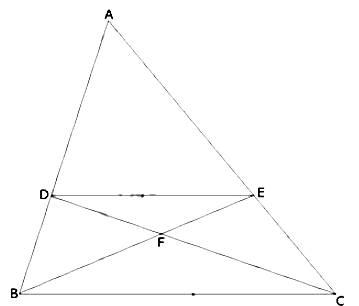
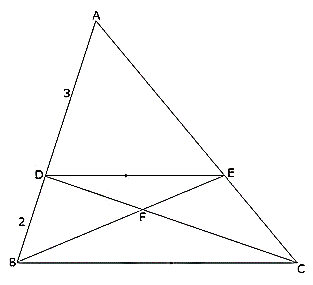
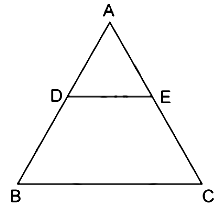
In the given figure, ABC is a triangle. DE is parallel to BC and $\frac{ AD }{ DB }=\frac{3}{2}$

  (i) Determine the ratios } \frac{ AD }{ AB } \text { and } $\frac{ DE }{ BC }$
(ii) Prove that $\triangle DEF$ is similar to $\triangle CBF$ Hence, find $\frac{ EF }{ FB }$.
(iii) What is the ratio of the areas of ∆DEF and ∆BFC.
Answer

(i) Given, DE || BC and $\frac{ AD }{ DB }=\frac{3}{2}$
In ΔADE and ΔABC,
$\angle A = \angle A$ (Corresponding Angles)
$\angle ADE = \angle ABC$ (Corresponding Angles)
$\therefore \triangle ADE ~ \triangle ABC$ (By AA- similarity)
$\frac{A D}{A B}=\frac{A E}{A C}=\frac{D E}{B C}$
Now, $\frac{ AD }{ AB }=\frac{ AD }{ AD + DB }=\frac{3}{3+2}=\frac{3}{5}$
Using (1), we get $\frac{ AD }{ AE }=\frac{3}{5}=\frac{ DE }{ BC }$.
(ii) $\triangle \operatorname{In} D E F$ and $\triangle C B F$,
$\angle FDE =\angle FCB$ (Alternate Angle)
$\angle DFE =\angle BFC$ (Vertically Opposite Angle)
$\therefore \triangle DEF \sim \triangle CBF$ (By AA- similarity)
$ \frac{ EF }{ FB }=\frac{ DE }{ BC }=\frac{3}{5} \text { Using (2) }$
$\frac{ EF }{ FB }=\frac{3}{5} $
(iii) Since the ratio of the areas of two similar triangles is equal to the square of the ratio of the corresponding sides, therefore.
$\frac{\text { Area of } \triangle DFE }{\text { Area of } \triangle CBF }=\frac{( EF )^2}{( FB )^2}=\frac{3^2}{5^2}=\frac{9}{25}$
View full question & answer
Question 144 Marks
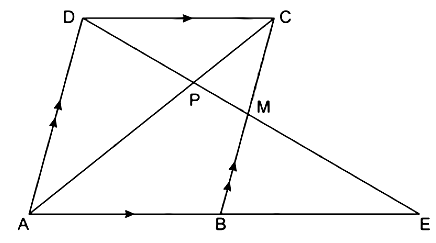
In the following figure, M is mid-point of BC of a parallelogram ABCD. DM intersects the diagonal AC at P and AB produced at E.
Prove that : PE = 2 PD
Answer
In $\triangle BME$ and $\triangle DMC,$
$\angle BME = \angle CMD ......$(vertically opposite angles)
$\angle MCD = \angle MBE ....$(alternate angles)
$BM = BC ......$(M is the mid-point of BC)
So, ΔBME ≅ ΔDMC ....(AAS congruence criterion)
$\Rightarrow$ BE = DC = AB
In ΔDCP and ΔEPA,
$\angle DPC = \angle EPA ...$(vertically opposite angles)
$\angle CDP = \angle AEP ...$(alternate angles)
$\triangle DCP \sim \triangle EAP ...$(AA criterion for similarity)
$\Rightarrow \frac{D C}{E A}=\frac{C P}{A P}=\frac{P D}{E P}$
$\Rightarrow \frac{D C}{E A}=\frac{P D}{P E}$
$\Rightarrow \frac{E A}{D C}=\frac{P E}{P D}$
$\Rightarrow \frac{P E}{P D}=\frac{A B+E A}{D C}$
$\Rightarrow \frac{P E}{P D}=\frac{2 D C}{D C}$
$\Rightarrow PE =2 PD $
View full question & answer
Question 154 Marks
The given figure shows a parallelogram ABCD. E is a point in AD and CE produced meets BA produced at point F. If AE = 4 cm, AF = 8 cm and AB = 12 cm, find the perimeter of the parallelogram ABCD.
Answer
$AF = 8$ cm and $AB = 12\ cm$
So, $FB = 20 cm$
In $\triangle DEC$ and $\triangle EAF$
$\angle DEC = \angle EAF ....$(vertically opposite angles)
$\angle EDC = \angle EAF ....$(alternate angles)
So, $\triangle DEC \sim \triangle AEF ...$(AA criterion for similarity)
$\Rightarrow \frac{D E}{A E}=\frac{E C}{E F}=\frac{D C}{A F}$
$\Rightarrow \frac{D E}{A E}=\frac{D C}{A F}$
$\Rightarrow \frac{D E}{A E}=\frac{A B}{A F}$
$\Rightarrow \frac{D E}{4}=\frac{12}{8}$
$\Rightarrow$DE = 6 cm
So, $AD = AE + ED = 4 + 6 = 10 cm$
Perimeter of the parallelogram $ABCD$
$= AB + BC + CD + AD$
$= 12 + 10 + 12 + 10$
$= 44 cm$
View full question & answer
Question 164 Marks

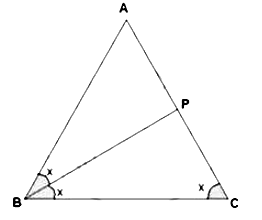
In Δ ABC, angle ABC is equal to twice the angle ACB, and bisector of angle ABC meets the opposite side at point P. Show that : AB x BC = BP x CA

Answer

In ΔABC,
∠ABC = 2∠ACB
Let ∠ACB = x
$\Rightarrow$ ∠ABC = 2∠ACB = 2x
Given BP is bisector of ∠ABC.
Hence ∠ABP = ∠PBC = x
Using the angle bisector theorem,
That is the bisector of an angle divides the side opposite to it in the ratio of other two sides
Hence, CB : BA = CP : PA
Consider ΔABC and ΔAPB,
∠ABC = ∠APB ..(Exterior angle property)
∠BCP = ∠ABP....(Given)
ΔABC and ΔAPB (AA criterion for similarity)
$\frac{C A}{A B}=\frac{B C}{B P} \ldots .$. (corresponding sides of similar triangles are proportional)
$\Rightarrow A B \times B C=B P \times C A$
View full question & answer
Question 174 Marks
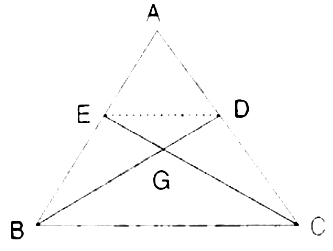
In the figure, given below, the medians BD and CE of a triangle ABC meet at G. Prove that:
(i) Δ EGD ~ ΔCGB and
(ii) BG = 2 GD from (i) above.
Answer
(i) Since, BD and CE are medians
AD = DC
AE = BE
Hence, by converse of Basic Proportionality theorem,
ED || BC
In ΔEGD and ΔCGB,
∠DEG = ∠GCB (alternate angles)
∠EGD = ∠BGC (Vertically opposite angles)
ΔEGD ~ ΔCGB (AA similarity)
(ii) since, ΔEGD ~ ΔCGB
$\frac{G D}{G B}=\frac{E D}{B C}$
In ΔAED and ΔABC,
∠AED = ∠ABC (Corresponding angles)
∠EAD = ∠BAC (Common)
ΔEAD ~ ΔBAC (AA similarity)
$\therefore \triangle E A D \sim \triangle B A C \quad$ (AA similarity)
$\therefore \frac{E D}{B C}=\frac{A E}{A B}=\frac{1}{2}$ (since, $E$ is the mid - point of $AB$ )
$\Rightarrow \frac{E D}{B C}=\frac{1}{2}$
From (1),
$\frac{G D}{G B}=\frac{1}{2}$
GB = 2GD
View full question & answer
Question 184 Marks
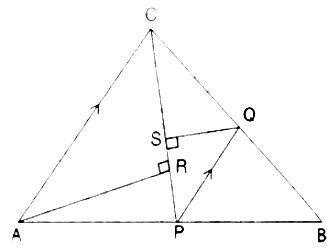
In the figure, given below, $P$ is a point on $AB$ such that $AP : PB = 4 : 3. PQ$ is parallel to $AC.$

(i) Calculate the ratio $PQ : AC,$ giving reason for your answer.
(ii) In triangle $ARC, \angle ARC = 90^\circ.$ Given $QS = 6\ cm,$ calculate the length of $AR.$
Answer
(i) Given, $AP : PB = 4 : 3.$
Since, PQ || AC. Using Basic Proportionality theorem,
$\frac{A P}{P B}=\frac{C Q}{Q B}$
$\Rightarrow \frac{C Q}{Q B}=\frac{4}{3}$
$\Rightarrow \frac{B Q}{B C}=\frac{3}{7}......(1)$
Now, $\angle PQB = \angle ACB$ (Corresponding angles)
$\angle QPB = \angle CAB$ (Corresponding angles)
$\therefore \triangle PBQ \sim \triangle ABC$ (AA similarity)
$\Rightarrow \frac{P Q}{A C}=\frac{B Q}{B C}$
$\Rightarrow \frac{P Q}{A C}=\frac{3}{7} \quad \text { (using (1)) }$
(ii) $\angle ARC = \angle QSP = 90^\circ$
$\angle ACR = \angle SPQ$ (Alternate angles)
$\therefore ∆ARC \sim ∆QSP$ (AA similarity)
$\Rightarrow \frac{A R}{Q S}=\frac{7}{3}$
$\Rightarrow A R=\frac{7 \times 6}{3}=14 cm $
View full question & answer
Question 194 Marks
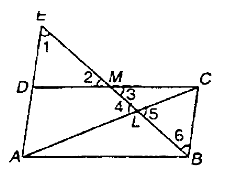
Through the mid-point M of the side CD of a parallelogram ABCD, the line BM is drawn intersecting diagonal AC in L and AD produced in E. Prove that: EL = 2BL.
Answer

∠1 = ∠6 (Alternate interior angles)
∠2 = ∠3 (Vertically opposite angles)
DM = MC (M is the mid-point of CD)
ΔDEM ≅ ΔCBM (AAS Congruence criterion)
So, DE = BC (Corresponding parts of congruent triangles)
Also, AD = BC (Opposite sides of a parallelogram)
AE = AD + DE = 2BC
Now, ∠1 = ∠6 and ∠4 = ∠5
ΔELA ∼ ΔBLC (AA similarity)
$\Rightarrow \frac{E L}{B L}=\frac{E A}{B C}$
$\Rightarrow \frac{E L}{B L}=\frac{2 B C}{B C}=2$
$\Rightarrow$ EL = 2BL
View full question & answer
Question 204 Marks
In the given figure, AB ∥ EF ∥ DC ; AB = 67.5 cm, DC = 40.5 cm and AE = 52.5 cm.

(i) Name the three pairs of similar triangles.
(ii) Find the lengths of EC and EF.
Answer
(i) The three pair of similar triangles are:
∆BEF and ∆BDC
∆CEF and ∆CAB
∆ABE and ∆CDE
(ii) Since, ∆ABE and ∆CDE are similar,
$\frac{A B}{C D}=\frac{A E}{C E}$
$\frac{67.5}{40.5}=\frac{52.5}{C E}$
CE=31.5cm
Since, ∆CEF and ∆CAB are similar,
$\frac{C E}{C A}=\frac{E F}{A B}$
$\frac{31.5}{52.5+31.5}=\frac{E F}{67.5}$
$\frac{31.5}{84}=\frac{E F}{67.5}$
$E F=\frac{2126.25}{84}$
$E F=\frac{405}{16}=25 \frac{5}{16} cm $
View full question & answer
Question 214 Marks
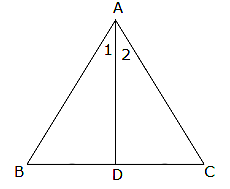
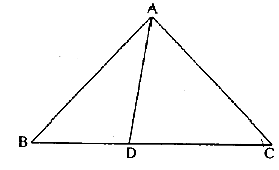
In triangle $ABC, AD$ is perpendicular to side $BC$ and $AD^2 = BD \times DC$.
Show that angle $BAC = 90°$
Answer

Given $AD^2 = BD \times DC$
$\frac{A D}{D C}=\frac{B D}{A D}$
∠ADB = ∠ADC = 90°
∴ ∆DBA ~ ∆DAC (SAS similarity)
So, these two triangles will be equiangular.
∴ ∠1 = ∠C and ∠2 = ∠B
∠1 + ∠2 = ∠B + ∠C
∠A = ∠B + ∠C ...(i)
By angle sum property,
∠A + ∠B + ∠C = 180°
∠A + ∠A = 180° ...(From (i) we get)
2∠A = 180°
∠A = ∠BAC = 90°
View full question & answer
Question 224 Marks
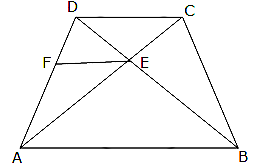
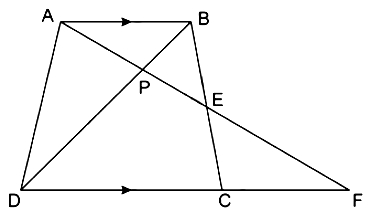
In quadrilateral ABCD, diagonals AC and BD intersect at point E such that
AE: EC = BE: ED
Show that ABCD is a trapezium.
Answer
Given, AE : EC = BE : ED
Draw EF || AB

In ∆ABD, EF || AB
Using Basic Proportionality theorem,
$\frac{D E}{F A}=\frac{D E}{E B}$
But, given $\frac{D E}{E B}=\frac{C E}{E A}$
$\therefore \frac{D F}{F A}=\frac{C E}{E A}$
Thus, in ∆DCA, E and F are points on CA and DA respectively such that $\frac{D F}{F A}=\frac{C E}{E A}$
Thus, by converse of Basic proportionality theorem, FE || DC.
But, FE || AB.
Hence, AB || DC.
Thus, ABCD is a trapezium.
View full question & answer
Question 234 Marks
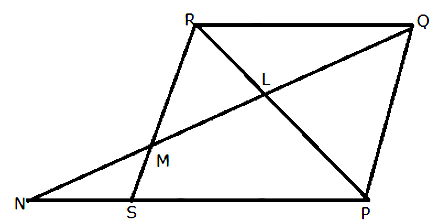
In the figure, PQRS is a parallelogram with PQ = 16 cm and QR = 10cm, L is a point on PR
such that RL: LP = 2: 3. QL produced meets RS at M and PS produced at N.

Find the lengths of PN and RM.
Answer
In ∆RLQ and ∆PLN,
∠RLQ = ∠PLN (Vertically opposite angles)
∠LRQ = ∠LPN (Alternate angles)
∆RLQ ~ ∆PLN (AA Similarity)
$\therefore \frac{R L}{L P}=\frac{R Q}{P N}$
$\frac{2}{3}=\frac{10}{P N}$
PN=15 cm
In ∆RLM and ∆PLQ
∠RLM = ∠PLQ (Vertically opposite angles)
∠LRM= ∠LPQ (Alternate angles)
∆RLM ~ ∆PLQ (AA Similarity)
$\therefore \frac{ RM }{ PQ }=\frac{ RL }{ LP }$
$\frac{ RM }{16}=\frac{2}{3}$
$RM =\frac{32}{3}=10 \frac{2}{3} cm $
View full question & answer
Question 244 Marks
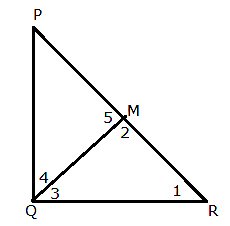
In $\triangle \mathrm{PQR}, \angle \mathrm{Q}=90^{\circ}$ and QM is perpendicular to PR . Prove that:
(i) $\mathrm{PQ}^2=\mathrm{PM} \times \mathrm{PR}$ (ii) $\mathrm{QR}^2=\mathrm{PR} \times \mathrm{MR}$
(iii) $P Q^2+Q R^2=P R^2$
Answer

(i) In ∆PQM and ∆PQR,
∠PMQ = ∠PQR = 90°
∠QPM = ∠RPQ (Common)
∴∆PQM ~ ∆PRQ (By AA Similarity)
$\frac{P Q}{P R}=\frac{M R}{P Q}$
$\Rightarrow PQ ^2= PM \times PR$
(ii) In ∆QMR and ∆PQR,
∠QMR = ∠PQR = 90°
∠QRM = ∠QRP (Common)
∴ ∠QRM ~ ∠PQR (By AA similarity)
$\therefore \frac{ QR }{ PR }=\frac{ MR }{ QR }$
$\Rightarrow QR ^2= PR \times MR $
(iii) Adding the relations obtained in (i) and (ii), we get,
$ PQ ^2+ QR ^2= PM \times PR + PR \times MR$
$= PR ( PM + MR )$
$= PR \times PR$
$= PR ^2$
View full question & answer
Question 254 Marks
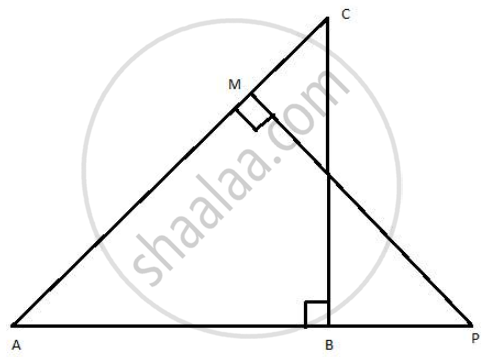
In the given figure,
$\triangle ABC$ and $\triangle AMP$ are right-angled at $B$ and $M$ respectively.
Given $AC = 10 cm, AP = 15 cm$ and $PM = 12\ cm.$
(i) Prove $\triangle ABC \sim \triangle AMP$
(ii) Find $AB$ and $BC$

Answer
In $\triangle ABC$ and $\triangle AMP,$
$\text { i) } \angle BAC =\angle PAM  {(\text { Common })}$
$\angle ABC =\angle PMA  {\left(\text { Each }=90^{\circ}\right)}$
$\therefore \triangle ABC \sim \triangle AMP ...$ (by AA similarity)
ii) $AM =\sqrt{ AP ^2- PM ^2}=\sqrt{15^2-12^2}=9$
Since $\triangle  ABC − \triangle AMP,$
$\frac{A B}{A M}=\frac{B C}{P M}=\frac{A C}{A P}$
$\Rightarrow \frac{A B}{A M}=\frac{B C}{P M}=\frac{A C}{A P}$
$\Rightarrow \frac{A B}{9}=\frac{B C}{12}=\frac{10}{15}$
From this we can write,
$\frac{ AB }{9}=\frac{10}{15}$
$\Rightarrow AB =\frac{10 \times 9}{15}=6$
$\frac{ BC }{12}=\frac{10}{15}$
$\Rightarrow BC =8 cm $
View full question & answer
Question 264 Marks
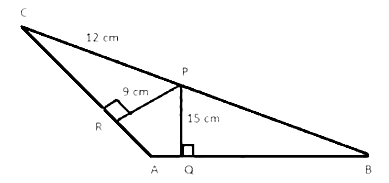
Angle $BAC$ of triangle $ABC$ is obtuse and $AB = AC. P$ is a point in $BC$ such that $PC = 12 cm. PQ$ and $PR$ are perpendiculars to sides $AB$ and $AC$ respectively. If $PQ = 15 cm$ and $PR = 9 cm;$ find the length of $PB.$
Answer

In $\triangle ABC,$
$AC = AB ...$(Given)
$\Rightarrow \angle ABC = \angle ACB ....$(Angles opposite equal sides are equal)
In $\triangle PRC$ and $\triangle PQB,$
$\angle ABC = \angle ACB$
$\angle PRC = \angle PQB ...$ (BOth are right angles)
$\Rightarrow \triangle PRC \sim \triangle PQB ...$(AA criterion for similarity)
$\Rightarrow \frac{P R}{P Q}=\frac{R C}{Q B}=\frac{P C}{P B}$
$\Rightarrow \frac{P R}{P Q}=\frac{P C}{P B}$
$\Rightarrow \frac{9}{15}=\frac{12}{P B}$
$\Rightarrow P B=20 cm $
View full question & answer
Question 274 Marks
In the following figure,$\text{ ABCD}$ to a trapezium with $AB \| DC$. If $AB = 9 \ cm, DC = 18 \ cm, CF = 13.5,cm, AP = 6 \ cm$ and $BE = 15 \ cm, $ Calculate : $PE$
​​​​​​​
Answer
Given : $\text{ABCD}$ is trapezium $, AB \| DC$
$AB = 9 \ cm, DC = 18 \ cm, CF = 13.5 \ cm, AP = 6 \ cm, BE = 15 \ cm$
Consider $\triangle APB$ and $\triangle FPD,$
$\Rightarrow \angle APB = \angle FPD...\ ($vertically opposite angles$)$
$\Rightarrow \angle BAP = \angle DFP...($since $AB \| DF)$
$\triangle APB ~ \triangle FPD...\ (AA$ criterion for Similarity$)$
$\Rightarrow \frac{ AP }{ FP }=\frac{ AB }{ FD }$
$\Rightarrow \frac{6}{ FP }=\frac{9}{31.5}$
$\Rightarrow FP = 21 \ cm$
So $, AF = AP + PF = 6 + 21 = 27 \ cm$
In $\triangle AEB$ and $\triangle FEC,$
$\angle AEB = \angle FEC...($vertically opposite angles$)$
$\angle BAF = \angle CFE...($Since $AB \| DC)$
$\triangle AEB ~ \triangle FEC...\ (AA$ criterion for Similarity$)$
$\Rightarrow \frac{ AF }{ FE }=\frac{ AB }{ FC }$
$\Rightarrow \frac{ AP + PE }{ FE }=\frac{9}{13.5}$
$\Rightarrow \frac{ AP + PE }{ FE }=\frac{90}{135}$
$\Rightarrow \frac{6+ PE }{ FE }=\frac{30}{45}=\frac{2}{3}$
$\Rightarrow 3(6+ PE )=2 FE$
$\Rightarrow \frac{3(6+ PE )}{2}= FE $
$\Rightarrow \frac{3(6+ PE )}{2}= FE$
Now $, PF = PE + EF$
$21= PE +\frac{3(6+ PE )}{2}$
$21=\frac{2 PE +18+3 PE }{2}$
$42=5 PE +18$
$42-18=5 PE$
$24=5 PE$
$\frac{24}{5}= PE$
$PE =4.8$
View full question & answer
Question 284 Marks
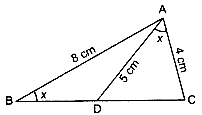
In $\triangle ABC, \angle ABC = \angle DAC. AB = 8 \ cm, AC = 4 \ cm, AD = 5 \ cm.$
$(1)$ Prove that $\triangle ACD$ is similar to $\triangle BCA$.
$(2)$ Find $BC$ and $CD$
$(3)$ Find area of $\triangle ACD$: area of $\triangle BCA$
​​​​​​​
Answer
$\angle ABC = \angle DAC = x\ ($say$)$

$AB = 8 \ cm,$
$AC = 4 \ cm,$
$AD = 5 \ cm.$
$(i)$ In $\triangle ACD$ and $\triangle BCA$
$\angle ABC = \angle DAC ... \ ($Given$)$
$\angle ACD = \angle BCA ...\ ($Common angles$)$
$\Rightarrow \triangle ACD \sim \triangle BCA ...\ (AA$ criterion for similarity$)\ \ (i)$.
Hence $\triangle ACD$ is similar to $\triangle BCA$.
$(ii)$ In $\triangle ACD$ and $\triangle BCA$
$\triangle ACD \sim \triangle BCA ...\ ($from $(i))$
$\frac{ AC }{ BC }=\frac{ CD }{ CA }=\frac{ AD }{ BA }$
$\Rightarrow \frac{4}{ BC }=\frac{ CD }{4}=\frac{5}{8}$
$\Rightarrow \frac{4}{ BC }=\frac{5}{8}$
$\Rightarrow BC =\frac{8 \times 4}{5}=\frac{32}{5}$
$=6.4 \ cm .$
and $ \frac{C D}{4}=\frac{5}{8}$
$\Rightarrow C D=\frac{5 \times 4}{8}$
$\Rightarrow C D=2.5 \ cm .$
$(iii) $ In $\triangle ACD$ and $\triangle BCA$
$\triangle ACD \sim \triangle BCA ...\ ($from $(i))$
$\frac{\text { Area of } \triangle ACD }{\text { Area of } \triangle ABC }=\left(\frac{ AC }{ AB }\right)^2$
$\Rightarrow \frac{\text { Area of } \triangle ACD }{\text { Area of } \triangle ABC }=\frac{5^2}{8^2}=\frac{25}{64}$
View full question & answer
Question 294 Marks
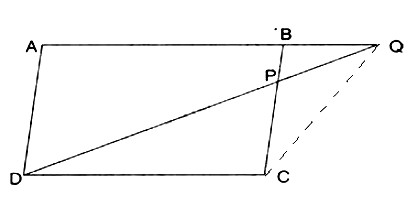
In the figure, given below, $ \text{ABCD}$ is a parallelogram. $P$ is a point on $BC$ such that $BP : PC = 1:$
$2. \ DP$ produced meets $AB$ produces at $Q.$ Given the area of triangle $ \text{CPQ} = 20 \ cm^2$

Calculate:
$(i)$ area of triangle $ \text{CDP,}$
$(ii)$ area of parallelogram $ \text{ABCD.}$
Answer
$(i)$ In $\triangle BPQ$ and $\triangle CPD$
$\angle BPQ = \angle CPD ($Vertically opposite angles$)$
$\angle BQP = \angle PDC ($Alternate angles$)$
$\triangle BPQ ~ \triangle CPD (AA$ similarity$)$
$\therefore \frac{B P}{P C}=\frac{P Q}{P D}=\frac{B Q}{C D}=\frac{1}{2}\left(\because \frac{B P}{P C}=\frac{1}{2}\right)$
Also, $\frac{\operatorname{ar}(\triangle B P Q)}{\operatorname{ar}(\triangle C P D)}=\left(\frac{B P}{P C}\right)^2$
$\Rightarrow \frac{10}{\operatorname{ar}(\triangle C P D)}=\frac{1}{4}\left[ar(\triangle B P Q)=\frac{1}{2} \times \operatorname{ar}(\triangle C P Q), \operatorname{ar}(C P Q)=20\right]$
$\Rightarrow \operatorname{ar}(\triangle C P D)=40 \ cm ^2$
$(ii)$ In $\triangle BAP$ and $\triangle AQD$
As $ \text{BP || AD,}$ corresponding angles are equal
$\angle QBP = \angle QAD$
$\angle BQP = \angle AQD ($Common$)$
$\triangle BQP ~ \triangle AQD (AA$ similarity$)$
$\therefore \frac{A Q}{B Q}=\frac{Q D}{Q P}=\frac{A D}{B P}=3\left(\because \frac{B P}{P C}=\frac{P Q}{P D}=\frac{1}{2} \Rightarrow \frac{P Q}{Q D}=\frac{1}{3}\right)$
$\text { Also, } \frac{\operatorname{ar}(\triangle A Q D)}{\operatorname{ar}(\triangle B Q D)}=\left(\frac{A Q}{B Q}\right)^2$
$\Rightarrow \frac{\operatorname{ar}(\triangle A Q D)}{10}=9$
$\Rightarrow \operatorname{ar}(\triangle A Q D)=90 \ cm ^2$
$\therefore \operatorname{ar}(A D P B)=\operatorname{ar}(\triangle A Q D)-\operatorname{ar}(\triangle B Q P)=90 \ cm ^2-10 \ cm ^2=80 \ cm ^2$
$\operatorname{ar}(A B C D)=\operatorname{ar}(\triangle C D P)+\operatorname{ar}(A D P B)=40 \ cm ^2+80 \ cm ^2=120 \ cm ^2$
View full question & answer
Question 304 Marks
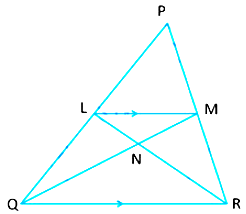
In the given triangle $\text{PQR}, LM$ is parallel to $QR$ and $PM : MR = 3: 4$

Calculate the value of ratio:
$(1) \frac{P L}{P Q}$ and then $\frac{L M}{Q R}$
$(2) \frac{\text { Area of } \Delta LMN }{\text { Area of } \Delta MNR }$
$(3) \frac{\text { Area of } \Delta LQM }{\text { Area of } \Delta LQN }$
Answer
$(1) $ In $\triangle PLM$ and $\triangle PQR,$
As $LM \| QR,$ Corresponding angles are equal
$\angle PLM = \angle PQR$
$\angle PML = \angle PRQ$
$\triangle PLM ~ \triangle PQR$
$\Rightarrow \frac{3}{7}=\frac{L M}{Q R}\left(\because \frac{P M}{M R}=\frac{3}{4} \Rightarrow \frac{P M}{P R}=\frac{3}{7}\right)$
Also, by using basic proportionality theorem, we have:
$\frac{P L}{L Q}=\frac{P M}{M R}=\frac{3}{4}$
$\Rightarrow \frac{L Q}{P L}=\frac{4}{3}$
$\Rightarrow 1+\frac{L Q}{P L}=1+\frac{4}{3}$
$\Rightarrow \frac{P L+L Q}{P L}=\frac{3+4}{3}$
$\Rightarrow \frac{P Q}{P L}=\frac{7}{3}$
$\Rightarrow \frac{P L}{P Q}=\frac{3}{7}$
$(ii)$ Since $\triangle LMN$ and $\triangle MNR$ have common vertex at $M$ and their bases $LN$ and $NR$ are along the same straight line
$\therefore \frac{\text { Area of } \Delta LMN }{\text { Area of } \Delta MNR }=\frac{L N}{N R}$
Now, in $\triangle LNM$ and $\triangle RNQ$
$\angle NLM = \angle NRQ\ ($Alternate angles$)$
$\angle LMN = \angle NQR \ ($Alternate angles$)$
$\triangle LMN ~ \triangle RNQ \ (AA$ Similarity$)$
$\therefore \frac{M N}{Q N}=\frac{L N}{N R}=\frac{L M}{Q R}=\frac{3}{7}$
$\therefore \frac{\text { Area of } \Delta LMN }{\text { Area of } \Delta MNR }=\frac{L N}{N R}=\frac{3}{7}$
$(iii)$ Since $\triangle LQM$ and $\triangle LQN$ have common vertex at $L$ and their bases $QM$ and $QN$ are along the same straight line
$\frac{\text { Area of } \triangle LQM }{\text { Area of } \Delta MNR }=\frac{Q M}{Q N}=\frac{10}{7}$
$\left(\therefore \frac{N M}{Q N}=\frac{3}{7} \Rightarrow \frac{Q M}{Q N}=\frac{10}{7}\right)$
View full question & answer
Question 314 Marks
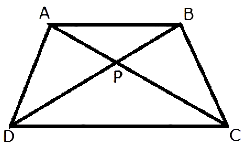
The given figure shows a trapezium in which $AB$ is parallel to $DC$ and diagonals $AC$ and $BD$
intersect at point $P$. If $AP : CP = 3: 5,$

Find:
$(1) \triangle APB : \triangle CPB$
$(2 ) \triangle DPC : \triangle APB$
$(3) \triangle ADP : \triangle APB $
​​​​​​​$(4) \triangle APB : \triangle ADB$
Answer
$(i)$ Since $\triangle APB$ and $\triangle CPB$ have common vertex at $B$ and their bases $AP$ and $PC$ are along the
same straight line
$\therefore \frac{\operatorname{ar}(\triangle A P B)}{\operatorname{ar}(\triangle C P B)}=\frac{A P}{P C}=\frac{3}{5}$
$(ii)$ Since $\triangle DPC$ and $\triangle BPA$ are similar
$\therefore \frac{\operatorname{ar}(\triangle D P C)}{\operatorname{ar}(\triangle C P B)}=\left(\frac{P C}{A P}\right)^2=\left(\frac{5}{3}\right)^2=\frac{25}{9}$
$(iii)$ Since $\triangle ADP$ and $\triangle APB$ have common vertex at $A$ and their bases $DP$ and $PB$ are along the same straight line
$\left.\therefore \frac{\operatorname{ar}(\triangle A D P)}{\operatorname{ar}(\triangle A P B)}=\frac{D P}{P B}=\frac{5}{3}\right)^{\prime}$
$\left(\triangle A P B{\sim} \triangle C P D \Rightarrow \frac{A P}{P C}=\frac{B P}{P D}=\frac{3}{5}\right)$
$(iv)$ Since $\triangle APB$ and $\triangle ADB$ have common vertex at $A$ and their bases $BP$ and $BD$ are along the same straight line.
$\therefore \frac{\operatorname{ar}(\triangle A P B)}{\operatorname{ar}(\triangle A D B)}=\frac{P B}{B D}=\frac{3}{8}$
$\left(\triangle A P B \sim \triangle C P D \Rightarrow \frac{A P}{P C}=\frac{B P}{P D}=\frac{3}{5} \Rightarrow \frac{B P}{B D}=\frac{3}{8}\right)$
View full question & answer
Question 324 Marks
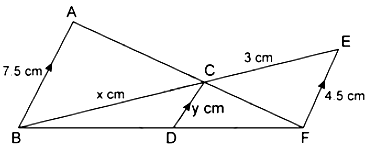
In the figure, given below, $AB, CD$ and $EF$ are parallel lines. Given $AB = 7.5 \ cm, DC = y \ cm, EF = 4.5 \ cm, BC = x \ cm $ and $CE = 3. \ cm,$ calculate the values of $x$ and $y.$
​​​​​​​
Answer
In $\triangle BEF, \text{DC || EF}$
$\Rightarrow \frac{B D}{D F}=\frac{B C}{C E}$
$\Rightarrow \frac{B D}{D F}=\frac{ x }{3}$
So, $BD = x$ and $DF = 3$
In $\triangle AFB, \text{DC || AB.}$
$\Rightarrow \frac{F D}{C D}=\frac{F B}{A B}$
$\Rightarrow \frac{F D}{C D}=\frac{F D+D B}{A B}$
$\Rightarrow \frac{3}{y}=\frac{ x +3}{7.5} \ldots..(i)$
In $\triangle BEF, \text{DC || EF.}$
$\Rightarrow \frac{B C}{C D}=\frac{B E}{E F}$
$\Rightarrow \frac{B C}{C D}=\frac{B C+C E}{E F}$
$\Rightarrow \frac{ x }{ y }=\frac{ x +3}{4.5}$
$\Rightarrow y=\frac{4.5 x }{ x +3} \ldots . . \text { (ii) }$
Substituting $(ii)$ in $(i),$ we get
$\frac{3}{\frac{4.5 x}{x+3}}=\frac{x+3}{7.5}$
$\Rightarrow \frac{3 x+9}{4.5 x}=\frac{x+3}{7.5}$
$\Rightarrow 22.5x + 67.5 = 4.5x^{2 }+ 13.5x$
$\Rightarrow 4.5x^{2 }+ 13.5x - 22.5x - 67.5 = 0$
$\Rightarrow x^{2 }- 2x - 15 = 0$
$\Rightarrow (x - 5)(x + 3) = 0$
So, $x = 5$ and $x = -3$
Since side of a triangle cannot be negative, $x = 5$
Substituting this value in $(ii),$ we get
$y=\frac{4.5(5)}{x+3}=2.8125$
Hence, $x = 5$ and $y = 2.8125$
View full question & answer
Question 334 Marks
In the given figure $, \triangle ABC ~ \triangle ADE.$ If $AE: EC = 4 : 7$ and $DE = 6.6 \ cm,$ find $BC$. If $'x\ '$ be the length of the perpendicular from $A$ to $DE,$ find the length of perpendicular from $A$ to $BC$ in terms of $'x\ '$.
Answer

$\triangle ABC \sim \triangle ADE,$
$\Rightarrow \frac{A E}{A C}=\frac{D E}{B C}$
$\Rightarrow \frac{4}{11}=\frac{6.6}{B C}$
$\Rightarrow B C=\frac{11 \times 6.6}{4}=18.15 \ cm $
Given that $\triangle ABC \sim \triangle ADE$
$\angle ABC = \angle ADE$ and $\angle ACB = \angle AED$
So $, DE \| BC$
Also, $\frac{A B}{A D}=\frac{A C}{A E}=\frac{11}{4} \ldots .\left(\right.$ Since $\left.\frac{A E}{E C}=\frac{4}{7}\right)$
In $\triangle ADP$ and $\triangle ABQ,$
$\angle ADP = \angle ABQ .....($Since $DP \| BQ)$
$\angle APD = \angle AQB ....($Since $ DP \| BQ)$
So, $\triangle ADP \sim \triangle ABQ ......\ (AA$ Criterion for similarity$)$
$\Rightarrow \frac{A D}{A B}=\frac{A P}{A Q}$
$\Rightarrow \frac{4}{11}=\frac{ x }{A Q}$
$\Rightarrow A Q=\frac{11}{4} x $
View full question & answer
Question 344 Marks
In the given figure $, DE \| BC, AE = 15 \ cm, EC = 9 \ cm, NC = 6 \ cm $ and $BN = 24 \ cm.$
Find lengths of $ME$ and $DM$.
Answer
In $\triangle AME$ and $\triangle ANC,$
$\angle AME = \angle ANC ......\ ($Since $DE \| BC$ that is $, ME \| NC)$
$\angle MAE = \angle NAC....\ ($common angle$)$
$\Rightarrow \triangle AME$ and $\triangle ANC ....(AA$ criterion for similarity$)$
$\Rightarrow \frac{M E}{N C}=\frac{A E}{A C}$
$\Rightarrow \frac{M E}{6}=\frac{15}{24}$
$\Rightarrow ME = 3.75 \ cm$
In $\triangle ADE$ and $\triangle ABN,$
$\angle ADE = \angle ABC ......\ ($Since $DE \| BC$ that is $, ME || NC)$
$\angle AED = \angle ACB....\ ($Since $DE \| BC)$
$\Rightarrow \triangle ADE$ and $\triangle ABC ....\ (AA$ criterion for similarity$)$
$\Rightarrow \frac{A D}{A B}=\frac{A E}{A C}=\frac{15}{24} \ldots \ldots (I)$
In $\triangle ADM$ and $\triangle ABN,$
$\angle ADM = \angle ABN ......\ ($Since $DE \| BC$ that is $, ME || NC)$
$\angle DAM = \angle BAN....\ ($common angle$)$
$\Rightarrow \triangle ADM$ and $\triangle ABN ....\ (AA$ criterion for similarity$)$
$\Rightarrow \frac{D M}{B N}=\frac{A D}{A B}=\frac{15}{24} \ldots . . . ($from $(i)$
$\Rightarrow \frac{D M}{24}=\frac{15}{24}$
$\Rightarrow DM = 15 \ cm$
View full question & answer
Question 354 Marks
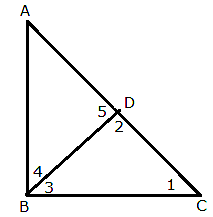
In $ \triangle ABC, \angle B = 90^\circ $ and $BD \perp AC$.
$(i)$ If $CD = 10 \ cm$ and $BD = 8 \ cm$; find $AD$.
$(ii)$ IF $AC = 18 \ cm$ and $AD = 6\ cm$ ; find $BD$.
$(iii)$ If $AC = 9 \ cm$ and $AB = 7\ cm$ ; find $AD$.
Answer

$(i)$ In $\triangle CDB,$
$\angle 1 + \angle 2 + \angle 3 = 180^\circ$
$\angle 1 + \angle 3 = 90^\circ ..... (1)\ ($Since $, \angle 2 = 90^\circ )$
$\angle 3 + \angle 4 = 90^\circ .....(2)\ ($Since $, \angle ABC = 90^\circ )$
From $(1)$ and $(2),$
$\angle 1 + \angle 3 = \angle 3 + \angle 4$
$\angle 1 = \angle 4$
Also $, \angle 2 = \angle 5 = 90^\circ$
$\therefore \triangle CDB ~ \triangle BDA \ ($By $AA$ similarity$)$
$\Rightarrow \frac{C D}{B D}=\frac{B D}{A D}$
$\Rightarrow B D^2=A D \times C D$
$\Rightarrow(8)^2=A D \times 10$
$\Rightarrow A D=6.4$
Hence $, AD= 6.4\ cm$
$(ii)$ Also, by similarity, we have:
$\frac{B D}{D A}=\frac{C D}{B D}$
$B D^2=6 \times(18-6)$
$B D^2=72$
Hence $, BD = 8.5 \ cm$
$(iii)$ Clearly $, \triangle ADB ~ \triangle ABC$
$\therefore \frac{A D}{A B}=\frac{A B}{A C}$
$A D=\frac{7 \times 7}{9}=\frac{49}{9}=5 \frac{4}{9}$
Hence $,  A D=5 \frac{4}{9} \ cm $
View full question & answer
[4 marks sum] - Mathematics STD 10 Questions - Vidyadip