Questions

[5 marks sum]

🎯

Test yourself on this topic

9 questions · timed · auto-graded

Question 15 Marks
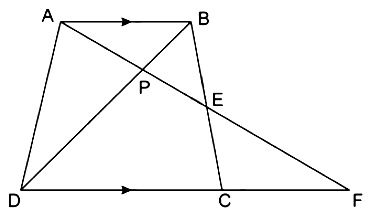
In the following figure, ABCD to a trapezium with AB ‖ DC. If AB = 9 cm, DC = 18 cm, CF = 13.5,cm, AP = 6 cm and BE = 15 cm, Calculate: PE
Answer
Given: ABCD is trapezium, AB || DC
AB = 9 cm, DC = 18 cm, CF = 13.5 cm, AP = 6 cm, BE = 15 cm
Consider ΔAPB and ΔFPD,
$\Rightarrow$ ∠APB = ∠FPD...(vertically opposite angles)
$\Rightarrow$ ∠BAP = ∠DFP...(since AB || DF)
ΔAPB ~ ΔFPD...(AA criterion for Similarity)
$\Rightarrow \frac{ AP }{ FP }=\frac{ AB }{ FD }$
$\Rightarrow \frac{6}{ FP }=\frac{9}{31.5}$
$\Rightarrow$ FP = 21 cm
So, AF = AP + PF = 6 + 21 = 27 cm
In ΔAEB and ΔFEC,
∠AEB = ∠FEC...(vertically opposite angles)
∠BAF = ∠CFE...(Since AB || DC)
ΔAEB ~ ΔFEC...(AA criterion for Similarity)
$\Rightarrow \frac{ AF }{ FE }=\frac{ AB }{ FC }$
$\Rightarrow \frac{ AP + PE }{ FE }=\frac{9}{13.5}$
$\Rightarrow \frac{ AP + PE }{ FE }=\frac{90}{135}$
$\Rightarrow \frac{6+ PE }{ FE }=\frac{30}{45}=\frac{2}{3}$
$\Rightarrow 3(6+ PE )=2 FE$
$\Rightarrow \frac{3(6+ PE )}{2}= FE $
$\Rightarrow \frac{3(6+ PE )}{2}= FE$
$\text { Now }, PF = PE + EF$
$21= PE +\frac{3(6+ PE )}{2}$
$21=\frac{2 PE +18+3 PE }{2}$
$42=5 PE +18$
$42-18=5 PE$
$24=5 PE$
$\frac{24}{5}= PE$
$PE =4.8$
View full question & answer
Question 25 Marks
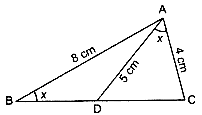
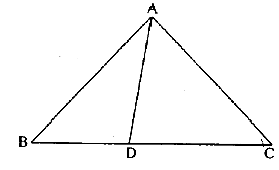
In Δ ABC, ∠ABC = ∠DAC. AB = 8 cm, AC = 4 cm, AD = 5 cm.
1) Prove that ΔACD is similar to ΔBCA.
2) Find BC and CD
3) Find area of ΔACD: area of ΔBCA
Answer
∠ABC = ∠DAC = x(say)

AB = 8 cm,
AC = 4 cm,
AD = 5 cm.
(i) In ΔACD and ΔBCA
∠ABC = ∠DAC ...(Given)
∠ACD = ∠BCA ...(Common angles)
$\Rightarrow$ ΔACD ∼ ΔBCA ...(AA criterion for similarity)(i).
Hence ΔACD is similar to ΔBCA.
(ii) In ΔACD and ΔBCA
ΔACD ∼ ΔBCA ...(from (i))
$\frac{ AC }{ BC }=\frac{ CD }{ CA }=\frac{ AD }{ BA }$
$\Rightarrow \frac{4}{ BC }=\frac{ CD }{4}=\frac{5}{8}$
$\Rightarrow \frac{4}{ BC }=\frac{5}{8}$
$\Rightarrow BC =\frac{8 \times 4}{5}=\frac{32}{5}$
$=6.4 cm .$
$\text { and } \frac{C D}{4}=\frac{5}{8}$
$\Rightarrow C D=\frac{5 \times 4}{8}$
$\Rightarrow C D=2.5 cm .$
(iii) In ΔACD and ΔBCA
ΔACD ∼ ΔBCA ...(from (i))
$\frac{\text { Area of } \triangle ACD }{\text { Area of } \triangle ABC }=\left(\frac{ AC }{ AB }\right)^2$
$\Rightarrow \frac{\text { Area of } \triangle ACD }{\text { Area of } \triangle ABC }=\frac{5^2}{8^2}=\frac{25}{64}$
View full question & answer
Question 35 Marks
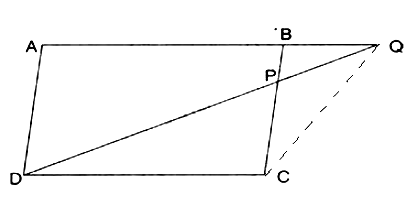
In the figure, given below, $ABCD$ is a parallelogram. $P$ is a point on $BC$ such that $BP : PC = 1:$
2. $DP$ produced meets $AB$ produces at $Q.$ Given the area of triangle $CPQ = 20 cm^2$​​​​​​​

Calculate:
(i) area of triangle $CDP,$
(ii) area of parallelogram $ABCD.$
Answer
(i) In $\triangle BPQ$ and $\triangle CPD$
$\angle BPQ = \angle CPD$ (Vertically opposite angles)
$\angle BQP = \angle PDC$ (Alternate angles)
$\triangle BPQ \sim \triangle CPD$ (AA similarity)
$\therefore \frac{B P}{P C}=\frac{P Q}{P D}=\frac{B Q}{C D}=\frac{1}{2}\left(\because \frac{B P}{P C}=\frac{1}{2}\right)$
Also, $\frac{\operatorname{ar}(\triangle B P Q)}{\operatorname{ar}(\triangle C P D)}=\left(\frac{B P}{P C}\right)^2$
$\Rightarrow \frac{10}{\operatorname{ar}(\triangle C P D)}=\frac{1}{4}\left[ar(\triangle B P Q)=\frac{1}{2} \times \operatorname{ar}(\triangle C P Q), \operatorname{ar}(C P Q)=20\right]$
$\Rightarrow \operatorname{ar}(\triangle C P D)=40 cm ^2$
(ii) In $\triangle BAP$ and $\triangle AQD$
As BP ∥ AD, corresponding angles are equal
$\angle QBP = \angle QAD$
$\angle BQP = \angle AQD$ (Common)
$\triangle BQP \sim ∆AQD$ (AA similarity)
$\therefore \frac{A Q}{B Q}=\frac{Q D}{Q P}=\frac{A D}{B P}=3\left(\because \frac{B P}{P C}=\frac{P Q}{P D}=\frac{1}{2} \Rightarrow \frac{P Q}{Q D}=\frac{1}{3}\right)$
$\text { Also, } \frac{\operatorname{ar}(\triangle A Q D)}{\operatorname{ar}(\triangle B Q D)}=\left(\frac{A Q}{B Q}\right)^2$
$\Rightarrow \frac{\operatorname{ar}(\triangle A Q D)}{10}=9$
$\Rightarrow \operatorname{ar}(\triangle A Q D)=90 cm ^2$
$\therefore \operatorname{ar}(A D P B)=\operatorname{ar}(\triangle A Q D)-\operatorname{ar}(\triangle B Q P)=90 cm ^2-10 cm ^2=80 cm ^2$
$\operatorname{ar}(A B C D)=\operatorname{ar}(\triangle C D P)+\operatorname{ar}(A D P B)=40 cm ^2+80 cm ^2=120 cm ^2$
View full question & answer
Question 45 Marks
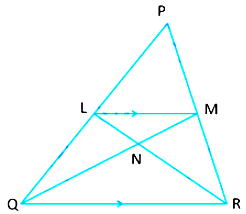
In the given triangle PQR, LM is parallel to QR and PM : MR = 3: 4

Calculate the value of ratio:
1) $\frac{P L}{P Q}$ and then $\frac{L M}{Q R}$
2) $\frac{\text { Area of } \Delta LMN }{\text { Area of } \Delta MNR }$
3) $\frac{\text { Area of } \Delta LQM }{\text { Area of } \Delta LQN }$
Answer
1) In ∆PLM and ∆PQR,
As LM ∥ QR, Corresponding angles are equal
∠PLM = ∠PQR
∠PML = ∠PRQ
∆PLM ~ ∆PQR
$\Rightarrow \frac{3}{7}=\frac{L M}{Q R}\left(\because \frac{P M}{M R}=\frac{3}{4} \Rightarrow \frac{P M}{P R}=\frac{3}{7}\right)$
Also, by using basic proportionality theorem, we have:
$\frac{P L}{L Q}=\frac{P M}{M R}=\frac{3}{4}$
$\Rightarrow \frac{L Q}{P L}=\frac{4}{3}$
$\Rightarrow 1+\frac{L Q}{P L}=1+\frac{4}{3}$
$\Rightarrow \frac{P L+L Q}{P L}=\frac{3+4}{3}$
$\Rightarrow \frac{P Q}{P L}=\frac{7}{3}$
$\Rightarrow \frac{P L}{P Q}=\frac{3}{7}$
(ii) Since ∆LMN and ∆MNR have common vertex at M and their bases LN and NR are along the same straight line
$\therefore \frac{\text { Area of } \Delta LMN }{\text { Area of } \Delta MNR }=\frac{L N}{N R}$Now, in ∆LNM and ∆RNQ
∠NLM = ∠NRQ (Alternate angles)
∠LMN = ∠NQR (Alternate angles)
∆LMN ~ ∆RNQ (AA Similarity)
$\therefore \frac{M N}{Q N}=\frac{L N}{N R}=\frac{L M}{Q R}=\frac{3}{7}$
$\therefore \frac{\text { Area of } \Delta LMN }{\text { Area of } \Delta MNR }=\frac{L N}{N R}=\frac{3}{7}$
(iii) Since ΔLQM and ΔLQN have common vertex at L and their bases QM and QN are along the same straight line
$\frac{\text { Area of } \triangle LQM }{\text { Area of } \Delta MNR }=\frac{Q M}{Q N}=\frac{10}{7}$
$\left(\therefore \frac{N M}{Q N}=\frac{3}{7} \Rightarrow \frac{Q M}{Q N}=\frac{10}{7}\right)$
View full question & answer
Question 55 Marks
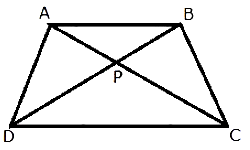
The given figure shows a trapezium in which AB is parallel to DC and diagonals AC and BD
intersect at point P. If AP : CP = 3: 5,

Find:
(1) ∆APB : ∆CPB (2 ) ∆DPC : ∆APB
(3) ∆ADP : ∆APB (iv) ∆APB : ∆ADB
Answer
(i) Since ΔAPB and ΔCPB have common vertex at B and their bases AP and PC are along the
same straight line
$\therefore \frac{\operatorname{ar}(\triangle A P B)}{\operatorname{ar}(\triangle C P B)}=\frac{A P}{P C}=\frac{3}{5}$
(ii) Since ΔDPC and ΔBPA are similar
$\therefore \frac{\operatorname{ar}(\triangle D P C)}{\operatorname{ar}(\triangle C P B)}=\left(\frac{P C}{A P}\right)^2=\left(\frac{5}{3}\right)^2=\frac{25}{9}$
(iii) Since ΔADP and ΔAPB have common vertex at A and their bases DP and PB are along the same straight line
$\left.\therefore \frac{\operatorname{ar}(\triangle A D P)}{\operatorname{ar}(\triangle A P B)}=\frac{D P}{P B}=\frac{5}{3}\right)^{\prime}$
$\left(\triangle A P B^{\sim} \triangle C P D \Rightarrow \frac{A P}{P C}=\frac{B P}{P D}=\frac{3}{5}\right)$
(iv) Since ΔAPB and ΔADB have common vertex at A and their bases BP and BD are along the same straight line.
$\therefore \frac{\operatorname{ar}(\triangle A P B)}{\operatorname{ar}(\triangle A D B)}=\frac{P B}{B D}=\frac{3}{8}$
$\left(\triangle A P B \sim \triangle C P D \Rightarrow \frac{A P}{P C}=\frac{B P}{P D}=\frac{3}{5} \Rightarrow \frac{B P}{B D}=\frac{3}{8}\right)$
View full question & answer
Question 65 Marks
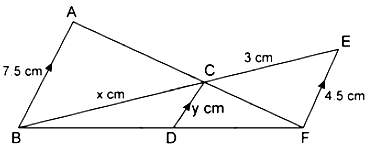
In the figure, given below, $A B, C D$ and $E F$ are parallel lines. Given $A B=7.5 cm, D C=y cm, E F=4.5 cm, B C=x cm$ and $C E=3 . cm$, calculate the values of $x$ and $y$.
Answer
In $\triangle BEF, DC || EF$
$\Rightarrow \frac{B D}{D F}=\frac{B C}{C E}$
$\Rightarrow \frac{B D}{D F}=\frac{ x }{3}$
So, $BD = x$ and $DF = 3$
In $\triangle AFB, DC || AB.$
$\Rightarrow \frac{F D}{C D}=\frac{F B}{A B}$
$\Rightarrow \frac{F D}{C D}=\frac{F D+D B}{A B}$
$\Rightarrow \frac{3}{y}=\frac{ x +3}{7.5} \ldots . .$. (i)
In $\triangle BEF, DC || EF.$
$\Rightarrow \frac{B C}{C D}=\frac{B E}{E F}$
$\Rightarrow \frac{B C}{C D}=\frac{B C+C E}{E F}$
$\Rightarrow \frac{ x }{ y }=\frac{ x +3}{4.5}$
$\Rightarrow y=\frac{4.5 x }{ x +3} \ldots . . \text { (ii) }$
Substituting $(ii)$ in $(i)$, we get
$\frac{3}{\frac{4.5 x}{x+3}}=\frac{x+3}{7.5}$
$\Rightarrow \frac{3 x+9}{4.5 x}=\frac{x+3}{7.5}$
$\Rightarrow 22.5x + 67.5 = 4.5x^2+ 13.5x$
$\Rightarrow 4.5x^2+ 13.5x - 22.5x - 67.5 = 0$
$\Rightarrow x^2- 2x - 15 = 0$
$\Rightarrow (x - 5)(x + 3) = 0$
So, $x=5$ and $x=-3$
Since side of a triangle cannot be negative, $x=5$
Substituting this value in (ii), we get
$y=\frac{4.5(5)}{x+3}=2.8125$
Hence, $x=5$ and $y=2.8125$
View full question & answer
Question 75 Marks
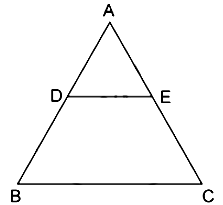
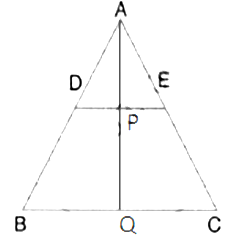
In the given figure, Δ ABC ~ Δ ADE. If AE: EC = 4 : 7 and DE = 6.6 cm, find BC. If 'x' be the length of the perpendicular from A to DE, find the length of perpendicular from A to BC in terms of 'x'.
Answer

ΔABC ∼ ΔADE,
$\Rightarrow \frac{A E}{A C}=\frac{D E}{B C}$
$\Rightarrow \frac{4}{11}=\frac{6.6}{B C}$
$\Rightarrow B C=\frac{11 \times 6.6}{4}=18.15 cm $
Given that ΔABC ∼ ΔADE
∠ABC = ∠ADE and ∠ACB = ∠AED
So, DE || BC
Also, $\frac{A B}{A D}=\frac{A C}{A E}=\frac{11}{4} \ldots .\left(\right.$ Since $\left.\frac{A E}{E C}=\frac{4}{7}\right)$
In ΔADP and ΔABQ,
∠ADP = ∠ABQ .....(Since DP || BQ)
∠APD = ∠AQB ....(Since DP || BQ)
So, ΔADP ∼ ΔABQ .......(AA Criterion for similarity)
$\Rightarrow \frac{A D}{A B}=\frac{A P}{A Q}$
$\Rightarrow \frac{4}{11}=\frac{ x }{A Q}$
$\Rightarrow A Q=\frac{11}{4} x $
View full question & answer
Question 85 Marks
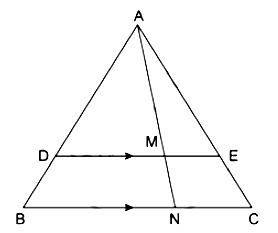
In the given figure, DE ‖ BC, AE = 15 cm, EC = 9 cm, NC = 6 cm and BN = 24 cm.
Find lengths of ME and DM.
Answer
In ΔAME and ΔANC,
∠AME = ∠ANC ......(((Since DE || BC that is, ME || NC)
∠MAE = ∠NAC....(common angle)
$\Rightarrow$ ΔAME and ΔANC ....(AA criterion for similarity)
$\Rightarrow \frac{M E}{N C}=\frac{A E}{A C}$
$\Rightarrow \frac{M E}{6}=\frac{15}{24}$
$\Rightarrow$ ME = 3.75 cm
In ΔADE and ΔABN,
∠ADE = ∠ABC ......(((Since DE || BC that is, ME || NC)
∠AED = ∠ACB....(Since DE || BC)
$\Rightarrow$ ΔADE and ΔABC ....(AA criterion for similarity)
$\Rightarrow \frac{A D}{A B}=\frac{A E}{A C}=\frac{15}{24} \ldots \ldots$ (I)
In ΔADM and ΔABN,
∠ADM = ∠ABN ......(((Since DE || BC that is, ME || NC)
∠DAM = ∠BAN....(common angle)
$\Rightarrow$ ΔADM and ΔABN ....(AA criterion for similarity)
$\Rightarrow \frac{D M}{B N}=\frac{A D}{A B}=\frac{15}{24} \ldots . . . \text { (from (i) }$
$\Rightarrow \frac{D M}{24}=\frac{15}{24}$
$\Rightarrow$ DM = 15 cm
View full question & answer
Question 95 Marks
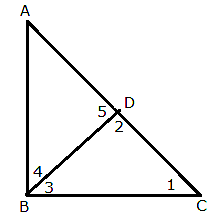
In ∆ABC, ∠B = 90° and BD ⊥ AC.
(i) If CD = 10 cm and BD = 8 cm; find AD.
(ii) IF AC = 18 cm and AD = 6cm; find BD.
(iii) If AC = 9 cm and AB = 7cm; find AD.
Answer

(i) In ∆ CDB,
∠1 + ∠2 + ∠3 = 180°
∠1 + ∠3 = 90° ..... (1)(Since, ∠2 = 90°)
∠3 + ∠4 = 90° .....(2) (Since, ∠ABC = 90°)
From (1) and (2),
∠1 + ∠3 = ∠3 + ∠4
∠1 = ∠4
Also, ∠2 = ∠5 = 90°
∴ ∆CDB ~ ∆BDA (By AA similarity)
$\Rightarrow \frac{C D}{B D}=\frac{B D}{A D}$
$\Rightarrow B D^2=A D \times C D$
$\Rightarrow(8)^2=A D \times 10$
$\Rightarrow A D=6.4$
Hence, AD= 6.4cm
(ii) Also, by similarity, we have:
$\frac{B D}{D A}=\frac{C D}{B D}$
$B D^2=6 \times(18-6)$
$B D^2=72$
Hence, BD = 8.5 cm
(iii)
Clearly, ∆ADB ~ ∆ABC
$\therefore \frac{A D}{A B}=\frac{A B}{A C}$
$A D=\frac{7 \times 7}{9}=\frac{49}{9}=5 \frac{4}{9}$
$\text { Hence, } A D=5 \frac{4}{9} cm $
View full question & answer
[5 marks sum] - Mathematics STD 10 Questions - Vidyadip