Question 14 Marks
The actual area of an island is $1872$ $km^2 $. On a map, this area is $117$ $cm^2$. if the length of the coastline is $44\ cm$ on the map, find the length of its actual coastline.
AnswerActual area $=1872 km ^2$
Area on map represents $117 cm ^2$
Let $1 cm$ represents $x km$
$\therefore 1 cm ^2$ represents $x \times x k \textrm {km } ^ { 2 }$
Actual area $= x \times x \times 117 km ^2$
$1872=x^2 x 117$
$x ^2=\frac{1872}{117} $
$x ^2=16$
$x=4$
$\therefore 1 cm$ represents $4 km$
Length of coastline on map $=44 cm$
Actual length of coastline $=44 \times 4 km =176 km$
View full question & answer→Question 24 Marks
An aeroplane is $30 \ m$ long and its model is $15 \ cm$ long. If the total outer surface area of the model is $150 cm^2$, find the cost of painting the outer surface of the aeroplane at Rs. $120$ per $m ^2$, if $50 m^2$ is left out for windows.
Answer$15 cm$ represents $=30 m$
$1 cm$ represents $\frac{30}{15}=2 m$
$1 cm ^2$ represents $2 m \times 2 m =4 m ^2$
Surface area of the model $=150 cm ^2$
Actual surface area of aeroplane $=150 \times 2 \times 2 m ^2=600 m ^2$
$50 m ^2$ is left out for windows
Area to be painted $=600-50=50 m ^2$
Cost of painting per $m ^2=$ Rs. 120
Cost of painting $550 m ^2=120 \times 550=$ Rs 66000
View full question & answer→Question 34 Marks
Figure shows $\triangle K L M, P$ an $T$ on $K L$ and $K M$ respectively such that $\angle K L M=\angle K T P$.
If $\frac{ KL }{ KT }=\frac{9}{5}$, find $\frac{\operatorname{Ar} \triangle KLM }{\operatorname{Ar} \triangle KTP }$.
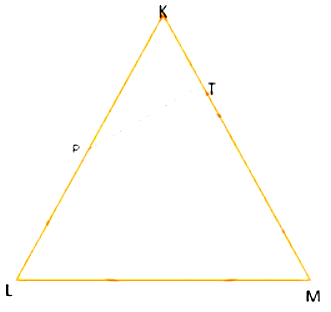
AnswerGiven: $\frac{ KL }{ KT }=\frac{9}{5}$
To find : $\frac{\operatorname{Ar} \triangle KLM }{\operatorname{Ar} \triangle KTP }$
Sol : In $\triangle KLM$ and $\triangle KTP$
$\angle K L M=\angle K T P \quad$....(Given)
$\angle LKM =\angle TKP$....(common)
$\triangle KLM$ and $\triangle KTP$ $\ldots$(AA corollary)
$
\therefore \frac{ Ar \triangle KLM }{ Ar \triangle KTP }=\left(\frac{ KL }{ KT }\right)^2=\left(\frac{9}{5}\right)^2=\frac{81}{25}
$
i.e., $81: 25$
[The ration of areas of two similar triangle is equal to the ratio of square of their corresponding sides.]
View full question & answer→Question 44 Marks
$\text { In } \triangle ABC , MN \| BC \text {. }$
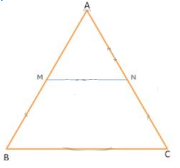
If $BC =14 cm$ and $MN =6 cm$, find $\frac{\operatorname{Ar} \triangle AMN }{\text { Ar. (trapezium MBCN) }}$
$\text { In } \triangle ABC , MN \| BC \text {. }$
If $BC =14 cm$ and $MN =6 cm$, find $\frac{\operatorname{Ar} \triangle AMN }{\text { Ar. (trapezium MBCN) }}$ Answer$\triangle AMN -\triangle ABC \quad \text { \{proved above in (a) }\}$
$\frac{\text { Ar } \triangle AMN }{ Ar \triangle ABC }=\left(\frac{ MN }{ BC }\right)^2=\left(\frac{6}{14}\right)^2=\frac{9}{49}$
$\frac{\text { Ar } \triangle \text { AMN }}{(\text { Ar } \triangle \text { AMN })+\text { Ar. }(\text { trapezium MBCN })}=\frac{9}{49}$
$49 \text { Ar. } \triangle AMN =9 Ar . \triangle AMN +9 Ar .(\text { trapezium } MBCN )$
$40 Ar . \triangle AMN =9 Ar .(\text { trapezium } MBCN )$
$\frac{\operatorname{Ar} \triangle AMN }{\text { Ar. }(\text { trapezium MBCN })}=\frac{9}{40}$
View full question & answer→Question 54 Marks
In $\triangle ABC , MN \| BC$.
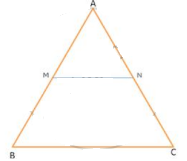
If $\frac{ AB }{ AM }=\frac{9}{4}$, find $\frac{\operatorname{Ar}(\text { trapezium } MBCN )}{\operatorname{Ar} .(\triangle ABC )}$ Answer$\Delta AMN \sim \triangle ABC \text { \{proved above \}} $
$\frac{ Ar \triangle AMN }{ Ar \triangle ABC }=\frac{ AM ^2}{ AB ^2}=\left(\frac{4}{9}\right)^2=\frac{16}{81} $
$\frac{ Ar \triangle ABC - Ar (\text { trapezium MBCN })}{ Ar . \triangle ABC }=\frac{16}{81} $
$81 \times Ar . \triangle ABC -81 \times Ar \text {. (trapezium MBCN) }=16 \times Ar . \triangle ABC $
$64 Ar . \triangle ABC =81 Ar .(\text { trapezium MBCN }) $
$\frac{\operatorname{Ar}(\operatorname{trapezium~MBCN})}{\operatorname{Ar} .(\triangle ABC )}=\frac{65}{81}$
i.e. $65: 81$
View full question & answer→Question 64 Marks
If Δ ABC , MN || BC .
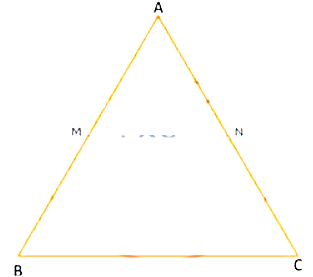
If AN : AC= 5 : 8, find ar(Δ AMN) : ar(Δ ABC)
AnswerGiven : $\frac{ AN }{ AC }=\frac{5}{8}$
To Find: $\frac{\operatorname{Ar} \triangle AMN }{\operatorname{Ar} \triangle ABC }$
In $\triangle AMN$ and $\triangle ABC$
$\angle AMN =\angle ACB$....(corresponding angles)
$\angle ABC =\angle ACB$
$\therefore \triangle AMN \sim \triangle ABC \quad$..... (AA corollary)
$\therefore \frac{ Ar \triangle AMN }{ Ar \triangle ABC }=\frac{ AN ^2}{ AC ^2}$
[The ration of areas of two similar triangle is equal to the ratio of square of their corresponding sides.]
$=\left(\frac{5}{8}\right)^2$
$\frac{\operatorname{Ar} \triangle AMN }{ Ar \triangle ABC }=\frac{25}{64}$
Required ratio is $25: 64$.
View full question & answer→Question 74 Marks
$\triangle A B C-\triangle X Y Z$. If area of $\triangle A B C$ is $9 cm^2$ and area of $\triangle X Y Z$ is $16 cm^2$ and if $B C=2.1 cm$, find the length of $Y Z$.
Answer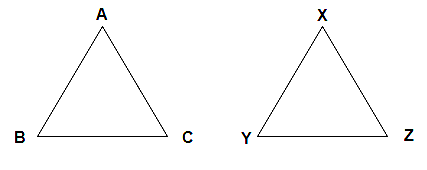
Given : $\triangle ABC \sim \triangle XYZ$
To find : $Y Z$
Sol: $\frac{ Ar \triangle ABC }{ Ar \triangle XYZ }=\frac{ BC ^2}{ YZ ^2}$
[The ration of areas of two similar triangle is equal to the ratio of square of their corresponding sides.]
$\frac{9}{16}=\frac{(2.1)^2}{ YZ ^2}$
Taking square root both sides,
$ \frac{3}{4}=\frac{2.1}{ YZ }$
$YZ =\frac{2.1 \times 4}{3}$
$YZ =2.8 cm $ View full question & answer→Question 84 Marks
$\triangle ABC \sim \triangle DEF.$ If $BC = 3cm , EF=4cm$ and area of $\triangle ABC = 54\ cm^2 ,$ find area of $\triangle DEF.$
Answer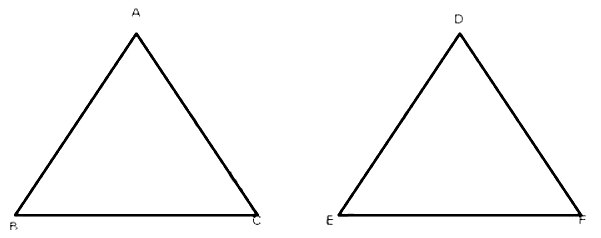
Given : $\triangle ABC \sim \Delta DEF$
To find: Ar. of $\triangle D E F$
Sol : $\frac{\text { Ar. } \triangle ABC }{\text { Ar. } \triangle DEF }=\frac{ BC ^2}{ EF ^2}$
[The ratio of areas of two triangles is equal to the ratio of square of their corresponding sides.]
$ \frac{54}{\operatorname{Ar} \triangle DEF }=\left(\frac{3}{4}\right)^2$
$\frac{54}{ Ar \triangle DEF }=\left(\frac{9}{16}\right) $
$\operatorname{Ar} \triangle DEF =\frac{54 \times 16}{9}$
$=96 cm ^2$ View full question & answer→Question 94 Marks
D and E are points on the sides AB and AC respectively of Δ ABC such that AB=5.6cm, AD= 1.4cm, AC=7 .2cm and AE = 1.5 cm, show that DE is parallel to BC
Answer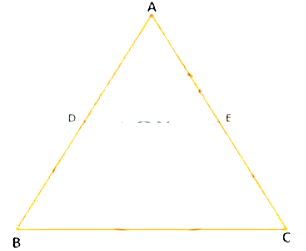
To prove : DE || BC
Sol : $A B=5.6 cm AC =7.2 cm$
$A D=1.4 cm \quad AE =1.8 cm$
$DB =4.2 cm \quad EC =5.4 cm$
$\frac{ AD }{ DB }=\frac{1.4}{4.2}=\frac{1}{3}\ldots(1)$
$\frac{ AE }{ EC }=\frac{1.8}{5.4}=\frac{1}{3}\ldots(2)$
From (1) and (2)
$\frac{ AD }{ DB }=\frac{ AE }{ EC }$
$\therefore DE \| BC$ (by concerse of BPT) View full question & answer→Question 104 Marks
In $\triangle PQR, MN$ is drawn parallel to QR. If $PM = x, MQ = (x-2), PN = (x+2)$ and $NR = (x-1),$ find the value of x.
Answer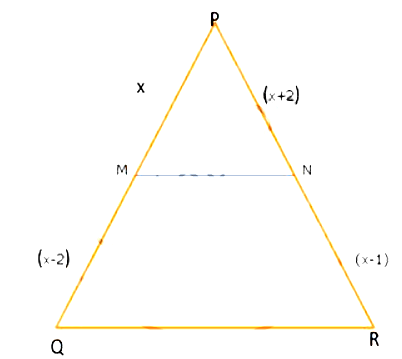
$\text { In } \triangle PQR , MN \| QR ,$
$ \therefore By\ BPT \frac{ PM }{ MQ }=\frac{ PN }{ NR } $
$\frac{ x }{ x -2}=\frac{ x +2}{ x -2}$
$ \Rightarrow x ^2- x = x ^2-4$
$ \Rightarrow- x =-4$
$\Rightarrow x =4$ View full question & answer→Question 114 Marks
In $\triangle ABC , DE$ is parallel to $BC$ and $\frac{ AD }{ DB }=\frac{2}{7} IF A C=5.6$, find $AE$.
Answer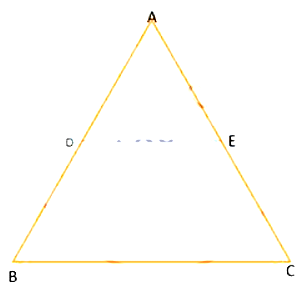
Given :- $\frac{ AD }{ DB }=\frac{2}{7}, AC =5.6$
To find: $A E=x$
In $\triangle ABC , DE \| BC$,
$\therefore$ By $BPT \frac{ AD }{ DB }=\frac{ AE }{ EC }$
$\frac{2}{7}=\frac{ x }{5.6- x }$
$\Rightarrow 11 . .2-2 x =7 x$
$\Rightarrow 11.2=9 x$
$\Rightarrow x=1.24$ View full question & answer→Question 124 Marks
On a map drawn to a scale of $1 : 25000,$ a rectangular plot of land$, \text{ABCD}$ is measured as $AB= 12 \ cm$ and $BC = 16\ cm$. calculate the diagonal distance of the plot in $km$ and the plot area in $km^2.$
AnswerScale $: - 1: 25000$
$\therefore 1 \ cm$ represents $25000 \ cm =\frac{25000}{1000 \times 100}$
$=2.5 \ km$
$\therefore 1 \ cm$ represents $0.25 \ km$
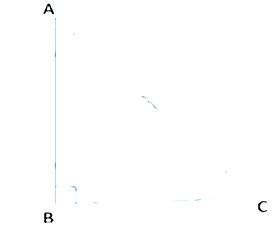
Actual length of $A B=6 \times 0.25=1.50 \ km$
Area of $\triangle \text{ABC} =\frac{1}{2} \times BC \times AB$
$=\frac{1}{2} \times 8 \times 6$
$=24 \ cm ^2$
$1 \ cm$ represents $0.25 \ km$
$1 \ cm ^2$ represents $0.25 \times 0.25 \ km ^2$
The area of plot $=0.25 \times 0.25 \times 25 \ km ^2$
$=.0625 \times 24$
$=1.5 \ km ^2$ View full question & answer→Question 134 Marks
On a map drawn to a scale of $1 : 25000,$ a triangular plot of a land is marked as $\text{ABC}$ with $AB= 6\ cm, BC = 8\ cm$ and $\angle \text{ABC} = 90^\circ $ . Calculate the actual length of $AB$ in $km$ and the actual area of the plot in $km^2$.
AnswerScale : - : $1: 25000$
$\therefore 1 \ cm$ represents $25000 \ cm =\frac{25000}{1000 \times 100}=2.5 \ km$
$\therefore 1 \ cm$ represents $0.25 \ km$
Actual length of $A B=6 \times 0.25$
$=1.50 \ km$
Area of $\triangle \text{ABC} =\frac{1}{2} \times BC \times AB$
$=\frac{1}{2} \times 8 \times 6$
$=24 \ cm ^2$
$1 \ cm$ represents $0.25 \ km$
$1 \ cm ^2$ represents $0.25 \times 0.25 \ km ^2$
The area of plot $=0.25 \times 0.25 \times 25 \ km ^2$
$=.0625 \times 24$
$=1.5 \ km ^2$ View full question & answer→Question 144 Marks
Figure shows $\triangle PQR$ in which $ST \| QR$ and $SR$ and $QT$ intersect each other at $M$. If $\frac{ PT }{ TR }=\frac{5}{3}$ find $\frac{\operatorname{Ar}(\triangle MTS )}{\operatorname{Ar}(\triangle MQR )}$
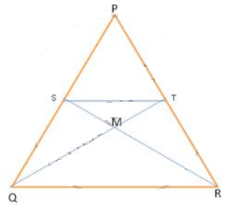
AnswerGiven: $\frac{ PT }{ TR }=\frac{5}{3}$
To find: $\frac{\operatorname{Ar}(\triangle MTS )}{\operatorname{Ar}(\triangle MQR )}$
Sol : In $\triangle PST$ and $\triangle PRQ$
$\angle PST =\angle PQR$
$\angle PST =\angle PQR \quad \ldots$ (Corresponding angles)
$\therefore \triangle PST \sim \triangle PQR \quad \ldots .( AA$ corollary)
$\therefore \frac{ PT }{ PR }=\frac{ ST }{ QR }=\frac{5}{8} \quad \ldots .$. (similar sides of similar triangles)
Now, In $\triangle$ MTS and $\triangle M Q R$
$\angle MTS =\angle MQR$...(Alternate interior angles)
$\angle MTS =\angle MQR$
$\therefore \triangle$ MTS $\sim \triangle MQR \quad$....(AA corollary)
$\therefore \frac{\operatorname{Ar}(\triangle MTS )}{\operatorname{Ar}(\triangle MQR )}=\frac{ TS ^2}{ QR ^2}=\left(\frac{5}{8}\right)^2=\frac{25}{64}$
i.e. $25: 64$
[The ration of areas of two similar triangle is equal to the ratio of square of their corresponding sides.]
View full question & answer→Question 154 Marks
In $\triangle ABC$, $DE \| BC$; $DC$ and $EB$ intersects at $F$. if $\frac{ DE }{ BC }=\frac{2}{7}$, find $\frac{\operatorname{Ar}(\triangle FDE )}{\operatorname{Ar}(\triangle FBC )}$
Answer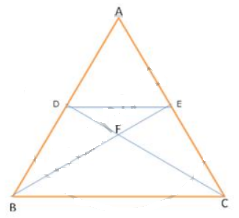
Given: $\frac{ DE }{ BC }=\frac{2}{7}$
To find : (similar sides of similar triangles)
$\ln \triangle FDE$ and $\triangle FCB$
$\angle FDE =\angle FCB$
$\angle FED =\angle FBC$(Alternate interior angles)
$\Delta FDE \sim \Delta FCB$(AA corollary)
$
\frac{\operatorname{Ar}(\triangle FDE )}{\operatorname{Ar}(\triangle FBC )}=\frac{ DE ^2}{ BC ^2}=\left(\frac{2}{7}\right)^2=\frac{4}{49}
$
[The ration of areas of two similar triangle is equal to the ratio of square of their corresponding sides.] View full question & answer→Question 164 Marks
Prove that the area of $\triangle BCE$ described on one side $BC$ of a square $\ce{ABCD}$ is one half the area of the similar $\triangle ACF$ described on the diagonal $AC.$
Answer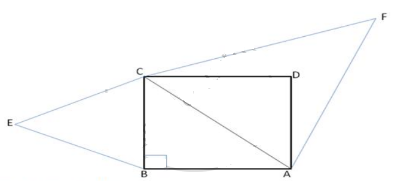
In right angled triangle $A B C$,
By Pythagoras Theorem, $AB ^2+ BC ^2= AC ^2$
Given, $\triangle BCE \sim \triangle ACF$
$\frac{ Ar \triangle BCE }{ Ar \triangle ACF }=\frac{ BC ^2}{ AC ^2}$
$[$The ration of areas of two similar triangle is equal to the ratio of square of their corresponding sides.$]$
$=\frac{ BC ^2}{ AC ^2}$
$=\frac{1}{2}$
Required ratio is $1: 2$. View full question & answer→Question 174 Marks
Δ ABC ∼ Δ PQR. AD and PS are altitudes from A and P on sides BC and QR respectively. If AD : PS = 4 : 9 , find the ratio of the areas of Δ ABC and Δ PQR.
Answer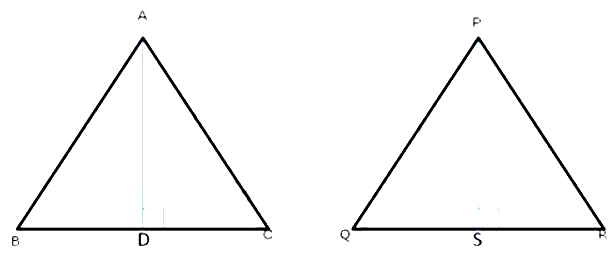
Given : $AD : PS =4: 9$ and $\triangle ABC \sim \triangle PQR$
To Find: $\frac{\operatorname{Ar} \triangle ABC }{\operatorname{Ar} \triangle PQR }$
Sol: $\frac{ Ar \triangle ABC }{ Ar \triangle PQR }=\frac{ AB ^2}{ PQ ^2}\ldots(1)$
[The ratio of area of two similar triangles is equal to the ratio of square of their corresponding sides]
In $\triangle BAD$ and $\triangle QPS$
$
\angle B =\angle Q \quad(\triangle ABC \sim \triangle PQR )
$
$\angle AOB =\angle PSQ \left(90^{\circ}\right.$ each $)$
$\triangle BAD \sim \triangle QPS \quad$ (AA corollary)
$\therefore \frac{ AB }{ PQ }=\frac{ AD }{ PS }$ ...(2) (similar sides of similar triangles)
Using (1) and (2)
$
\frac{ Ar \triangle ABC }{ Ar \triangle PQR }=\frac{ AD ^2}{ PS ^2}=\left(\frac{4}{9}\right)^2=\frac{16}{81}
$
Required ratio is $16: 81$. View full question & answer→Question 184 Marks
$\triangle ABC \sim \triangle PQR$ such that $AB= 1.5 \ cm$ and $PQ=2. 1 \ cm.$ Find the ratio of areas of $\triangle ABC$ and $\triangle PQR.$
Answer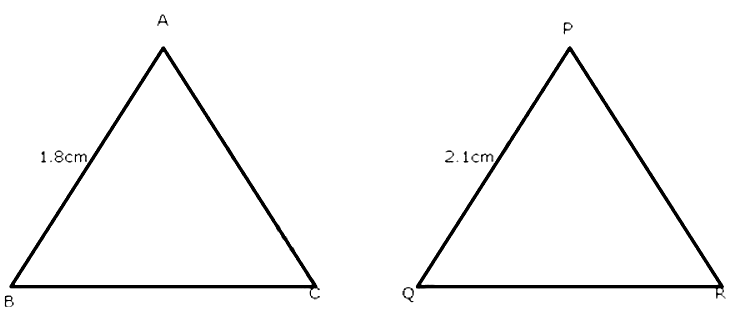
To find : $\frac{\operatorname{Ar} \triangle ABC }{\operatorname{Ar} \triangle PQR }=\frac{ AB ^2}{ PQ ^2}$
$[$The ration of areas of two similar triangle is equal to the ratio of square of their corresponding sides.$]$
$=\left(\frac{1.8}{2.1}\right)^2$
$=\left(\frac{6}{7}\right)^2$
$=\frac{36}{49}$
Required ratio $=36: 49$. View full question & answer→Question 194 Marks
In $\text{MBC}, DE$ is drawn parallel to $BC$. If $AD: DB=2:3, DE =6\ cm$ and $AE =3.6\ cm,$ find $BC$ and $AC$.
Answer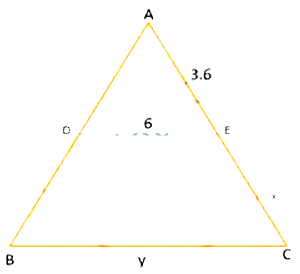
Given : $DE =6 \ cm , AE =3.6 \ cm , \frac{ AD }{ DB }=\frac{2}{3}, DE \| BC$
To find: $BC$ and $AC$
Sol : In $\triangle ABC , DE \| BC$
$\therefore \text { By } BPT \frac{ AD }{ DB }=\frac{ AE }{ EC }$
$\frac{2}{3}=\frac{3.6}{ x }$
$x =\frac{3.6 \times 2}{2}$
$=1.8 \times 3$
$x =5.4= EC$
$\therefore AC =3.6+5.4=9 \ cm$
$AC =9 \ cm$
In $\triangle ADE$ and $\triangle ABC$
$\angle ADE =\angle ABC$
Similarly $\angle AED =\angle ACB\ ($corresponding angles$)$
$\therefore \triangle ADE \sim \triangle ABC \ (AA$ corollary$)$
$\frac{ AE }{ AC }=\frac{ DE }{ BC }\ ($similar sides of angles$)$
$\frac{3.6}{9}=\frac{6}{ y }$
$y =\frac{9 \times 6}{3.6}$
$y =15$
$BC =15 \ cm$ View full question & answer→Question 204 Marks
AD and BC are two straight lines intersecting at 0. CD and BA are perpendirulars from Band Con AD. If AB=6cm, CD =9cm, AD =20cm and BC=25cm, find the lengths of AO, BO, CO and DO.
Answer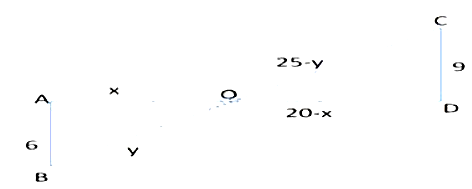
To find: $AO , BO , CO , DO$
In $\triangle AOB$ and $\triangle COD$
$
\angle O A B=\angle O D C\left(90^{\circ} \text { each }\right)
$
$\angle AOB =\angle DOC$ (vertically opposite angles)
$\therefore \triangle AOB \sim \triangle DOC$ (AA corollary)
$
\therefore \frac{ AO }{ DO }=\frac{ OB }{ OC }=\frac{ AB }{ DC }
$
$\frac{x}{20-x}=\frac{y}{25-y}=\frac{6}{9}$
$\frac{ x }{20- x }=\frac{2}{3}, \frac{ y }{25- y }=\frac{2}{3}$
$3 x=40-2 x, 3 y=50-2 y$
$5 x=40,5 y=50$
$x=8, y=10$
$AO =8 xm , OB =10 cm$
$O D=20-8=12 cm , O C=25-10=15 cm$ View full question & answer→Question 214 Marks
$\text{ABCD}$ and $\text{PQRS}$ are similar figures. $\ce{AB= 12\ cm, BC=x \ cm, CD= 15 \ cm, AD= 10 \ cm, PQ= 8 \ cm, QR = 5 \ cm, RS = m \ cm}$ and $\ce{PS = n \ cm} .$Find the values of $x, m$ and $n.$
Answer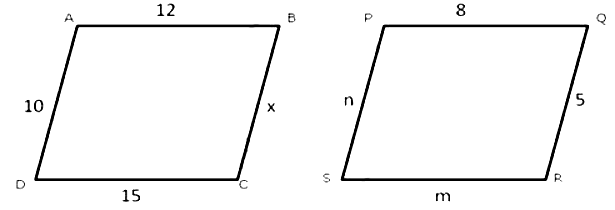
Given : quadrilateral $\ce{ABCD} \sim$ quadrilateral $\ce{PQRS}$
To find : $x , m$ and $n$
Sol : quadrilateral $\ce{ABCD} \sim$ quadrilateral $\ce{PQRS}$
$\ce{\frac{ AB }{ PQ }=\frac{ BC }{ QR }=\frac{ DC }{ SR }=\frac{ AD }{ SR }}$
$\frac{12}{8}=\frac{ x }{5}=\frac{15}{ m }=\frac{10}{ n }$
$\frac{12}{8}=\frac{ x }{5}, \frac{12}{8}=\frac{15}{ m }, \frac{12}{8}=\frac{10}{ n }$
$60=8 x , 4 m =40,3 n =20$
$x =\frac{60}{8}, m =10 \ cm , n =\frac{20}{3}$
$x =\frac{15}{2}, m =10 \ cm , n =6.66 \ldots$
$x =7.5 \ cm , m =10 \ cm , n =6.67 \ cm$ View full question & answer→Question 224 Marks
Δ ABC is similar to Δ PQR. If AB = 6cm, BC = 9cm, PQ = 9cm and PR = 10.5cm, find the lengths of AC and QR.
Answer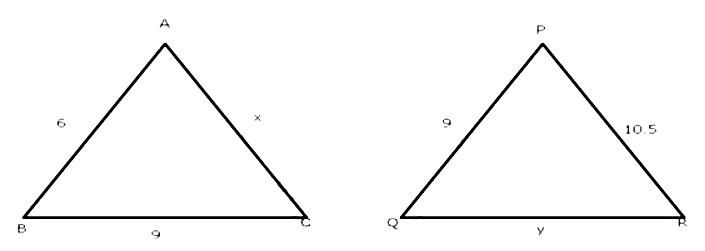
Given: $\triangle ABC \sim \triangle PQR$
To find : $AC$ and $QR$
Sol : $\triangle ABC \sim \triangle PQR$
$\therefore \frac{ AB }{ PQ }=\frac{ BC }{ QR }=\frac{ AC }{ PR }$ (Similar sides of similar triangles)
$
\frac{6}{9}=\frac{9}{y}=\frac{x}{10.5}
$
$\begin{array}{ll}\frac{6}{9}=\frac{9}{y} & \frac{6}{9}=\frac{x}{10.5} \\ \Rightarrow 6 y=81 & \Rightarrow 63=9 x \\ \Rightarrow y=\frac{81}{6} & \Rightarrow x=7 \\ \Rightarrow y=\frac{27}{2} & \Rightarrow A C=7 cm \\ \Rightarrow Q R=13.5 cm & \end{array}$ View full question & answer→Question 234 Marks
In the figure, $\text{ABCD}$ is a quadrilateral.$F$ is a point on $A D$ such that $A F=2.1 cm$ and $F D=4.9 cm$. $E$ and $G$ are points on $A C$ and $A B$ respectively such that $E F \| C D$ and $G E \| B C$. Find $\frac{\operatorname{Ar} \triangle B C D}{\operatorname{Ar} \triangle G E F}$
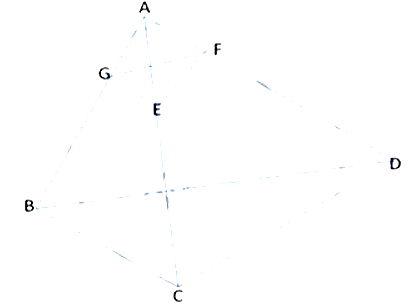
AnswerIn $\triangle ABC, GE \| BC$
$\therefore$ By $\text{BPT}$
$\frac{ AG }{ GB }=\frac{ AF }{ FD }\ldots(1)$
Similarly, in $\triangle A C D$
$\frac{ AE }{ EC }=\frac{ AF }{ FD }\ldots(2)$
From $(1)$ and $(2)$
$\frac{ AG }{ GB }=\frac{ AF }{ FD }$
$\therefore GE \| BC ...($By converse of $\text{BPT})$
In $\triangle AGF$ and $\triangle ABD$
$\angle A =\angle A \ ($common$)$
$\angle AFG =\angle ADB \ ($Corresponding angles$)$
$\therefore \triangle AGF \sim \triangle ABD \ (AA$ corollary$)$
$\therefore \frac{ AF }{ AD }=\frac{ GF }{ BD } \ ($Similar sides of similar triangles$)$
$\frac{2.1}{7}=\frac{ GF }{ BD }$
$\frac{3}{10}=\frac{ GF }{ BD }$
$\frac{ Ar \triangle GEF }{ Ar \triangle BCD }=\frac{ GF ^2}{ BD ^2}$
$[$The ration of areas of two similar triangle is equal to the ratio of square of their corresponding sides.$]$
$=\left(\frac{3}{10}\right)^2$
$=\frac{9}{100}$
$=9: 100$
$( Ar \triangle BCD ):( Ar \triangle GEF )=100: 9$
View full question & answer→Question 244 Marks
In figure $, \text{DEF}$ is a right $-$ angled triangle with $\angle E =90^{\circ}$. $FE$ is produced to $G$ and $GH$ is drawn perpendicular to $DE =8 \ cm , DH =8 \ cm , DH =6 \ cm$ and $HF =4 \ cm$, find $\frac{\operatorname{Ar} \triangle DEF }{\operatorname{Ar} \triangle GHF }$
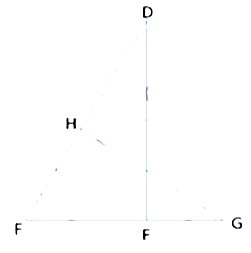
Answer$\operatorname{In} \triangle DEF \text { and } \triangle GHF _{,}$
$\angle DEF =\angle GHF \ (90^{\circ}$ each$)$ .
$\angle DEF =\angle GHF \ldots \ ($common$)$
$\triangle DEF =\triangle GHF \ldots .\ ( AA $ corollary$)$
$\therefore \frac{ Ar \triangle DEF }{ Ar \triangle GHF }=\frac{ EF ^2}{ HF ^2}\ldots(1)$
$[$The ration of areas of two similar triangle is equal to the ratio of square of their corresponding sides.$]$
In right $\triangle D E F, \ ($By Pythagoras theorem$)$
$D E^2+E F^2=D F^2$
$E F^2=10^2-8^2$
$E F^2=36$
$E F=6$
From $( 1),$
$\frac{\operatorname{Ar} \triangle DEF }{\operatorname{Ar} \triangle GHF }=\left(\frac{6}{4}\right)^2=\frac{9}{4}$
i.e. $9: 4$
View full question & answer→