Questions

[5 marks sum]

🎯

Test yourself on this topic

13 questions · timed · auto-graded

Question 15 Marks
On a map drawn to a scale of $1 : 25000,$ a rectangular plot of land, $ABCD$ is measured as $AB= 12\ cm$ and $BC = 16\ cm.$ calculate the diagonal distance of the plot in km and the plot area in $km^2 .$
Answer
Scale : - : $1: 25000$
$\therefore 1 cm$ represents $25000 cm =\frac{25000}{1000 \times 100}=2.5 km$
$\therefore 1 cm$ represents $0.25 km$
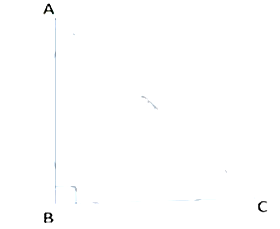

Actual length of $A B=6 \times 0.25=1.50 km$
Area of $\triangle ABC =\frac{1}{2} \times BC \times AB$
$=\frac{1}{2} \times 8 \times 6=24 cm ^2$
$1 cm$ represents $0.25 km$
$1 cm ^2$ represents $0.25 \times 0.25 km ^2$
The area of plot $=0.25 \times 0.25 \times 25 km ^2$
$ =.0625 \times 24$
$=1.5 km ^2 $
View full question & answer
Question 25 Marks
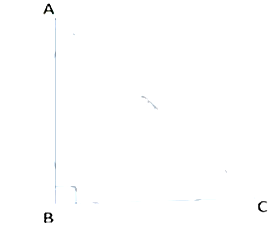
On a map drawn to a scale of $1 : 25000,$ a triangular plot of a land is marked as $ABC$ with $AB= 6cm, BC = 8cm$ and $\angle ABC = 90^\circ.$ Calculate the actual length of $AB$ in km and the actual area of the plot in $km^2 .$
Answer
Scale : - : $1: 25000$
$\therefore 1 cm$ represents $25000 cm =\frac{25000}{1000 \times 100}=2.5 km$
$\therefore 1 cm$ represents $0.25 km$


Actual length of $A B=6 \times 0.25=1.50 km$
Area of $\triangle ABC =\frac{1}{2} \times BC \times AB$
$=\frac{1}{2} \times 8 \times 6=24 cm ^2$
$1 cm$ represents $0.25 km$
$1 cm ^2$ represents $0.25 \times 0.25 km ^2$
The area of plot $=0.25 \times 0.25 \times 25 km ^2$
$ =.0625 \times 24$
$=1.5 km ^2 $
View full question & answer
Question 35 Marks
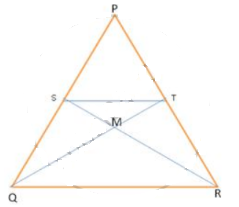
Figure shows $\triangle PQR$ in which $ST \| QR$ and $SR$ and $QT$ intersect each other at $M$. If $\frac{ PT }{ TR }=\frac{5}{3}$ find $\frac{\operatorname{Ar}(\triangle MTS )}{\operatorname{Ar}(\triangle MQR )}$
Image
Answer
Given: $\frac{ PT }{ TR }=\frac{5}{3}$
To find: $\frac{\operatorname{Ar}(\triangle MTS )}{\operatorname{Ar}(\triangle MQR )}$
Sol : In $\triangle PST$ and $\triangle PRQ$
$\angle PST =\angle PQR$
$\angle PST =\angle PQR \quad \ldots$ (Corresponding angles)
$\therefore \triangle PST \sim \triangle PQR \quad \ldots .( AA$ corollary)
$\therefore \frac{ PT }{ PR }=\frac{ ST }{ QR }=\frac{5}{8} \quad \ldots .$. (similar sides of similar triangles)
Now, In $\triangle$ MTS and $\triangle M Q R$
$\angle MTS =\angle MQR$...(Alternate interior angles)
$\angle MTS =\angle MQR$
$\therefore \triangle$ MTS $\sim \triangle MQR \quad$....(AA corollary)
$\therefore \frac{\operatorname{Ar}(\triangle MTS )}{\operatorname{Ar}(\triangle MQR )}=\frac{ TS ^2}{ QR ^2}=\left(\frac{5}{8}\right)^2=\frac{25}{64}$
i.e. $25: 64$
[The ration of areas of two similar triangle is equal to the ratio of square of their corresponding sides.]
View full question & answer
Question 45 Marks
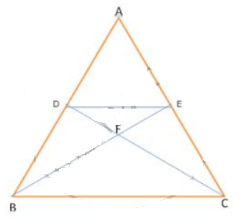
In $\triangle ABC$, $DE \| BC$; $DC$ and $EB$ intersects at $F$. if $\frac{ DE }{ BC }=\frac{2}{7}$, find $\frac{\operatorname{Ar}(\triangle FDE )}{\operatorname{Ar}(\triangle FBC )}$
Answer
Image

Given: $\frac{ DE }{ BC }=\frac{2}{7}$
To find : (similar sides of similar triangles)
$\ln \triangle FDE$ and $\triangle FCB$
$\angle FDE =\angle FCB$
$\angle FED =\angle FBC$(Alternate interior angles)
$\Delta FDE \sim \Delta FCB$(AA corollary)
$
\frac{\operatorname{Ar}(\triangle FDE )}{\operatorname{Ar}(\triangle FBC )}=\frac{ DE ^2}{ BC ^2}=\left(\frac{2}{7}\right)^2=\frac{4}{49}
$
[The ration of areas of two similar triangle is equal to the ratio of square of their corresponding sides.]
View full question & answer
Question 55 Marks
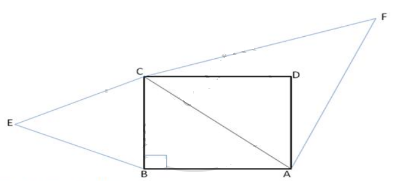
Prove that the area of Δ BCE described on one side BC of a square ABCD is one half the area of the similar Δ ACF described on the diagonal AC.
Answer
Image
In right angled triangle $A B C$,
By Pythagoras Theorem, $AB ^2+ BC ^2= AC ^2$
Given, $\triangle BCE \sim \triangle ACF$
$\frac{ Ar \triangle BCE }{ Ar \triangle ACF }=\frac{ BC ^2}{ AC ^2}$
[The ration of areas of two similar triangle is equal to the ratio of square of their corresponding sides.]
$=\frac{ BC ^2}{ AC ^2}$
$=\frac{1}{2}$
Required ratio is $1: 2$.
View full question & answer
Question 65 Marks
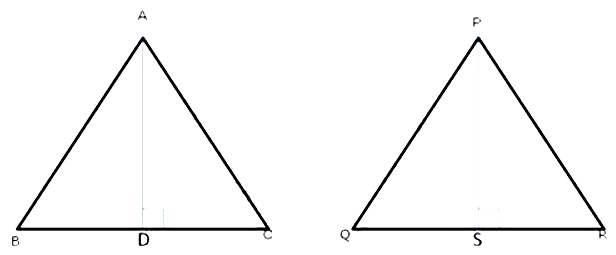
Δ ABC ∼ Δ PQR. AD and PS are altitudes from A and P on sides BC and QR respectively. If AD : PS = 4 : 9 , find the ratio of the areas of Δ ABC and Δ PQR.
Answer

Given : $AD : PS =4: 9$ and $\triangle ABC \sim \triangle PQR$
To Find: $\frac{\operatorname{Ar} \triangle ABC }{\operatorname{Ar} \triangle PQR }$
Sol: $\frac{ Ar \triangle ABC }{ Ar \triangle PQR }=\frac{ AB ^2}{ PQ ^2}\ldots(1)$
[The ratio of area of two similar triangles is equal to the ratio of square of their corresponding sides]
In $\triangle BAD$ and $\triangle QPS$
$
\angle B =\angle Q \quad(\triangle ABC \sim \triangle PQR )
$
$\angle AOB =\angle PSQ \left(90^{\circ}\right.$ each $)$
$\triangle BAD \sim \triangle QPS \quad$ (AA corollary)
$\therefore \frac{ AB }{ PQ }=\frac{ AD }{ PS }$ ...(2) (similar sides of similar triangles)
Using (1) and (2)
$
\frac{ Ar \triangle ABC }{ Ar \triangle PQR }=\frac{ AD ^2}{ PS ^2}=\left(\frac{4}{9}\right)^2=\frac{16}{81}
$
Required ratio is $16: 81$.
View full question & answer
Question 75 Marks
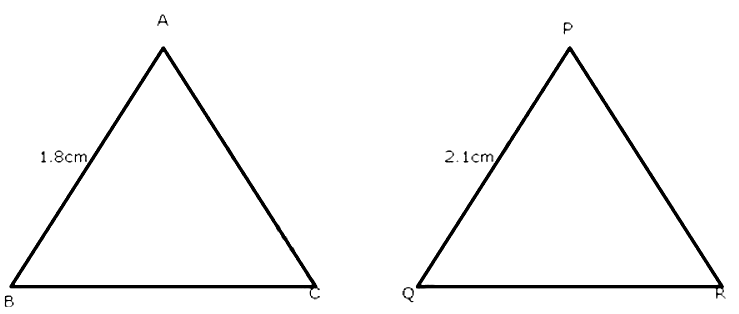
Δ ABC ∼ Δ PQR such that AB= 1.5 cm and PQ=2. 1 cm. Find the ratio of areas of Δ ABC and ΔPQR.
Answer


To find : $\frac{\operatorname{Ar} \triangle ABC }{\operatorname{Ar} \triangle PQR }=\frac{ AB ^2}{ PQ ^2}$
[The ration of areas of two similar triangle is equal to the ratio of square of their corresponding sides.]
$=\left(\frac{1.8}{2.1}\right)^2$
$=\left(\frac{6}{7}\right)^2$
$=\frac{36}{49}$
Required ratio $=36: 49$.
View full question & answer
Question 85 Marks
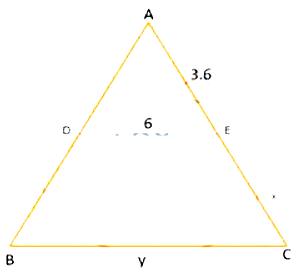
In $MBC, DE$ is drawn parallel to $BC.$ If $AD: DB=2:3, DE =6\ cm$ and $AE =3.6\ cm,$ find $BC$ and $AC.$
Answer


Given : $DE =6 cm , AE =3.6 cm , \frac{ AD }{ DB }=\frac{2}{3}, DE \| BC$
To find: $BC$ and $AC$
Sol : In $\triangle ABC , DE \| BC$
$ \therefore \text { By } BPT \frac{ AD }{ DB }=\frac{ AE }{ EC }$
$\frac{2}{3}=\frac{3.6}{ x }$
$x =\frac{3.6 \times 2}{2}$
$=1.8 \times 3$
$x =5.4= EC$
$\therefore AC =3.6+5.4=9 cm$
$AC =9 cm $
In $\triangle ADE$ and $\triangle ABC$
$\angle ADE =\angle ABC$
Similarly $\angle AED =\angle ACB$ (corresponding angles)
$ \therefore \triangle ADE \sim \triangle ABC \quad \text { (AA corollary) }$
$\frac{ AE }{ AC }=\frac{ DE }{ BC } \text { (similar sides of angles) }$
$\frac{3.6}{9}=\frac{6}{ y }$
$y =\frac{9 \times 6}{3.6}$
$y =15$
$BC =15 cm $
View full question & answer
Question 95 Marks
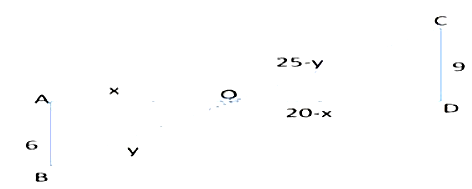
AD and BC are two straight lines intersecting at 0. CD and BA are perpendirulars from Band Con AD. If AB=6cm, CD =9cm, AD =20cm and BC=25cm, find the lengths of AO, BO, CO and DO.
Answer


To find: $AO , BO , CO , DO$
In $\triangle AOB$ and $\triangle COD$
$
\angle O A B=\angle O D C\left(90^{\circ} \text { each }\right)
$
$\angle AOB =\angle DOC$ (vertically opposite angles)
$\therefore \triangle AOB \sim \triangle DOC$ (AA corollary)
$
\therefore \frac{ AO }{ DO }=\frac{ OB }{ OC }=\frac{ AB }{ DC }
$
$\frac{x}{20-x}=\frac{y}{25-y}=\frac{6}{9}$
$\frac{ x }{20- x }=\frac{2}{3}, \frac{ y }{25- y }=\frac{2}{3}$
$3 x=40-2 x, 3 y=50-2 y$
$5 x=40,5 y=50$
$x=8, y=10$
$AO =8 xm , OB =10 cm$
$O D=20-8=12 cm , O C=25-10=15 cm$
View full question & answer
Question 105 Marks
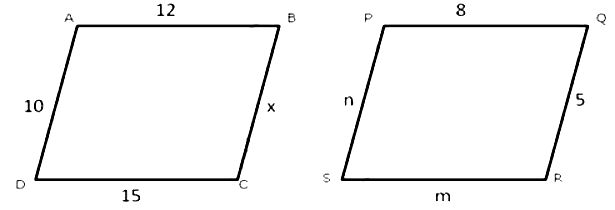
$ABCD$ and $PQRS$ are similar figures. $AB= 12cm, BC=x\ cm, CD= 15 cm, AD= 10 cm, PQ= 8 cm, QR = 5 cm, RS = m\ cm$ and $PS = n\ cm .$ Find the values of $x, m$ and $n.$
Answer


Given : quadrilateral $ABCD \sim$ quadrilateral $PQRS$
To find : $x , m$ and $n$
Sol : quadrilateral $ABCD \sim$ quadrilateral $PQRS$
$ \frac{ AB }{ PQ }=\frac{ BC }{ QR }=\frac{ DC }{ SR }=\frac{ AD }{ SR }$
$\frac{12}{8}=\frac{ x }{5}=\frac{15}{ m }=\frac{10}{ n }$
$\frac{12}{8}=\frac{ x }{5}, \frac{12}{8}=\frac{15}{ m }, \frac{12}{8}=\frac{10}{ n }$
$60=8 x , 4 m =40,3 n =20$
$x =\frac{60}{8}, m =10 cm , n =\frac{20}{3}$
$x =\frac{15}{2}, m =10 cm , n =6.66 \ldots$
$x =7.5 cm , m =10 cm , n =6.67 cm $
View full question & answer
Question 115 Marks
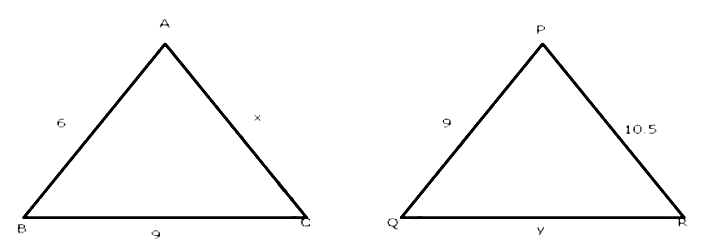
Δ ABC is similar to Δ PQR. If AB = 6cm, BC = 9cm, PQ = 9cm and PR = 10.5cm, find the lengths of AC and QR.
Answer


Given: $\triangle ABC \sim \triangle PQR$
To find : $AC$ and $QR$
Sol : $\triangle ABC \sim \triangle PQR$
$\therefore \frac{ AB }{ PQ }=\frac{ BC }{ QR }=\frac{ AC }{ PR }$ (Similar sides of similar triangles)
$
\frac{6}{9}=\frac{9}{y}=\frac{x}{10.5}
$
$\begin{array}{ll}\frac{6}{9}=\frac{9}{y} & \frac{6}{9}=\frac{x}{10.5} \\ \Rightarrow 6 y=81 & \Rightarrow 63=9 x \\ \Rightarrow y=\frac{81}{6} & \Rightarrow x=7 \\ \Rightarrow y=\frac{27}{2} & \Rightarrow A C=7 cm \\ \Rightarrow Q R=13.5 cm & \end{array}$
View full question & answer
Question 125 Marks
In the figure, $A B C D$ is a quadrilateral.$F$ is a point on $A D$ such that $A F=2.1 cm$ and $F D=4.9 cm$. $E$ and $G$ are points on $A C$ and $A B$ respectively such that $E F \| C D$ and $G E \| B C$. Find $\frac{\operatorname{Ar} \triangle B C D}{\operatorname{Ar} \triangle G E F}$
Answer
In $\triangle ABC, GE \| BC$
$\therefore$ By BPT
$\frac{ AG }{ GB }=\frac{ AF }{ FD }\ldots(1)$
Similarly, in $\triangle A C D$
$\frac{ AE }{ EC }=\frac{ AF }{ FD }\ldots(2)$
From ( 1) and (2)
$\frac{ AG }{ GB }=\frac{ AF }{ FD }$
$\therefore$ GE $\|$ BC ...(By converse of BPT)
In $\triangle AGF$ and $\triangle ABD$
$\angle A =\angle A$ (common)
$\angle AFG =\angle ADB$ (Corresponding angles)
$\therefore \triangle AGF \sim \triangle ABD$ (AA corollary)
$\therefore \frac{ AF }{ AD }=\frac{ GF }{ BD }$ (Similar sides of similar triangles)
$\frac{2.1}{7}=\frac{ GF }{ BD }$
$\frac{3}{10}=\frac{ GF }{ BD }$
$\frac{ Ar \triangle GEF }{ Ar \triangle BCD }=\frac{ GF ^2}{ BD ^2}$
[The ration of areas of two similar triangle is equal to the ratio of square of their corresponding sides.]
$=\left(\frac{3}{10}\right)^2$
$=\frac{9}{100}$
$=9: 100$
$( Ar \triangle BCD ):( Ar \triangle GEF )=100: 9$
View full question & answer
Question 135 Marks
In figure, DEF is a right -angled triangle with $\angle E =90^{\circ}$. $FE$ is produced to $G$ and $GH$ is drawn perpendicular to $DE =8 cm , DH =8 cm , DH =6 cm$ and $HF =4 cm$, find $\frac{\operatorname{Ar} \triangle DEF }{\operatorname{Ar} \triangle GHF }$
Answer
$\operatorname{In} \triangle DEF \text { and } \triangle GHF _{,}$
$\angle DEF =\angle GHF \left(90^{\circ} \text { each) }\right.$
$\angle DEF =\angle GHF \quad \ldots \text { (common) }$
$\triangle DEF =\triangle GHF \quad \ldots .( AA \text { corollary) }$
$\therefore \frac{ Ar \triangle DEF }{ Ar \triangle GHF }=\frac{ EF ^2}{ HF ^2}\ldots(1)$
[The ration of areas of two similar triangle is equal to the ratio of square of their corresponding sides.]
In right $\triangle D E F$, (By Pythagoras theorem)
$D E^2+E F^2=D F^2$
$E F^2=10^2-8^2$
$E F^2=36$
$E F=6$
From ( 1),
$\frac{\operatorname{Ar} \triangle DEF }{\operatorname{Ar} \triangle GHF }=\left(\frac{6}{4}\right)^2=\frac{9}{4}$
i.e. $9: 4$
View full question & answer
[5 marks sum] - Mathematics STD 10 Questions - Vidyadip