Question 14 Marks
The sum of the ages of a father and his son is $45$ years. Five years ago, the product of their ages (in year) was $124.$ determine their presnet ages.
AnswerLet the present ages of father and his son be $x$ years and $(45 - x)$ years respectively.
Five years ago,
Father's age $= (x - 5)$ years
Son's age $= (45 - x - 5)$ years $= (40 - x)$ years
From the given information, we have:$(x - 5) (40 - x) = 124$
$40x - x^2 - 200 + 5x= 124$
$x^2 - 45x + 324 = 0$
$x^2 - 36x - 9x + 324 = 0$
$x(x - 36) - 9(x - 36) = 0$
$(x - 36) (x - 9) = 0$
$x = 36, 9$
$if x = 9,$
Father's age = 9 years, Son's age $= (45 - x) = 36$ years
This is not possible
Hence, $x = 36$
Father's age = 36 years
Son's age $= (45 - 36)$ years = $9$ years
View full question & answer→Question 24 Marks
An Aero plane travelled a distance of $400\ km$ at an average speed of $x\ km/hr. $ On the return journey, the speed was increased by $40\ km/hr.$ Write down an expression for the time taken for:
(1) the onward journey;
(2) the return journey.
If the return journey took 30 minutes less than the onward journey, write down an equation in x and find its value.
AnswerDistance $= 400\ km$
The average speed of the aeroplane $= x\ km/hr$
Speed while returning $= (x + 40)\ km/hr$
1) We know $:$ Time $=\frac{\text { Distance }}{\text { Speed }}$
Time taken for onward journey $=\frac{400}{ x }$ hrs
2) Time taken for return journey $=\frac{400}{x+40}$ hrs
From the given information we have
$\frac{400}{x}-\frac{400}{x+40}=\frac{30}{60}$
$\frac{400 x+16000-400 x}{x(x+40)}=\frac{1}{2}$
$\frac{16000}{x(x+40)}=\frac{1}{2}$
$x^2+40 x-32000=0$
$x^2+40 x-32000=0$
$x^2+200 x-160 x-32000=0$
$x(x + 20) - 160(x + 2000) = 0$
$(x + 200)(x - 160) = 0$
$x = -200, 160$
Since speed cannot be negative. Thus $x = 160$
View full question & answer→Question 34 Marks
A hotel bill for a number of people for the overnight stay is $Rs.4800.$ If there were $4$ people more, the bill each person had to pay, would have reduced by $Rs.200.$ Find the number of people staying overnight.
AnswerLet the number of people staying overnight be x
Total hotel bill $= Rs.4800$
Hotel bill for each person $=\operatorname{Rs} \frac{4800}{ x }$
From the given information
$\frac{4800}{x}-\frac{4800}{x+4}=200 $
$ \frac{4800 x+4800 \times 4-4800 x}{x(x+4)}=200$
$ \frac{96}{x^2+4 x}=1^{\prime}$
$x^2+4 x-96=0$
$ x^2+12 x-8 x-96=0$
$x(x + 12) - 8(x + 12) =0$
$(x - 8)(x + 12) = 0$
$x = 8, -12$
Since the number of people cannot be negative So $x = 8$
Thus the number of peple staying overnight is $8$
View full question & answer→Question 44 Marks
The sum of the ages of Vivek and his younger brother Amit is $47$ years. The product of their ages in years is $550$. Find their ages.
AnswerLet Vivek’s present age be x years.
His brother’s age = (47 – x) years
According to question,
$x(47 – x) = 550$
$\Rightarrow 47x – x^2 = 550$
$\Rightarrow x^2 – 47x + 550 = 0$
$\Rightarrow x^2 – 25x – 22x + 550 = 0$
$\Rightarrow x(x – 25) – 22(x – 25) – 0$
$\Rightarrow (x - 25)(x - 22) = 0$
$\Rightarrow x - 25 = 0 or x - 22 = 0$
$\Rightarrow x = 25 or x = 22$
When x = 25, then 47 - x = 47 - 25 = 22
When x = 22, then $47 - x = 47 - 22 = 25 ...$(does not satisfy the given condition)
∴ Vivek's age = x = 25 years.
His younger brother's age = 22 years.
View full question & answer→Question 54 Marks
A bus covers a distance of 240 km at a uniform speed. Due to heavy rain its speed gets reduced by 10km/h and as such it takes two hrs longer to cover the total distance. Assuming the uniform speed to be 'x' km/h, form an equation and solve it to evaluate 'x'.
AnswerTime taken by bus to cover total distance with speed x km/h $=\frac{240}{ x } hrs$
Time taken by bus to cover total distance with speed (x - 10) km/h= $\left(\frac{240}{x-10}\right)$ hrs
According to the gven condition,We have
$\frac{240}{ x -10}-\frac{240}{ x }=2$
$\Rightarrow 240\left(\frac{1}{ x -10}-\frac{1}{ x }\right)=2$
$\Rightarrow \frac{1}{ x -10}-\frac{1}{ x }=\frac{1}{120}$
$\Rightarrow \frac{ x - x +10}{ x ( x -10)}=\frac{1}{120}$
$\Rightarrow \frac{10}{ x ^2-10 x}=\frac{1}{120}$
$\Rightarrow x2 - 10x = 1200$
$\Rightarrow x2 - 10x - 1200 = 0$
$\Rightarrow (x - 40) (x + 30) = 0$
$\Rightarrow x - 40 = 0 or x + 30 = 0$
$\Rightarrow x = 40 or x = -30$
Since the speed cannot be negative, we have $x = 40\ km/h$
View full question & answer→Question 64 Marks
$Rs. 480$ is divided equally among 'x' children. If the number of children were $20$ more, then each would have got $Rs. 12$ less. Find 'x'.
AnswerTotal amount $= Rs. 480$
Let the number of children be x.
The amount each children got $=\frac{480}{ x }$
when the number of children were $20,$
amount of each children $=\frac{480}{x+20}$
From the given information, we have:
$\frac{480}{x}-\frac{480}{x+20}=12$
$\frac{480 x+480 \times 20-480 x}{x(x+20)}=12 $
$ \frac{9600}{x(x+20)}=12$
$ \frac{800}{x(x+20)}=1$
$x^2+20 x-800=0 $
$ x^2+40 x-20 x-800=0$
$ x(x+40)-20(x+40)=0$
$(x-20)(x+40)=0 $
$ x=20,-40$
Since, number of children cannot be negative. So, $x = 20$
Number of children $= 20$
View full question & answer→Question 74 Marks
Some school children went on an excursion by bus to a picnic spot at a distance of 300 km. While returning, it was raining and the bus had to reduce its speed by 5 km/hr and it took two hours longer for returning. Find the time taken to return.
AnswerDistance = 300 km
Let the original speed of the bud be x km/hr
While returning speed of the bus = (x - 5) km/ hr
From the given information we have
$\frac{300}{x-5}-\frac{300}{x}=2$
$\frac{300 x-300 x+1500}{x(x-5)}=2$
$\frac{750}{x(x-5)}=1$
$x^2-5 x-750=0$
$x^2-30 x+25 x-750=0$
$x(x - 30) + 25(x - 30) = 0$
$(x - 30)(x + 25) = 0$
$x = 30, -25$
Since speed cannot be negative So $x= 30$
Speed of the bus while returining = 25 km/hr
Time taken by the bus to return $=\frac{300}{25} hrs =12 hrs$
View full question & answer→Question 84 Marks
In a certain positive fraction, the denominator is greater than the numerator by $3.$ If 1 is subtracted from the numerator and the denominator both, the fraction reduces by. Find the fraction.
AnswerLet the fraction be $\frac{x}{x+3}$
When $1$ is subtracted from both numerator and denominator, then the fraction be comes $\frac{x-1}{x+2}$
From the given information we have
$\frac{x}{x+3}-\frac{1}{14}=\frac{x-1}{x+2}$
$\frac{14 x-x-3}{14(x+3)}=\frac{x-1}{x+2}$
$\frac{13 x \pm 3}{14(x+3)}=\frac{x-1}{x+2}$
$(13 x-3)(x+2)=14\left(x^2+28 x-42\right)$
$x^2+5 x-36=0$
$x^2+9 x-4 x-36=0$
$x(x + 9)(x - 4) = 0$
$(x + 9)(x - 4) = 0$
$x = -9, 4$
Since x cannot be negative So $x = 4$
Hence the fraction is
$\frac{x}{x+3}=\frac{4}{7}$
View full question & answer→Question 94 Marks
Two years ago, a man’s age was three times the square of his son’s age. In three years time, his age will be four times his son’s age. Find their present ages.
AnswerLet the age of son 2 years ago be $x$ years.
Then, father's age 2 years ago $=3 x^2$ years
Present age of son $=(x+2)$ years
Present age of father $=\left(3 x^2+2\right)$ years
3 years hence:
Son's age $=(x+2+3)$ years $=(x+5)$ years
Father's age $=\left(3 x^2+2+3\right)$ years $=\left(3 x^2+5\right)$ years
From the given information,
$3x^2 + 5 = 4(x + 5)$
$3x^2 – 4x – 15 = 0$
$3x^2 – 9x + 5x – 15 = 0$
$3x(x – 3) + 5(x – 3) = 0$
$(x – 3) (3x + 5) = 0$
$x = 3,$
Since, age cannot be negative. So, $x=3$.
Present age of son $=(x+2)$ years $=5$ years
Present age of father $=\left(3 x^2+2\right)$ years $=29$ years
View full question & answer→Question 104 Marks
Mohan takes $16$ days less than Manoj to do a piece of work. If both working together can do it in $15$ days, in how many days will Mohan alone complete the work?
AnswerLet the number of days in which Mohan completes the works be $x$
Number of days in which Manoj completes the work $= x + 16$
In one day, Mohan completes $\frac{1}{x}$ parts of work.
In one day, Manoj completes $\frac{1}{ x +16}$ parts of work
It is given that they both can do the work in 15 days.
$\therefore \frac{1}{x}+\frac{1}{x+16}=\frac{1}{15} $
$ \frac{x+16+x}{x(x+16)}=\frac{1}{15} $
$ \frac{2 x+16}{x^2+16 x}=\frac{1}{15} $
$30 x+240=x^2+16 x $
$ x^2-14 x-240=0 $
$ x^2-24 x+10 x-240=0$
$x(x - 24) + 10(x - 24) = 0$
$(x - 24) (x + 10) = 0$
Since the number of days cannot be negative So $x = 24$
Thus Mohan alone can complete the work in $24$ days
View full question & answer→Question 114 Marks
Mr. Mehra sends his servant to the market to buy oranges worth $Rs.15.$ The servant having eaten three oranges on the way. Mr. Mehra pays $Rs.25$ paise per orange more than the market price.
Taking $x$ to be the number of oranges which Mr. Mehra receives, form a quadratic equation in $x.$ Hence, find the value of $x.$
AnswerNumber of oranges $= y$
Cost of one orange $= Rs.15/y$
The servant ate $3$ oranges so Mr. Mehra received $(y - 3)$ oranges.
So $x = y - 3 \Rightarrow y = x + 3 ....(1)$
Cost of one orange paid by Mr. Mehra $=\operatorname{Rs} \frac{15}{y}+0.25$
$\left(\frac{15}{x+3}+\frac{1}{4}\right) \times x=15$
$ \frac{60+x+3}{4(x+3)} \times x=15$
$63 x+x^2=60 x+180 $
$ x^2=3 x-180=0 $
$(x+15)(x-12)=0 $
$ x=-15,12$
But the number of oranges cannot be negative So $x = 12$
View full question & answer→Question 124 Marks
The age of a father is twice the square of the age of his son. Eight years hence, the age of the father will be $4$ years more than three times the age of the son. Find their present ages.
AnswerLet the present age of the son be x years.
$\therefore$ Present age of father $=2x^2$ Eight years hence,
Son's age $= (x + 8)$ years
Father's age $=\left(2 x^2+8\right)$years
It is given that eight years hence, the age of the father will be $4$ years more than three times the age of the son.
$\therefore 2 x^2+8=3(x+8)+4$
$2 x^2+8=3 x+24+4$
$2 x^2-3 x-20=0$
$2 x^2-8 x+5 x-20=0$
$2 x(x-4)+5(x-4)=0$
$(x-4)(2 x+5)=0$
$x=4, \frac{-5}{2}$
But, the age cannot be negative, so, $x = 4.$
Present age of son $= 4$ years
Present age of father $= 2(4)^2$ years $= 32$ years.
View full question & answer→Question 134 Marks
One year ago, a man was $8$ times as old as his son. Now his age is equal to the square of his son’s age. Find their present ages.
AnswerLet the present age of the son be $x$ years.
$\therefore$ Present age of man $= x^2 $ years
One year ago,
Son’s age $= (x – 1)$ years
Man’s age $= (x^2 – 1)$ years
It is given that one year ago; a man was 8 times as old as his son.
$\therefore (x^2 – 1) = 8(x – 1)$
$x^2 – 8x – 1 + 8 = 0$
$x^2 – 8x + 7 = 0$
$(x – 7) (x – 1) = 0$
$x = 7, 1$
If $x = 1$, then $x^2 = 1,$ which is not possible as father’s age cannot be equal to son’s age.
So, $x = 7.$
Present age of son $= x$ years $= 7$ years
Present age of man $= x^2 $ years $= 49$ years
View full question & answer→Question 144 Marks
The total cost price of a certain number of identical articles is $Rs.4800.$ By selling the articles at $Rs.100$ each, a profit equal to the cost price of $15$ articles is made. Find the number of articles bought.
AnswerTotal cost of some articles $= Rs. 4800$
Let number of articles $= x$
S.P. of one article $= Rs. 100$
S.P. of x articles $= Rs. 100x$
Profit = Cost price of $15$ articles
$=\frac{15 \times 4800}{x}=\frac{72000}{x}$
$\therefore \text { S.P. = C.P. + Profit }$
$\Rightarrow 100 x=4800+\frac{72000}{x}$
$\Rightarrow 100x^2 = 4800x + 72000$
$\Rightarrow x^2 = 48x + 720$ (Dividing by $100$)
$\Rightarrow x^2 – 48x – 720 = 0$
$\Rightarrow x^2 – 60x + 12x – 720 = 0$
$\Rightarrow x (x – 60) + 12 (x – 60) = 0$
$\Rightarrow (x – 60) (x + 12) = 0$
Either $x – 60 = 0,$ then $x = 60$
or $x + 12 = 0,$ then $x = -12$ Which is not possible.
$x = 60$
Number of articles $= 60$
View full question & answer→Question 154 Marks
A car made a run of $390$ km in $‘x’$ hours. If the speed had been $4$ km/hour more, it would have taken $2$ hours less for the journey. Find $‘x’.$
AnswerLet the original speed of the car be y km/hr
We know
$\text { Speed }=\frac{\text { Distance }}{\text { Time }}$
$ \therefore y=\frac{390}{x} $
$ \Rightarrow x=\frac{390}{y} \ldots .(1)$
New speed of the car $= (y + 4)$ km/hr
New time taken by the car to cover $390$ km $=\frac{390}{y+4}$
From the given information
$\frac{390}{y}-\frac{390}{y+4}=2$
$\frac{390 y=1560-390 y}{y(y+4)=2} $
$\frac{780}{y^2+4 y}=1 \\ y^2+4 y-780=0 $
$y^2+4 y-780=0 $
$ y^2+30 y-26 y-780=0 $
$y(y+30)-26(y+30)=0$
$(y+30)(y-26)=0 $
$ y=-30,26$
Since time cannot be negative so $y = 26$ From $1$ we have
$x=\frac{390}{y}=\frac{390}{26}=15$
View full question & answer→Question 164 Marks
A girl goes to her friend’s house, which is at a distance of $12$ km. She covers half of the distance at a speed of x km/hr and the remaining distance at a speed of $(x + 2)$ km/hr. If she takes $2$ hrs $30$ minutes to cover the whole distance, find $‘x’.$
AnswerWe know
Time $=\frac{\text { Distance }}{\text { Speed }}$
Given the girl covers a distance of $6$ km at a speed x km/hr
Time taken to cover first $6$ km$=\frac{6}{x}$Also the girl covers the remaining $6$ km distance at a speed $(x + 2)$ km/hr.
Time taken to cover next $6$ km$=\frac{6}{x+2}$
Time taken to cover the whole distance $= 2$ hrs $30$ mins $- 2$
$\frac{30}{60}=2 \frac{1}{2}=\frac{5}{2} \text { hrs }$
$\therefore \frac{6}{x}+\frac{6}{x+2}=\frac{5}{2}$
$\frac{6 x+12+6 x}{x(x+2)}=\frac{5}{2}$
$\frac{12+12 x}{x^2+2 x}=\frac{5}{2}$
$24+24 x=5 x^2+10 x$
$5 x^2-14 x-24=0$
$5 x^2-20 x+6 x-24=0$
$5 x(x-4)+6(x-4)=0$
$(5 x+6)(x-4)=0$
$x=\frac{-6}{5}, 4$
Since speed cannot be negative. Therefore $x = 4$
View full question & answer→Question 174 Marks
If the speed of an aeroplane is reduced by $40\ km/hr,$ it takes $20$ minutes more to cover $1200\ km.$ Find the speed of the aeroplane.
AnswerLet the original speed of the aeroplane be $x\ km/hr.$
Time taken to cover a distance of $1200 km = 1200/x hrs$
$\left(\right.$ Time $\left.=\frac{\text { Distance }}{\text { Speed }})\right.$
Let the new speed of the aeroplane be $(x - 40) km/hr$
Time taken to cover a distance of $1200 km =\frac{1200}{x-40}$ hrs
From the given information we have
$\frac{1200}{x-40}-\frac{20}{60}=\frac{1200}{x}$
$\frac{1200}{x-40}-\frac{1200}{x}=\frac{20}{60}$
$\frac{1200 x-1200 x+48000}{x(x-40)}=\frac{1}{3}$
$x(x-40)=48000 \times 3$
$x^2-40 x-144000=0$
$x^2-400 x+360 x-144000=0$
$x(x - 400) + 360(x - 400) = 0$
$(x - 400)(x + 360) = 0$
$x = 400,-360$
But, speed cannot be negative. So, $x = 400.$
Thus, the original speed of the aeroplane is $400\ km/hr.$
View full question & answer→Question 184 Marks
If the speed of a car is increased by $10\ km$ per hr, it takes $18$ minutes less to cover a distance of $36\ km.$ Find the speed of the car.
AnswerLet the speed of the car be $x\ km/hr.$
Distance $= 36\ km$
Time taken to cover a distance of $36\ km = 36/x hrs$
$\left(\right.$ Time $\left.=\frac{\text { Distance }}{\text { Speed }})\right.$
New speed of the car $= (x + 10)\ km/hr$
New time taken by the car to cover a distance of $36\ km =\frac{36}{x+10} hrs$
From the given information, we have:
$\frac{36}{x}-\frac{36}{x+10}=\frac{18}{60}$
$\frac{36 x+360-36 x}{x(x+10)}=\frac{3}{10}$
$\frac{360}{x^2+10 x}=\frac{3}{10}$
$\frac{120}{x^2+10 x}=\frac{1}{10}$
$x^2+10 x-1200=0$
$(x+40)(x-30)=0$
$x=-40,30$
But speed cannot be negative So $x = 30$
Hence the original speed of the car is $30\ km/hr$
View full question & answer→Question 194 Marks
The speed of an ordinary train is x km per hr and that of an express train is (x + 25) km per hr.
(1) Find the time taken by each train to cover 300 km.(2) If the ordinary train takes 2 hrs more than the express train;calculate speed of the express train.
Answer1) Speed of ordinary train = x km/hr
Speed of express train = (x + 25) km/hr
Distance = 300
We know
Time $=\frac{\text { Distance }}{\text { Speed }}$
$\therefore$ Time taken by ordinary train to cover $300 km =\frac{300}{x}$ hrs
Time taken by express train to cover $300 km =\frac{300}{x+25} hrs$
2) Given that the ordinary train takes 2 hours more than the express train to cover the distance.
Therefore,
$\frac{300}{x}-\frac{300}{x+25}=2$
$\frac{300 x+7500-300 x}{x(x+25)}=2$
$7500=2 x^2+50 x$
$2 x^2+50 x-7500=0$
$x^2+25 x-3750=0$
$x^2+75 x-50 x-3750=0$
$x(x+75)-50(x+75)=0$
$(x+75)(x-50)=0$
$x=-75,50$
But, speed cannot be negative. So, x = 50.
∴ Speed of the express train = (x + 25) km/hr = 75 km/hr
View full question & answer→Question 204 Marks
The sides of a right-angled triangle containing the right angle are 4x cm and $(2x – 1)$ cm. If the area of the triangle is $30\ cm^2;$ calculate the lengths of its sides.
Answer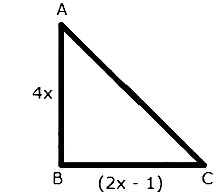
Area of triangle $= 30\ cm^2$
$\therefore \frac{1}{2} \times(4 x) \times(2 x-1)=30$
$2 x^2-x=15$
$2 x^2-x-15=0$
$2 x^2-6 x+5 x-15=0$
$2 x(x-3)+5(x-3)=0$
$(x-3)(2 x+5)=0$
$x=3, \frac{-5}{2}$
But x cannot be negative so $x= 3$
Thus we have
$AB = 4 \times 3 cm = 12 cm$
$BC = (2 \times 3 - 1) cm = 5 cm$
$CA =\sqrt{12^2+5^2} cm = 13 cm$ (Using Pythagoras therorem) View full question & answer→Question 214 Marks
The area of a big rectangular room is $300\ m^2.$ If the length were decreased by $5\ m$ and the breadth increased by $5\ m;$ the area would be unaltered. Find the length of the room.
AnswerLet the original length and breadth of the rectangular room be x m and y m respectively.
Area of the rectangular room $= xy = 300$
$\Rightarrow y=\frac{300}{x}$
New length $= (x – 5) m$
New breadth $= (y + 5) m$
New area $= (x – 5) (y + 5) = 300$ (given)
Using (1), we have:
$(x-5)\left(\frac{300}{x}+5\right)=300$
$300+5 x-\frac{1500}{x}-25=300$
$5 x-\frac{1500}{x}-25=0$
$5 x^2-25 x-1500=0$
$x^2-5 x-300=0$
$x^2-20 x+15 x-300=0$
$x(x - 20) + 15(x - 20) = 0$
$(x - 20)(x + 15) = 0$
$x = 20,-15$
But, x cannot be negative. So, $x = 20.$
Thus, the length of the room is $20\ m.$
View full question & answer→Question 224 Marks
A square lawn is bounded on three sides by a path $4m$ wide. If the area of the path is $7/8$ that of the lawn, find the dimensions of the lawn.
AnswerLet the side of the square lawn be x m.
Area of the square lawn $= x^2 m^2$
The square lawn is bounded on three sides by a path which is $4 m$ wide.
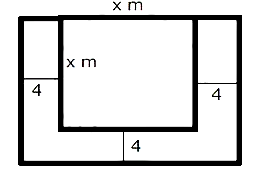
Area of outer rectangle $= (x + 4) (x + 8) = x^2 + 12x + 32$
Area of path $= x^2 + 12x + 32 – x^2 = 12x + 32$
From the given information, we have:
$12 x+32=\frac{7}{8} x^2$
$96 x+256=7 x^2$
$7 x^2-96 x-256=0$
$7 x^2-112 x+16 x-256=0$
$7 x(x-16)+16(x-16)=0$
$(x-16)(7 x+16)=0$
$x=16, \frac{-16}{7}$
Since, x cannot be negative. So, $x = 16\ m.$
Thus, each side of the square lawn is $16\ m.$ View full question & answer→Question 234 Marks
A farmer has $70\ m$ of fencing, with which he encloses three sides of a rectangular sheep pen; the fourth side being a wall. If the area of the pen is $600$ sq. m, find the length of its shorter side.
AnswerLet the length and breadth of the rectangular sheep pen be x and y respectively.
From the given information,
$x + y + x = 70$
$2x + y = 70 … (1)$
Also, area $= xy = 600$
Using $(1),$ we have:
$x (70 – 2x) = 600$
$70x – 2x^2 = 600$
$2x^2 – 70x + 600 = 0$
$x^2 – 35x + 300 = 0$
$x^2 – 15x – 20x + 300 = 0$
$x(x – 15) – 20(x – 15) = 0$
$(x – 15)(x – 20) = 0$
$x = 15, 20$
If $x = 15, $ then $y = 70 – 2x = 70 – 30 = 40$
If $x = 20,$ then $y = 70 – 2x = 70 – 40 = 30$
Thus, the length of the shorter side is $15\ m$ when the longer side is $40\ m.$ The length of the shorter side is $20\ m$ when the longer side is $30\ m.$
View full question & answer→Question 244 Marks
An area is paved with square tiles of a certain size and the number required is $128.$ If the tiles had been $2\ cm$ smaller each way, $200$ tiles would have been needed to pave the same area. Find the size of the larger tiles.
AnswerLet the size of the larger tiles be $x\ cm.$
Area of larger tiles $= x^2 cm^2$
Number of larger tiles required to pave an area is 128.
So, the area needed to be paved $= 128 x^2 cm^2 …. (1)$
Size of smaller tiles $= (x – 2)cm$
Area of smaller tiles $= (x – 2)^2 cm^2$
Number of larger tiles required to pave an area is 200.
So, the area needed to be paved $= 200 (x – 2)^2 cm^2 …. (2)$
Therefore, from $(1)$ and $(2),$ we have:
$128 x^2 = 200 (x – 2)^2$
$128 x^2 = 200x^2 + 800 – 800x$
$72x^2 – 800x + 800 = 0$
$9x^2 – 100x + 100 = 0$
$9x^2 – 90x – 10x + 100 = 0$
$9x(x – 10) – 10(x – 10) = 0$
$(x – 10)(9x – 10) = 0x = 10,10/9$
if $x = 10/9$ then $x - 2 = 10/9 - 2 = (10 - 18)/9 = (-8)/9$ which is not possible.
Hence, the size of the larger tiles is $10\ cm.$
View full question & answer→Question 254 Marks
The sum of the squares of two positive integers is $208$. If the square of the large number is 18 times the smaller. Find the numbers.
AnswerLet the two numbers be x and y, y being the bigger number. From the given information,
$x^2+ y^2= 208 ..... (i)$
$y^2 = 18x ..... (ii)$
From (i), we get $y^2=208 - x^2.$ Putting this in (ii), we get,
$208 - x^2= 18x$
$x^2 + 18x - 208 = 0$
$x^2 + 26X - 8X - 208 = 0$
$x(x + 26) - 8(x + 26) = 0$
$(x - 8)(x + 26) = 0$
$x $ can't be a negative number , hence $x = 8$
Putting $x = 8$ in (ii), we get $y^2 = 18 x 8=144$
$y = 12$, since $y$ is a positive integer
Hence, the two numbers are $8$ and $12.$
View full question & answer→Question 264 Marks
Divide $15$ into two parts such that the sum of their reciprocals is
$\frac{3}{10}$
AnswerLet the two parts be $x$ and $15 - x.$
$\frac{1}{x}+\frac{1}{15-x}=\frac{3}{10}$
$\frac{15-x+x}{x(15-x)}=\frac{3}{10}$
$\frac{15}{15 x-x^2}=\frac{3}{10}$
$\frac{15^5}{15 x-x^2} \times \frac{10}{\beta_1}=0$
$\frac{5}{15 x-x^2} \times 10=0$
$x^2-15 x+50=0$
$x^2-10 x-5 x+50=0$
$(x-10)(x-5)=0$
$\therefore x-10=0$
$\therefore x = 10$
$\therefore x - 5 = 0$
$\therefore x = 5$
Thus the required two parts are $5$ and $10.$
View full question & answer→Question 274 Marks
A positive number is divided into two parts such that the sum of the squares of the two parts is $20.$ The square of the larger part is $8$ times the smaller part. Taking x as the smaller part of the two parts, find the number.
AnswerLet the smaller part be x
Then, (larger part)$^2 = 8x$
$\therefore$ larger part $=\sqrt{8 x}$
Now, the sum of the squares of both the terms is given to be $20$
$x^2+(\sqrt{8 x})^2=20$
$\Rightarrow x^2+8 x=20$
$\Rightarrow x^2+8 x-20=0$
$\Rightarrow x^2-2 x+10 x-20=0$
$\Rightarrow x(x-2)+10(x-2)=0$
$\Rightarrow(x-2)(x+10)=0$
$\Rightarrow x=2 \text { or } x=-10$
$x =-10 \text { is rejected as it is negative }$
$\therefore x = 2$
smallerpart $= 2$
larger part = $\sqrt{8 \times 2}=4$
Thus, the required number $= 2 + 4 = 6$
View full question & answer→Question 284 Marks
One pipe can fill a cistern in $3$ hours less than the other. The two pipes together can fill the cistern in $6$ hours $40$ minutes. Find the time that each pipe will take to fill the cistern.
AnswerLet one pipe fill the cistern in $x$ hours and the other fills it in $(x – 3)$ hours.
Given that the two pipes together can fill the cistern in $6$ hours $40$ minutes, i.e.,
$6 \frac{40}{60} \text { hours }=6 \frac{2}{3} \text { hour }=\frac{20}{3} \text { hours }$
$\frac{1}{x}+\frac{1}{x-3}=\frac{3}{20}$
$\frac{x-3+x}{x(x-3)}=\frac{3}{20}$
$\frac{2 x-3}{x^2-3 x}=\frac{3}{20}$
$40 x-60=3 x^2-9 x$
$3 x^2-49 x+60=0$
$3 x^2-45 x-4 x+60=0$
$3 x(x-15)-4(x-15)=0$
$(x-15)(3 x-4)=0$
$x=15, \frac{4}{3}$
if $x = 4/3$ then $x - 3 =\frac{4}{3}-3=\frac{4-9}{3}=\frac{-5}{3}$ which is not possible.
So $x = 15$
Thus oen pipe fill the cistern in 15 hours and other fills in $(x - 3) =- 15 - 3 = 12$ hours
View full question & answer→Question 294 Marks
Two trains leave a railway station at the same time. The first train travels due west and the second train due north. The first train travels $5 \ km/hr$ faster than the second train. If after $2$ hours, they are $50 \ km$ apart, find the speed of each train.
AnswerLet the speed of the second train be $x \ km/hr$
Then the speed of the first train is $(x + 5) \ km/hr$
Let $O$ be the position of the railways' station from which the two train leave
Distance travelled by the first train in $2$ hours $= OA =$ Speed $x$ Time $= 2(x + 5) \ km$
Distance travelled by the second train in $2$ hours in $OB =$ speed $x$ Time $= 2x \ km$
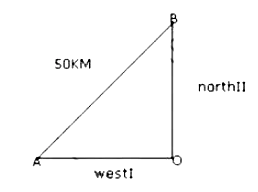
By Pythagoras Theorem we have
$( AB )^2=( OA )^2+( OB )^2$
$\Rightarrow(50)^2=[2(x+5)]^2+(2 x)^2$
$\Rightarrow 2500=4(x+5)^2=4 x^2$
$\Rightarrow 2500=4\left(x^2+25+10 x\right)+4 x^2$
$\Rightarrow 8 x^2+40 x-2400=0$
$\Rightarrow x^2+20 x-15 x-300=0$
$\Rightarrow(x+20)(x-15)=0$
$\Rightarrow x =-20 \text { or } x =15$
$\Rightarrow x =15 \ [\because x \text { cannot be negative] }$
Hence the speed of the second train is $15 \ km/hr$ and the speed of the first train is $20 \ km/hr$ View full question & answer→Question 304 Marks
A goods train leaves a station at $6 p.m.,$ followed by an express train which leaved at $8 p.m$. and travels $20 \ km/hr$ faster than the goods train. The express train arrives at a station, $1040 \ km$ away $,36$ minutes before the goods train. Assuming that the speeds of both the train remain constant between the two stations; calculate their speeds.
AnswerLet the speed of goods train be $x \ km/hr.$
So, the speed of express train will be $(x + 20) \ km/hr$.
Distance $= 1040 \ km$
We know
Time taken by good train to cover a distance of $1040 \ km =\frac{1040}{x} hrs$
Time taken by express train to cover a distance of 1$040 \ km =\frac{1040}{x+20} hrs$
It is given that the express train arrives at a station $36$ minutes before the goods train.
Also the express train leaves the station $2$ hours after the goods train.
This means that the express train arrives at the station $\left(\frac{36}{60}+2\right) hrs =\frac{13}{5} hrs$ before the good train.
Therefore we have
$\frac{1040}{x}-\frac{1040}{x+20}=\frac{13}{5}$
$\frac{1040 x+20800-1040 x}{x(x+20)}=\frac{13}{5}$
$\frac{20800}{x^2+20 x}=\frac{13}{5}$
$\frac{1600}{x^2+20 x}=\frac{1}{5}$
$x^2+20 x-8000=0$
$(x-80)(x+100)=0$
$x=80,-100$
Since the speed cannot be negative
So $x = 80$
Thus the speed of goods train is $80 \ km/hr$ and the speed of express train is $100 \ km/hr$
View full question & answer→Question 314 Marks
A car covers a distance of $400 \ km$ at a certain speed. Had the speed been $12 \ km/h$ more, the time taken for the journey would have been $1$ hour $40$ minutes less. Find the original speed of the car.
AnswerLet $x \ km/h$ be the original speed of the car.
We know that,
Time taken $= \frac{\text { Distance }}{\text { Speed }}$
It is given that the car covers a distance of $400 \ km$ with the speed of $x \ km/h.$
Thus, the time taken by the car to complete $400 \ km$ is
$t=\frac{400}{x}$
Now, the speed is increased by $12 \ km.$
Increased speed $= (x + 12) \ km/h$
Also given that, increasing the speed of the car will decrease the time taken by $1$ hour $40$ minutes.
Hence,
$\frac{400}{ x }-\frac{400}{ x +12}=1$ hour $40$ minutes
$\Rightarrow \frac{400}{ x }-\frac{400}{ x +12}=1 \frac{40}{60}$
$\Rightarrow \frac{400( x +12)-400 x }{ x ( x +12)}=1 \frac{2}{3}$
$\Rightarrow \frac{400 x +4800-400 x }{ x ( x +12)}=\frac{5}{3}$
$\Rightarrow \frac{4800}{ x ( x +12)}=\frac{5}{3}$
$\Rightarrow 3 \times 4800 = 5 \times x \times (x + 12)$
$\Rightarrow 14400 = 5x^2 + 60x$
$\Rightarrow 5x^2 + 60x - 14400 = 0$
$\Rightarrow x^2 + 12x - 2880 = 0$
$\Rightarrow x^2 + 60x - 48x - 2880 = 0$
$\Rightarrow x (x + 60) - 48 (x + 60) = 0$
$\Rightarrow ( x + 60) ( x - 48) = 0$
$\Rightarrow x + 60 = 0$ or $x - 48 = 0$
$\Rightarrow x = -60$ or $x = 48$
Since, speed cannot be negative, we reject $-60.$
Hence, the original speed of the car is $48 \ km/h.$
View full question & answer→Question 324 Marks
The dimensions of a rectangular field are $50 m$ and $40 m.$ A flower bed is prepared inside this field leaving a gravel path of uniform width all around the flower bed. The total cost of laying the flower bed and gravelling the path at $Rs. 30$ and $Rs. 20$ per square metre, respectively, is $Rs .52,000$. Find the width of the gravel path.
AnswerLet the width of the gravel path be $w m.$
Length of the rectangular field $= 50 m$
Breadth of the rectangular field $= 40 m$
Let the length and breadth of the flower bed be $x m$ and $y m$ respectively.
Therefore, we have :
$x + 2w = 50 … (1)$
$y + 2w = 40 … (2)$
Also, area of rectangular field $= 50 m \times 40 m = 2000 m^2$
Area of the flower bed $= xy m^2$
Area of gravel path $=$ Area of rectangular field $–$ Area of flower bed $= (2000 – xy) m^2$
Cost of laying flower bed $+$ Gravel path $=$ Area $\times$ cost of laying per $sq. \ m$
$52000 = 30 xy + 20 (2000 – xy)$
$52000 = 10xy + 40000$
$xy = 1200$
Using $(1)$ and $(2),$ we have:
$(50 – 2w) (40 – 2w) = 1200$
$2000 – 180w + 4w^2 = 1200$
$4w^2 – 180w + 800 = 0$
$w^2 – 45w + 200 = 0$
$w^2 – 5w – 40w + 200 = 0$
$w(w – 5) – 40(w – 5) = 0$
$(w – 5) (w – 40) = 0$
$w = 5, 40$
If $w = 40,$ then $x = 50 – 2w = -30,$ which is not possible.
Thus, the width of the gravel path is $5 m.$
View full question & answer→