Questions

[5 marks sum]

🎯

Test yourself on this topic

4 questions · timed · auto-graded

Question 15 Marks
Two trains leave a railway station at the same time. The first train travels due west and the second train due north. The first train travels $5$ km/hr faster than the second train. If after $2$ hours, they are $50$ km apart, find the speed of each train.
Answer
Let the speed of the second train be x km/hr
Then the speed of the first train is $(x + 5)$ km/hr
Let O be the position of the railways' station from which the two train leave
Distance travelled by the first train in $2$ hours $= OA =$ Speed x Time $= 2(x + 5)$ km
Distance travelled by the second train in $2$ hours in OB = speed x Time $= 2$ x km
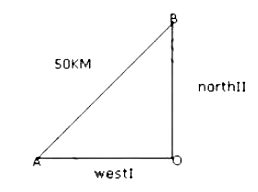
By Pythagoras Theorem we have
$( AB )^2=( OA )^2+( OB )^2$
$\Rightarrow(50)^2=[2(x+5)]^2+(2 x)^2$
$\Rightarrow 2500=4(x+5)^2=4 x^2$
$\Rightarrow 2500=4\left(x^2+25+10 x\right)+4 x^2$
$\Rightarrow 8 x^2+40 x-2400=0$
$\Rightarrow x^2+20 x-15 x-300=0$
$\Rightarrow(x+20)(x-15)=0$
$\Rightarrow x =-20 \text { or } x =15$
$\Rightarrow x =15[\because x \text { cannot be negative] }$
Hence the speed of the second train is $15$ km/hr and the speed of the first train is $20$ km/hr
View full question & answer
Question 25 Marks
A goods train leaves a station at 6 p.m., followed by an express train which leaved at 8 p.m. and travels 20 km/hour faster than the goods train. The express train arrives at a station, 1040 km away, 36 minutes before the goods train. Assuming that the speeds of both the train remain constant between the two stations; calculate their speeds.
Answer
Let the speed of goods train be x km/hr. So, the speed of express train will be $(x + 20)$ km/hr.
Distance $= 1040$ km
We know
Time taken by good train to cover a distance of $1040$ km $=\frac{1040}{x} hrs$
Time taken by express train to cover a distance of $1040$ km $=\frac{1040}{x+20}$ hrs
It is given that the express train arrives at a station $36$ minutes before the goods train. Also the express train leaves the station $2$ hours after the goods train.
This means that the express train arrives at the station $\left(\frac{36}{60}+2\right) hrs =\frac{13}{5}$ hrs before the good train.
Therefore we have
$\frac{1040}{x}-\frac{1040}{x+20}=\frac{13}{5}$
$\frac{1040 x+20800-1040 x}{x(x+20)}=\frac{13}{5}$
$\frac{20800}{x^2+20 x}=\frac{13}{5}$
$\frac{1600}{x^2+20 x}=\frac{1}{5}$
$x^2+20 x-8000=0$
$(x-80)(x+100)=0$
$x=80,-100$
Since the speed cannot be negative So $x = 80$
Thus the speed of goods train is $80\ km/hr$ and the speed of express train is $100\ km/hr$
View full question & answer
Question 35 Marks
A car covers a distance of $400\ km$ at a certain speed. Had the speed been $12\ km/h$ more, the time taken for the journey would have been $1$ hour $40$ minutes less. Find the original speed of the car.
Answer
Let $x\ km/h$ be the original speed of the car.
We know that,
Time taken $= \frac{\text { Distance }}{\text { Speed }}$
It is given that the car covers a distance of $400\ km$ with the speed of $x\ km/h.$
Thus, the time taken by the car to complete $400\ km$ is
$t=\frac{400}{x}$
Now, the speed is increased by $12\ km.$
Increased speed $= (x + 12)\ km/h$
Also given that, increasing the speed of the car will decrease the time taken by $1$ hour $40$ minutes.
Hence,
$\frac{400}{ x }-\frac{400}{ x +12}=1 \text { hour } 40 \text { minutes }$
$\Rightarrow \frac{400}{ x }-\frac{400}{ x +12}=1 \frac{40}{60}$
$\Rightarrow \frac{400( x +12)-400 x }{ x ( x +12)}=1 \frac{2}{3}$
$\Rightarrow \frac{400 x +4800-400 x }{ x ( x +12)}=\frac{5}{3}$
$\Rightarrow \frac{4800}{ x ( x +12)}=\frac{5}{3}$
$\Rightarrow 3 x 4800 = 5 \times x \times (x + 12)$
$\Rightarrow 14400 = 5x^2 + 60x$
$\Rightarrow 5x^2 + 60x - 14400 = 0$
$\Rightarrow x^2 + 12x - 2880 = 0$
$\Rightarrow x^2 + 60x - 48x - 2880 = 0$
$\Rightarrow x (x + 60) - 48 (x + 60) = 0$
$\Rightarrow ( x + 60) ( x - 48) = 0$
$\Rightarrow x + 60 = 0$ or $x - 48 = 0$
$\Rightarrow x = -60$ or $x = 48$
Since, speed cannot be negative, we reject $-60.$
Hence, the original speed of the car is $48\ km/h.$
View full question & answer
Question 45 Marks
The dimensions of a rectangular field are $50 m$ and $40 m$. A flower bed is prepared inside this field leaving a gravel path of uniform width all around the flower bed. The total cost of laying the flower bed and gravelling the path at Rs $30$ and Rs $20$ per square metre, respectively, is Rs $52,000$. Find the width of the gravel path.
Answer
Let the width of the gravel path be w $m.$
Length of the rectangular field $= 50 m$
Breadth of the rectangular field $= 40 m$
Let the length and breadth of the flower bed be x m and y m respectively.
Therefore, we have:
$x + 2w = 50 … (1)$
$y + 2w = 40 … (2)$
Also, area of rectangular field $= 50 m 40 m = 2000 m^2$
Area of the flower bed $= xy m^2$​​​​​​​
Area of gravel path = Area of rectangular field – Area of flower bed $= (2000 – xy) m^2$​​​​​​​
Cost of laying flower bed + Gravel path = Area x cost of laying per sq. m
$52000 = 30 xy + 20 (2000 – xy)$
$52000 = 10xy + 40000$
$xy = 1200$
Using (1) and (2), we have:
$(50 – 2w) (40 – 2w) = 1200$
$2000 – 180w + 4w^2 = 1200$
$4w^2 – 180w + 800 = 0$
$w^2 – 45w + 200 = 0$
$w^2 – 5w – 40w + 200 = 0$
$w(w – 5) – 40(w – 5) = 0$
$(w – 5) (w – 40) = 0$
$w = 5, 40$
If $w = 40$, then $x = 50 – 2w = -30$, which is not possible.
Thus, the width of the gravel path is $5 \ m.$
View full question & answer
[5 marks sum] - Mathematics STD 10 Questions - Vidyadip