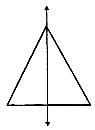
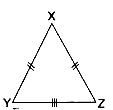
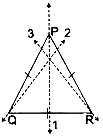
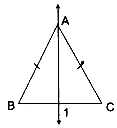
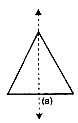
In the figure below are an isosceles triangle; state if the triangle is a symmetrical figure. If a figure is symmetrical, state the number of axis of symmetry and indicate them by dotted line.
In the figure below are an isosceles triangle; state if the triangle is a symmetrical figure. If a figure is symmetrical, state the number of axis of symmetry and indicate them by dotted line.
In the figure below are an isosceles triangle; state if the triangle is a symmetrical figure. If a figure is symmetrical, state the number of axis of symmetry and indicate them by dotted line.
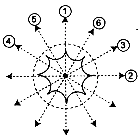
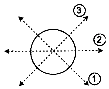
Every diameter of circle is an axis of the symmetry for the circle. Each of the figure below contain a circle or a part of a circle. State the number of axis of symmetry in each case and also indicate them.
Answer
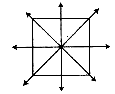
(a) Yes, Four. Yes, infinite since every diameter of a circle is an axis at symmetry for the circle and there are an infinite number of diameter in a circle.
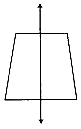
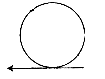
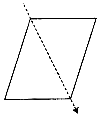
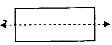
In each of the figure below, an additional line is indicated by dots. Observe, name the figure and state if the figure is symmetrical about the dotted line.
In each of the figure below, an additional line is indicated by dots. Observe, name the figure and state if the figure is symmetrical about the dotted line.
In each of the figure below, an additional line is indicated by dots. Observe, name the figure and state if the figure is symmetrical about the dotted line.