Questions

[4 marks sum]

🎯

Test yourself on this topic

14 questions · timed · auto-graded

Question 14 Marks
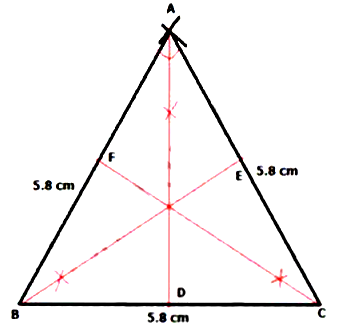
Construct a triangle ABC in which each side measures 5.8 cm. Draw all the possible lines of symmetry.
Answer
Steps of Construction :
(i) Draw a line segment BC = 5.8 cm.
(ii) With Band C as centre and radius = 5.8 cm, draw two arcs which intersect each other at A.
(iii) Join AB and AC. ABC is the required triangle.
(iv) Dr aw the bi sectors AD, BE and CF of L.A, L. Band L. C respectively.
Hence, AD, BE and CF are the lines of symmetry of trianQle ABC.
View full question & answer
Question 24 Marks
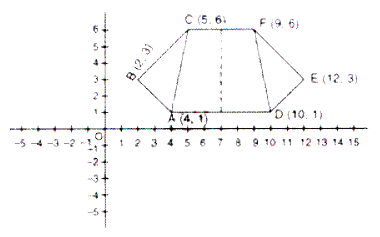
A( 4, 1 ), B(2,3) and C( 5,6) are the vertices of a figure which is symmetrical about x=7. Complete the figure and give the geometrical name of the figure if any. 
Answer

Steps of construction:
(i) Plot the point A, B and Con the graph.
(ii) Point symmetric to A( 4, 1) about x = 7 is D( 10, 1)
(iii) Point symmetric to B(2,3) about x = 7 is E( 12, 3)
(iv) Point symmetric to C(S,6) about x = 7 is F(9,6)
(v) Join AB, AC, BC, AD, DE, DF, EF and CF.
The figure formed is a trapezium ADCF with two equal scalene triangles (ABC and DEF) attached to it.
View full question & answer
Question 34 Marks
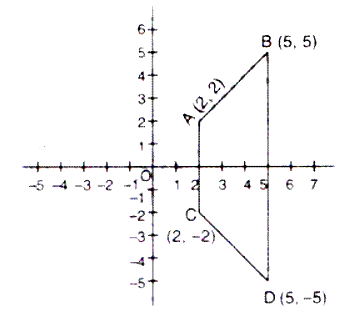
A(2,2) and B(5,5) are the vertices of a figure which is symmetrical about xaxis. Complete the figure and give its geometrical name. 
Answer

Steps of construction:
(i) Plot the point A and B on the graph.
(ii) Point symmetric to A(2,2) about x-axis is C(2,-2)
(iii) Point symmetric to B(5,5) about x-axis is 0(5,-5)
(iv) Join AB, AC, CD, BD.
The figure formed is a trapezium.
View full question & answer
Question 44 Marks
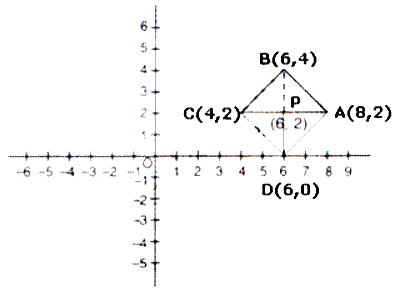
$A(8,2)$ and $B(6,4)$ are the vertices of a figure which is symmetrical about $x = 6$ and $y = 2.$ Complete the figure and give the geometrical name of the figure. 
Answer


Steps of construction:
$(i)$ Plot the point $A$ and $B$ on the graph.
$(ii)$ Plot point $P$ whose vertices are $x=6$ and $y=2$. Pis the point of symmetry.
$(iii)$ Point symmetric to $A(8,2)$ in the line $x=6$ is $C(4,2)$
$(iv)$ Point symmetric to $B(6,4)$ in the line $y=2$ is $D(6,0)$
$(v)$ Join $\ce{AP, PC, BP}$ and $\ce{PD.}$
Since $\text{BD}=4$,
$AD =\sqrt{(8-6)^2+(2-0)^2}=\sqrt{2^2+2^2}=\sqrt{4+4}=\sqrt{8}$
$AB =\sqrt{(8-6)^2+(2-4)^2}=\sqrt{2^2+(-2)^2}=\sqrt{4+4}=\sqrt{8}$
$\therefore \ce{BD^2= AD^2+ AB ^2}$
$4^2=(\sqrt{8})^2+(\sqrt{8})^2$
$16=8+8$
$16=16$
$\therefore \ce{\angle BAD}=90^{\circ}$
Clearly $\ce{AB=BC=CD=DA, \angle BAD}=90^{\circ}$ and $\text{AC}$ and $\text{BD}$ bisect each other at right angles $1$ therefore $\text{ABCD}$ is a square.
View full question & answer
Question 54 Marks
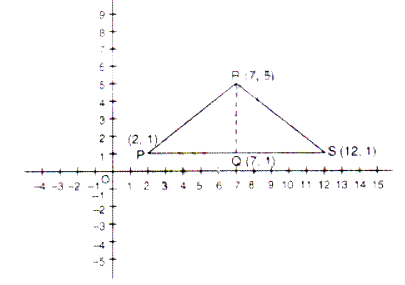
Take a graph paper and mark the points P(2, 1), Q(7, 1) and R(7,5). Taking QR as the line of symmetry, obtain and write the co-ordinates of point S. 
Answer

Steps of construction :
(i) Plot the points P, Q and Ras per given data.
(ii) Point S symmetrical about QR is a point with vertices x= 12 and y = 1 i.e. 5 unit right of line RQ.
(iii) Plot S( 12, 1)
(iv) Join PR, PS and RS
View full question & answer
Question 64 Marks
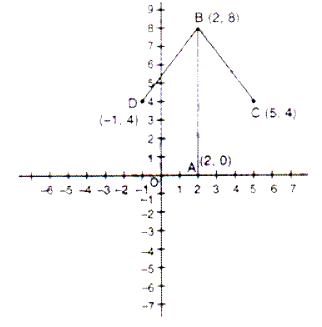
Take a graph paper and mark the points A(2,0), B(2,8) and C(S,4) on it. Taking AB as the line of symmetry, obtain and write the co-ordinates of point D. Complete the quadrilateral ABCD and give its geometrical name. 
Answer

Steps of oonstruction:
(i) Plot the points A, Band Casper given data.
(ii) Point D symmetrical about AB is a point with vertices x= -1 and y = 4 1. e. 3 units left of line AB.
(iii) Plot D( -1,4)
(iv) Join BC, AB, BD
The figure is an arrow.
View full question & answer
Question 74 Marks
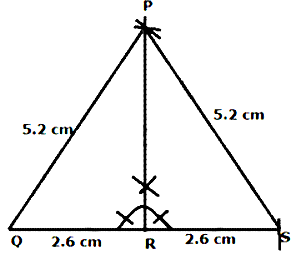
Construct a Δ PQR in which ∠ R = 90 ° ,  PQ = 5.2 cm and QR= 2.6 cm. Complete the figure taking PR as the line of symmetry and name the figure.
Answer

Steps of oonstruction:
(i) Draw a line segment QR = 2.6 cm
(ii) At R draw a perpendicular to QR.
(iii) With Q as centre and radius 5.2 cm cut an arc on perpendicular to R at P.
(iv) Join PQ . Δ PQR is the required triangle.
(v) Produce QR to S such that RS = 2.6 cm
(vi) With S as centre and radius 5.2 cm cut an arc on perpendicular to Rat P.
(vii) Join PS. Δ PSR is the triangle which is the reflection of &PQR.
Δ PQS is the required triangle and is an equilateral triangle.
View full question & answer
Question 84 Marks
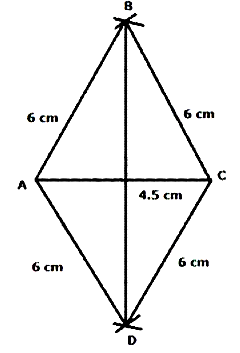
Construct a Δ ABC in whidi BA= BC= 6 cm and AC= 4.5 cm. Taking AC as line of symmetry, obtain a point D to form a quadrilateral ABCD. Name the figure ABCD. 
Answer

Steps of construction:
(i) Draw a line segment AC= 4.5 cm
(ii) With Band C as centres and 6 cm as radius 1 draw arcs which intersect each other at B.
(iii) Join AB and BC. Δ ABC is the required triangle.
(iv) Again with Band C as centres and 6 cm as radius 1 draw arcs which intersect each other at D.
(v) Join AD and DC. Δ ADC is the triangle which is the reflection of Δ ABC.
ABCD is the required quadrilateral and it is a rhombus.
View full question & answer
Question 94 Marks
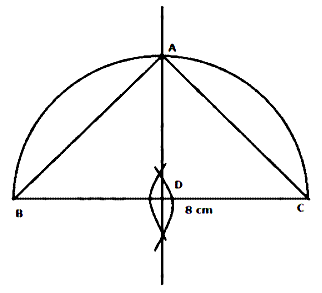
Construct an isosceles right-angled triangle, having hypotenuse= 8 cm. Draw its lines of symmetry. 
Answer

Steps of construction:
(i) Draw a line segment BC= 8 cm
(ii) Draw its perpendicular bisector whidi intersects BC at D. With Das centre and BD or CD as radius, draw a semi-circle.
(iii) Produce the perpendicular bi sector of BC which intersects the ci rel e at A.
(iv) Join AB and AC. Triangle ABC is the required isosceles right-angled triangle.
The perpendicular bisector of hypotenuse BC is the line of symmetry.
View full question & answer
Question 104 Marks
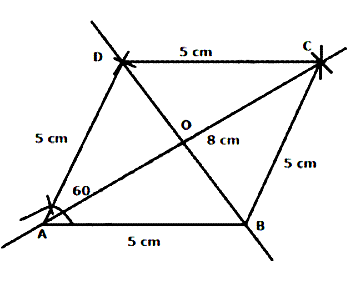
Construct a rhombus ABCD with AB= 5.0 cm and AC= 8 cm. Draw its lines of symmetry.
Answer

Steps of construction :
(i) Draw a line segment AB = 5 cm
(ii) With A as centre and radius 8 cm, and 8 as centre and radius 5 cm, draw arcs which intersect each other at C.
(iii) Join AC and BC.
(iv) Again with centre A and C and radius 5 cm, draw arcs which intersect each other at D
(v) Join AD and CD. ABCD is the required rhombus.
(vi) Join BO.
Two diagonals AC and BO are the lines of symmetry .
View full question & answer
Question 114 Marks
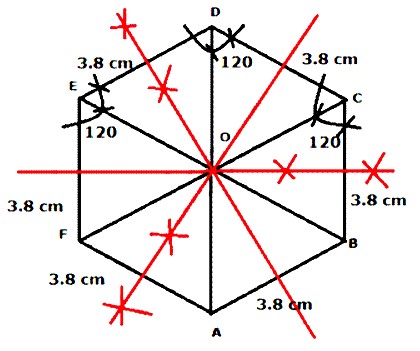
Construct a regular hexagon of side = 3.8 cm and draw all its lines of symmetry .
Answer

Steps of construction :
(i) Draw a line segment AB = 3.8 cm
(ii) At A and B, draw rays making an angle of 120° eadi and cut off AF = BC = 3.8 cm
(iii) Again at F and C, draw rays making an angle of 120• each and cut off CD = FE= 3.8 cm
(iv) Join DE. ABCDEF is the required hexagon.
(v) Draw perpendicular bisectors of each of the opposite sides and al so join AD 1 BE and CF. These six lines are the lines of symmetry .
View full question & answer
Question 124 Marks
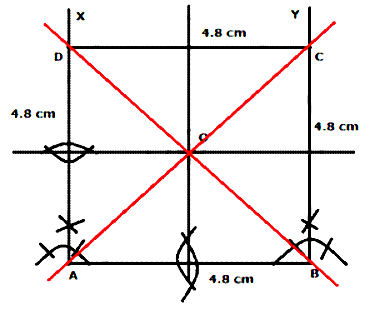
Construct a square of side 4.8 cm and draw all its lines of symmetry .
Answer

Steps of Construction :
(i) Draw a line segment AB = 4. 8 cm.
(ii) At A and B, draw perpendiculars AX and BY
(iii) From AX and BY, cut off AD = BC= 4. 8 cm
(iv) Join DC. ABCD is the required square.
(v) Now cir aw perpendi cu I ar bi sectors of AB and AD.
(vi) Also join the diagonals AC and BD.
The perpendicular bisectors and the diagonals are the lines of symmetry
View full question & answer
Question 134 Marks
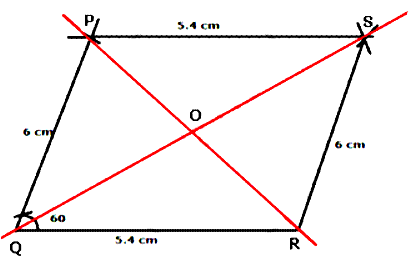
Construct a paralIelogra m PQRS in wh i di QR = 5. 4 cm , SR = 6. 0 cm and ∠ Q= 60°. Draw its lines of symmetry, if possible. 
Answer

Steps construction :
(i) Draw a line segment QR = 5.4 cm
(ii) At Q , draw a ray making an angle of 60 degrees with QR and OJt QP = SR = 6cm
(iii) Pas centre draw an arc equal to 5. 4 cm
(iv) Ras centre draw an arc equal to 6 cm which intersects the first arc at S.
(v) Join RS and PS. PQRS is the required parallelogram.
(vi) Join QS and PR which intersect each other at 0.
There is no line of symmetry of parallelogram PQRS but it has one point symmetry which is 0, the point of intersection of its diagonals.
View full question & answer
Question 144 Marks
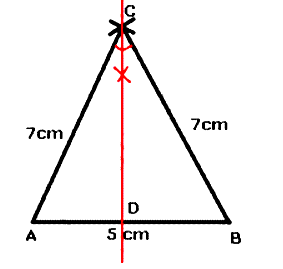
Construct an isosceles triangle whose equal sides are 7 cm each and the base side is 5 cm. Draw all its lines of symmetry. 
Answer

Steps of construction:
>(i) Draw a line segment AB = 5 cm > >(ii) With A as centre, cut an arc of 7 cm on one side of line segment AB. > >(iii) With B as centre, cut an arc of 7 cm on same side of line segment AB. Let the point be C. > >(iv) Join AC and BC. ABC is the required triangle. > >(v) Draw angle bisector of angle C meeting AB at D. > >(vi) CD is perpendicular bisector of AB and AC=BC. Hence CD is the line of symmetry. > >Isosceles triangle has only one line of symmetry.
View full question & answer
[4 marks sum] - Mathematics STD 10 Questions - Vidyadip