Questions

[3 marks sum]

🎯

Test yourself on this topic

35 questions · timed · auto-graded

Question 13 Marks
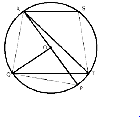
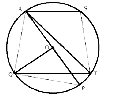
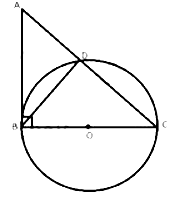
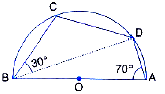
In the given figure, C and D are points on the semi-circle described on AB as diameter. Given angle BAD = 70° and angle DBC = 30°, calculate angle BDC.
Answer
Since ABCD is a cyclic quadrilateral, therefore, ∠BCD + ∠BAD = 180°
(since opposite angles of a cyclic quadrilateral are supplementary)
⇒ ∠BCD + 70° = 180°
⇒ ∠BCD = 180° − 70° = 110°
In ΔBCD, we have,
∠CBD + ∠BCD + ∠BDC = 180°
⇒ 30° + 110° + ∠BDC = 180°
⇒ ∠BDC = 180° − 140°
⇒ ∠BDC = 40°
View full question & answer
Question 23 Marks
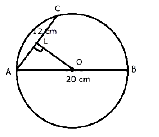
The diameter and a chord of a circle have a common end-point. If the length of the diameter is 20 cm and the length of the chord is 12 cm, how far is the chord from the centre of the circle?
View full question & answer
Question 43 Marks
In the given figure, O is the centre of the circle. The tangents at B and D intersect each other at point P. If AB is parallel to CD and ∠ABC = 55°, find:

(i) ∠BOD (ii) ∠BPD
Answer
$
\begin{aligned}
& \text { i) } \\
& \angle BOD =2 \angle BCD \\
& \Rightarrow \angle BOD =2 \times 55^{\circ}=110^{\circ}
\end{aligned}
$
ii) Since, BPDO is cyclic quadrilateral, opposite angles are supplementary.
$
\begin{aligned}
& \therefore \angle BOD +\angle BPD =180^{\circ} \\
& \Rightarrow \angle BPD =180^{\circ}-110^{\circ}=70^{\circ}
\end{aligned}
$
View full question & answer
Question 53 Marks
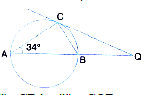
In the given figure, AB is the diameter. The tangent at C meets AB produced at Q.
If ∠CAB = 34°, Find : ∠CBA
Answer
AB is diameter of circle.
∴  ACB = 90°
In ΔABC,
∠ A + B + ∠ C = 180°
⇒  34° +  ∠ CBA + 90° =  180°
⇒  ∠ CBA =  56°
View full question & answer
Question 63 Marks
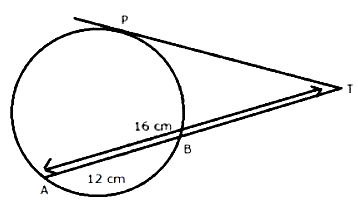
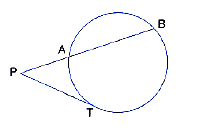
In the given figure, find $TP$ if $AT = 16 \ cm$ and $AB = 12 \ cm.$
Answer

$PT$ is the tangent and $TBA$ is the secant of the circle.
Therefore, $TP2 = TA \times TB$
$TP^2 = 16 \times (16 − 12) = 16 \times 4 = 64 = (8)^2$
Therefore, $TP = 8 \ cm$
View full question & answer
Question 73 Marks
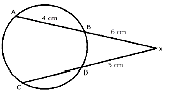
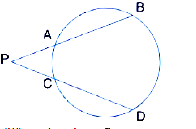
Chords AB and CD of a circle when extended meet at point X. Given AB = 4 cm, BX = 6 cm and XD = 5 cm, calculate the length of CD.
Answer

We know that XB.XA $=X D . X C$
Or, $X B \cdot(X B+B A)=X D \cdot(X D+C D)$
Or, $6(6+4)=5(5+C D)$
Or, $60=5(5+C D)$
Or, $5+ CD =\frac{60}{5}=12$
Or, $C D=12-5=7 cm$.
View full question & answer
Question 83 Marks
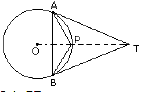
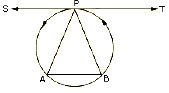
TA and TB are tangents to a circle with centre O from an external point T. OT intersects the circle at point P. Prove that AP bisects the angle TAB.
Answer

Join PB.
In $\triangle TAP$ and $\triangle TBP$,
$TA = TB$ (tangents segments from an external points are equal in length)
Also, $\angle ATP =\angle BTP$. (since OT is equally inclined with $TA$ and $TB$ )
$
TP = TP \text { (common) }
$
$\Rightarrow \triangle TAP \cong \triangle TBP$ (by SAS criterion of congruency)
$\Rightarrow \angle TAP =\angle TBP$ (corresponding parts of congruent triangles
are equal)
But $\angle TBP =\angle BAP$ (angles in alternate segments)
Therefore, $\angle TAP =\angle BAP$.
Hence, AP bisects $\angle TAB$.
View full question & answer
Question 93 Marks
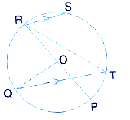
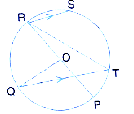
The given figure shows a circle with centre O such that chord RS is parallel to chord QT, angle PRT = 20° and angle POQ = 100°. Calculate: 
(iv) angle STR
View full question & answer
Question 103 Marks
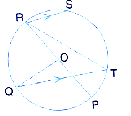
The given figure shows a circle with centre O such that chord RS is parallel to chord QT, angle PRT = 20° and angle POQ = 100°. Calculate:


(iii) angle QRS

 
Answer

Join $P Q, R Q$ and $S T$.RS || QT
$\therefore \angle SRT =\angle QTR$ (alternate angles)
But $\angle QTR =40^{\circ}$
$\therefore \angle SRT =40^{\circ}$
Now,
$
\begin{aligned}
& \angle QRS =\angle QRP +\angle PRT +\angle SRT \\
& \Rightarrow \angle QRS =50^{\circ}+20^{\circ}+40^{\circ}=110^{\circ}
\end{aligned}
$
View full question & answer
Question 113 Marks
The given figure shows a circle with centre O such that chord RS is parallel to chord QT, angle PRT = 20° and angle POQ = 100°. Calculate:
(ii) angle QRP
Answer

Join $P Q, R Q$ and $S T$.Arc QP subtends $\angle Q O P a t$ the centre and $\angle Q R P$ at the remaining part of the circle.
$
\begin{aligned}
& \therefore \angle Q R P=\frac{1}{2} \angle Q O P \\
& \Rightarrow \angle Q R P=\frac{1}{2} \times 100^{\circ}=50^{\circ}
\end{aligned}
$
View full question & answer
Question 123 Marks
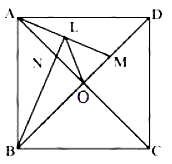
In a square ABCD, its diagonal AC and BD intersect each other at point O. The bisector of angle DAO meets BD at point M and bisector of angle ABD meets AC at N and AM at L. Show that - ALOB is a cyclic quadrilateral.
Answer
ABCD is a square whose diagonals AC and BD intersect each other at right angles at O.

In quadrilateral ALOB,
∵ ∠ ABO + ∠ ALO = 45°  + 90° + 45°  = 180°
Therefore, ALOB is a cyclic quadrilateral.
View full question & answer
Question 133 Marks
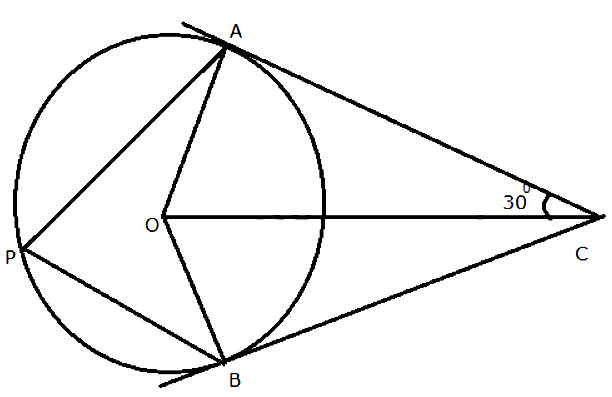
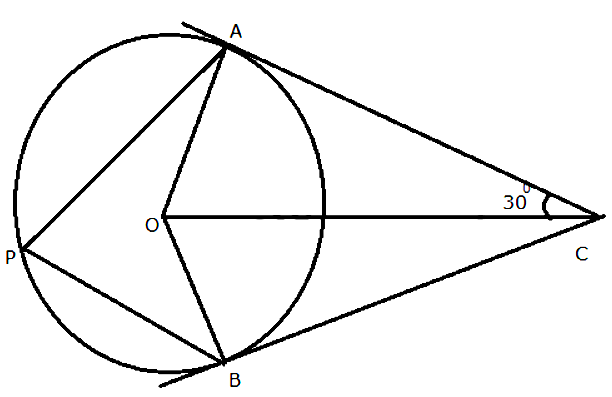
In the given figure, O is the centre of the circle. Tangents at A and B meet at C. If angle ACO = 30°, find: angle APB
Answer
In the given fig, $O$ is the centre of the circle and $C A$ and $C B$ are the tangents to the circle from C. Also, $\angle ACO =30^{\circ}$
$P$ is any point on the circle. $P$ and $PB$ are joined.To find : $\angle APB$
Proof:
$\operatorname{Arc} AB$ subtends $\angle AOB$ at the centre and $\angle APB$
is in the remaining part of the circle.
$\therefore \angle APB =\frac{1}{2} \angle AOB =\frac{1}{2} \times 120=60^{\circ}$
View full question & answer
Question 143 Marks
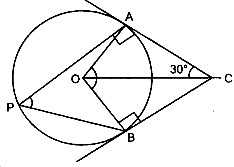
In the given figure, O is the centre of the circle. Tangents at A and B meet at C. If angle ACO = 30°, find: angle AOB
Answer
In the given fig, $O$ is the centre of the circle and $C A$ and $C B$ are the tangents to the circle from C. Also, $\angle ACO =30$
$P$ is any point on the circle. $P$ and $PB$ are joined.
To find : $\angle A O B$Proof :
$
\begin{aligned}
& \therefore \angle ACB =30^{\circ}+30^{\circ}=60^{\circ} \\
& \therefore \angle AOB +\angle ACB =180^{\circ} \\
& \Rightarrow \angle AOB +60^{\circ}=180^{\circ} \\
& \Rightarrow \angle AOB =180^{\circ}-60^{\circ} \\
& \Rightarrow \angle AOB =120^{\circ}
\end{aligned}
$
View full question & answer
Question 153 Marks
In the given figure, O is the centre of the circle. Tangents at A and B meet at C. If ∠ACO = 30°, find: ∠BCO 
Answer
In the given fig, $O$ is the centre of the circle and $C A$ and $C B$ are the tangents to the circle from
$
\text { C. Also, } \angle ACO =30^{\circ}
$
$P$ is any point on the circle. $P$ and $PB$ are joined.
To find: $\angle B C O$
Proof:
In $\triangle OAC$ and $OBC$
$O C=O C$ (Common)
$O A=O B$ (radius of the circle)
$C A=C B$ (tangents to the circle)
$\therefore \triangle OAC \cong \triangle OBC$ (SSS congruence criterion)
$\therefore \angle ACO =\angle BCO =30^{\circ}$
View full question & answer
Question 163 Marks
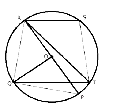
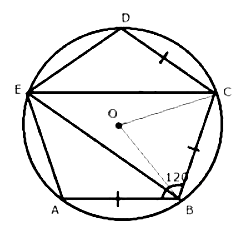
ABCDE is a cyclic pentagon with centre of its circumcircle at point O such that AB = BC = CD and angle ABC=120°.
Calculate: ∠ BED.
Answer

In cyclic quadrilateral BCDE,
∠ BED +  ∠ BCD = 180°
⇒ ∠ BED + 120°  =  180°
∴ ∠  BED =  60°
View full question & answer
Question 183 Marks
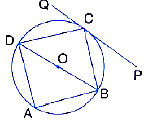
In the given figure, ABCD is a cyclic quadrilateral, PQ is tangent to the circle at point C and BD is its diameter. If ∠DCQ = 40° and ∠ABD = 60°, find;
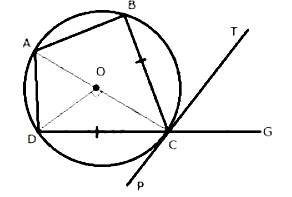
(i) ∠DBC (ii) ∠BCP (iii) ∠ADB
Answer
(i) $PQ$ is tangent and $CD$ is a chord
$\therefore \angle DCQ =\angle DBC$ (angles in the alternate segment)
$
\therefore DBC =40^{\circ}\left(\because \angle DCQ =40^{\circ}\right)
$
$
\begin{aligned}
& \text { ii) } \angle DCQ +\angle DCB +\angle BCP =180^{\circ} \\
& \Rightarrow 40^{\circ}+90^{\circ}+\angle BCP =180^{\circ}\left(\because \angle DCB =90^{\circ}\right) \\
& \Rightarrow \angle BCP =180^{\circ}=130^{\circ}=50^{\circ}
\end{aligned}
$
iii) In $\triangle ABD$
$
\begin{aligned}
& \angle ADB =180^{\circ}, \angle ABD =60^{\circ} \\
& \therefore \angle ADB =180^{\circ}-\left(90^{\circ}+60^{\circ}\right) \\
& \Rightarrow \angle ADB =180^{\circ}-150^{\circ}=30^{\circ}
\end{aligned}
$
View full question & answer
Question 193 Marks
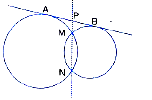
In the given figure, MN is the common chord of two intersecting circles and AB is their common tangent.

Prove that the line NM produced bisects AB at P.
Answer
From $P , AP$ is the tangent and PMN is the secant for first circle.
$\therefore A P^2=P M \times P N \ldots . . \text { (i) }$
Again from P, PB is the tangent and PMN is the secant for second circle.
$
\therefore P B^2=P M \times P N.....(ii)$
From (i) and (ii)
$
\begin{aligned}
& A P^2=P B^2 \\
& \Rightarrow AP = PB
\end{aligned}$
Therefore, P is the midpoint of AB.
View full question & answer
Question 213 Marks
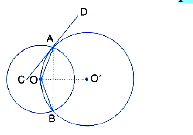
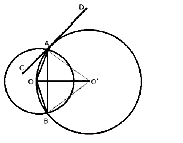
Two circle with centres O and O ' are drawn to intersect each other at points A and B.
Centre O of one circle lies on the circumference of the other circle and CD is drawn tangent to the circle with centre O ' at A. prove that OA bisects angle BAC.
View full question & answer
Question 223 Marks
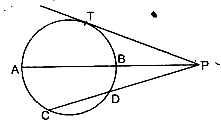
In the given figure, diameter AB and chord CD of a circle meet at P. PT is a tangent to the circle at T. CD = 7.8 cm, PD = 5 cm, PB = 4 cm. Find AB.
Answer
$\begin{aligned} & P A=A B+B P=(A B+4) cm \\ & P C=P D+C D=5+7.8=12.8 cm \\ & \text { Since } P A \times P B=P C \times P D \\ & \Rightarrow(A B+4) \times 4=12.8 \times 5 \\ & \Rightarrow A B+4=\frac{12.8 \times 5}{4} \\ & \Rightarrow A B+4=16 \\ & \Rightarrow A B=12 cm \end{aligned}$
View full question & answer
Question 233 Marks
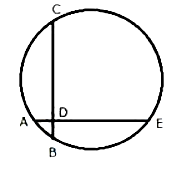
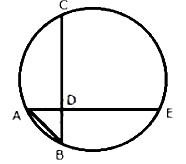
In the figure, chords AE and BC intersect each other at point D.
If AD = BD, Show that AE = BC.
Answer

Join AB.
If AD = BD .......(i)
We know that:
AD x DE = BD x DC
But AD = BD
Therefore, DE = DC .......(ii)
Adding (i) and (ii)
AD + DE = BD + DC
Therefore, AE = BC
View full question & answer
Question 243 Marks
(iii) In the given figure tangent PT = 12.5 cm and PA = 10 cm; find AB.
Answer
Since $P A B$ is the secant and $P T$ is the tangent
$
\begin{aligned}
& \therefore P T^2= PA \times PB \\
& \Rightarrow 12.5^2=10 \times PB \\
& \Rightarrow PB \frac{12.5 \times 12.5}{10}=15.625 cm \\
& AB = PB - PA =15.625-10=5.625 cm
\end{aligned}$
View full question & answer
Question 253 Marks
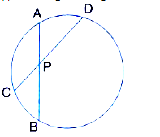
(ii) In the given figure, 5 × PA = 3 × AB = 30 cm and PC = 4cm. find CD.
Answer
Since two chords $A B$ and $C D$ intersect each other at $P$.
$
\begin{aligned}
& \therefore A P \times P B=C P \times P D \\
& \text { But } 5 \times P A=3 \times A B=30 cm \\
& \therefore 5 \times P A=30 cm \Rightarrow P A=6 cm
\end{aligned}
$ $3 \times A B=30 cm \Rightarrow A B=10 cm$
$
\Rightarrow BP = PA + AB =6+10=16 cm
$
Now,
$
\begin{aligned}
& A P \times P B=C P P D \\
& \Rightarrow 6 \times 16=4 \times P D \\
& \Rightarrow P D=\frac{6 \times 16}{4}=24 cm \\
& C D=P D-P C=24-4=20 cm
\end{aligned}$
View full question & answer
Question 263 Marks
i) In the given figure 3 × CP = PD = 9cm and AP = 4.5 cm Find BP. 
Answer
i) Since two chords $A B$ and $C D$ intersect each other at $P$.
$\begin{aligned}
& \therefore A P \times P B=C P \times P D \\
& \Rightarrow 4.5 \times P B=3 \times 9(3 C P=9 cm \Rightarrow C P=3 cm ) \\
& \Rightarrow P B=\frac{3 \times 9}{4.5}=6 cm
\end{aligned}
$
View full question & answer
Question 273 Marks
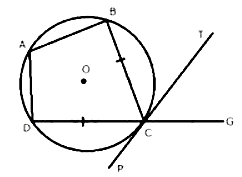
In the figure, ABCD is a cyclic quadrilateral with BC = CD. TC is tangent to the circle at point C and DC is produced to point G. If angle BCG=108°  and O is the centre of the circle, find: angle DOC
View full question & answer
Question 283 Marks
Two circle touch each other externally at point P. Q is a point on the common tangent through P. Prove that the tangents QA and QB are equal.
Answer
From Q, QA and QP are two tangents to the circle with centre O
Therefore, QA = QP.....(i)
Similarly, from Q, QB and QP are two tangents to the circle with centre O'
Therefore, QB = QP ......(ii)
From (i) and (ii)
QA = QB
Therefore, tangents QA and QB are equal.
View full question & answer
Question 303 Marks
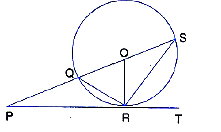
In the given figure, PT touches the circle with centre O at point R. Diameter SQ is produced to meet the tangent TR at P.
Given ∠SPR = x° and ∠QRP = y°;
Prove that:
(i) ∠ORS = y°
(ii) Write an expression connecting x and y.
Answer
$\begin{aligned} & \angle Q R P=\angle O S R=y \text { (angles in alternate segment) } \\ & \text { But OS }= OR \text { (Radii of the same circle) } \\ & \therefore \angle O R S=\angle O S R=y \\ & \therefore O Q=O R \text { (radii of same circle) } \\ & \left.\therefore O Q R=\angle O R Q=90^{\circ}-y \text {...........(i) (Since } O R \perp P T\right) \\ & \text { But in } \triangle P Q R, \\ & \text { Ext } \angle O Q R=x+y \ldots . . \text { (i) } \\ & \text { From (i) and (ii) } \\ & x+y=90^{\circ}-y \\ & \Rightarrow x+2 y=90^{\circ}\end{aligned}$
View full question & answer
Question 313 Marks
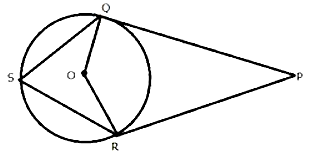
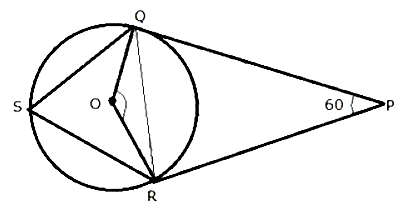
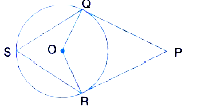
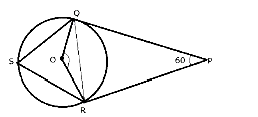
In the following figure, PQ and PR are tangents to the circle, with centre O. If ∠ QPR = 60° , calculate:
∠ QSR 
Answer

Now arc RQ subtends $\angle QOR$ at the centre and $\angle QSR$ at the remaining part of the circle.
$
\begin{aligned}
& \therefore \angle QSR =\frac{1}{2} \angle QOR \\
& \Rightarrow \angle QSR =\frac{1}{2} \times 120^{\circ} \\
& \Rightarrow \angle QSR =60^{\circ}
\end{aligned}
$
View full question & answer
Question 323 Marks
Answer

$\begin{aligned} & \text { Join } QR \text {. } \\ & \text { In quadrilateral ORPQ, } \\ & OQ \perp OP , OR \perp RP \\ & \therefore \angle OQP =90^{\circ}, \angle ORP =90^{\circ}, \angle QPR =60^{\circ} \\ & \angle QOR 360^{\circ}-\left(90^{\circ}+90^{\circ}+60^{\circ}\right) \\ & \angle QOR =360^{\circ}-240^{\circ} \\ & \angle QOR =120^{\circ}\end{aligned}$
View full question & answer
Question 333 Marks
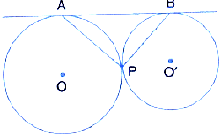
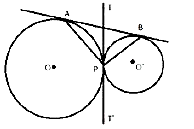
In the given figure, two circles touch each other externally at point P. AB is the direct common tangent of these circles. Prove that

tangent at point P bisects AB,
Answer

Draw TPT' as common tangent to the circles.
i) TA and TP are the tangents to the circle with centre O.
Therefore, TA = TP ………(i)
Similarly, TP = TB ………..(ii)
From (i) and (ii)
TA = TB
Therefore, TPT' is the bisector of AB
View full question & answer
Question 343 Marks
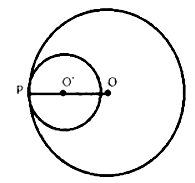
Radii of two circles are 6.3 cm and 3.6 cm. State the distance between their centers if -
they touch each other internally.
Answer
Radius of bigger circle = 6.3 cm
and of smaller circle = 3.6 cm

Two circles are touching each other at P internally. O and O’ are the centers of the circles. Join OP and O’P
OP = 6.3 cm, O’P = 3.6 cm
OO’ = OP - O’P = 6.3 - 3.6 = 2.7 cm
View full question & answer
Question 353 Marks
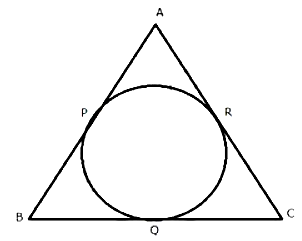
In the following figure; If AB = AC then prove that BQ = CQ.
Answer
Since, from A, AP and AR are the tangents to the circle
Therefore, AP = AR
Similarly, we can prove that
BP = BQ and CR = CQ
Adding,
AP + BP + CQ = AR + BQ + CR
(AP + BP) + CQ = (AR + CR) + BQ
AB + CQ = AC + BQ
But AB = AC
Therefore, CQ = BQ or BQ = CQ
View full question & answer
[3 marks sum] - Mathematics STD 10 Questions - Vidyadip