Questions · Page 1 of 2

[4 marks sum]

🎯

Test yourself on this topic

50 questions · timed · auto-graded

Question 14 Marks
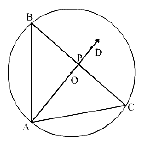
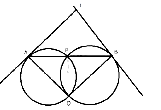
Show that the circle drawn on any one of the equal sides of an isosceles triangle as diameter bisects the base.
Answer
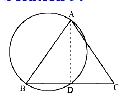
Join AD.
AB is the diameter.
∴ ∠ADB = 90º (Angle in a semi-circle)
But, ∠ADB + ∠ADC = 180º (linear pair)
⇒ ∠ADC = 90º
In ΔABD and ΔACD,
∠ADB = ∠ADC (each 90º)
AB = AC (Given)
AD = AD (Common)
ΔABD ≅ ΔACD (RHS congruence criterion)
⇒ BD = DC (C.P.C.T)
Hence, the circle bisects base BC at D.
 
View full question & answer
Question 24 Marks
In cyclic quadrilateral ABCD, ∠A = 3 ∠C and ∠D = 5 ∠B. Find the measure of each angle of the quadrilateral.
View full question & answer
Question 34 Marks
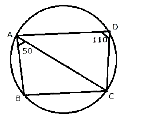
ABCD is a cyclic quadrilateral in which BC is parallel to AD, angle ADC = 110° and angle BAC = 50°. Find angle DAC and angle DCA.
View full question & answer
Question 44 Marks
Two chords AB and AC of a circle are equal. Prove that the centre of the circle lies on the bisector of angle BAC.
Answer

Given: AB and AC are two equal chords of C (O, r).
To prove: Centre, O lies on the bisector of ∠BAC.
Construction: Join BC. Let the bisector of ∠BAC intersects BC in P.
Proof:
In ΔAPB and ΔAPC,
AB = AC (Given)
∠ BAP = ∠CAP (Given)
AP = AP (Common)
∴ Δ APB ≅ ΔAPC (SAS congruence criterion)
⇒ BP = CP and ∠APB = ∠APC (CPCT)
∠APB + ∠APC = 180° (Linear pair)
⇒ 2 ∠APB = 180° (∠APB = ∠APC)
⇒ ∠APB = 90°
Now, BP = CP and ∠APB = 90°
∴ AP is the perpendicular bisector of chord BC.
⇒ AP passes through the centre, O of the circle.
View full question & answer
Question 54 Marks
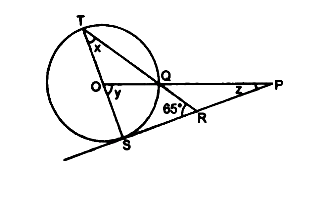
In the figure given below, O is the center of the circle of the circle and SP is a tangent. if ∠SRT=65°, find the value of x, y and Z.
Answer
$
\begin{aligned}
& T S \perp S P, \\
& \Rightarrow \angle T S R=90^{\circ} \\
& \text { In } \triangle T S R \\
& \angle T S R+\angle T R S+\angle R T S=180^{\circ} \\
& \Rightarrow 90^{\circ}+65^{\circ}+x=180^{\circ} \\
& \Rightarrow x=180^{\circ}-90^{\circ}-65^{\circ} \\
& \Rightarrow x=25^{\circ}
\end{aligned}
$
Now, $y=2 x$ (Angle subtended at the center is double that of the angle subtended by the arc at the same centre)
$
\begin{aligned}
& \Rightarrow y=2 \times 25^{\circ} \\
& \Rightarrow y=50^{\circ} \\
& \operatorname{In} \triangle O S P \\
& \angle O S P+\angle S P O+\angle P O S \equiv 180^{\circ} \\
& \Rightarrow 90^{\circ}+z+50^{\circ}=180^{\circ} \\
& \Rightarrow z=180^{\circ}-140^{\circ} \\
& \Rightarrow z=40^{\circ}
\end{aligned}
$
Hence, $x=25^{\circ}, y=50^{\circ}$ and $Z=40^{\circ}$
View full question & answer
Question 64 Marks
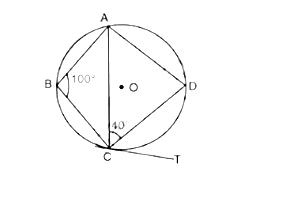
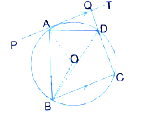
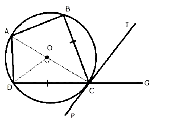
In the given circle with center o, ∠ABC=100°, ∠ACD=40° and CT is tangent to the circle at C. find ∠ADC and ∠DCT. 

 
Answer
$\angle A B C+\angle A D C=180^{\circ}$
(Opposite angle of a cydic quadrilateral are supplementary)
$
\begin{aligned}
& \Rightarrow 100^{\circ}+\angle A D C=180^{\circ} \\
& \Rightarrow \angle A D C=80^{\circ}
\end{aligned}
$
Now, in $\triangle A C D$,
$
\begin{aligned}
& \angle A D C+\angle C A D+\angle A D C=180^{\circ} \\
& \Rightarrow 40^{\circ}+\angle C A D+80^{\circ}=180^{\circ} \\
& \Rightarrow \angle C A D=180^{\circ}-120^{\circ} \\
& \Rightarrow \angle C A D=60^{\circ}
\end{aligned}
$
Now $\angle D C T=\angle C A D$ (angles in the alternate segment are equal)
$
\therefore \angle D C T=60^{\circ}
$
View full question & answer
Question 74 Marks
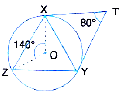
In the figure, given below, O is the centre of the circumcircle of triangle XYZ.

Tangents at X and Y intersect at point T. Given ∠XTY = 80°, and ∠XOZ = 140°, calculate the  value of ∠ZXY.
View full question & answer
Question 84 Marks
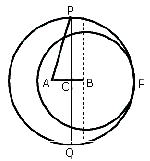
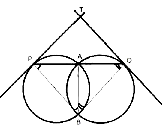
Two circle with centres A and B, and radii 5 cm and 3 cm, touch each other internally. If the perpendicular bisector of the segment AB meets the bigger circle in P and Q; find the length of PQ.
View full question & answer
Question 94 Marks
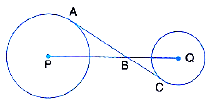
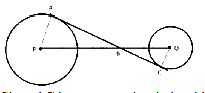
In the figure, given below, AC is a transverse common tangent to two circles with centres P and Q and of radii 6 cm and 3 cm respectively.

Given that AB = 8 cm, calculate PQ.
View full question & answer
Question 104 Marks
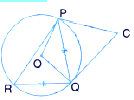
In the following figure, $PQ = QR , \angle RQP =68^{\circ}, PC$ and $CQ$ are tangents to the circle with centre $O$

(i) $\angle QOP$
(ii) $\angle QCP$
Answer
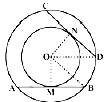
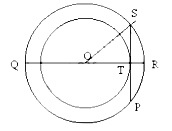
Consider two concentric circles with centres at $O$. Let $A B$ and $C D$ be two chords of the outer circle which touch the inner circle at the points $M$ and $N$ respectively.

To prove the given question, it is sufficient to prove $A B=C D$.
For this join OM, ON, OB and OD.
Let the radius of outer and inner circles be $R$ and $r$ respectively.
$A B$ touches the inner circle at $M$.
$A B$ is a tangent to the inner circle
$
\begin{aligned}
& \therefore OM \perp AB \\
& \Rightarrow BM =\frac{1}{2} AB \\
& \Rightarrow AB =2 BM
\end{aligned}
$Similarly $ON \perp CD$, and $CD =2 DN$
Using Pythagoras theorem in $\triangle OMB$ and $\triangle OND$
$
\begin{aligned}
& O B^2=O M^2+B M^2, O D^2=O N^2+D M^2 \\
& \Rightarrow B M=\sqrt{R^2-r^2}, D N=\sqrt{R^2-r^2}
\end{aligned}
$Now,
$
\begin{aligned}
& A B=2 B M=2 \sqrt{R^2-r^2}, C D=2 D N=2 \sqrt{R^2-r^2} \\
& \therefore AB = CD
\end{aligned}
$Hence proved.
View full question & answer
Question 114 Marks
In two concentric circles, prove that all chords of the outer circle, which touch the inner circle, are of equal length.
Answer
$
\begin{aligned}
& \text { i) } PQ = RQ \\
& \therefore \angle PRQ =\angle QPR \text { (opposite angles of equal sides of a triangle) } \\
& \Rightarrow \angle PRQ +\angle QPR +68^{\circ}=180^{\circ} \\
& \Rightarrow \angle 2 PRQ =180^{\circ}-68^{\circ} \\
& \Rightarrow \angle PRQ =\frac{112^{\circ}}{2}=56^{\circ}
\end{aligned}
$Now, $\angle QOP =2 \angle PRQ$ (angle at the centre is double)
$
\Rightarrow QOP =2 \times 56^{\circ}=112^{\circ}
$
ii) $\angle PQC =\angle PRQ$ (angles in alternate segments are equal) $\angle QPC =\angle PRQ$ (angles in alternate segments)
$
\begin{aligned}
& \therefore \angle PQC =\angle QPC =56^{\circ}\left(\because \angle PRQ =56^{\circ} \text { from }( i )\right) \\
& \angle PQC +\angle QPC +\angle QCP =180^{\circ} \\
& \Rightarrow 56^{\circ}+56^{\circ}+\angle QCP =180^{\circ} \\
& \Rightarrow \angle QCP =68^{\circ}
\end{aligned}
$
View full question & answer
Question 124 Marks
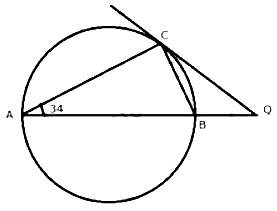
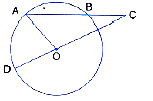
In the given figure, AB is the diameter. The tangent at C meets AB produced at Q.

If ∠ CAB = 34° , find : ∠ CQB
Answer
QC is tangent to the circle
∴ ∠ CAB  = ∠ QCB
Angle between tangent and chord = angle in alternate segment
∴ ∠ QCB =  34°
ABQ is a straight line
⇒ ∠ ABC + ∠ CBQ = 180°
⇒ 56° + ∠ CBQ = 180°
⇒ CBQ = 124°
Now,
∠ CQB  = 180° - ∠ QCB  = CBQ
⇒ ∠ CQB  = 180° - 34°- 124°
⇒ ∠ CQB   =  22°
View full question & answer
Question 134 Marks
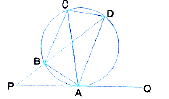
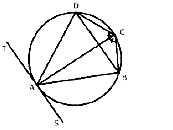
In the given figure, QAP is the tangent at point A and PBD is a straight line.

If ∠ACB = 36° and ∠APB = 42°, find:
(i) ∠BAP (ii) ∠ABD (iii) ∠QAD (iv) ∠BCD
Answer
$PAQ$ is a tangent and $AB$ is a chord of the circle.
i) $\therefore \angle B A P=\angle A C B \quad 36$ (angles in alternate segment)
ii) In $\triangle APB$Ext $\angle ABD =\angle APB +\angle BAP$
$\Rightarrow$ Ext $\angle A B D=42^{\circ}+36^{\circ}=78^{\circ}$
iii) $\angle ADB =\angle ACB =36^{\circ}$ (angles in the same segment)Now in $\triangle PAD$
Ext. $\angle QAD =\angle APB +\angle ADB$
$\Rightarrow$ Ext $\angle QAD =42^{\circ}+36^{\circ}=78^{\circ}$
iv) PAQ is the tangent and $A D$ is chord
$\therefore QAD =\angle ACD =78^{\circ}$ (angles in alternate segment)
And $\angle B C D=\angle A C B+\angle A C D$
$\therefore \angle BCD =36^{\circ}+78^{\circ}=114^{\circ}$
View full question & answer
Question 144 Marks
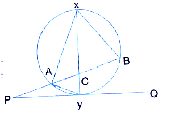
In the given figure, XY is the diameter of the circle and PQ is a tangent to the circle at Y.

If ∠AXB = 50° and ∠ABX = 70° and ∠BAY and ∠APY
Answer
In $\triangle AXB$,
$
\begin{aligned}
& \left.\angle XAB +\angle AXB +\angle ABX =180^{\circ} \text { [Triangle property }\right] \\
& \Rightarrow \angle XAB +50^{\circ}+70^{\circ}=180^{\circ} \\
& \Rightarrow \angle XAB =180^{\circ}-120^{\circ}=60^{\circ} \\
& \Rightarrow \angle XAY =90^{\circ}[\text { Angle of semi-circle }] \\
& \therefore \angle BAY =\angle XAY -\angle XAB =90^{\circ}-60^{\circ}=30^{\circ}
\end{aligned}
$
and $\angle B X Y=\angle B A Y=30^{\circ}$ [Angle of same segment]
$\angle A C X=\angle B X Y+\angle A B X[$ External angle $=$ Sum of two interior angles]
$
\begin{aligned}
& =30^{\circ}+70^{\circ} \\
& =100^{\circ}
\end{aligned}
$
also,
$
\begin{aligned}
& \angle XYP =90^{\circ}[\text { Diameter } \perp \text { tangent }] \\
& \angle APY =\angle ACX -\angle CYP \\
& \angle APY =100^{\circ}-90^{\circ} \\
& \angle APY =10^{\circ}
\end{aligned}
$
View full question & answer
Question 154 Marks
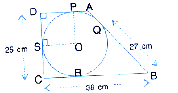
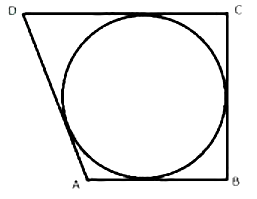
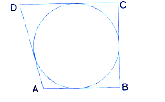
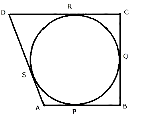
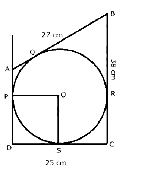
In the following figure, a circle is inscribed in the quadrilateral ABCD.

If BC = 38 cm, QB = 27 cm, DC = 25 cm and that AD is perpendicular to DC, find the radius of the circle.
 
Answer
From the figure we see that $BQ = BR =27 cm$ (since length of the tangent segments from an external point are equal)
$
\begin{aligned}
& \text { As } B C=38 cm \\
& \Rightarrow C R=C B-B R=38-27 \\
& =11 cm
\end{aligned}
$
Again,
$C R=C S=11 cm$ (length of tangent segments from an external point are equal)
Now, as DC $=25 cm$
$
\begin{aligned}
& \therefore D S=D C-S C \\
& =25-11 \\
& =14 cm
\end{aligned}
$
Now, in quadrilateral DSOP,
$\angle PDS =90^{\circ}$ (given)
$\angle OSD =90^{\circ}, \angle OPD =90^{\circ}$ (since tangent is perpendicular to the radius through the point of contact)
$\Rightarrow$ DSOP is a parallelogram
$\Rightarrow OP \| SD$ and $\Rightarrow PD \| OS$
Now, as OP $=$ OS (radii of the same circle)
$\Rightarrow$ OPDS is a square. $\therefore D S=O P=14 cm$
$\therefore$ radius of the circle $=14 cm$
View full question & answer
Question 164 Marks
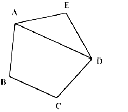
Prove that any four vertices of a regular pentagon are concylic (lie on the same circle)
View full question & answer
Question 174 Marks
Two circles intersect in points P and Q. A secant passing through P intersects the circles in Aand B respectively. Tangents to the circles at A and B intersect at T. Prove that A, Q, B and T lie on a circle.
View full question & answer
Question 184 Marks
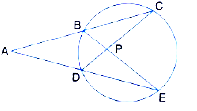
In the given figure, PAT is tangent to the circle with centre O at point A on its circumference and is parallel to chord BC. If CDQ is a line segment , show that:
(i) ∠BAP = ∠ADQ
(ii) ∠AOB = 2∠ADQ
(iii) ∠ADQ = ∠ADB
Answer
i) Since PAT || BC
$\therefore \angle PAB =\angle ABC$ (alternate angles)
In cyclic quadrilateral $A B C D$,
Ext $\angle A D Q=\angle A B C$
From (i) and (ii)
$
\angle PAB =\angle ADQ
$
ii) Arc $A B$ subtends $\square A O B$ at the centre and $\triangle A D B$ at the remaining part of the circle.
$
\begin{aligned}
& \therefore \angle AOB =2 \angle ADB \\
& \Rightarrow \angle AOB =2 \angle PAB \text { (angles in alternate segments) } \\
& \Rightarrow \angle AOB =2 \angle ADQ \text { (proved in (i) part) }
\end{aligned}
$
iii)
$
\begin{aligned}
& \therefore \angle BAP =\angle ADB \text { (angles in alternate segments) } \\
& \text { But } \\
& \angle BAP =\angle ADQ \text { (proved in (i) part) } \\
& \therefore \angle ADQ =\angle ADB
\end{aligned}
$
View full question & answer
Question 194 Marks
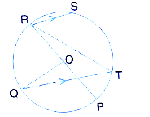
The given figure shows a circle with centre O such that chord RS is parallel to chord QT, angle PRT = 20° and angle POQ = 100°. Calculate:
(i) angle QTR
View full question & answer
Question 204 Marks
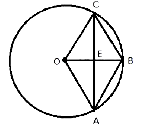
OABC is a rhombus whose three vertices A, B and C lie on a circle with centre O.
(ii) If the area of the rhombus is 32 3 cm2 find the radius of the circle.
View full question & answer
Question 214 Marks
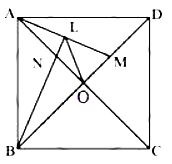
In a square ABCD, its diagonal AC and BD intersect each other at point O. The bisector of angle DAO meets BD at point M and bisector of angle ABD meets AC at N and AM at L. Show that -  ∠ BAM = ∠ BMA
View full question & answer
Question 224 Marks
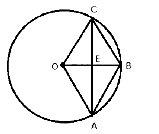
OABC is a rhombus whose three vertices A, B and C lie on a circle with centre O.
(i) If the radius of the circle is 10 cm, find the area of the rhombus
Answer

$\begin{aligned} & \text { i) Radius }=10 cm \\ & \text { In rhombus } O A B C \text {, } \\ & O C=10 cm \\ & \therefore O E=\frac{1}{2} \times O B=\frac{1}{2} \times 10=5 cm \\ & \text { In Rt. } \triangle O C E \text {, } \\ & O C^2=O E^2+E C^2 \\ & \Rightarrow 10^2=5^2+E C^2 \\ & \Rightarrow E C^2=100-25=75 \\ & \Rightarrow E C=5 \sqrt{3} \\ & \therefore A C=2 \times E C=2 \times 5 \sqrt{3}=10 \sqrt{3} \\ & \text { Area of rhombus }=\frac{1}{2} \times O B \times A C \\ & =\frac{1}{2} \times 10 \times 10 \sqrt{3} \\ & =50 \sqrt{3} cm ^2 \approx 86.6 cm ^2(\sqrt{3}=1.73)\end{aligned}$
View full question & answer
Question 234 Marks
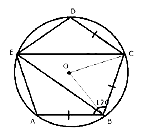
ABCDE is a cyclic pentagon with centre of its circumcircle at point O such that AB = BC = CD and angle ABC = 120°
Calculate :  ∠BEC 
View full question & answer
Question 244 Marks
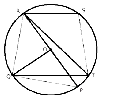
In the given figure, AC = AE Show that:
(i) CP = EP
(ii) BP = DP

 
Answer
In $\triangle A D C$ and $\triangle A B E$,
$\angle A C D=\angle A E B$ (angles in the same segment)
$AC = AE$ (Given)
$\angle A=\angle A($ common)
$\therefore \triangle ADC \cong \triangle ABE$ (ASA postulate)
$\Rightarrow A B=A D$
But $A C=A E$
$\therefore A C-A B=A E-A D$
$\Rightarrow BC = DE$
In $\triangle BPC$ and $\triangle DPE$
$\angle C =\angle E$ (angles in the same segment)
$BC = DE$
$\angle CBP =\angle CDE$ (angles in the same segment)
$\therefore \triangle BPC \cong \triangle DPE$ (ASA Postulate)
$\Rightarrow BP = DP$ and $CP = PE$ (cpct)
View full question & answer
Question 254 Marks
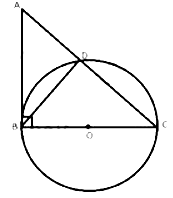
$ABC$ is a right triangle with angle $B = 90^\circ . A$ circle with $BC$ as diameter meets by hypotenuse $AC$ at point $D.$
Prove that $- BD^2 = AD \times DC.$
Answer

$\text { In } \triangle ADB ,$
$ \angle D =90^{\circ}$
$ \therefore \angle A +\angle ABD =90^{\circ}$
But in $\triangle ABC , \angle B =90$
$\therefore \angle A +\angle C =90$
From $(i)$ and $(ii)$
$\angle C=\angle ABD$
Now in $\triangle A B D$ and $\triangle C B D$
$\angle BDA =\angle BDA =90^{\circ}$
$ \angle ABD =\angle BCD$
$ \therefore \triangle ABD \sim \triangle CBD \text { (AA postulate) }$
$ \therefore \frac{ BD }{ DC }=\frac{ AD }{ DP }$
$ \Rightarrow BD ^2=A D \times D C$
View full question & answer
Question 264 Marks
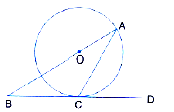
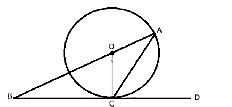
The given figure shows a circle with centre O and BCD is tangent to it at C. Show that: ∠ACD + ∠BAC = 90°
View full question & answer
Question 274 Marks
In the figure, AB is the chord of a circle with centre O and DOC is a line segment such that BC = DO. If ∠C = 20°, find angle AOD.
View full question & answer
Question 284 Marks
Bisectors of vertex angles $A, B$, and $C$ of a triangle $A B C$ intersect its circumcircle at the points $D, E$ and $F$ respectively. Prove that angle EDF $=90^{\circ}-\frac{1}{2} \angle A$
View full question & answer
Question 294 Marks
In a cyclic quadrilateral ABCD, the diagonal AC bisects the angle BCD. Prove that the diagonal BD is parallel to the tangent to the circle at point A.
View full question & answer
Question 304 Marks
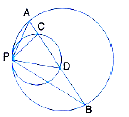
Two circles touch each other internally at a point P. A chord $A B$ of the bigger circle intersects the other circle in $C$ and $D$. Prove that $\angle CPA =\angle DPB$.
View full question & answer
Question 314 Marks
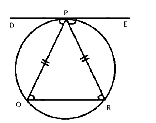
Tangent at P to the circumcircle of triangle PQR is drawn. If the tangent is parallel to side, QR show that ΔPQR is isosceles.
View full question & answer
Question 324 Marks
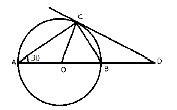
AB is the diameter and AC is a chord of a circle with centre O such that angle BAC = 30°. The tangent to the circle at C intersects AB produced in D. show that BC = BD.
View full question & answer
Question 334 Marks
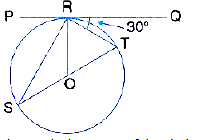
If PQ is a tangent to the circle at R; calculate:
(i) ∠PRS
(ii) ∠ROT 

Given :  O is the centre of the circle and angle TRQ = 30°
Answer
PQ is a tangent and OR is the radius.
∴ OR ⊥  PQ
∴ ∠ ORT = 90°
⇒∠ TRQ = 90° - 30° = 60°
But in Δ OTR ,
OT = OR (Radii of the same circle)
∴ ∠ OTR = 60° Or ∠ STR = 60°
But,
∠ PRS = ∠ STR = 60 (Angle in the alternate segment)
In ΔORT,
∠ ORT  = 60°
∠ OTR =60°
∴ ∠ ROT = 180° - (60° +60° ) 
∴ ∠ ROT = 180°  - 120° = 60°
View full question & answer
Question 344 Marks
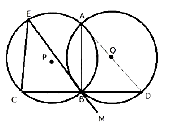
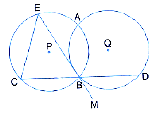
Circles with centres P and Q intersect at points A and B as shown in the figure. CBD is a segment and EBM is tangent to the circle with centre Q, at point B. If the circle are congruent; show that
CE = BD
View full question & answer
Question 364 Marks
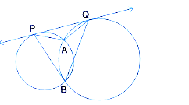
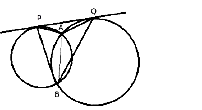
Two circles intersect each other at points A and B. their common tangent touches the circles at points P and Q as shown in the figure. Show that the angles PAQ and PBQ are supplementary.
View full question & answer
Question 374 Marks
Two circles intersect each other at points A and B. A straight line PAQ cuts the circles at P and Q. If the tangents at P and Q intersect at point T; show that the points P, B, Q and T are concyclic
View full question & answer
Question 384 Marks
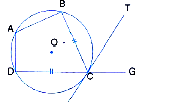
In the figure, ABCD is a cyclic quadrilateral with BC = CD. TC is tangent to the circle at point C and DC is produced to point G. If ∠BCG = 108° and O is the centre of the circle, find : Angle BCT

Answer

Join OC, OD and AC
∠ BCG + ∠ BCD = 180° (Linear pair)
⇒ 180 °+  ∠ BCD  = 180°
⇒ ∠ BCD = 180°  - 108°  =72°
BC = CD
∴ ∠ DCP = ∠ BCT
But, ∠ BCT + ∠ BCD + ∠ DCP = 180°
∴ ∠ BCT  + ∠ BCT + 72° = 180°
2 ∠ BCT = 180°  - 72°
∠ BCT = 54°
View full question & answer
Question 394 Marks
From the given figure, prove that:
$
AP + BQ + CR = BP + CQ + AR
$

Also show that:
$
A P+B Q+C R=\frac{1}{2} \times \text { Perimeter of } \triangle A B C \text {. }
$
Answer
Since from $B, B Q$ and $B P$ are the tangents to the circle
Therefore, $BQ = BP$
Similarly, we can prove that
$AP = AR$
and $C R=C Q$
Adding,
$
AP + BQ + CR = BP + CQ + AR
$
Adding $A P+B Q+C R$ to both sides
$
\begin{aligned}
& 2(A P+B Q+C R)=A P+P Q+C Q+Q B+A R+C R \\
& 2(A P+B Q+C R)=A B+B C+C A
\end{aligned}
$Therefore, $A P+B Q+C R=\frac{1}{2} \times(A B+B C+C A)$
$A P+B Q+C R=\frac{1}{2} \times$ perimeter of triangle $A B C$
View full question & answer
Question 404 Marks
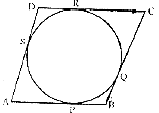
If the sides of a parallelogram touch a circle in following figure , Prove that the parallelogram is a rhombus.
Answer

From A, AP and AS are tangents to the circle.
Therefore, AP = AS.......(i)
Similarly, we can prove that:
BP = BQ .........(ii)
CR = CQ .........(iii)
DR = DS .........(iv)
Adding,
AP + BP + CR + DR = AS + DS + BQ + CQ
AB + CD = AD + BC
Hence, AB + CD = AD + BC
But AB = CD and BC = AD.......(v) Opposite sides of a ||gm
Therefore, AB + AB = BC + BC
2AB = 2 BC
AB = BC ........(vi)
From (v) and (vi)
AB = BC = CD = DA
Hence, ABCD is a rhombus
View full question & answer
Question 414 Marks
If the sides of a quadrilateral ABCD touch a circle, prove that:
AB + CD = BC + AD
Answer

Let the circle touch the sides AB, BC, CD and DA of quadrilateral ABCD at P, Q, R and S respectively.
Since AP and AS are tangents to the circle from external point A
AP = AS .......(i)
Similarly, we can prove that:
BP = BQ .......(ii)
CR = CQ .......(iii)
DR = DS ........(iv)
Adding,
AP + BP + CR + DR = AS + DS + BQ + CQ
AB + CD = AD + BC
Hence, AB + CD = AD + BC
View full question & answer
Question 434 Marks
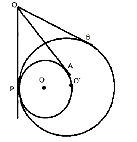
Two circle touch each other internally. Show that the tangents drawn to the two circles from any point on the common tangent are equal in length.
Answer

From Q, QA and QP are two tangents to the circle with centre O
Therefore, QA = QP .......(i)
Similarly, from Q, QB and QP are two tangents to the circle with centre O'
Therefore, QB = QP .......(ii)
From (i) and (ii)
QA = QB
Therefore, tangents QA and QB are equal.
View full question & answer
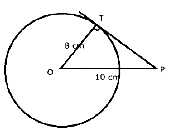
Question 444 Marks
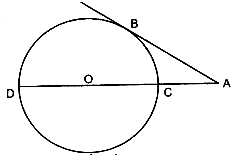
In the given figure, O is the center of the circle and AB is a tangent at B. If AB = 15 cm and AC = 7.5 cm, calculate the radius of the circle.
Answer
$
A B=15 cm , A C=7.5 cm
$
Let ' $r$ ' be the radius of the circle.
$
\begin{aligned}
& \therefore O C=O B=r \\
& A O=A C+O C=7.5+r \\
& \ln \triangle A O B, \\
& A O^2=A B^2=O B^2 \\
& (7.5+r)^2=15^2+r^2 \\
& \Rightarrow\left(\frac{15+2 r}{2}\right)^2=225+r^2 \\
& \Rightarrow 225+4 r^2+60 r=900+4 r^2 \\
& \Rightarrow 60 r =675 \\
& \Rightarrow r =11.25 cm
\end{aligned}
$
Therefore, $r=11.25 cm$
View full question & answer
Question 454 Marks
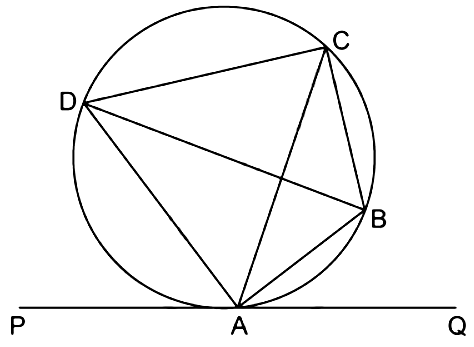
In the given figure, PQ is a tangent to the circle at A. AB and AD are bisectors of ∠CAQ and ∠PAC. If ∠BAQ = 30°, prove that : BD is diameter of the circle.
Answer
∠CAB = ∠BAQ = 30°……(AB is angle bisector of ∠CAQ) 
∠CAQ = 2∠BAQ = 60°……(AB is angle bisector of ∠CAQ)
∠CAQ + ∠PAC = 180°……(angles in linear pair)
∴∠PAC = 120°
∠PAC = 2∠CAD……(AD is angle bisector of ∠PAC) 
∠CAD = 60° 
Now,
∠CAD + ∠CAB = 60 + 30 = 90° 
∠DAB = 90° 
Thus, BD subtends 90° on the circle
So, BD is the diameter of circle
View full question & answer
Question 464 Marks
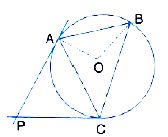
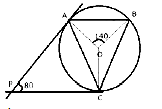
In the given figure, O is the centre of the circumcircle ABC. Tangents at A and C intersect at P. Given angle AOB = 140° and angle APC = 80°; find the angle BAC.
View full question & answer
Question 474 Marks
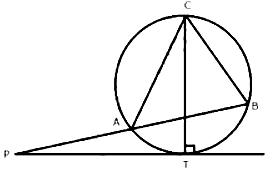
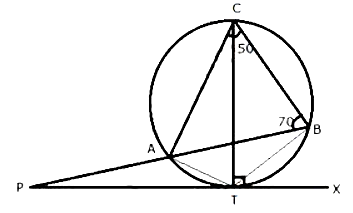
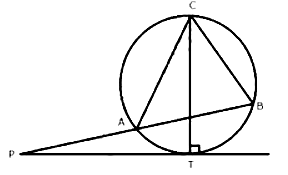
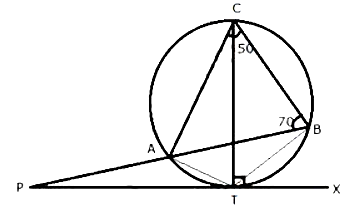
PT is a tangent to the circle at T. If ∠ ABC = 70° and ∠ ACB = 50° ; calculate : ∠ APT
Answer

Join AT and BT.
∠ BTX = ∠ TCB = 30° (Angles in the same segment)
∴ ∠ PTB = 180° - 30° = 150°
Now in Δ PTB ,
∠APT + ∠ PTB + ∠ ABT = 180°
⇒ ∠APT +  150° + 20° = 180°
⇒ ∠APT = 180° - 170° = 10°
View full question & answer
Question 484 Marks
PT is a tangent to the circle at T. If ∠ ABC = 70° and ∠ ACB = 50° ; calculate : ∠ APT
Answer

Join AT and BT.
∠ CBA = 70°
∴ ∠ABT = ∠CBT - ∠CBA = 90° - 70° = 20°
Now , ∠ ACT = ∠ABT = 20°  (Angles the same segment of the circle)
∴ ∠TCB = ∠ACB - ∠ACT = 50° - 20° = 30°
But , ∠TCB = ∠TAB (Angles in the same segment of the circle)
But , ∠TCB or ∠BAT = 30° 
View full question & answer
Question 494 Marks
In quadrilateral ABCD; angles D = 90°, BC = 38 cm and DC = 25 cm. A circle is inscribed in this quadrilateral which touches AB at point Q such that QB = 27 cm, Find the radius of the circle.
Answer

$B Q$ and $B R$ are the tangents from $B$ to the circle.
Therefore, $BR = BQ =27 cm$.
Also $RC =(38-; 27)=11 cm$
Since $C R$ and $C S$ are the tangents from $C$ to the circle
Therefore, $C S=C R=11 cm$
So, DS $=(25-11)=14 cm$
Now DS and DP are the tangents to the circle
Therefore, $DS = DP$
Now, $\angle PDS =90^{\circ}$ (given)
and $OP \perp AD , OS \perp DC$
therefore, radius $= DS =14 cm$
View full question & answer
[4 marks sum] - Mathematics STD 10 Questions - Vidyadip