Questions

[5 marks sum]

🎯

Test yourself on this topic

13 questions · timed · auto-graded

Question 15 Marks
AB is a line segment and M is its mid – point three semi circles are drawn with AM, MB and AB as diameter on the same side of the line AB. A circle with radius r unit is drawn so  that it  touches all the three semi circles show that : AB = 6 × r
Answer
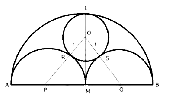
Let $O, P$ and $Q$ be the centers of the circle and semicircles. Join $O P$ and $O Q$.
$
O R=O S=r
$
and $AP = PM = MQ = QB =\frac{A B}{4}$
Now, $OP = OR + RP = r +\frac{A B}{4}$ (since $PM = RP =$ radii of same circle)Similarly, $OQ = OS + SQ = r +\frac{A B}{4}$
$
OM = LM -; OL =\frac{A B}{2}- r
$Now in Rt. $\triangle O P M$,
$
\begin{aligned}
& O P^2=P M^2+O M^2 \\
& \Rightarrow\left(r=\frac{A B}{4}\right)^2=\left(\frac{A B}{4}\right)^2+\left(\frac{A B}{2}-r\right)^2
\end{aligned}
$$
\begin{aligned}
& \Rightarrow r^2+\frac{ AB ^2}{16}+\frac{ rAB }{2}=\frac{ AB ^2}{16}+\frac{ AB ^2}{4}+r^2-r A B \\
& \Rightarrow \frac{ rAB }{2}=\frac{ AB ^2}{4}-r A B \\
& \Rightarrow \frac{ AB ^2}{4}=\frac{ rAB }{2}+r A B \\
& \Rightarrow \frac{ AB ^2}{4}=\frac{3 rAB }{2} \\
& \Rightarrow \frac{ AB }{4}=\frac{3}{2} r \\
& \Rightarrow A B=\frac{3}{2} r \times 4=6 r
\end{aligned}
$Hence $A B=6 \times r$
View full question & answer
Question 25 Marks
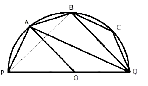
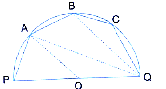
The given figure shows a semi-circle with centre O and diameter PQ. If PA = AB and ∠BCQ =140°; Find measures of angles PAB and AQB. Also, show that AO is parallel to BQ.
Answer

Join PB.
i) In cyclic quadrilateral $PBCQ$,
$
\begin{aligned}
& \angle BPQ +\angle BCQ =180^{\circ} \\
& \Rightarrow \angle BPQ +140^{\circ}=180^{\circ} \\
& \Rightarrow \angle BPQ =40^{\circ} \ldots \ldots . .(1)
\end{aligned}
$Now in $\triangle PBQ$,
$
\begin{aligned}
& \angle PBQ + BPQ +\angle BQP =180^{\circ} \\
& \Rightarrow 90^{\circ}+40^{\circ}+\angle BQP =180^{\circ} \\
& \Rightarrow \angle BQP =50^{\circ}
\end{aligned}
$In cyclic quadrilateral $PQBA$,
$
\begin{aligned}
& \angle PQB +\angle PAB =180^{\circ} \\
& \Rightarrow 50^{\circ}+\angle PAB =180^{\circ} \\
& \Rightarrow \angle PAB =130^{\circ}
\end{aligned}
$
ii) Now in $\triangle PAB$,
$
\begin{aligned}
& \angle PAB +\angle APB + ABP =180^{\circ} \\
& \Rightarrow 130^{\circ}+\angle APB +\angle ABP =180^{\circ} \\
& \Rightarrow \angle APB +\angle ABP =50^{\circ} \\
& \text { But } \\
& \angle APB =\angle ABP (\because PA = PB ) \\
& \therefore \angle APB =\angle ABP =25^{\circ} \\
& \angle BAQ =\angle BPQ =40^{\circ} \\
& \angle APB =25^{\circ}=\angle AQB \text { (angles in the same segment) }
\end{aligned}
$$
\therefore \angle AQB =25^{\circ}
$
iii) Arc AQ subtends $\angle A O Q a t$ the centre and $\angle A P Q$ at the remaining part of the circle.
We have,
$
\angle APQ =\angle APB +\angle BPQ
$From (1), (2) and (3), we have
$
\begin{aligned}
& \angle APQ =25^{\circ}+40^{\circ}=65^{\circ} \\
& \therefore \angle AOQ =2 \angle APQ =2 \times 65^{\circ}=130^{\circ}
\end{aligned}
$Now in $\triangle A O Q$,
$
\angle O A Q=\angle O Q A=(\because O A=O Q)
$But
$
\begin{aligned}
& \angle OAQ +\angle OQA +\angle AOQ =180^{\circ} \\
& \Rightarrow \angle OAQ +\angle OAQ +130^{\circ}=180^{\circ} \\
& \Rightarrow 2 \angle OAQ =50^{\circ} \\
& \Rightarrow \angle OAQ =25^{\circ} \\
& \therefore \angle OAQ =\angle AQB
\end{aligned}
$
But these are alternate angles.
Hence, $AO$ is parallel to $BQ$.
View full question & answer
Question 35 Marks
In a square ABCD, its diagonals AC and BD intersect each other at point O. the bisector of angle DAO meets BD at point M and the bisector of angle ABD meets AC at N and AM at L. Show that:
∠ ONL + ∠ OML = 180
View full question & answer
Question 45 Marks
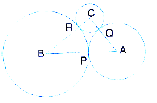
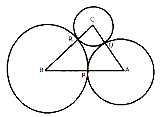
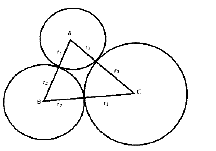
ABC is a triangle with AB = 10 cm, BC = 8 cm and AC = 6 cm (not drawn to scale). Three circle are drawn touching each other with the vertices as their centres. Find the radii of the three circles
View full question & answer
Question 55 Marks
Prove that, of any two chords of a circle, the greater chord is nearer to the centre.
View full question & answer
Question 65 Marks
Prove that the perimeter of a right triangle is equal to the sum of the diameter of its incircle and twice the diameter of its circumcircle.
View full question & answer
Question 75 Marks
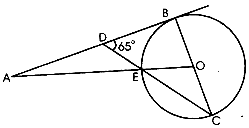
In the adjoining figure, O is the centre of the circle and AB is a tangent to it at point B. ∠BDC = 65° Find ∠BAO.
Answer
$A B$ is a straight line.
$
\begin{aligned}
& \therefore \angle ADE +\angle BDE =180^{\circ} \\
& \Rightarrow \angle ADE +65^{\circ}=180^{\circ} \\
& \Rightarrow \angle ADE =115^{\circ}
\end{aligned}
$
$A B$ i.e. $D B$ is tangent to the circle at point $B$ and $B C$ is the diameter.
$
\begin{aligned}
& \therefore \angle DB =90^{\circ} \\
& \operatorname{In} \triangle BDC \\
& \angle DBC +\angle BDC +\angle DCB =180^{\circ} \\
& \Rightarrow 90^{\circ}+65^{\circ}+\angle DCB =180^{\circ} \\
& \Rightarrow \angle DCB =25^{\circ}
\end{aligned}
$
Now, $O E=O C$ (radii of the same circle)
$
\therefore \angle DCB \text { or } \angle OCE =\angle OEC =25^{\circ}
$
Also,
$
\angle OEC =\angle DEC =25^{\circ}
$
(vertically opposite angles)
$
\begin{aligned}
& \text { In } \triangle ADE \\
& \angle ADE +\angle DEA +\angle DAE =180^{\circ} \\
& \text { From (i) and (ii) } \\
& 115^{\circ}+25^{\circ}+\angle DAE =180^{\circ} \\
& \Rightarrow \angle DAE \text { or } \angle BAO =180^{\circ}-140^{\circ}=40^{\circ} \\
& \therefore \angle BAO =40^{\circ}
\end{aligned}
$
View full question & answer
Question 85 Marks
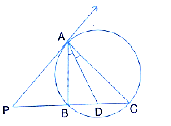
In the figure; $PA$ is a tangent to the circle, $PBC$ is secant and $AD$ bisects angle BAC. Show that triangle PAD is an isosceles triangle. Also, show that:
$
\angle C A D=\frac{1}{2}(\angle P B A-\angle P A B)
$
Answer
i) $PA$ is the tangent and $AB$ is a chord
$
\therefore \angle PAB =\angle C.....(i)
$
(angles in the alternate segment)
$A D$ is the bisector of $\angle B A C$
$
\begin{aligned}
& \therefore \angle 1=\angle 2 \ldots \ldots . . . \text { (ii) } \\
& \text { In } \triangle ADC \\
& \text { Ext. } \angle ADP =\angle C +\angle 1 \\
& \Rightarrow \text { Ext } \angle ADP =\angle PAB +\angle 2=\angle PAD
\end{aligned}
$
Therefore, $\triangle PAD$ is an isosceles triangle.
ii) In $\triangle A B C$,
$
\begin{aligned}
& \text { Ext. } \angle PBA =\angle C +\angle BAC \\
& \angle BAC =\angle PBA -\angle C \\
& \Rightarrow \angle 1+\angle 2=\angle P B A-\angle PAB
\end{aligned}
$
(fom (i) part)
$\begin{aligned} & 2 \angle 1=\angle P B A-\angle P A B \\ & \angle 1=\frac{1}{2}(\angle P B A-\angle P A B) \\ & \Rightarrow \angle C A D=\frac{1}{2}(\angle P B A-\angle P A B)\end{aligned}$
View full question & answer
Question 95 Marks
Three circles touch each other externally. A triangle is formed when the centres of these circles are joined together. Find the radii of the circle, if the sides of the triangle formed are 6 cm, 8 cm and 9 cm
View full question & answer
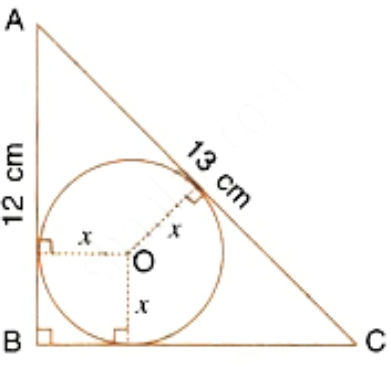
Question 105 Marks
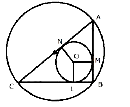
Answer
$
\text { In } \triangle A B C, \angle B=90^{\circ}
$
$OL \perp AB , OM \perp BC$ and $ON \perp AC$LBNO is a square
$
\begin{aligned}
& \angle B=B N=O L=O M=O N=x \\
& \therefore A L=12-x \\
& \therefore A L=A N=12-x
\end{aligned}
$
since $A B C$ is a right triangle
$
\begin{aligned}
& A C^2=A B^2+ BC ^2 \\
& \Rightarrow 13^2=12^2+ BC ^2 \\
& \Rightarrow 169=144+ BC ^2 \\
& \Rightarrow BC ^2=25 \\
& \Rightarrow BC =5
\end{aligned}
$
$\begin{aligned} & \therefore M C=5-X \\ & \text { but } C M=C N \\ & \therefore C N=5-X \\ & \text { Now }, A C=A N+N C \\ & 13=(12-x)+(5-x) \\ & 13=17-2 x \\ & 2 x=4 \\ & x=2 cm \end{aligned}$
View full question & answer
Question 115 Marks
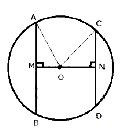
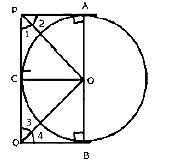
Two parallel tangents of a circle meet a third tangent at points P and Q. prove that PQ subtends a right angle at the centre.
View full question & answer
Question 125 Marks
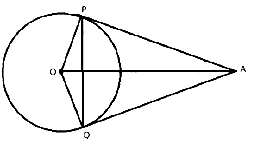
Tangents AP and AQ are drawn to a circle, with centre O, from an exterior point A. prove that: PAQ = 2 ∠OPQ
View full question & answer
Question 135 Marks
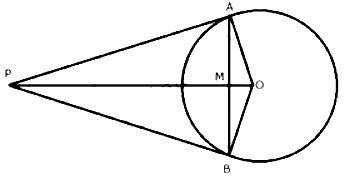
From a point P outside the circle, with centre O, tangents PA and PB are drawn. Prove that:
OP is the perpendicular bisector of chord AB.
Answer

In Δ OAM and Δ OBM
OA = OB (Radii of the same circle)
∠ AOM = ∠ BOM  (Proved ∠AOP = ∠BOP)
OM = OM (Common)
∴ By side angle side criterion ofcongruence,
Δ OAM ≅ Δ OBM
The corresponding parts of the congruent triangles are congruent.
⇒ AM = MB
and ∠OMA = ∠OMB = 180°
∴ ∠OMA = ∠OMB = 90°
Hence , OM or OP is the perpendicular bisector of chord AB.
View full question & answer
[5 marks sum] - Mathematics STD 10 Questions - Vidyadip