Question 14 Marks
Two men on either side of a temple 75 m high observed the angle of elevation of the top of the temple to be 30° and 60° respectively. Find the distance between the two men.
Answer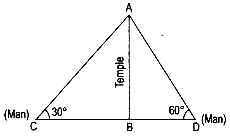
Given the height of the temple AB = 75 m.
Now in right-angled ΔABC,
$\Rightarrow \frac{ BC }{ AB }=\cot 30^{\circ}$
$\Rightarrow \frac{ BC }{ AB }=\sqrt{3}$
$\Rightarrow \frac{ BC }{75}=\sqrt{3}$
⇒ BC = 75√3 ....(i)
Also in right angled ΔABD,
$\Rightarrow \frac{ BD }{ AB }=\cot 60^{\circ}$
$\Rightarrow \frac{ BD }{75}=\frac{1}{\sqrt{3}}$
$\Rightarrow BD =\frac{75}{\sqrt{3}} \times \frac{\sqrt{3}}{\sqrt{3}}$
$\Rightarrow B D=25 \sqrt{ } 3$ ....(ii)
Now the distance between the two men = CD
= BC + BD
= 75√3 + 25√3
= 100√3
Hence, the distance between two men = 100√3 m = 173.2 m View full question & answer→Question 24 Marks
A man standing on the bank of a river observes that the angle of elevation of a tree on the opposite bank is 60°. When he moves 50 m away from the bank, he finds the angle of elevation to be 30°. Calculate:
(i) the width of the river;
(ii) the height of the tree.
Answer 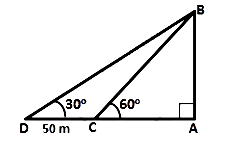
Let AB be the tree and AC be the width of the river. let D be a point such that CD - 50 m . Given that ∠BCA = 60° and ∠ BDA= 30°.
In Δ BAD,
$\frac{B A}{A D}=\tan 30^{\circ}$
$\Rightarrow B A=\frac{A D}{\sqrt{3}}$ ...(1)
In Δ BAC,
$\frac{B A}{A C}=\tan 60^{\circ}$
$\Rightarrow B A=A C \sqrt{3}$ ...(2)
From (1) and (2), we get
$\frac{A D}{\sqrt{3}}-A C \sqrt{3}$
⇒ (50 + AC)-3AC
∴ AC = 25 m
Thus , width of the river is 25 m .
from (2)
BA - 25 x 1.732 = 432.3 m
Hence , height of the tree is 43.3 m . View full question & answer→Question 34 Marks
From the top of a hill, the angles of depression of two consecutive kilometer stones, due east, are found to be 30° and 45° respectively. Find the distances of the two stones from the foot of the hill.
Answer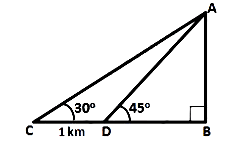
Let AB be the hill of height 'h' km and C and D be two consecutive stones such that CD= 1 km , ∠ACB = 30° and ∠ADB = 45°,
In ΔABD,
$\frac{A B}{B D}=\tan 45^{\circ}=1$
$\Rightarrow BD = h$
$\ln \triangle ABC ,$
$\frac{A B}{B C}=\tan 30^{\circ}$
$\Rightarrow \frac{h}{B C}=\frac{1}{\sqrt{3}}$
$\Rightarrow \frac{h}{h+1}=\frac{1}{\sqrt{3}}$
$\Rightarrow h=\frac{1}{\sqrt{3}-1}=\frac{\sqrt{3}+1}{2}=\frac{2.732}{2}=1.366 km .$
∴ BD = 1.366 km
BC = BD + DC = 1.366 + 1= 2.366 km.
Hence, the two stone are at a distance of 1.366 km and 2.366 km from the foot of the hill. View full question & answer→Question 44 Marks
From a lighthouse, the angles of depression of two ships on opposite sides of the lighthouse were observed to be $30^\circ$ and $45^\circ.$ If the height of the lighthouse is $90$ metres and the line joining the two ships passes through the foot of the lighthouse, find the distance between the two ships, correct to two decimal places.
Answer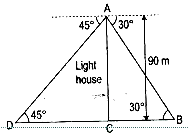
Let AB is the lighthouse, C and D are the position of two ships.
From right-angled ΔABC,
$\tan 30^{\circ}=\frac{A C}{B C}$
$\Rightarrow \frac{1}{\sqrt{3}}=\frac{90 m}{B C}$
$\Rightarrow B C=[90 \times \sqrt{ } 3] m $
$\therefore BC = 155.88 m$
Again, from right angled $\triangle ACD,$
$\tan 45^{\circ}=\frac{ AC }{ CD }$
$\Rightarrow 1=\frac{90 m }{ CD }$
$\Rightarrow CD = 90 m$
Hence, the distance between the two ships
$= BC + Cd$
$= 155.88 + 90 m$
$= 245.88 m$ View full question & answer→Question 54 Marks
The angle of elevation of a cloud from a point 200 metres above a lake is 30° and the angle of depression of its reflection in the lake is 60°. Find the height of the cloud.
Answer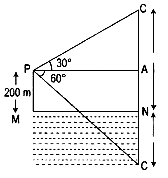
Let P be the point of observation and C, the position of cloud. CN ⊥ from C on the surface of the lake and C' be the reflection of the cloud in the lake so that
CN = NC' = x (say)
Then, PM = 200 m
∴ AN = MP = 200 m
CA = CN - AN = ( x - 200 ) m
C'A = NC' + AN = ( x + 200 ) m
Let, PA = y m
Then in right angled ΔPAC,
$\Rightarrow \frac{C A}{P A}=\tan 30^{\circ}$
$\Rightarrow \frac{x-200}{y}=\frac{1}{\sqrt{3}}$
⇒ y = √3( x - 200) ....(i)
Also, in right angled ΔC'AP,
$\Rightarrow \frac{C \prime A}{P A}=\tan 60^{\circ}$
$\Rightarrow \frac{x+200}{y}=\sqrt{3}$
⇒ x + 200 = √3y
$\Rightarrow y =\frac{x+200}{\sqrt{3}}$ .....(ii)
From (i) and (ii),
$\Rightarrow \frac{x+200}{\sqrt{3}}=\sqrt{3}(x-200)$
⇒ x + 200 = 3( x - 200)
⇒ x + 200 = 3x - 600
⇒ 2x = 800
⇒ x = 400
Hence, the height of the cloud = 400 m. View full question & answer→Question 64 Marks
Vertical tower is $20m$ high. A man standing at some distance from the tower knows that the cosine of the angle of elevation of the top of the tower is $0.53.$ How far is he standing from the foot of the tower?
Answer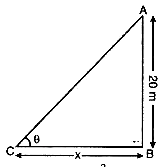
Given, $\cos \theta = 0.53$
Let the man is standing at a distance of $'x'$ m from the foot of the tower.
$\cos \theta=\frac{ BC }{ AC }=\frac{x}{\sqrt{x^2+400}}$
$ 0.53=\frac{x}{\sqrt{x^2+400}}$
$\Rightarrow(0.53)^2=\frac{x^2}{\sqrt{x^2+400}}$
$\Rightarrow 0.2809 x^2+112.36=x^2 $
$\Rightarrow x^2-0.2809 x^2=112.36$
$\Rightarrow x^2=\frac{112.36}{0.7191} $
$ \Rightarrow x^2=156.25 $
$ \Rightarrow x=12.5 \text { metres }$
$\therefore$ The man is standing from the foot of the tower be $12.5$ meter. View full question & answer→Question 74 Marks
A round balloon of radius 'a' subtends an angle θ at the eye of the observer while the angle of elevation of its centre is Φ. Prove that the height of the centre of the balloon is a sin Φ cosec $\frac{\theta}{2}$.
Answer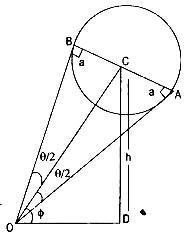
Let C be the centre of the balloon, O be the position of man's eye.
Let h be the height of the centre of the balloon.
Then, $\angle AOB = \theta $
So, $\angle BOC = \angle COA = \frac{\theta}{2}$
$\text { In } \triangle OAC ,$
$\sin \theta / 2=\frac{a}{ OC }$
$\Rightarrow OC = a \operatorname{cosec} \frac{\theta}{2}$
$\text { In } \triangle COD ,$
$\sin \Phi=\frac{h}{ OC }$
$\Rightarrow h=O C \sin \Phi$
$\Rightarrow h=a \operatorname{cosec} \frac{\theta}{2} \sin \Phi$
$\Rightarrow h=a \sin \Phi \cos e c \frac{\theta}{2}$ View full question & answer→Question 84 Marks
A man is standing on the deck of a ship, which is 10 m above water level. He observes the angle of elevation of the top of a hill as 60° and the angle of depression of the base of the hill as 30°. Calculate the distance of the hill from the ship and the height of the hill.
Answer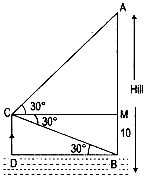
Let AB be the height of the hill.
In right-angled ΔBCD,
$\frac{ CD }{ DB }=\tan 30^{\circ}$
⇒ DB = 10√3 m.
In right-angled ΔAMC,
$\frac{ AM }{ CM }=\tan 60^{\circ}$
⇒ AM = √3 CM
⇒ AM = √3 DB = √3 x 10√3 = 30 m
Thus,
AB = AM + MB
AB = (30 + 10) m = 40 m
∴ Height of the hill be 40 m.
View full question & answer→Question 94 Marks
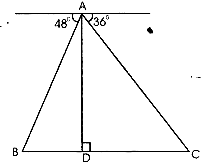
From the top of a lighthouse 100 m high the angles of depression of two ships on opposite sides of it are 48° and 36° respectively. Find the distance between the two ships to the nearest metre.
Answer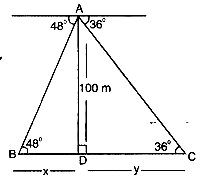
From right angle $\triangle ADC,$
$\frac{ AD }{ CD }=\tan 36^{\circ}$
$\frac{100}{y}=\tan 36^{\circ}$
$y=\frac{100}{\tan {36} ^{\circ}}$
$y=\frac{100}{0.7265}$
$y = 137.646\ m$
From right angle $\triangle ADB,$
$\frac{100}{x}=\tan 48^{\circ}$
$x=\frac{100}{1.1106}$
$x = 90.04\ m$
Distance between the ships $= x + y$
$= 137.638 + 90.04$
$= 227.678 m$
$= 228\ m$ (appro.) View full question & answer→Question 104 Marks
With reference to the given figure, a man stands on the ground at point A , which is on the same horizontal plane as $B$, the foot of the vertical pole $B C$. The height of the pole is 10 m . The man's eye $s 2 m$ above the ground. He observes the angle of elevation of $C$, the top of the pole, as $x^{\circ}$, where $\tan x^{\circ}=\frac{2}{5}$.
Calculate :
(i) the distance $A B$ in metres.
(ii) angle of elevation of the top of the pole when he is standing 15 metres from the pole. Give your answer to the nearest degree.
Answer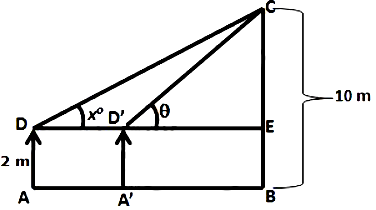
(i) Let AD be the height of the man, $AD =2 m$
$\therefore C E=(10-2)=8 m$
In $\triangle C E D$,
$\frac{C E}{D E}=\tan x^{\circ}=\frac{2}{5}$
$\Rightarrow \frac{8}{D E}=\frac{2}{5} \quad \Rightarrow D E=20 m$
Here $A B=D E$
$\therefore AB=20 m$
(ii) Let AD be the height of the man, $AD =2 m$.
$\therefore C E=(10-2)=8 m$
Let $A$ "D" be the new position of the man and $\theta$ be angle of elevation of the top of the tower.
so, $D'E = 15 m$
In $\triangle CED,$
$\tan \theta=\frac{C E}{D^{\prime} E}=\frac{8}{15}=0.533$
$\Rightarrow \theta=28^{\circ}$ View full question & answer→Question 114 Marks
Prove that $\sin^25^\circ + \sin^210^\circ$ .......... $+ \sin^285^\circ + \sin^290^\circ = 9 \frac{1}{2}$.
Answer$LHS$
$= \sin^25^\circ + \sin^210^\circ + \sin^215^\circ + \sin^220^\circ + \sin^225^\circ + \sin^230^\circ + \sin^235^\circ +$
$ \sin^240^\circ + in^2 45^\circ + \sin^250^\circ + \sin^255^\circ + \sin^260^\circ + $
$\sin^265^\circ + \sin^270^\circ + \sin^275^\circ + \sin^280^\circ + \sin^285^\circ + \sin^290^\circ .$
$= (\sin^25^\circ + \sin^285^\circ ) + (\sin^210^\circ + \sin^280^\circ ) + (\sin^215^\circ + \sin^275^\circ ) +$
$ (\sin^220^\circ + \sin^270^\circ ) + (\sin^225^\circ + \sin^265^\circ ) + (\sin^230^\circ + \sin^260^\circ )$
$ + (\sin^235^\circ + \sin^255^\circ ) + (\sin^240^\circ + \sin^250^\circ ) + \sin^2 45^\circ + \sin^290^\circ .$
$= (\sin^25^\circ + \cos^25^\circ ) + (\sin^210^\circ + \cos^210^\circ ) + (\sin^215^\circ + \cos^215^\circ )$
$ + (\sin^220^\circ + \cos^220^\circ ) + (\sin^225^\circ + \cos^225^\circ ) $
$+ (\sin^230^\circ + \cos^230^\circ ) + (\sin^235^\circ + \cos^235^\circ ) + (\sin^240^\circ + \cos^240^\circ ) + $
$\left(\frac{1}{\sqrt{2}}\right)^2+(1)^2 \ldots\left[\because \sin \left(90^{\circ}-\theta\right)=\cos \theta \because \sin 90^{\circ}=1\right.$ and $\left.\sin 45^{\circ}=\frac{1}{\sqrt{2}}\right]\left[\because \sin ^2 \theta+\cos ^2 \theta=1\right]$
$=1+1+1+1+1+1+1+1+\frac{1}{2}+1$
$=9 \frac{1}{2}$
$= RHS$
Hence proved.
View full question & answer→Question 124 Marks
Prove the following trigonometric identities.$\frac{1+\sin \theta}{\cos \theta}+\frac{\cos \theta}{1+\sin \theta}=2 \sec \theta$
AnswerWe have to prove $\frac{1+\sin \theta}{\cos \theta}+\frac{\cos \theta}{1}+\sin \theta-2 \sec \theta$
We know that, $\sin ^2 \theta+\cos ^2 \theta=1$
Multiplying the denominator and numerator of the second term by $(1-\sin \theta)$ we have
$\frac{1+\sin \theta}{\cos \theta}+\frac{\cos \theta}{1+\sin \theta}=\frac{1=\sin \theta}{\cos \theta}=\frac{\cos \theta(1-\sin \theta)}{(1+\sin \theta)(1-\sin \theta)} $
$=\frac{1+\sin \theta}{\cos \theta}=\frac{\cos \theta(1-\sin \theta)}{1-\sin \theta} $
$ =\frac{1+\sin \theta}{\cos \theta}+\frac{\cos \theta(1-\sin \theta)}{\cos ^2 \theta} $
$ =\frac{1+\sin \theta}{\cos \theta}+\frac{1-\sin \theta}{\cos \theta} $
$=\frac{1+\sin \theta+1-\sin \theta}{\cos \theta} $
$ =\frac{2}{\cos \theta} $
$ =2 \sec \theta$
View full question & answer→Question 134 Marks
Prove that $\sqrt{\frac{1-\sin \theta}{1+\sin \theta}}=\sec \theta-\tan \theta$
Answer$\text { L.H.S. }=\sqrt{\frac{(1-\sin \theta)(1-\sin \theta)}{(1+\sin \theta)(1-\sin \theta)}} $
$ =\sqrt{\frac{1+\sin ^2 \theta-2 \sin \theta}{1-\sin ^2 \theta}}$
$ =\sqrt{\frac{1+\sin ^2 \theta-2 \sin \theta}{\cos ^2 \theta}}$
$=\sqrt{\frac{1}{\cos ^2 \theta}+\frac{\sin ^2 \theta}{\cos ^2 \theta}-\frac{2 \sin \theta}{\cos \theta} \times \frac{1}{\cos \theta}}$
$ =\sqrt{\sec ^2 \theta+\tan ^2 \theta-2 \tan \theta \cdot \sec \theta} $
$ =\sqrt{(\sec \theta-\tan \theta)^2}$
$= sec \theta - tan \theta$
$= R.H.S.$
Hence proved.
View full question & answer→Question 144 Marks
Prove the following trigonometric identities.$\frac{\cos A}{1-\tan A}+\frac{\sin A}{1-\cot A}=\sin A+\cos A$
AnswerWe need to prove
$\frac{\cos A}{1-\tan A}+\frac{\sin A}{1-\cot A}=\sin A+\cos$
Solving the L.H.S, we get
$\frac{\cos A}{1-\tan A}+\frac{\sin A}{1-\cot A}=\frac{\cos A}{1-\frac{\sin A}{\cos A}}=\frac{\sin A}{1-\frac{\cos A}{\sin A}} $
$ =\frac{\cos A}{\frac{\cos A-\sin A}{\cos A}}+\frac{\sin A}{\frac{\sin A-\cos A}{\sin A}} $
$ =\frac{\cos ^2 A}{\cos A-\sin A}=\frac{\sin ^2 A}{\sin A-\cos A} $
$ =\frac{\cos ^2 A-\sin ^2 A}{\cos A-\sin A}$
$=\frac{(\cos A+\sin A)(\cos A-\sin A)}{\cos A-\sin A}$ [using $\left.a^2-b^2=(a+b)(a-b)\right]$
$= \cos A + \sin A$
$= RHS$
Hence proved.
View full question & answer→Question 154 Marks
Prove that $\left(\frac{1+\sin \theta-\cos \theta}{1+\sin \theta+\cos \theta}\right)^2=\frac{1-\cos \theta}{1+\cos \theta}$.
AnswerLHS $=\left(\frac{1+\sin \theta-\cos \theta}{1+\sin \theta+\cos \theta}\right)^2$
$\Rightarrow \frac{1+\sin ^2 \theta+\cos ^2 \theta+2(\sin \theta-\cos \theta-\sin \theta \cdot \cos \theta)}{1+\sin ^2 \theta+\cos ^2 \theta+2(\sin \theta+\cos \theta+\sin \theta \cdot \cos \theta)} $
$ =\frac{1+1+2(\sin \theta-\cos \theta-\sin \theta \cdot \cos \theta)}{1+1+2((\sin \theta+\cos \theta+\sin \theta \cdot \cos \theta)}$
$ =\frac{2(1+\sin \theta-\cos \theta-\sin \theta \cdot \cos \theta)}{2(1+(\sin \theta+\cos \theta+\sin \theta \cdot \cos \theta))} $
$ =\frac{1+\sin \theta-\cos \theta(1+\sin \theta)}{1+\sin \theta+\cos \theta(1+\sin \theta)} $
$=\frac{(1+\sin \theta)(1-\cos \theta)}{(1+\sin \theta)(1+\cos \theta)}$
$=\frac{1-\cos \theta}{1+\cos \theta} $
$=\text { RHS }$
Hence proved.
View full question & answer→Question 164 Marks
Prove that$\frac{\tan ^3 \theta}{1+\tan ^2 \theta}+\frac{\cot ^3 \theta}{1+\cot ^2 \theta}=\sec \theta \cdot \operatorname{cosec} \theta-2 \sin \theta \cos \theta$.
Answer$\text { LHS }=\frac{\tan ^3 \theta}{1+\tan ^2 \theta}+\frac{\cot ^3 \theta}{1+\cot ^2 \theta}$
$=\frac{\tan ^3 \theta}{\sec ^2 \theta}+\frac{\cot ^3 \theta}{\cos e c^2 \theta}$
$=\frac{\sin ^3 \theta}{\cos ^3 \theta} \times \cos ^2 \theta+\frac{\cos ^3 \theta}{\sin ^3 \theta} \times \sin ^2 \theta$
$=\frac{\sin ^3 \theta}{\cos \theta}+\frac{\cos ^3 \theta}{\sin \theta}$
$=\frac{\sin ^4 \theta+\cos ^4 \theta}{\cos \theta \cdot \sin \theta}$
$=\frac{\left(\sin ^2 \theta+\cos ^2 \theta\right)^2-2 \sin ^2 \theta \cdot \cos ^2 \theta}{\sin \theta \cdot \cos \theta}$
$=\frac{(1)^2-2 \sin ^2 \theta \cdot \cos ^2 \theta}{\sin \theta \cdot \cos \theta}$
$=\frac{1-2 \sin ^2 \theta \cdot \cos ^2 \theta}{\sin \theta \cdot \cos \theta}$
$=\frac{1}{\sin \theta \cdot \cos \theta}-\frac{2 \sin ^2 \theta \cdot \cos ^2 \theta}{\sin \theta \cdot \cos \theta}$
$= \sec \theta \cdot \operatorname{cosec} \theta-2 \sin \theta \cos \theta$.
$= RHS$
Hence proved.
View full question & answer→Question 174 Marks
Prove that $\frac{\sin A}{\sec A+\tan A-1}+\frac{\cos A}{\operatorname{cosec} A+\cot A-1}=1$
Answer$\text { LHS }=\frac{\sec A}{\sec A+\tan A-1}+\frac{\cos A}{\operatorname{cosec} A+\cot A-1} $
$=\frac{\sin A}{\frac{1}{\cos A}+\frac{\sin A}{\cos A}-1}+\frac{\cos A}{\frac{1}{\sin A}+\frac{\cos A}{\sin A}-1} $
$=\frac{\frac{\sin A}{1+\sin A-\cos A}}{\cos A}+\frac{\frac{\cos A}{1+\cos A-\sin A}}{\sin A}$
$=\frac{\sin A \cdot \cos A}{1+\sin A-\cos A}+\frac{\sin A \cdot \cos A}{1+\cos A-\sin A}$
$=\frac{\sin A \cdot \cos A(1+\cos A-\sin A+1+\sin A-\cos A)}{[1+(\sin A-\cos A)][1-(\sin A-\cos A)]}$
$=\frac{2 \sin A \cdot \cos A}{(1)^2-(\sin A-\cos A)^2}$
$=\frac{2 \sin A \cdot \cos A}{1-\left(\sin ^2 A+\cos ^2 A-2 \sin A \cdot \cos A\right)} $
$ =\frac{2 \sin A \cdot \cos A}{1-1+2 \sin A \cdot \cos A} $
$=\frac{2}{2}=1$
$= RHS$
Hence proved.
View full question & answer→Question 184 Marks
If $x \sin^3\theta + y \cos^3 \theta = \sin \theta \cos \theta $ and $x \sin \theta = y \cos \theta $ , then show that $x^2 + y^2 = 1.$
AnswerGiven: $x \sin^3 \theta + y \cos^3 \theta = \sin \theta . \cos \theta$
$\Rightarrow (x \sin \theta ) \sin^2\theta + (y \cos \theta ) \cos^2\theta = \sin \theta . \cos \theta$
$\Rightarrow (x \sin \theta ) \sin^2\theta + (x \sin \theta ) \cos^2\theta = \sin \theta . \cos \theta .....(\because y \cos \theta = x \sin \theta )$
$\Rightarrow x \sin \theta ( \sin^2\theta + \cos^2\theta ) = \sin \theta . \cos \theta$
$\Rightarrow x \sin \theta = \sin \theta . \cos \theta$
$\Rightarrow x = \cos \theta ....(1)$
Again $x \sin \theta = y \cos \theta$
$\Rightarrow \cos \theta \sin \theta = y \cos \theta$
$\Rightarrow y = \sin \theta .....(2)$
Squaring and adding $(1)$ and $(2)$, we get the required result.
Hence proved.
View full question & answer→Question 194 Marks
Prove that $\frac{\sin ^2 \theta}{\cos ^2 \theta}+\frac{\cos ^2 \theta}{\sin ^2 \theta}=\frac{1}{\sin ^2 \theta \cdot \cos ^2 \theta}-2$.
Answer$\text { LHS }=\frac{\sin ^2 \theta}{\cos ^2 \theta}+\frac{\cos ^2 \theta}{\sin ^2 \theta} $
$ =\frac{\sin ^4 \theta+\cos ^4 \theta}{\sin ^2 \theta \cdot \cos ^2 \theta}$
$=\frac{\left(\sin ^2 \theta+\cos ^2 \theta\right)^2-2\left(\sin ^2 \theta \cdot \cos ^2 \theta\right)}{\sin ^2 \theta \cdot \cos ^2 \theta} $
$ =\frac{(1)^2-2 \sin ^2 \theta \cdot \cos ^2 \theta}{\sin ^2 \theta \cdot \cos ^2 \theta} $
$ =\frac{1}{\sin ^2 \theta \cdot \cos ^2 \theta}-\frac{2 \sin ^2 \theta \cdot \cos ^2 \theta}{\sin ^2 \theta \cdot \cos ^2 \theta}$
$=\frac{1}{\sin ^2 \theta \cdot \cos ^2 \theta}-2 $
$ =\text { RHS }$
View full question & answer→Question 204 Marks
Prove that $\frac{\sin A+\cos A}{\sin A-\cos A}+\frac{\sin A-\cos A}{\sin A+\cos A}=\frac{2}{2 \sin ^2 A-1}$.
Answer$\text { LHS }=\frac{\sin A+\cos A}{\sin A-\cos A}+\frac{\sin A-\cos A}{\sin A+\cos A}$
$=\frac{(\sin A+\cos A)^2+(\sin A-\cos A)^2}{(\sin A-\cos A)(\sin A+\cos A)}$
$=\frac{\sin ^2 A+\cos ^2 A+2 \sin A \cos A+\sin ^2 A+\cos ^2 A-2 \sin A \cdot \cos A}{\sin ^2 A-\cos ^2 A}$
$=\frac{2\left(\sin ^2 A+\cos ^2 A\right)}{\sin ^2 A-\cos ^2 A} $
$ =\frac{2 \times 1}{\sin ^2 A-\left(1-\sin ^2 A\right)}$
$ =\frac{2}{\sin ^2 A-1+\sin ^2 A} \\ =\frac{2}{2 \sin ^2 A-1}$
$= RHS$
Hence proved.
View full question & answer→Question 214 Marks
If $\sec \theta + \tan \theta = p,$ show that $\frac{p^2-1}{p^2+1}=\sin \theta$
AnswerWe have,
$=\frac{\sec ^2 \theta+\tan ^2 \theta+2 \sec \theta \tan \theta-1}{\sec ^2 \theta+\tan ^2 \theta+2 \sec \theta \tan \theta+1}$
$ =\frac{\left(\sec ^2 \theta-1\right)+\tan ^2 \theta+2 \sec \theta \tan \theta}{\sec ^2 \theta+2 \sec \theta \tan \theta+\left(1+\tan ^2 \theta\right)} $
$ =\frac{\tan ^2 \theta+\tan ^2 \theta+2 \sec \theta \tan \theta}{\sec ^2 \theta+2 \sec \theta \tan \theta+\sec ^2 \theta} $
$ =\frac{2 \tan ^2 \theta+2 \tan \theta \sec \theta}{2 \sec ^2 \theta+2 \sec \theta \tan \theta} $
$ =\frac{2 \tan \theta(\tan \theta+\sec \theta)}{2 \sec \theta(\sec \theta+\tan \theta)}$
$=\frac{\tan \theta}{\sec \theta}=\frac{\sin \theta}{\cos \theta \sec \theta} $
$=\sin \theta=\text { RHS }$
View full question & answer→Question 224 Marks
Prove that $\sqrt{\frac{1+\cos A}{1-\cos A}}=\frac{\tan A+\sin A}{\tan A \cdot \sin A}$
AnswerLHS $=\sqrt{\frac{(1+\cos A)(1+\cos A)}{(1-\cos A)(1+\cos A)}}$
$=\sqrt{\frac{(1+\cos A)^2}{1-\cos ^2 A}}$
$=\sqrt{\frac{1+\cos ^2 A+2 \cos A}{\sin ^2 A}}$
$=\frac{1+\cos A}{\sin A}$
$ \text { RHS }=\frac{\tan A+\sin A}{\tan A \sin A} $
$=\frac{\sin A\left(\frac{1}{\cos A}+1\right)}{\left(\frac{\sin A}{\cos A} \times \sin A\right)}$
$=\frac{\sin A(1+\cos A)}{\cos A} \times \frac{\cos A}{\sin A \sin A} $
$ =\frac{1+\cos A}{\sin A}$
Hence proved.
View full question & answer→Question 234 Marks
If tan $α = n$ tan β, sin $α = m$ sin β, prove that $\cos^2 \alpha =\frac{m^2-1}{n^2-1}$.
AnswerWe have,
tan α = n tan β
$\Rightarrow \tan \beta=\frac{\tan \alpha}{n}$
$\Rightarrow \cot \beta=\frac{n}{\tan \alpha}$
sin α = m sin β
$\Rightarrow \sin \beta=\frac{\sin \alpha}{m}$
$\Rightarrow \operatorname{cosec} \beta=\frac{m}{\sin \alpha}$
Since, $cosec^2\beta - \cot^2\beta = 1$
$\Rightarrow \frac{m^2}{\sin ^2 \alpha}-\frac{n^2}{\tan ^2 \alpha}=1$
$\Rightarrow \frac{m^2}{\sin ^2 \alpha}-\frac{n^2 \cos ^2 \alpha}{\sin ^2 \alpha}=1$
$\Rightarrow m^2 - n^2cos^2 \alpha = \sin^2 \alpha$
$\Rightarrow m^2 - n^2cos^2 \alpha = 1 - \cos^2 \alpha$
$\Rightarrow m^2 - 1 = (n^2 - 1)\cos^2 \alpha$
$\Rightarrow \cos ^2 \alpha=\frac{m^2-1}{n^2-1}$
Hence proved.
View full question & answer→Question 244 Marks
If $tan\ A + sin\ A = m$ and $tan\ A - sin\ A = n$, then show that $m^2 - n^2 = 4 \sqrt{m n}$.
AnswerHere,
$m^2 - n^2 = (\tan A + \sin A)^2 - (\tan A - \sin A)^2$
$m^2 - n^2 = (\ tan A + \sin A +\ tan A - \sin A )( \tan A + \sin A - \tan A + \sin A)$
$m^2 - n^2 = (2 \tan A)(2 \sin A)$
$m^2 - n^2 = 4 \tan A \sin A ....(1)$
Also,
$4 \sqrt{m n}=4 \sqrt{(\tan A+\sin A)(\tan A-\sin A)}$
$=4 \sqrt{\tan ^2 A-\sin ^2 A}$
$=4 \sqrt{\frac{\sin ^2 A}{\cos ^2 A}-\sin ^2 A}$
$=4 \sin A \sqrt{\frac{1-\cos ^2 A}{\cos ^2 A}}$
$=4 \sin A \sqrt{\frac{\sin ^2 A}{\cos ^2 A}}$
$=4 \sin A \sqrt{\frac{\sin A}{\cos A}}$
$= 4 \sin A. \tan A ....(2)$
Using equation (1) and equation (2) we get the required conditions.
Hence proved.
View full question & answer→Question 254 Marks
A man on the top of vertical observation tower observes a car moving at a uniform speed coming directly towards it. If it takes $12$ minutes for the angle of depression to change from $30^\circ$ to $45^\circ ,$ how soon after this will the car reach the observation tower? $($Give your answer correct to nearest seconds$)$.
Answer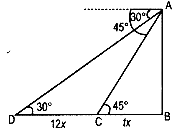
Here $, \angle ACB = 30^\circ$ and $\angle ADB = 45^\circ .$
Let $C$ denote the initial position of the car and $D$ be its position after $12$ minutes.
Let the speed of the car be $x$ meter/minute, then
$CD = 12x$ meters $.....( \because$ Distance $=$ speed $x$ Time$)$
Let the car take $t$ minutes to reach the tower from $D$.
Then $, DB = tx $ meters
Now in the right $-$ angled triangles $\text{ACB},$
$\tan 30^{\circ}=\frac{ AB }{ CB }$
$\Rightarrow \frac{1}{\sqrt{3}}=\frac{ AB }{ CD + DB }$
$\Rightarrow \frac{1}{\sqrt{3}}=\frac{ AB }{12 x+t x}$
$\Rightarrow A B=\frac{12 x+t x}{\sqrt{3}} ....(1)$
Also, in the right $-$ angled triangle $\text{ADB},$
$\tan 45^{\circ}=\frac{ AB }{ DB }$
$\Rightarrow 1=\frac{ AB }{ DB }$
$\Rightarrow AB = DB = tx ......(2)$
From $(1)$ and $(2)$, we have
$ t =\frac{12}{\sqrt{3}-1}=12 \frac{\sqrt{3}+1}{2}$
$t =6(\sqrt{3}+1)$
$t =15.39$
$t = 15.39$
$\therefore$ Time $= 16.39$ minutes
Time $= 16$ minutes $23$ seconds. View full question & answer→Question 264 Marks
The shadow of a vertical tower on a level ground increases by $10\ m$ when the altitude of the sun changes from $45^\circ$ to $30^\circ .$ Find the height of the tower, correct to two decimal places.
Answer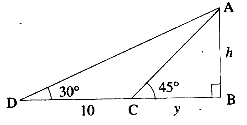
Let the height of tower be $h$ meter and length of shawdow $y$ meter initially.
In $\triangle ABC,$
$\tan 45^\circ = \frac{ AB }{ BC }$
$1=\frac{h}{y}$
$y = h ....(1)$
In $\triangle ABD,$
$\tan 30^\circ = \frac{ AB }{ DB }$
$\frac{1}{\sqrt{3}}=\frac{h}{y+10}$
Put $y = h$ in equation $(ii),$
$h +10=h \sqrt{3}$
$ h =10 \frac{\sqrt{3}+1}{(\sqrt{3}-1)(\sqrt{3}+1)}$
$h =\frac{10}{3-1}(\sqrt{3}+1)$
$h =\frac{10}{2}(\sqrt{3}+1)$
$h = 5(1.732 + 1)$
$h = 2 \times 2.732$
$h = 13.66$ meter View full question & answer→Question 274 Marks
A man observes the angle of elevation of the top of a building to be $30^\circ $. He walks towards it in a horizontal line through its base. On covering $60 \ m,$ the angle of elevation changes to $60^\circ$ . Find the height of the building correct to the nearest metre.
Answer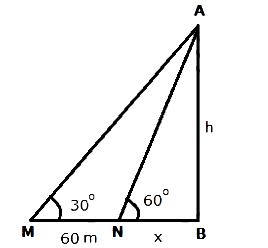
Let $AB$ be a building and $M$ and $N$ are the two $p\ [$osition of the man which makes angle of elevation of top of buildings $30^\circ$ and $60^\circ$ respectively$]$.
$MN= 60 \ m$
Let $AB = h $ and $NB = x \ m$
Now in right $\triangle AMB ,$
$\tan 30^{\circ}=\frac{A B}{M B}$
$\Rightarrow \tan 30^{\circ}=\frac{h}{60+x}$
$\Rightarrow \frac{1}{\sqrt{3}}=\frac{h}{60+x}$
$\Rightarrow 60+\times=\sqrt{3}$
$\Rightarrow x=\sqrt{3} h-60 ...(1)$
similaraly in right $\triangle ANB, \ \tan 60^\circ \frac{A B}{N B}$
$\tan 60^{\circ}=\frac{h}{60+x}$
$\Rightarrow \sqrt{3}-\frac{h}{x}$
$\Rightarrow x=\frac{h}{\sqrt{3}} ...(2)$
from $(1)$ and $(2),$ we have ,
$\sqrt{3}-60=\frac{h}{\sqrt{3}}$
$\Rightarrow 3 h-60 \sqrt{3}=h$
$\Rightarrow 2 h=60 \sqrt{3}$
$\Rightarrow h=\frac{60 \sqrt{3}}{2}$
$\Rightarrow h=30 \sqrt{3}=30 \times 1.732$
$\Rightarrow h=51.96\ m$
$\therefore$ Height of the building $= 51.96=52\ m \ ($approx$)$ View full question & answer→Question 284 Marks
A man on the deck of a ship is $10 m$ above water level. He observes that the angle of elevation of the top of a cliff is $42^\circ$ and the angle of depression of the base is $20^\circ$ . Calculate the distance of the cliff from the ship and the height of the cliff.
Answer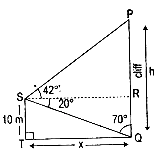
Let the height of the cliff be $h$ meters and the distance of the cliff from the ship be $x$ meters.
In right $-$ angled $\triangle QRS,$
$\therefore QR = ST = 10 m$
$TQ = RS = x m$
$\therefore \tan 70^\circ = \frac{ RS }{ QR }$
$\Rightarrow 2.747=\frac{x}{10 m}$
$\therefore x = 27.47\ m$
Hence, the distance of the cliff from the ship $= 27.47 \ m$
Again in right angled $\triangle PRS,$
$\therefore \tan 42^{\circ}=\frac{ PR }{ RS }$
$\Rightarrow 0.9004=\frac{ PR }{27.47}$
$\Rightarrow PR = [ 0.9004 x \ 27.47 ]\ m$
$\Rightarrow PR = 24.73 \ m$
$\therefore PQ = PR + RQ$
$PQ = [ 24.73 + 10 ] \ m$
$PQ = 34.73 \ m$
Hence the height of the cliff $ = 34.73\ m.$ View full question & answer→Question 294 Marks
If the angle of elevation of a cloud from a point h meters above a lake is a $*$ and the angle of depression of its reflection in the lake is . Prove that the height of the cloud is $\frac{h(\tan \beta+\tan \alpha)}{\tan \beta-\tan \alpha}$.
Answer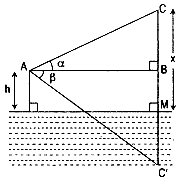
Let $LM$ be the upper surface of the lake and $A$ be a point such that $AL = h.$
Let $C$ be the position of the cloud and $C\ '$ be its reflection in the lake.
$CM = MC' = x\ ($ let$)$
$\angle BAC = \alpha$ and $\angle BAC' = \beta$
Now In $\triangle CBA,$
$ \tan \alpha =\frac{ CB }{ AB }$
$\tan \alpha =\frac{x-h}{ AB }$
$AB =\frac{x-h}{\tan \alpha} .....(i)$
In $\triangle C'BA,$
$\tan \beta=\frac{ CB }{ AB }$
$\tan \beta=\frac{x+h}{ AB }$
$AB =\frac{x+h}{\tan \beta} .....(ii)$
From $(i)$ and $(ii),$
$\frac{x-h}{\tan \alpha}=\frac{x+h}{\tan \beta}$
or $\frac{x+h}{x-h}=\frac{\tan \beta}{\tan \alpha}$
App. componendo and dividendo,
$\frac{x+h+x-h}{x+h-x+h}=\frac{\tan \beta+\tan \alpha}{\tan \beta-\tan \alpha}$
$\frac{2 x}{2 h}=\frac{\tan \beta+\tan \alpha}{\tan \beta-\tan \alpha}$
$x=\frac{h(\tan \beta+\tan \alpha)}{\tan \beta-\tan \alpha}$
$\therefore$ Height of the cloud is $x=\frac{h(\tan \beta+\tan \alpha)}{\tan \beta-\tan \alpha} ....$
Hence proved. View full question & answer→Question 304 Marks
The angles of elevation of the top of a tower from two points A and B at a distance of a and b respectively from the base and in the same straight line with it are complementary. Prove that the height of the tower is $\sqrt{a b}$.
View full question & answer→Question 314 Marks
An aeroplane at an altitude of 250 m observes the angle of depression of two Boats on the opposite banks of a river to be 45° and 60° respectively. Find the width of the river. Write the answer correct to the nearest whole number.
Answer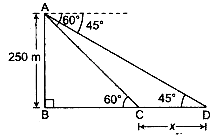
Let the width of the river CD be x,
In ΔABC,
$\tan 60^{\circ}=\frac{ AB }{ BC }$
$\sqrt{3}=\frac{250}{ BC }$
$BC =\frac{250}{\sqrt{3}} \times \frac{\sqrt{3}}{\sqrt{3}}$
$BC =\left(\frac{250}{3}\right) \sqrt{3}$ .....(i)
In Δ ABD,
$\tan 45^{\circ}=\frac{ AB }{ BD }$
⇒ AB = BD = 250 ....(ii)
∴ BD = BC + CD
$\therefore 250=\left(\frac{250}{3}\right) \sqrt{3}+x$ ....(using (i) and (ii))
$\therefore x=250-\left(\frac{250}{3}\right) \times 1.732$
∴ x = 250 - 83.33 x 1.732
∴ x = 250 - 144.33
∴ x = 105.67 m
∴ x = 106 m .....(to the nearest whole numbers)
Thus, width of the river is 106 m. View full question & answer→Question 324 Marks
As observed from the top of a $80\ m$ tall lighthouse, the angles of depression of two ships, on the same side of a light house in a horizontal line with its base, are $30^\circ$ and $40^\circ$ respectively. Find the distance between the two ships. Give your answer corrected to the nearest metre.
Answer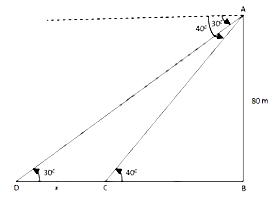
Let $AB$ represent the lighthouse.
Let the two ships be at point $D$ and $C$ having angle of depression $30^\circ$ and $40^\circ$ respectively.
Let $x$ be the distance between the two ships.
clearly $, m\angle ACB = 40^\circ$ and $m\angle ADB= 30 ^\circ$
In $\triangle ACB$
$\tan 40^{\circ}=\frac{80}{C B}$
$\Rightarrow C B=\frac{80}{0.84}=95.24\ m$
In $\triangle ADB$
$\tan 30^{\circ}=\frac{80}{D B}$
$\Rightarrow D B=\frac{80}{0.58}=137.93\ m$
$DC = DB - CB$
$\Rightarrow X=137.93-95.24$
$\Rightarrow X=42.69 \approx 43 \ m$
The distance between the two ship is $43\ m$ . View full question & answer→Question 334 Marks
Two-person standing on the same side of a tower in a straight line with it measures the angle of elevation of the top of the tower as 25° and 50° respectively. If the height of the tower is 70 m find the distance between the two-person.
Answer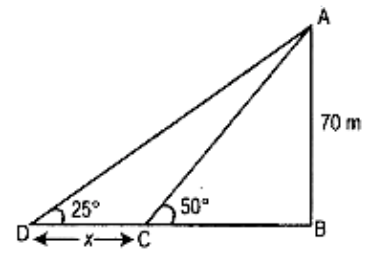
Let CD be the distance between the two persons.
In ΔABC,
cot 50° = $\frac{ BC }{ AB }$
cot (90° - 40°) =$\frac{B C}{70}$
BC = 70 tan 40°
BC = 70 x 0.8391 = 58.74 m
In ΔABD,
cot 25° = $\frac{ BD }{ AB }$
cot (90° - 65°) = $\frac{ BD }{ 70 }$
tan 65° =$\frac{ BD }{ 70 }$
BD = 70 tan 65°
BD = 70 x 2.11451 = 150.12 m
CD = 150.12 - 58.74 = 91.38 m
∴ The distance between the two person be 91.38 m. View full question & answer→Question 344 Marks
From two points $A$ and $B$ on the same side of a building, the angles of elevation of the top of the building are $30^\circ$ and $60^\circ$ respectively. If the height of the building is $10\ m,$ find the distance between $A$ and $B$ correct to two decimal places.
Answer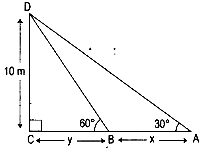
Let $CD$ is building $A$ and $B$ are two given points using horizontally on the same side of building.
In $\triangle DBC,$
$\tan 60^\circ = \frac{ DC }{ CB }$
$\sqrt{ } 3=\frac{10}{y} ...(1)$
In $\triangle DCA,$
$\tan 30^\circ = \frac{ DC }{ CA }$
$\frac{1}{\sqrt{ } 3}=\frac{10}{x+y} ...(2)$
From $(1),$ put $y=\frac{10}{\sqrt{3}}$ in $(2),$ we get
$\frac{1}{\sqrt{3}}=\frac{10}{x+\frac{10}{\sqrt{3}}}$
$\frac{1}{\sqrt{3}}=\frac{10 \sqrt{3}}{\sqrt{3} x+10}$
$30=\sqrt{3} x+10$
$x=\frac{20}{\sqrt{3}}$
$x=11.55\ m$
Hence, distance between two points $A$ and $B$ is $11.55 \ m$. View full question & answer→Question 354 Marks
Prove that : $\frac{\tan A}{1-\cot A}+\frac{\cot A}{1-\tan A}=\sec A \cdot \operatorname{cosec} A+1$.
Answer$\text { LHS }=\frac{\frac{\sin A}{\cos A}}{1-\frac{\cos A}{\sin A}}+\frac{\frac{\cos A}{\sin A}}{1-\frac{\sin A}{\cos A}}$
$=\frac{\sin A}{\cos A} \times \frac{\sin A}{\sin A-\cos A}+\frac{\cos A}{\sin A} \times \frac{\cos A}{\cos A-\sin A}$
$=\frac{\sin ^2 A}{\cos A(\sin A-\cos A)}+\frac{\cos ^2 A}{\sin A(\cos A-\sin A)}$
$=\frac{\sin ^2 A}{\cos A(\sin A-\cos A)}-\frac{\cos ^2 A}{\sin A(\sin A-\cos A)}$
$=\frac{\sin ^3 A-\cos 3 A}{\sin A \cdot \cos A(\sin A-\cos A)}$
$=\frac{1+\sin A \cdot \cos A}{\sin A \cdot \cos A}$
$=\frac{1}{\sin A \cdot \cos A}+\frac{\sin A \cdot \cos A}{\sin A \cdot \cos A}$
$= \sec A.\ce{cosec} \ A + 1$
$= \ce{RHS}$
Hence proved.
View full question & answer→Question 364 Marks
Prove the following identity :$\left[\frac{1}{\left(\sec ^2 \theta-\cos ^2 \theta\right)}+\frac{1}{\left(\operatorname{cosec} 2 \theta-\sin ^2 \theta\right)}\right]\left(\sin ^2 \theta \cos ^2 \theta\right)=\frac{1-\sin ^2 \theta \cos ^2 \theta}{2+\sin ^2 \theta \cos ^2 \theta}$
Answer$\text { LHS }=\left[\frac{1}{\left(\sec ^2 \theta-\cos ^2 \theta\right)}+\frac{1}{\left(\operatorname{cosec} 2 \theta-\sin ^2 \theta\right)}\right]\left(\sin ^2 \theta \cos ^2 \theta\right)$
$=\left[\frac{1}{\left(\frac{1}{\cos ^2 \theta}-\cos ^2 \theta\right)}+\frac{1}{\left(\frac{1}{\sin ^2 \theta}-\sin ^2 \theta\right)}\right]\left(\sin ^2 \theta \cos ^2 \theta\right)$
$=\left[\frac{1}{\left(\frac{1-\cos ^4 \theta}{\cos ^2 \theta}\right)}+\frac{1}{\left(\frac{1-\sin ^4 \theta}{\sin ^2 \theta}\right)}\right]\left(\sin ^2 \theta \cos ^2 \theta\right)$
$\left.=\left[\frac{\cos ^2 \theta}{1-\cos ^4 \theta}+\frac{\sin ^2 \theta}{1-\sin ^4 \theta}\right)\right]\left(\sin ^2 \theta \cos ^2 \theta\right)$
$\left.=\left[\frac{\cos ^2 \theta-\cos ^2 \theta \sin ^2 \theta+\sin ^2 \theta-\sin ^2 \theta \cos ^4 \theta}{\left(1-\cos ^4 \theta\right)\left(1-\sin ^4 \theta\right)}\right]\left(\sin ^2 \theta \cos ^2 \theta\right)\right]$
$\overline{\overline{=}}\left[\frac{\cos ^2 \theta+\sin ^2 \theta-\cos ^2 \theta \sin ^2 \theta\left(\cos ^2 \theta+\sin ^2 \theta\right)}{\left(1-\cos ^2 \theta\right)\left(1+\cos ^2 \theta\right)\left(1-\sin ^2 \theta\right)\left(1+\sin ^2 \theta\right)}\right]\left(\sin ^2 \theta \cos ^2 \theta\right)$
$=\left[\frac{1-\cos ^2 \theta \sin ^2 \theta}{\sin ^2 \theta\left(1+\cos ^2 \theta\right) \cos ^2 \theta\left(1+\sin ^2 \theta\right)}\right]\left(\sin ^2 \theta \cos ^2 \theta\right)$
$\left(\because \cos ^2 \theta+\sin ^2 \theta=1,\left(1-\cos ^2 \theta\right)=\sin ^2 \theta,\left(1-\sin ^2 \theta\right)=\cos ^2 \theta\right)$
$=\frac{1-\cos ^2 \theta \sin ^2 \theta}{\left(1+\cos ^2 \theta\right)\left(1+\sin ^2 \theta\right)}=\frac{1-\cos ^2 \theta \sin ^2 \theta}{1+\sin ^2 \theta+\cos ^2 \theta+\sin ^2 \theta \cos ^2 \theta}$
$=\frac{1-\cos ^2 \theta \sin ^2 \theta}{1+1+\sin ^2 \theta \cos ^2 \theta}=\frac{1-\sin ^2 \theta \cos ^2 \theta}{2+\sin ^2 \theta \cos ^2 \theta}$
View full question & answer→