Questions

[5 marks sum]

🎯

Test yourself on this topic

12 questions · timed · auto-graded

Question 15 Marks
A man on the top of vertical observation tower observes a car moving at a uniform speed coming directly towards it. If it takes $12$ minutes for the angle of depression to change from $30^\circ$ to $45^\circ$, how soon after this will the car reach the observation tower? (Give your answer correct to nearest seconds).
Answer
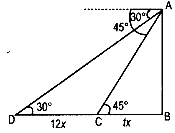
Here, $\angle ACB = 30^\circ$ and $\angle ADB = 45^\circ$.
Let $C$ denote the initial position of the car and $D$ be its position after $12$ minutes.
Let the speed of the car be x meter/minute, then
$CD = 12x$ meters .....( $\because$ Distance $=$ speed $\times$ Time)
Let the car take $t$ minutes to reach the tower from $D.$
Then, $DB = tx$ meters
Now in the right-angled triangles $ACB,$
$\tan 30^{\circ}=\frac{ AB }{ CB }$
$\Rightarrow \frac{1}{\sqrt{3}}=\frac{ AB }{ CD + DB }$
$\Rightarrow \frac{1}{\sqrt{3}}=\frac{ AB }{12 x+t x}$
$\Rightarrow A B=\frac{12 x+t x}{\sqrt{3}}$ ....(1)
Also, in the right-angled triangle ADB,
$\tan 45^{\circ}=\frac{ AB }{ DB }$
$\Rightarrow 1=\frac{ AB }{ DB }$
$\Rightarrow AB = DB = tx ......(2)$
From $(1)$ and $(2),$ we have
$ t =\frac{12}{\sqrt{3}-1}=12 \frac{\sqrt{3}+1}{2}$
$t =6(\sqrt{3}+1)$
$t =15.39$
$t = 15.39$
$\therefore$ Time $= 16.39$ minutes
Time $= 16$ minutes $23$ seconds.
View full question & answer
Question 25 Marks
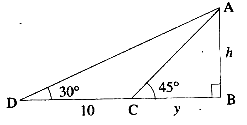
The shadow of a vertical tower on a level ground increases by 10 m when the altitude of the sun changes from 45° to 30°. Find the height of the tower, correct to two decimal places.
Answer

Let the height of tower be h meter and length of shawdow y meter initially.
In ΔABC,
$\tan 45^\circ =\frac{ AB }{ BC }$
$1=\frac{h}{y}$
y = h ....(1)
In $\triangle ABD,$
tan 30° = $\frac{ AB }{ DB }$
$\frac{1}{\sqrt{3}}=\frac{h}{y+10}$
Put y = h in equation (ii),
$h +10=h \sqrt{3}$
$ h =10 \frac{\sqrt{3}+1}{(\sqrt{3}-1)(\sqrt{3}+1)}$
$h =\frac{10}{3-1}(\sqrt{3}+1)$
$h =\frac{10}{2}(\sqrt{3}+1)$
$h = 5(1.732 + 1)$
$h = 2 \times 2.732$
$h = 13.66$ meter
View full question & answer
Question 35 Marks
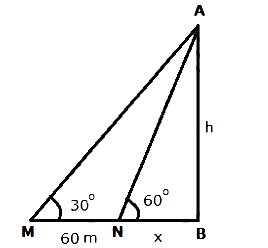
A man observes the angle of elevation of the top of a building to be 30°. He walks towards it in a horizontal line through its base. On covering 60 m, the angle of elevation changes to 60°. Find the height of the building correct to the nearest metre.
Answer

Let AB be a building and M and N are the two p[osition of the man which makes angle of elevation of top of buildings 30° and 60° respectively.
MN= 60 m
Let AB = h and NB = x m
Now in right Δ AMB ,
$\tan 30^{\circ}=\frac{A B}{M B}$
$\Rightarrow \tan 30^{\circ}=\frac{h}{60+x}$
$\Rightarrow \frac{1}{\sqrt{3}}=\frac{h}{60+x}$
$\Rightarrow 60+\times=\sqrt{3}$
$\Rightarrow x=\sqrt{3} h-60$ ...(1)
similaraly in right Δ ANB,
tan 60° $\frac{A B}{N B}$
$\tan 60^{\circ}=\frac{h}{60+x}$
$\Rightarrow \sqrt{3}-\frac{h}{x}$
$\Rightarrow x=\frac{h}{\sqrt{3}}$ ...(2)
from (1) and (2), we have ,
$\sqrt{3}-60=\frac{h}{\sqrt{3}}$
$\Rightarrow 3 h-60 \sqrt{3}=h$
$\Rightarrow 2 h=60 \sqrt{3}$
$\Rightarrow h=\frac{60 \sqrt{3}}{2}$
$\Rightarrow h=30 \sqrt{3}=30 \times 1.732$
$\Rightarrow h=51.96 m$
$\therefore $ Height of the building = 51.96=52m (approx)
View full question & answer
Question 45 Marks
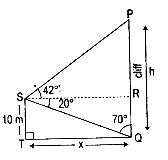
A man on the deck of a ship is 10 m above water level. He observes that the angle of elevation of the top of a cliff is 42° and the angle of depression of the base is 20°. Calculate the distance of the cliff from the ship and the height of the cliff.
Answer


Let the height of the cliff be h meters and the distance of the cliff from the ship be x meters.
In right-angled ΔQRS,
∴ QR = ST = 10 m
TQ = RS = x m
∴ tan 70° = $\frac{ RS }{ QR }$
$\Rightarrow 2.747=\frac{x}{10 m}$
∴ x = 27.47 m
Hence, the distance of the cliff from the ship = 27.47 m
Again in right angled ΔPRS,
$\therefore \tan 42^{\circ}=\frac{ PR }{ RS }$
$\Rightarrow 0.9004=\frac{ PR }{27.47}$
⇒ PR = [ 0.9004 x 27.47 ] m
⇒ PR = 24.73 m
∴ PQ = PR + RQ
PQ = [ 24.73 + 10 ] m
PQ = 34.73 m
Hence the height of the cliff = 34.73 m.
View full question & answer
Question 55 Marks
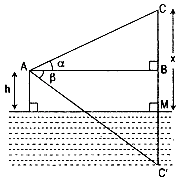
If the angle of elevation of a cloud from a point h meters above a lake is a*and the angle of depression of its reflection in the lake is |i. Prove that the height of the cloud is $\frac{h(\tan \beta+\tan \alpha)}{\tan \beta-\tan \alpha}$.
Answer

Let LM be the upper surface of the lake and A be a point such that AL = h.
Let C be the position of the cloud and C' be its reflection in the lake.
CM = MC' = x(let)
$\angle BAC = \alpha $ and $\angle BAC' = \beta$
Now In $\triangle CBA,$
$ \tan \alpha  =\frac{ CB }{ AB }$
$\tan \alpha =\frac{x-h}{ AB }$
$AB =\frac{x-h}{\tan \alpha}$ .....(i)
In $\triangle C'BA,$
$\tan \beta=\frac{ CB }{ AB }$
$\tan \beta=\frac{x+h}{ AB }$
$AB =\frac{x+h}{\tan \beta}$ .....(ii)
From (i) and (ii),
$\frac{x-h}{\tan \alpha}=\frac{x+h}{\tan \beta}$
or $\frac{x+h}{x-h}=\frac{\tan \beta}{\tan \alpha}$
App. componendo and dividendo,
$\frac{x+h+x-h}{x+h-x+h}=\frac{\tan \beta+\tan \alpha}{\tan \beta-\tan \alpha}$
$\frac{2 x}{2 h}=\frac{\tan \beta+\tan \alpha}{\tan \beta-\tan \alpha}$
$x=\frac{h(\tan \beta+\tan \alpha)}{\tan \beta-\tan \alpha}$
∴ Height of the cloud is $x=\frac{h(\tan \beta+\tan \alpha)}{\tan \beta-\tan \alpha}$ ....Hence proved.
View full question & answer
Question 65 Marks
The angles of elevation of the top of a tower from two points A and B at a distance of a and b respectively from the base and in the same straight line with it are complementary. Prove that the height of the tower is $\sqrt{a b}$.
View full question & answer
Question 75 Marks
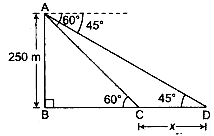
An aeroplane at an altitude of 250 m observes the angle of depression of two Boats on the opposite banks of a river to be 45° and 60° respectively. Find the width of the river. Write the answer correct to the nearest whole number.
Answer

Let the width of the river CD be x,
In ΔABC,
$\tan 60^{\circ}=\frac{ AB }{ BC }$
$\sqrt{3}=\frac{250}{ BC }$
$BC =\frac{250}{\sqrt{3}} \times \frac{\sqrt{3}}{\sqrt{3}}$
$BC =\left(\frac{250}{3}\right) \sqrt{3}$ .....(i)
In Δ ABD,
$\tan 45^{\circ}=\frac{ AB }{ BD }$
⇒ AB = BD = 250 ....(ii)
∴ BD = BC + CD
$\therefore 250=\left(\frac{250}{3}\right) \sqrt{3}+x$ ....(using (i) and (ii))
$\therefore x=250-\left(\frac{250}{3}\right) \times 1.732$
∴ x = 250 - 83.33 x 1.732
∴ x = 250 - 144.33
∴ x = 105.67 m
∴ x = 106 m .....(to the nearest whole numbers)
Thus, width of the river is 106 m.
View full question & answer
Question 85 Marks
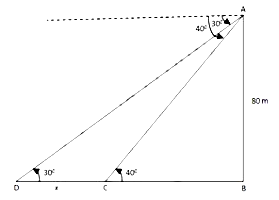
As observed from the top of a 80 m tall lighthouse, the angles of depression of two ships, on the same side of a light house in a horizontal line with its base, are 30° and 40° respectively. Find the distance between the two ships. Give your answer corrected to the nearest metre.
Answer

Let AB represent the lighthouse.
Let the two ships be at point D and C having angle of depression 30° and 40° respectively.
Let x be the distance between the two ships.
clearly,$ m\angle ACB = 40^\circ$ and $m \angle ADB= 30 ^\circ$
In $\triangle ACB$
$\tan 40^{\circ}=\frac{80}{C B}$
$\Rightarrow C B=\frac{80}{0.84}=95.24 m$
In $\triangle ADB$
$\tan 30^{\circ}=\frac{80}{D B}$
$\Rightarrow D B=\frac{80}{0.58}=137.93 m$
$DC = DB - CB$
$\Rightarrow X=137.93-95.24$
$\Rightarrow X=42.69 \approx 43 m$
The distance between the two ship is $43\ m .$
View full question & answer
Question 95 Marks
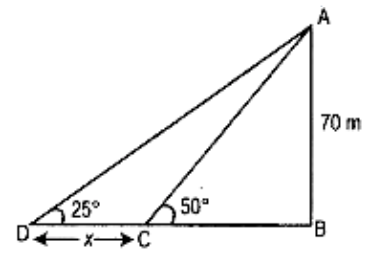
Two-person standing on the same side of a tower in a straight line with it measures the angle of elevation of the top of the tower as 25° and 50° respectively. If the height of the tower is 70 m find the distance between the two-person.
Answer
Image
Let CD be the distance between the two persons.
In ΔABC,
cot 50° = $\frac{ BC }{ AB }$
cot (90° - 40°) =$\frac{B C}{70}$
BC = 70 tan 40°
BC = 70 x 0.8391 = 58.74 m
In ΔABD,
cot 25° = $\frac{ BD }{ AB }$
cot (90° - 65°) = $\frac{ BD }{ 70 }$
tan 65° =$\frac{ BD }{ 70 }$
BD = 70 tan 65°
BD = 70 x 2.11451 = 150.12 m
CD = 150.12 - 58.74 = 91.38 m
∴ The distance between the two person be 91.38 m.
View full question & answer
Question 105 Marks
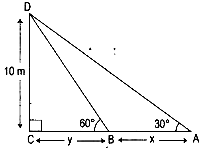
From two points A and B on the same side of a building, the angles of elevation of the top of the building are 30° and 60° respectively. If the height of the building is 10 m, find the distance between A and B correct to two decimal places.
Answer

Let CD is building A and B are two given points using horizontally on the same side of building.
In $\triangle DBC,$
$\tan 60^\circ = \frac{ DC }{ CB }$
$\sqrt{ } 3=\frac{10}{y}$ ...(1)
In $\triangle DCA,$
tan 30° = $\frac{ DC }{ CA }$
$\frac{1}{\sqrt{ } 3}=\frac{10}{x+y}$ ...(2)
From (1), put $y=\frac{10}{\sqrt{3}}$ in (2), we get
$\frac{1}{\sqrt{3}}=\frac{10}{x+\frac{10}{\sqrt{3}}}$
$\frac{1}{\sqrt{3}}=\frac{10 \sqrt{3}}{\sqrt{3} x+10}$
$30=\sqrt{3} x+10$
$x=\frac{20}{\sqrt{3}}$
$x=11.55 m$
Hence, distance between two points A and B is 11.55 m.
View full question & answer
Question 115 Marks
Prove that : $\frac{\tan A}{1-\cot A}+\frac{\cot A}{1-\tan A}=\sec A \cdot \operatorname{cosec} A+1$.
Answer
$\text { LHS }=\frac{\frac{\sin A}{\cos A}}{1-\frac{\cos A}{\sin A}}+\frac{\frac{\cos A}{\sin A}}{1-\frac{\sin A}{\cos A}}$
$ =\frac{\sin A}{\cos A} \times \frac{\sin A}{\sin A-\cos A}+\frac{\cos A}{\sin A} \times \frac{\cos A}{\cos A-\sin A} $
$ =\frac{\sin ^2 A}{\cos A(\sin A-\cos A)}+\frac{\cos ^2 A}{\sin A(\cos A-\sin A)} $
$=\frac{\sin ^2 A}{\cos A(\sin A-\cos A)}-\frac{\cos ^2 A}{\sin A(\sin A-\cos A)}$
$=\frac{\sin ^3 A-\cos 3 A}{\sin A \cdot \cos A(\sin A-\cos A)}$
$=\frac{1+\sin A \cdot \cos A}{\sin A \cdot \cos A} $
$ =\frac{1}{\sin A \cdot \cos A}+\frac{\sin A \cdot \cos A}{\sin A \cdot \cos A}$
$= sec A.cosec A + 1$
$= RHS$
Hence proved.
View full question & answer
Question 125 Marks
Prove the following identity :$\left[\frac{1}{\left(\sec ^2 \theta-\cos ^2 \theta\right)}+\frac{1}{\left(\operatorname{cosec} 2 \theta-\sin ^2 \theta\right)}\right]\left(\sin ^2 \theta \cos ^2 \theta\right)=\frac{1-\sin ^2 \theta \cos ^2 \theta}{2+\sin ^2 \theta \cos ^2 \theta}$
Answer
$\text { LHS }=\left[\frac{1}{\left(\sec ^2 \theta-\cos ^2 \theta\right)}+\frac{1}{\left(\operatorname{cosec} 2 \theta-\sin ^2 \theta\right)}\right]\left(\sin ^2 \theta \cos ^2 \theta\right) $
$=\left[\frac{1}{\left(\frac{1}{\cos ^2 \theta}-\cos ^2 \theta\right)}+\frac{1}{\left(\frac{1}{\sin ^2 \theta}-\sin ^2 \theta\right)}\right]\left(\sin ^2 \theta \cos ^2 \theta\right) $
$ =\left[\frac{1}{\left(\frac{1-\cos ^4 \theta}{\cos ^2 \theta}\right)}+\frac{1}{\left(\frac{1-\sin ^4 \theta}{\sin ^2 \theta}\right)}\right]\left(\sin ^2 \theta \cos ^2 \theta\right)$
$\left.=\left[\frac{\cos ^2 \theta}{1-\cos ^4 \theta}+\frac{\sin ^2 \theta}{1-\sin ^4 \theta}\right)\right]\left(\sin ^2 \theta \cos ^2 \theta\right) $
$ \left.=\left[\frac{\cos ^2 \theta-\cos ^2 \theta \sin ^2 \theta+\sin ^2 \theta-\sin ^2 \theta \cos ^4 \theta}{\left(1-\cos ^4 \theta\right)\left(1-\sin ^4 \theta\right)}\right]\left(\sin ^2 \theta \cos ^2 \theta\right)\right]$
$\overline{\overline{=}}\left[\frac{\cos ^2 \theta+\sin ^2 \theta-\cos ^2 \theta \sin ^2 \theta\left(\cos ^2 \theta+\sin ^2 \theta\right)}{\left(1-\cos ^2 \theta\right)\left(1+\cos ^2 \theta\right)\left(1-\sin ^2 \theta\right)\left(1+\sin ^2 \theta\right)}\right]\left(\sin ^2 \theta \cos ^2 \theta\right)$
$=\left[\frac{1-\cos ^2 \theta \sin ^2 \theta}{\sin ^2 \theta\left(1+\cos ^2 \theta\right) \cos ^2 \theta\left(1+\sin ^2 \theta\right)}\right]\left(\sin ^2 \theta \cos ^2 \theta\right) $
$ \left(\because \cos ^2 \theta+\sin ^2 \theta=1,\left(1-\cos ^2 \theta\right)=\sin ^2 \theta,\left(1-\sin ^2 \theta\right)=\cos ^2 \theta\right) $
$=\frac{1-\cos ^2 \theta \sin ^2 \theta}{\left(1+\cos ^2 \theta\right)\left(1+\sin ^2 \theta\right)}=\frac{1-\cos ^2 \theta \sin ^2 \theta}{1+\sin ^2 \theta+\cos ^2 \theta+\sin ^2 \theta \cos ^2 \theta} $
$ =\frac{1-\cos ^2 \theta \sin ^2 \theta}{1+1+\sin ^2 \theta \cos ^2 \theta}=\frac{1-\sin ^2 \theta \cos ^2 \theta}{2+\sin ^2 \theta \cos ^2 \theta}$
View full question & answer
[5 marks sum] - Mathematics STD 10 Questions - Vidyadip