Questions

[2 Mark Question Answer]

🎯

Test yourself on this topic

26 questions · timed · auto-graded

Question 12 Marks
$1 \ kg$ of ice at $0^o$ is heated at constant rate and its temperature is recorded after every $30$ s till steam is formed at $100^o C.$ Draw a temperature time graph to represent the change of phase.
View full question & answer
Question 22 Marks
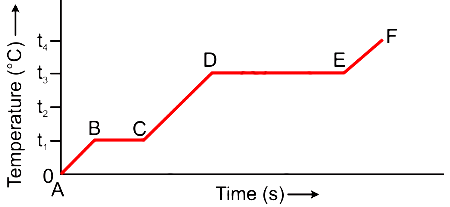
The diagram in Fig $11.12$ below shows the change of phase of a substance on a temperature time graph.


(a) What do the parts $AB, BC, CD$ and $DE$ represent?
(b) what is the melting points of the substance?
(c) what is the boiling points of the substance?
Answer
(a) AB part shows rise in temperature of solid from 0 to $T 1^{\circ} C , BC$ part shows melting at temperature $T 1^{\circ} C , CD$ part shows rise in temperature of liquid from $T 1^{\circ} C$ to $T 3^{\circ} C , DE$ part shows the boiling at temperature $T 3^{\circ} C$.(b) $T 1^{\circ} C$.
(c) $T 3^{\circ} C$.
View full question & answer
Question 32 Marks
State the effect of increase of pressure on the melting point of ice.
Answer
The melting point of ice decreases by the increase in pressure. The melting point of ice decrease by 0.0072oC for every one atmosphere rise in pressure.
View full question & answer
Question 42 Marks
State the effect of presence of impurity on the melting point of ice. Give one use of it.
Answer
The melting point of ice decreases by the presence of impurity in it.
Use: In making the freezing mixture by adding salt to ice. This freezing mixture is used in preparation of ice creams.
View full question & answer
Question 52 Marks
A substance undergoes (i) a change in its temperature, (ii) a change in its phase without change in its temperature. In each case, state the change in energy of molecules of the substance.
Answer
(i) Average kinetic energy of molecules changes.
(ii) Average potential energy of molecules changes.
View full question & answer
Question 62 Marks
Explain the following:

The heat supplied to a substance during it change of state, does not cause any rise in its temperature.

Answer
Heat supplied to a substance during its change of state, does not cause any rise in its temperature because this is latent heat of phase change which is required to change the phase only.
View full question & answer
Question 72 Marks
The temperature of the surrounding starts falling when ice in a frozen lake starts melting. Give reason.
Answer
The reason is that the heat energy required for melting the frozen lake is absorbed from the surrounding atmosphere. As a result, the temperature of the surrounding falls and it became very cold.
View full question & answer
Question 82 Marks
It is generally cold after a hail-storm then during and before the hail storm. Give reason.
Answer
The reason is that after the hail storm, the ice absorbs the heat energy required for melting from the surrounding, so the temperature of the surrounding falls further down and we feel colder.
View full question & answer
Question 92 Marks
(a) Which requires more heat: 1 g ice at 0℃ or 1 g water at 0℃ to raise its temperature to 10℃?

(b) Explain your answer in part (a).

Answer
(a) 1 g ice at 0oC requires more heat because ice would require additional heat energy equal to latent heat of melting.

(b) 1 g ice at 0oC first absorbs 336 J heat to convert into 1 g water at 0oC.

View full question & answer
Question 102 Marks
Define the term specific latent heat of fusion of ice state its S.I unit.
Answer
The quantity of heat required to convert unit mass of ice into liquid water at $0^{\circ} C$ (melting point) is called the specific latent heat of fusion of ice.
Its S.I. unit is $Jkg ^{-1}$.
View full question & answer
Question 112 Marks
What do you understand by the term latent heat?
Answer
Latent heat: The heat energy exchanged in change of phase is not externally manifested by any rise or fall in temperature, it is considered to be hidden in the substance and is called the latent heat.
View full question & answer
Question 122 Marks
A piece of iron of mass $2.0 kg$ has a thermal capacity of $966 JK ^{-1}$. Find : heat energy needed to warm it by $15^{\circ} C$
Answer
We know that heat energy needed to raise the temperature by $15^{\circ}$ is $=$ heat capacity $\times$ change in temperature.
Heat energy required $=966 J K ^{-1} \times 15 K =14490 J$.
View full question & answer
Question 132 Marks
Define the term specific heat capacity and state its S.I. unit.
Answer
The specific heat capacity of a substance is the amount of heat energy required to raise the temperature of unit mass of that substance through by 1oC (or 1K).
S.I. unit is joule per kilogram per kelvin (Jkg-1K-1).
View full question & answer
Question 142 Marks
Define the term heat capacity and state its S.I. unit.
Answer
The heat capacity of a body is the amount of heat energy required to raise its temperature by 1oC or 1K.
S.I. unit is joule per kelvin (JK-1).
View full question & answer
Question 152 Marks
Define temperature and name its S.I. unit.
Answer
The quantity which determines the direction of flow of heat between two bodies kept in contact is called temperature.
S.I. unit kelvin (K).
View full question & answer
Question 162 Marks
Define the term calorie. How is it related to joule(the S.I. unit of heat)?
Answer
One calorie of heat is the heat energy required to raise the temperature of 1 g of water from 14.5oC to 15.5 oC.
1 calorie = 4.186 J
View full question & answer
Question 172 Marks
Why is the base of a cooking pan generally made thick?
Answer
By making the base of a cooking pan thick, its thermal capacity becomes large and it imparts sufficient heat energy at a low temperature to the food for proper cooking. Further, it keeps the food warm for a long time after cooking.
View full question & answer
Question 182 Marks
A liquid X has specific heat capacity higher than the liquid Y. Which liquid is useful as coolant in car radiators .
Answer
The specific heat capacity of liquid X is higher than that of Y. So, for same mass and same heat energy, the rise in temperature for X will be less than that of Y.

As a coolant in car radiators, the liquid needs to absorb more energy without much change in temperature. So, liquid X is ideal for this function.

View full question & answer
Question 192 Marks
Water is used in hot water bottles for fomentation give a reason.
Answer
The reason is that water does not cool quickly due to its large specific heat capacity, so a hot
water bottle provides heat energy for fomentation for a long time.
View full question & answer
Question 202 Marks
What is the principle of method of mixture (or principle of calorimetry)? Name the law on which
this principle is based.
Answer
The principle of method of mixture:
Heat energy lost by the hot body = Heat energy gained by the cold body.
This principle is based on law of conservation of energy.
View full question & answer
Question 212 Marks
Same amount of heat is supplied to two liquid A and B. The liquid A and B. The liquid A
shows a greater rise in temperature. What can you say about the heat capacity of A as compared
to that of B?
Answer
Heat capacity of liquid A is less than that of B.
As the substance with low heat capacity shows greater rise in temperature.
View full question & answer
Question 222 Marks
Write the expression for the heat energy $Q$ received by the substance when $m kg$ of substance of specific heat capacity c $J kg ^{-1} k ^{-1}$ is heated through $\Delta t ^{\circ} C$.
Answer
The expression for the heat energy Q
Q= mc Δ t (in joule)
View full question & answer
Question 232 Marks
Specific heat capacity of a substance A is $3.8 J g^{-1} K^{-1}$ and of substance B is $0.4 Jg^{-1} k^{-1}$​​​​​​​. Which substance is a good conductor of heat? How did you arrive at your conclusion?
Answer
The specific heat capacity of substance $B$ is lesser than that of A. So, for same mass and same heat energy, the rise in temperature for $B$ will be more than that of A. Hence, substance $B$ is a good conductor of heat.
View full question & answer
Question 242 Marks
What do you mean by the following statement:
The specific heat capacity of copper is $0.4 Jg ^{-1} K ^{-1}$.
Answer
The specific heat capacity of copper is $0.4 Jg ^{-1} K ^{-1}$ means to increase the temperature of one gram of copper by $1 K$ we have to supply 0.4 joules of energy.

View full question & answer
Question 252 Marks
What do you mean by the following statement:
The heat capacity of a body is $50 JK ^{-1}$ ?
Answer
The heat capacity of a body is $50 JK ^{-1}$ means to increase the temperature of this body by $1 K$ we have to supply 50 joules of energy.
View full question & answer
Question 262 Marks
How is heat capacity of a body related to specific heat capacity of its substance?
Answer
Heat capacity of a body $=$ Mass $\times$ specific heat capacity of its substance.
Heat capacity $=\frac{\Delta \theta}{\Delta T}=\frac{ mc \Delta T }{\Delta T }= mc$
View full question & answer
[2 Mark Question Answer] - Physics STD 10 Questions - Vidyadip