Questions

[2 Mark Question Answer]

🎯

Test yourself on this topic

26 questions · timed · auto-graded

Question 12 Marks
An electric iron is rated 750 W, 230 V. Calculate the electrical energy consumed by the iron in 16 hours.
Answer
Energy , E = Power × time

= 750 × 16

= 12000 Wh

or E = 12 kWh

View full question & answer
Question 22 Marks
A bulb of 40 W is used for 12.5 h each day for 30 days. Calculate the electrical energy consumed.
Answer
Energy consumed per day , E = P × t

= 40 × 12.5

= 500 Wh

Energy consumed for 30 days

E = 500 × 30 = 15000 Wh = 15 kWh.

View full question & answer
Question 32 Marks
Define the term kilowatt - hour and state its value in $S.I.$ unit.
Answer
One kilowatt-hour (kWh) is the electrical energy consumed by an electrical appliance of power 1 kW when it is used for one hour.Its value in SI unit is 1 kWh $= 3.6 \times 10^6 J$
View full question & answer
Question 42 Marks
Name the physical quantity which is measured in (i) kW, (ii) kWh.
Answer

(i) Electrical power is measured in kW and

(ii) Electrical energy is measured in kWh.

View full question & answer
Question 52 Marks
State and define the household unit of electricity.
Answer

The household unit of electricity is kilowatt-hour (kWh).

One kilowatt-hour (kWh) is the electrical energy consumed by an electrical appliance of power 1 kW when it is used for one hour.

View full question & answer
Question 62 Marks
Name the S.I. unit of electrical energy. How is it related to Wh?
Answer

The S.I. unit of electrical energy is joule.

1Wh = 3600 J

View full question & answer
Question 72 Marks
An electric bulb is marked '100 W, 250 V'. What information does this convey?
Answer
It means that if the bulb is lighted on a 250 V supply, it consumes 100 W electrical power (which means 100J of electrical energy is converted in the filament of bulb into the light and heat energy in 1 second).
View full question & answer
Question 82 Marks
A battery of e.m.f 3.0 V supplies current through a circuit in which the resistance can be changed.
A high resistance voltmeter is connected across the battery. When the current is 1.5 A, the voltmeter reads 2.7 V. Find the internal resistance of the battery.
Answer
ε = 3 volt
I = 1.5 A
V = 2.7 V
V = ε − Ir
r = (e-V) / I
= (3 – 2.7) / 1.5 = 0.2 ohm
View full question & answer
Question 92 Marks
A particular resistance wire has a resistance of 3 ohm per meter. Find :

The potential difference of the battery which gives a current of 2 A in each of the 1.5 m length when connected in the parallel to the battery (assume that resistance of the battery is negligible).

Answer

I = 2 A

V = IR = 2 x 4.5 = 9 V

View full question & answer
Question 102 Marks
A particular resistance wire has a resistance of 3 ohm per meter. Find:
The total resistance of three lengths of this wire each 1.5 m long, joined in parallel.
Answer
Resistance of $1 m$ of wire $=3 ohm$
Resistance of $1.5 m$ of wire $=3 \times 1.5=4.5 W$
$
\frac{1}{R}=\frac{1}{4.5}+\frac{1}{4.5}+\frac{1}{4.5}=\frac{3}{4.5}
$
$
R =1.5 ohm
$
View full question & answer
Question 112 Marks
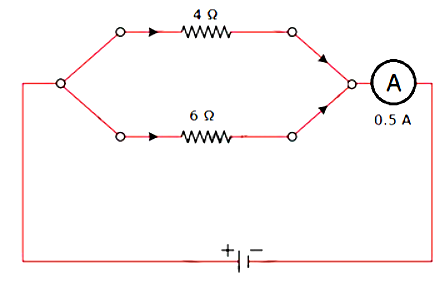
Two resistors of resistance 4 Ω and 6 Ω are connected in parallel to a cell to draw 0.5 A current from the cell.

Draw a labeled diagram of the arrangement
Answer
Circuit diagram

View full question & answer
Question 122 Marks
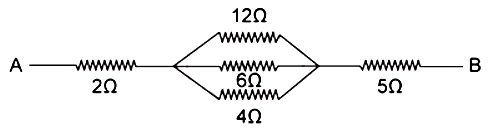
Calculate the effective resistance between the points A and B in the network shown below in figure.

Answer
For parallel resistance
$
\begin{aligned}
& \frac{1}{ R }=\frac{1}{12}+\frac{1}{6}+\frac{1}{4}=\frac{1+2+3}{12}=\frac{6}{12} \\
& R =2 \Omega
\end{aligned}
$
Now all resistances are in series
$
R=2+2+5=9 \Omega
$
View full question & answer
Question 132 Marks
Write the expressions for the equivalent resistance R of three resistors R1, R2 and R3 joined in
(a) parallel (b) series
Answer
(a) Total Resistance in series:
$
R=R_1+R_2+R_3
$
(b) Total Resistance in parallel:
$
\frac{1}{R}=\frac{1}{R_1}+\frac{1}{R_2}+\frac{1}{R_3}
$
View full question & answer
Question 142 Marks
A cell is used to send current to an external circuit. (a) How does the voltage across its terminals compare with its e.m.f? (b) under what condition is the e.m.f of a cell equal to its terminal
voltage?
Answer
(a) Terminal voltage is less than the emf : Terminal Voltage < e.m.f.
(b) e.m.f. is equal to the terminal voltage when no current is drawn.
View full question & answer
Question 152 Marks
(a) Name and state the law which relates the potential difference and current in a conductor.

(b) What is the necessary condition for a conductor to obey the law named above in part (a) ?

Answer

(a)The law is called Ohm's law. It states that the current flowing through the conductor is directly proportional to the potential difference across the ends of a conductor given the temperature remains constant.

(b) Temperature should remain constant.
View full question & answer
Question 162 Marks
How is the electric potential difference between the two points defined? State its S.I. unit.
Answer
The potential difference between two points is equal to the work done in moving a unit positive charge from one point to the other.
It's S.I. unit is Volt.
View full question & answer
Question 172 Marks
Name the material used for heating element of a room heater.
Answer
A nichrome wire is used as a heating element for a room heater because the resistivity of
nichrome is high and increase in its value with increase in temperature is high.
View full question & answer
Question 182 Marks
Name a material which is used for making the standard resistor. Give a reason for your answer.
Answer
Manganin is used for making the standard resistor because its resistivity is quite large and the
effect of change in temperature on their resistance is negligible.
View full question & answer
Question 192 Marks
Define the term electric potential. State its S.I. unit.
Answer
Potential at a point is defined as the work done in bringing a unit positive charge from infinity
to that point. Its S.I. unit is volt, where 1 V = 1 joule/1 coulomb
View full question & answer
Question 202 Marks
Define the term resistivity and state its S.I unit.
Answer
The resistivity of a material is the resistance of a wire of that material of unit length and unit
area of cross-section.
Its S.I. unit is ohm metre.
View full question & answer
Question 212 Marks
Define the term current and state its S.I unit.
Answer
Current is defined as the rate of flow of charge.
i.e. $I=\frac{Q}{t}$
Its S.I. unit is Ampere (A), where $1 A =\frac{1 \text { coulomb }}{1 \text { second }}$.
View full question & answer
Question 222 Marks
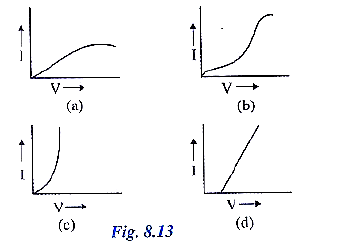
Figure , below shows the I-V characteristic curves for four resistors. Identify the ohmic and non-ohmic resistors. Give a reason for your answer.
Answer
Ohmic: (d), Non-Ohmic: (a), (b) and (c)
Only for (d) the I-V graph is a straight line or linear while for (a), (b) and (c), the graph is a curve.
View full question & answer
Question 232 Marks
Give two difference between an ohmic and non-ohmic resistor.
Answer
(1) Ohmic resistor obeys ohm's law i.e., V/I is constant for all values of V or I; whereas Non-ohmic resistor does not obey ohm's law i.e., V/I is not same for all values of V or I.
(2) In Ohmic resistor, V-I graph is linear in nature whereas in non-ohmic resistor, V-I graph is non-linear in nature.
View full question & answer
Question 242 Marks
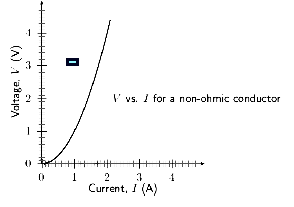
What are non-ohmic reistors? Give one example and draw a graph to show its current-voltage relationship.
Answer
The conductors which do not obey Ohm's Law are called non-ohmic resistors. Example: diode valve
View full question & answer
Question 252 Marks
Draw a I – V graph for a linear resistor. What does its slope represent?
Answer

The slope of I-V graph (=
$
\begin{aligned}
& \Delta l \\
& \Delta v
\end{aligned}
$
) is equal to the reciprocal of the resistance of the conductor, i.e.
Slope $=\frac{\Delta I}{\Delta V}=\frac{1}{\text { Resistance of conductor }}=$ conductance
View full question & answer
Question 262 Marks
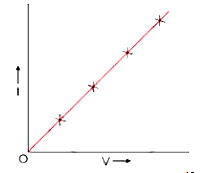
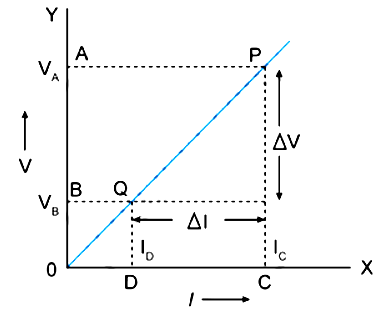
(a) draw a V-I graph for a conductor obeying Ohm’s law.

(b) what does the slope of V–I graph for a conductor represent?
Answer
(a)


(b) Slope of VI graph represents the resistance.
View full question & answer
[2 Mark Question Answer] - Physics STD 10 Questions - Vidyadip