Questions · Page 1 of 2

[3 Mark Question Answer]

🎯

Test yourself on this topic

50 questions · timed · auto-graded

Question 13 Marks
Find the heat produced in joules when a current of 10 amperes flows through a connecting wire of resistance $2 \times 10^{-2}$ ohms and heating element of resistance 250 ohms for 2 seconds.
Answer
Heat produced when current flows in the wire for $2$ seconds $Q_1 = I^2Rt$
$Q_1 = 10 \times 10 \times 2 \times 10^{-2} \times 2$
$Q_1= 4 J$
Heat produced in heating element in $2$ seconds
$Q_2 = 10 \times 10 \times 250 \times 2$
$Q_2= 50000 J$
View full question & answer
Question 23 Marks
A family uses a light bulb of 100W, a fan of 100W, and a heater of 1000W, each for 8 hours a day. If the cost of electricity is Rs. 2 per unit, what is the expenditure to the family per day, on electricity?
Answer
Power consumed in watt-hours
= 100 × 8 + 100 × 8 + 1000 × 8
(bulb) (fan) (heater) = (800 + 800 + 8000) watt-hours
= 9600 watt hour (units)
i.e. Electric energy comsumed in kWh (units)
$=\frac{9600}{1000}=9.6 kWh$.
Cost at Rs. 2 per unit or per kWh
= Rs. 2 × 9.6 = Rs. 19.20.
View full question & answer
Question 33 Marks
Out of the three fuses with current ratings 5A, 10A, 15A, which one is to be connected in a geyser circuit marked 3 kW, 220V? Give reason for your answer.
Answer
The current flowing through Geyser
$=\frac{3 \times 1000}{220}=13.63 A =14 A$.
The rating of fuse should be just matching with the maximum current carried by the circuit. So the fuse rating should be of 15A.
View full question & answer
Question 43 Marks
An Electric bulb is marked 100 W, 230 V. What how long would this lamp take to consume one unit of electricity?
Answer
Energy consumed in kWh =
$\frac{ W \times \text { Time in hour }}{1000}$
$=\frac{100 \times t ( in hr )}{1000}$
If energy consumed in 1 kWh, then 1 =
$\frac{100 \times t}{1000}$
time required for consuming 1 kWh, t = 10 hour.
View full question & answer
Question 53 Marks
An electric iron is rated at 230 V, 750 W. What is its resistance? What maximum current can be passed through it?
Answer
V = 230 V, Power = 750 W
P = V × I
∴ 750 = 230 × I
∴ I = 750/230
∴ I = 3.26 A
By Ohm's law $\frac{ V }{ I }= R$
∴ R = 70.53 Ω
View full question & answer
Question 63 Marks
An electric lamp A of $40 \ W$ and another electric lamp B of $100 \ W$ are connected to $220 \ V$ supply. Calculate the ratio of their filament resistances?
Answer
$P=V \cdot I=\frac{V . V}{R}$
$40=\frac{(220)^2}{ R _{ A }}$
$R _{ A }=\frac{220 \times 220}{40}$
$R_A = 110 \times 11$
$P=\frac{V^2}{R}$
$100=\frac{(220)^2}{R_B}$
$R _{ B }=\frac{220 \times 220}{100}$
$R_B= 22 \times 22$
$\frac{ R _{ A }}{ R _{ B }}=\frac{110 \times 11}{22 \times 22}=\frac{5}{2}=5: 2$
$\frac{ R _{ A }}{ R _{ B }}=5: 2$
View full question & answer
Question 73 Marks
State three factors on which the heat produced in a metallic wire due to passage of current in it depends.
Answer
(i) On resistance of wire.
(ii) On strength of current through the wire.
(iii) On time for which the current flows in the wire.
View full question & answer
Question 83 Marks
What is electric power? State and define its S.I. unit.
Answer
Electric power is the rate of doing work or it is the work done in 1 second.
The S. I. unit of power is ‘Watt’.
If a current of 1 ampere flows through a metallic conductor at a potential difference of 1 volt, the power is said to be 1 watt.
or 1 Watt = 1 Volt × 1 Ampere.
View full question & answer
Question 93 Marks
What is the function of the split rings in a d.c. motor?
Answer
The split ring atts as a commutator in a d.c. motor. With the split ring, the direction of current through the coil is reversed after every half rotation of coil and thus the direction of couple rotating the coil remains unchanged and the coil continues to rotate in the same direction.
View full question & answer
Question 103 Marks
What would happen and why, to an electric bulb when it is connected across a supply of voltage (i) lower (ii) higher than its proper rating?
Answer
We know, Current = Voltage/Resistance
For a given bulb, the filament would have a definite characteristic resistance. Hence
(i) When the bulb is connected to a lower voltage supply, it would draw less current than its ‘proper current’. Hence it would not glow to its full capacity.
(ii) When the bulb is connected to a higher voltage supply, it would draw more current than its ‘proper current’. Hence its filament would get heated to a temperature higher than its proper permitted limit and is, therefore, likely to melt or fuse.
View full question & answer
Question 113 Marks
Name two precautions to be observed while using an immersion heater.
Answer
The two main precautions to be observed are:
(i) Never try to find the temperature of water by dipping your fingers in water because some times when water comes in contact with the live or neutral wire, there is a possibility of getting an electric shock.
(ii) The heater must be surrounded by water to the desired level before it is switched on. If not,
so the heat produced in the nichrome wire will not dissipate easily and so the heating element will melt.
View full question & answer
Question 123 Marks
Two lamps are rated $220\ V, 50\ W$ and the other rated $220\ V, 100\ W$ are connected in series with the mains of $220 V$. Explain, why the 50W lamp glows more?
Answer
From relation $R=V^2 / P$, the resistance of filament of $50 W$ lamp will be more than that of $100 W$ lamp. If the two lamps are connected in series with the mains, same current will flow through each lamp. From relation $H =1^2 Rt$, since resistance of $50 W$ lamp is more than that of 100 W lamp, so the $50 W$ lamp will consume more electrical energy than that of $100 W$ lamp, in the same time. Hence the 50W lamp will glow more.
View full question & answer
Question 133 Marks
Where are the cartridge type fuse used?
Answer
Cartidge type fuse are used to provide additional safety to an electric appliance. The fuse wire used must have a lower rating than the maximum current which the appliance or the circuit can withstand. Hence, the fuse blows off just the current nearly approaches the maximum value and thus it protects the appliance from any damage done due to heating.
View full question & answer
Question 143 Marks
Why fuse wire must always be connected in ‘live’ wire? Explain.
Answer
Under any circumstances, fuse wire always be connected in a live wire and never in neutal wire. The reason is that in the case of over-loading, if fuse wire is connected in neutral wire, it will certainly melt and break, but the electric appliance still be in contact with the live wire, so if any person happens to touch the appliance, he will get a shock which may prove fatal.
View full question & answer
Question 153 Marks
An electric filament lamp is connected to a supply of voltage higher than the recommended value. Give reasons, why compared with a normal performance, the lamp emits a brighter light and its life is shortened.
Answer
The lamp will have the filament of a particular resistance. If it is connected to a supply of higher voltage, the heat energy produced in it will be more (since $H = V ^2 t / R$ ), i.e., the filament will get more heated so it will glow more and the lamp will emit a brighter light. On the other hand, due to Excess heating, the filament may vaporize and so its life may shorten.
View full question & answer
Question 163 Marks
What are ‘dual switches’? Mention their one main use.
Answer
Dual switches are double pole type switches. With such switches an appliance, e.g., and electric bulb can be switched off or on from two different places. They are generally used in staircases, long corridors etc.
View full question & answer
Question 173 Marks
State the purpose served by the terminals of a three pin plug.
Answer
The earth pin, which is thicker and longer than the other two pins; first connects the appliances to the earth and ensures safety from an electric shock to the user. The live pin on the right and the neutral pin on the left connects the appliance to the live wire and the neutral wire of the circuit at the supply voltage.
View full question & answer
Question 183 Marks
A switch is not touched with wet hands while putting it on or off. Give a reason for your answer.
Answer
A switch should not be touched with wet hands. If water reaches the live wire, it forms a conducting layer between the hand and the live wire of the switch through which the current passes to the hand and the person may get a fatal shock.
View full question & answer
Question 193 Marks
What will happen if switch is connected in ‘neutral wire’?
Answer
If switch is connected in the neutral wire, an electric appliance, e.g., an electric iron will remain connected to the live wire even when the switch is off and so if any one happens to touch the appliances; he of she will get a shock which is sometimes fatal.
View full question & answer
Question 203 Marks
What is a switch? State its function in an electric circuit.
Answer
A switch is an on-off device for current flowing in a circuit or in an electric appliance. The switch should always be connected in the live wire. Its main function is either to connect or disconnect an electric appliance in an electric circuit.
View full question & answer
Question 213 Marks
What is meant by ‘MCB’? Which part of the domestic electric circuit does it replace?
Answer
‘MCB’ stands for ‘miniature circuit breaker’. This is a device that automatically ‘switches off the mains supply if the current drawn Exceeds the prescribed upper safe limit. It can be ‘reset’ with the help of a flip-over switch. It protects the entire circuit and appliances against short circuiting, etc.
View full question & answer
Question 223 Marks
Why mica is preferred to other insulators in an electric iron?
Answer
Mica is preferred to other insulators in an electric iron because mica is a bad conductor of electricity, but it easily conducts away heat. So when current flows through nichrome wire, the heating element is fully protected against any leakage of electric current, whereas heat is easily conducted.
View full question & answer
Question 233 Marks
Why is the heating element of an electric oven wound on a helix? State the reason.
Answer
In an electric oven, the china clay plate is provided either with lateral grooves or grooves in the form of a spiral helix. This type of spiral winding reduces the area of spread of nichrome wire and helps to concentrate heat in a small region.
View full question & answer
Question 243 Marks
Why is that the same current flowing through the bulb heats up the filament, while the leads are not heated up?
Answer
The leads are much thicker than the filament wire. Thus the resistance of the leads is much smaller than that of filament wire. So with the same current, the filament gets heated while the leads are not.
View full question & answer
Question 253 Marks
Define Kilo watt hour.
Answer
Kilowatt-hour is a commercial unit of electric energy consumed. It is also called B.O.T. (Board of Trade) unit and is used throughout the world in calculating the amount of electric energy consumed. kWh is defined as the amount of electric energy consumed by an electric appliance of power 1kW for one hour.
View full question & answer
Question 263 Marks
What is meant by earthing of an electrical appliance? Why is it essential?
Answer
Earthing of an electrical appliance meant the outer metallic case of appliance is connected with earth, wire which is welded to the end of a copper rod and it is burned in the ground.
It save the appliance during short-circuiting by passing Excessive current to earth.
View full question & answer
Question 273 Marks
Household wiring for lamp connections can either be done in parallel or in series.Which one would you prefer? Give a reason for your answer.
Answer
We would prefer the parallel wiring. This is done for the following reasons:
(i) In parallel wiring, each lamp can have its independent switch and the disconnection (putting off) of one of them will not effect the other lamps.
(ii) All lamps have the same potential difference (equal to that of the mains) across the terminals and are thus able to work as per their specified rating.
View full question & answer
Question 283 Marks
In an electric radiator or room heater, state with reason, why the porcelain tube wound with a nichrome wire is placed between the pole and principal focus of the parabolic concave reflector.
Answer
In this position, when current passes through the nichrome wire, it becomes red hot and the concave reflector helps in spreading the heat radiation in the room because it forms a divergent beam on account of the heating element being placed between the pole and the principal focus of the reflector.
View full question & answer
Question 293 Marks
Name two common material used for heating elements.
Answer
Nichrome and manganin are the common alloys that are mostly used for making heating elements.
Nichrome is: 60% nickel + 25% iron + 15% chromium.
Manganin is: 83% manganese + 13% copper + 4% nickel.
View full question & answer
Question 303 Marks
Mention three uses of the carbon arc.
Answer
(i) They are used in light houses.
(ii) They are used in search lights and cinema projection appliances.
(iii) They are used in electric furnace and electric welding.
View full question & answer
Question 313 Marks
Name three main characteristics of an heating element.
Answer
The three main characteristics of an heating element are:
(i) It should have a high resistance so that a major amount of electric energy is converted into heat energy.
(ii) It should not get oxidised easily up to a temperature of 1000°C.
(iii) It should have a high melting point and a low thermal Expansion so that it does not get loosened on getting heated.
View full question & answer
Question 323 Marks
Define watt-hour. How many joules are equal to 1 watt-hour?
Answer
Watt hour is a smaller commercial unit of electric energy, which is spent by an electric appliance of 1 watt power in 1 hour, i.e.
1 watt hour = 1 watt × hour = 1 watt × (60 × 60)s
= 3600 joule.
View full question & answer
Question 333 Marks
State two advantages of ‘the ring system of house wiring’.
Answer
The three advantages of ring system are:
(i) Length of wiring used is much less and so less costly, since a single ring feeds the whole house.
(ii) In case of short-circuit, only the fuse of that particular appliance blows off, diconnecting it from the electric circuit; while the circuits of other appliances remain unaffected.
View full question & answer
Question 343 Marks
Point out two main disadvantages of ‘Tree System’.
Answer
The three main disadvantages are:
(i) Longer length of wire is required for wiring different rooms in a house. Since all circuits start from the main distribution board and so it is comparatively more Expensive.
(ii) If fuse blows off in any part of the building, it disconnects all the appliances in the circuit.
View full question & answer
Question 353 Marks
What are the two main systems of wiring commonly used in houses? Which of these systems mentioned by you is better and why?
Answer
The two main systems of wiring are:
(i) the tree system, and
(ii) the ring system.
Out of these systems, the ring system is better. The reason is that this system of wiring is cheaper because a low rating wire can be used for connection of appliances.
View full question & answer
Question 363 Marks
An electric current is passed through a metallic wire. The wire gets heated up. Give the reason. Is it possible to melt the wire by passing a heavy current?
Answer
The metallic wire gets heated up on passing an electric current through it due to collisions of free electrons and energy is transferred to the positive ions which begin to vibrate more violently, causing to produce heat. It is possible to melt the wire by passing a heavy current. The wire will melt when its temperature due to heating reaches its melting point.
View full question & answer
Question 373 Marks
A. bulb is rated at 100W, 250V and another one at 60W, 250V. What is the current flowing in the circuit if the two bulbs are put in series across a 220 V mains supply?
Answer
The resistance of first bulb $=$
$
\frac{ V ^2}{ P _1}=\frac{250 \times 250}{100} \Omega=625 \Omega
$
Resistance of second bulb $=$
$
\frac{ V ^2}{ P }=\frac{250 \times 250}{60} \Omega=\frac{3125}{3} \Omega
$
$\therefore$ Resistance of the circuit containing the two bulbs in series
$
\begin{aligned}
& =\left(625+\frac{3125}{3}\right) \Omega=\frac{5000}{3} \Omega \\
& \therefore \text { Current flowing }=200 \div\left(\frac{5000}{3}\right) A \\
& =\frac{220 \times 3}{5000} A \\
& =\frac{220 \times 3}{5000} \times 1000 mA =132 mA
\end{aligned}
$
View full question & answer
Question 383 Marks
A bulb is connected to a battery of e.m.f. 6V and internal resistance 2Ω A steady current of 0.5A flows through the bulb. Calculate the resistance of the bulb.
Answer
or $R =\frac{5}{0.5}=10 \Omega$
View full question & answer
Question 393 Marks
A bulb is connected to a battery of e.m.f. 6V and internal resistance 2Ω A steady current of 0.5A flows through the bulb. Calculate the total energy supplied by the battery in 10 minutes.
Answer
Given: E = 6V, r = 2Ω, i = 0.5A, t = 10 minute = 10 × 60s = 600s.

The total energy supplied by the battery = Eit

= 6 × 0.5 × 600 = 1800 J

View full question & answer
Question 403 Marks
Two resistances $R_1 = 4Ω$ and $R_2 = 6Ω$ are connected in series. The combination is connected with a battery of e.m.f. $6V$ and negligible resistance. Calculate:
(i) the heat produced per minute in each resistor,
(ii) the power supplied by the battery.
Answer
Given: $R_1=4 \Omega, R_2=6 \Omega, E=6 V, t=1$ minute $=60 s$.
Total resistance of the circuit $R=R_1+R_2=4+6=10 \Omega$
Current through the battery I =
$\frac{E}{R}=\frac{6}{10}=0.6 A$
The same current flows through each resistor.
(i) The heat produced in resistor $R _1$ is $H _1=1^2 R _1 t$
$=(0.6)^2 \times 4 \times 60=86.4 J$
The heat produced in resistor $R _2$ is $H _2=1^2 R _2 t$
$=(0.6)^2 \times 6 \times 60=129.6 J$
(ii) The power supplied by the battery $= E \times 1$
$=6 \times 0.6=3.6 W \text {. }$
View full question & answer
Question 413 Marks
Find the cost of operating an electric toaster for two hours if it draws 8 A current on a 110 volt circuit. The cost of electrical energy is Rs. 2.50 per kWh.
Answer
$
\begin{aligned}
& \text { Time }=2 hrs , I =8 A , V =110 \text { volt } \\
& \text { Power }= IV \\
& =8 \times 110=880 Watt
\end{aligned}
$
Electrical energy (in $kWh )=$
Power(in Watt) $\times$ Time(in hour)
$
1000
$
$
\begin{aligned}
& =\frac{880 \times 2}{1000} \\
& =1.76 kWh
\end{aligned}
$
Cost of $1 kWh$ energy = Rs. 2.50
Cost of $1.76 kWh$ energy $=2.50 \times 1.76$
Rs. 4.40
View full question & answer
Question 423 Marks
An electrical appliance is rated 1500 W, 250 V. This appliance is connected to 250 V mains. Calculate:
(i) the current drawn,
(ii) the electrical energy consumed in 60 hours,
(iii) the cost of electrical energy consumed at Rs. 2.50 per kWh.
Answer
Step-up transformer. Step-up transformer works on the principle of electromagnetic induction.
View full question & answer
Question 433 Marks
The resistance of filament of an electric heater is 500 Ω It is operated at 200V for 1 hour daily. Calculate the current drawn by the heater and the energy consumed in kWh, by the heater in a month of 30 days.
Answer
Given: $R=500 \Omega, V=200$ volt.
Total time $= t =1 \times 30 h =30 h =30 \times 60=60 s =$ 108000s.
Current drawn by the heater $I =\frac{ V }{ R }=\frac{200}{500}=0.4 A$
The energy consumed (in $kWh$ ) = $\frac{\text { voltage } \times \text { Current }}{100} \times$ Time
$
=\frac{200 \times 0.4}{1000} \times 30=2.4 kWh
$
View full question & answer
Question 443 Marks
The resistance of filament of an electric heater is 500 Ω It is operated at 200V for 1 hour daily. Calculate the current drawn by the heater and the energy consumed in joule.
Answer
Given: $R=500 \Omega, V=200$ volt.
Total time $= t =1 \times 30 h =30 h =30 \times 60=60 s =$ 108000s.
Current drawn by the heater $I =\frac{ V }{ R }=\frac{200}{500}=0.4 A$
The energy consumed (in joule) $=\frac{ V ^2}{ R } t$
$
\begin{aligned}
& =\frac{(200)^2}{500} \times 108000 \\
& =8640000 J .
\end{aligned}
$
View full question & answer
Question 453 Marks
You are required to connect a bulb, a fan and a socket outlet to the mains in one set A and an air-conditioner and a refrigerator to the mains in other set B. Will you recommend the wire of same thickness and same insulation in both? explain your answer.
Answer
No. The wire used in set B must be thicker and of better insulation than that used in set A. The reason is that in set B, the appliances will draw heavy current (= 15A) when they are used, whereas in set A, the appliances will draw ordinary current (= 5A) when they are in use. Therefore, the resistance of wire used in set B must be less than that of wire used in set A. A thick wire has less resistance than a thin wire.
View full question & answer
Question 463 Marks
Give the role of each of the three terminals of a three way pin plug.
Answer
The earth pin being thicker can never enter live or neutral sockets thus a given electric appliance gets connected only in one proper electrical position, where the live wire, neutral and earthing are connected correctly.
The earth pins being longer, get connected to earth terminal first, thus ensuring that the user will not get an electric shock, because the current will melt the fuse in case the electrical appliance is short-circuited.
View full question & answer
Question 473 Marks
An electric filament lamp is connected to a supply of voltage higher than the recommended value. Give reasons, why compared with a normal performance, the lamp emits a brighter light and its life is shortened.
Answer
The lamp will have the filament of a particular resistance. If it is connected to a supply of higher voltage, the heat energy produced in it will be more (since $H = V^2t/R)$, i.e., the filament will get more heated so it will glow more and the lamp will emit a brighter light. On the other hand, due to Excess heating, the filament may vaporize and so its life may shorten.
View full question & answer
Question 483 Marks
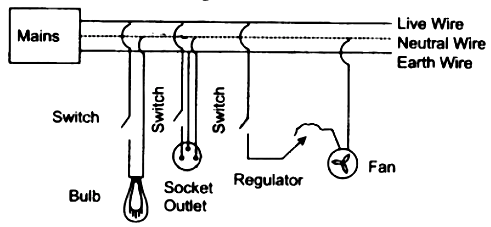
Draw a labelled diagram with necessary switch, regulator etc. to connect a bulb, a plug socket outlet and a fan with the mains. In what arrangement have you connected these to the mains?
Answer
The labelled diagram of the circuit is given below.

The different appliances have been connected to the mains in parallel.
View full question & answer
Question 493 Marks
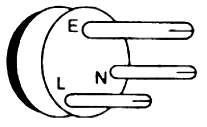
Draw a diagram of a three pin plug top. Mark the pins used for live, neutral and earth connections as L, N and E respectively. To which part of the appliance is the pin marked as E connected. To which line L or N is the fuse connected?
Answer
The labelled diagram of a three-pin plug top is shown below.

The pin marked as E is connected to the outer metallic case of the appliance. The fuse is connected to the live line L.
View full question & answer
Question 503 Marks
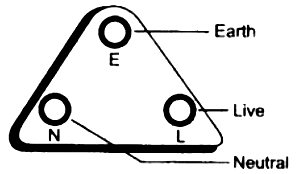
Draw diagram of a three pin socket outlet and state the connections made to them.
Answer
A three-pin socket-outlet is shown in the figure.

E—Earth
N—Neutral
L—Live wire.
View full question & answer
[3 Mark Question Answer] - Physics STD 10 Questions - Vidyadip