Questions · Page 1 of 2

MCQ

🎯

Test yourself on this topic

50 questions · timed · auto-graded

MCQ 11 Mark
In a step up transformer:
  • A
    $N_s=N_p$
  • B
    $N_s < n_p$
  • $N_s>N_p$
  • D
    nothing can be said
Answer
Correct option: C.
$N_s>N_p$
$N_s>N_p$
Hint : Since a step-up transformer is used to change a low voltage alternating e.m.f. to a high voltage alternating e.m.f. of same frequency, the number of turns in the secondary coil is more than the number of turns in the primary coil, i.e. $N_s>N_p$
View full question & answer
MCQ 21 Mark
The direction of induced current is obtained by:
  • Fleming's left hand rule
  • B
    Clock rule
  • C
    Right hand thumb rule
  • D
    Right hand thumb rule
Answer
Correct option: A.
Fleming's left hand rule
Fleming's right hand rule

Statement : According to Fleming's right hand rule, if we stretch the thumb, middle finger and forefinger of our right hand mutually perpendicular to each other such that the forefinger indicates the direction of magnetic field and thumb indicates the direction of motion of conductor, then the middle finger will indicate the direction of induced current.

View full question & answer
MCQ 31 Mark
In an electric motor the energy transformation is
  • A
    From electrical to chemical
  • B
    From chemical to light
  • C
    From mechanical to electrical
  • From electrical to mechanical
Answer
Correct option: D.
From electrical to mechanical
In an electric motor, the energy transformation is from electrical to mechanical.
Note: An electric motor is a device which converts electrical energy into mechanical energy.
View full question & answer
MCQ 41 Mark
By reversing the direction of current in a wire, the magnetic field produced by it:
  • Gets reversed in direction
  • B
    Increases in strength
  • C
    Decreases in strength
  • D
    Remains unchanged in strength and direction
Answer
Correct option: A.
Gets reversed in direction
By reversing the direction of current in a wire, the magnetic field produced by it gets reversed in direction.

Hint: On reversing the direction of current in a wire, the polarity of the faces of the wire also reverses. Thus, the direction of magnetic field produced by it also gets reversed.

View full question & answer
MCQ 51 Mark
The present of magnetic field at a point can be detected by :
  • A
    A strong magnet
  • B
    A solenoid
  • A compass needle
  • D
    A current carrying wire
Answer
Correct option: C.
A compass needle
The presence of magnetic field at a point can be detected by a compass needle.

Note: In the presence of a magnetic field, the needle of compass rests only in the direction of magnetic field and in the absence of any magnetic field, the needle of compass can rest in any direction. In the earth's magnetic field alone, the needle rests along north-south direction.

View full question & answer
MCQ 61 Mark
Horse shoe magnets are used in:
  • A
    DC motor
  • B
    AC generator
  • C
    Electric bell
  • All of the above
Answer
Correct option: D.
All of the above
(d)
All of the above
Explanation:
Horse shoe magnets are versatile and used in various devices including DC motors, AC generators, and electric bells due to their strong and concentrated magnetic fields.
View full question & answer
MCQ 71 Mark
The type of magnet commonly used to study the magnetic properties of substances and for scientific research is:
  • A
    Permanent magnet
  • B
    Bar magnet
  • Electromagnet
  • D
    None of the above
Answer
Correct option: C.
Electromagnet
(c)
Electromagnet
Explanation:
Electromagnets are preferred in scientific research for studying magnetic properties because their magnetic field can be precisely controlled.
View full question & answer
MCQ 81 Mark
A strong permanent magnet is typically made of:
  • A
    Soft iron
  • Steel
  • C
    Nickel
  • D
    Copper
Answer
Correct option: B.
Steel
(b)
Steel
Explanation :
Steel is used to make strong permanent magnets due to its high retentivity compared to materials like soft iron.
View full question & answer
MCQ 91 Mark
On reversing the direction of current in a wire, the magnetic field produced by it:
  • Gets reversed in direction
  • B
    Increases in strength
  • C
    Decreases in strength
  • D
    Remains unchanged in strength and direction.
Answer
Correct option: A.
Gets reversed in direction
(a)
Gets reversed in direction
Explanation :
When the current direction in a wire is reversed, the magnetic field also reverses its direction, as per the right-hand rule.
View full question & answer
MCQ 101 Mark
The magnetic field lines inside a solenoid are:
  • A
    Parallel and circular
  • Straight and parallel to the axis of the solenoid
  • C
    Straight and perpendicular to the axis of the solenoid
  • D
    Circular
Answer
Correct option: B.
Straight and parallel to the axis of the solenoid
(b)
Straight and parallel to the axis of the solenoid
Explanation :
Inside a solenoid, the magnetic field lines are straight and align parallel to the axis, creating a uniform magnetic field.
View full question & answer
MCQ 111 Mark
Which statement is NOT true for an electromagnet?
  • A
    It is made of soft iron.
  • B
    Its magnetic field strength can be changed.
  • The polarity of an electromagnet cannot be changed.
  • D
    It can easily be demagnetised.
Answer
Correct option: C.
The polarity of an electromagnet cannot be changed.
(c)
The polarity of an electromagnet cannot be changed.
Explanation:
The polarity of an electromagnet can indeed be changed by reversing the current's direction flowing through its solenoid.
View full question & answer
MCQ 121 Mark
Which of the following statements about a bar magnet is NOT true?
  • The strength of the magnetic field due to a bar magnet can be changed.
  • B
    A solenoid behaves like a bar magnet, attracting iron filings.
  • C
    The magnetic field strength increases if a soft iron core is placed along the axis of the solenoid.
  • D
    The magnetic field lines inside the solenoid are nearly straight and parallel to the axis.
Answer
Correct option: A.
The strength of the magnetic field due to a bar magnet can be changed.
(a)
The strength of the magnetic field due to a bar magnet can be changed.
Explanation:
The magnetic strength of a bar magnet is fixed and cannot be altered, as it is determined by the material's properties.
View full question & answer
MCQ 131 Mark
For burning of coal in a thermoelectric station, the energy conversion taking place is:
  • A
    chemical to heat to mechanical
  • chemical to heat to mechanical to electrical
  • C
    chemical to heat to light
  • D
    heat to chemical to mechanical
Answer
Correct option: B.
chemical to heat to mechanical to electrical
(b)
chemical to heat to mechanical to electrical
Explanation :
Burning of fuel by chemical combustion produces heat which drives the turbine to produce electricity.
View full question & answer
MCQ 141 Mark
Lenz's law is based on the law of conservation of:
  • A
    force
  • B
    charge
  • C
    mass
  • energy
Answer
Correct option: D.
energy
(d)
energy
Explanation:
Lenz's law is based on the law of conservation of energy it states that the induced current is always opposed by the cause that produces it. Therefore, there is extra work done against the opposing force.
View full question & answer
MCQ 151 Mark
If the strength of the current flowing through a wire is increased, the strength of the magnetic field produced by it:
  • A
    decreases
  • increases
  • C
    remains the same
  • D
    first increases then decreases
Answer
Correct option: B.
increases
(b)
increases
Explanation:
Magnetic field produced is directly proportional to current flowing through the conductor.
View full question & answer
MCQ 161 Mark
The energy conversion in a washing machine is from _____________ .
  • A
    magnetic to electrical
  • electrical to mechanical
  • C
    electrical to magnetic
  • D
    magnetic to electrical
Answer
Correct option: B.
electrical to mechanical
(b)
electrical to mechanical
Explanation :
Electrical energy supplied to the washing machine gets converted into mechanical kinetic rotational energy are to the use of DC motor.
View full question & answer
MCQ 171 Mark
By using Fleming's right hand rule we can indicate the ______________ .
  • A
    Direction of magnetic field
  • B
    Direction of motion of conductor
  • D
    All of the above,
Answer
Correct option: C.
(c)
Direction of current
Explanation:
According to Faraday's law of electromagnetic induction, when a conductor moves through a magnetic field, an electric current is induced in it. Fleming's right hand rule is used to determine the direction of the induced current.
Image
View full question & answer
MCQ 181 Mark
AC Generator works on the principle of _____________ .
  • A
    Lenz's law
  • Faraday law of electromagnetic induction
  • C
    Lorantz law of electromagnetic
  • D
    None of the above
Answer
Correct option: B.
Faraday law of electromagnetic induction
(b)
Faraday law of electromagnetic induction
Explanation:
AC generators work on the principle of Faraday's law of electromagnetic induction, which states that electromotive force EMF or voltage is generated in a current-carrying conductor that cuts a uniform magnetic field.
View full question & answer
MCQ 191 Mark
Which type of energy conversion takes place in an electric DC motor?
  • A
    electrical to kinetic energy
  • B
    electrical to rotational energy
  • C
    electrical to potential energy
  • electrical to rotational kinetic energy
Answer
Correct option: D.
electrical to rotational kinetic energy
(d)
electrical to rotational kinetic energy
Explanation:
Option (d) is correct as an electric motor is a device that converts electrical energy into rotational kinetic energy
View full question & answer
MCQ 201 Mark
When a conductor carrying current is placed in a magnetic field, perpendicular to it then the direction of the force experienced can be found out using _______________ .
  • A
    Lenz's law
  • Fleming's left hand rule
  • C
    Flemings right hand rule
  • D
    Right hand thumb rule
Answer
Correct option: B.
Fleming's left hand rule
(b)
Fleming's left hand rule
Explanation:
Fleming's left hand rule is used to find the direction of the force experienced by a current carrying conductor placed in magnetic field. It states that if we arrange our thumb, forefinger and middle finger of the left hand perpendicular to one another, then the thumb points towards the direction of force, the forefinger points towards the direction of magnetic field and the middle finger points towards the direction of current.
View full question & answer
MCQ 211 Mark
Our household voltage source is on 50 Hz. In this circumstances which of the following a transformer can do?
  • It cannot alter the frequency of the voltage source.
  • B
    It can increase the frequency of the voltage source upto 100 Hz.
  • C
    It can increase the frequency of the voltage source upto 500 Hz.
  • D
    It can decrease the frequency of the voltage source upto 5 Hz.
Answer
Correct option: A.
It cannot alter the frequency of the voltage source.
(a)
It cannot alter the frequency of the voltage source.
Explanation:
The frequency of the alternating voltage is not affected by the transformer; the frequency remains unchanged, i.e. 50 Hz.
View full question & answer
MCQ 221 Mark
Match the following:
Column IColumn II
(i) Cathode ray tube in TV1.6 V
(ii) Household mains2.220 V
(iii) Door bell3. 11,000 V
  • A
    (i) 1. (ii) 3, (iii) 2
  • B
    (i)-1, (ii) 2, (iii)-3
  • C
    (i) -3, (ii) -1, (iii) -2
  • (1)-3, (ii)-2, (iii)-1
Answer
Correct option: D.
(1)-3, (ii)-2, (iii)-1
(d)
(1)-3, (ii)-2, (iii)-1
Explanation:
In our everyday lives, we utilise a variety of electrical equipment that require operating voltages other than the mains voltage (i.e., 220 V), such as a doorbell that requires 6 V and a television's cathode ray tube that requires over 10,000 V

View full question & answer
MCQ 231 Mark
Which of the following voltage sources generally used in Indian factories?
  • 220 VAC
  • B
    220 VDC
  • C
    440 VAC
  • D
    440 VDC
Answer
Correct option: A.
220 VAC
(a)
220 VAC
Explanation:
In Indian households and factories we use 220 VAC .
View full question & answer
MCQ 241 Mark
Consider a 100 Hz electric supply. How many times per second will the polarity at the supply terminal change?
  • A
    100 times
  • 200 times
  • C
    300 times
  • D
    50 times
Answer
Correct option: B.
200 times
(b)
200 times
Explanation:
If the supply is 100 Hz , then the polarity at the supply terminal changes $2 \times 100=200$ times a second, i.e., 100 times +100 times.
View full question & answer
MCQ 251 Mark
In our houses, we have electric supply of frequency ____________ .
  • A
    20 Hz
  • B
    40 Hz
  • 50 Hz
  • D
    100 Hz
Answer
Correct option: C.
50 Hz
(c)
50 Hz
Explanation:
In our houses, we have electric supply of frequency 50 Hz .
View full question & answer
MCQ 261 Mark
Which of the following is the correct relation of magnitude of induced e.m.f. in an alternating current at any instant time $t$ if the coil makes $n$ rotations per second? [Where $e_0$ represents the maximum values of e.m.f.]
  • $e=e_0 \sin 2 \pi n t$
  • B
    $e=e_0 \sin 4 \pi n t$
  • C
    $e=\frac{e_0}{\sin 2 \pi u t}$
  • D
    $e=2 e_0 \sin 2 \pi n t$
Answer
Correct option: A.
$e=e_0 \sin 2 \pi n t$
(a)
$e=e_0 \sin 2 \pi n t$
Explanation:
The relation of magnitude of induced e.m.f. in an alternating current at any instant of time $t$ if the coil makes $n$ rotations per second.
View full question & answer
MCQ 271 Mark
In our electric bell if an AC source is applied instead of a DC source what might happen?
  • A
    The core of the electromagnet will lose magnetism
  • B
    Polarity of electromagnet will change
  • C
    The bell will stop ringing
  • Both (a) and (b)
Answer
Correct option: D.
Both (a) and (b)
(d)
Both (a) and (b)
Explanation:
If an ac. source is used instead of a battery, the electromagnet's core will get magnetised, but the polarity at its ends will alter. Because the armature's attraction is independent of the electromagnet's polarity, hitting the switch will cause
the bell to ring.
View full question & answer
MCQ 281 Mark
If we used a DC source of 50 Hz, what will happen to the iron rod in the solenoid?
  • A
    The iron core might get magnetised.
  • B
    The polarity will change 60 times per second.
  • C
    The polarity will change 50 times per second.
  • Both (a) and (c).
Answer
Correct option: D.
Both (a) and (c).
(d)
Both (a) and (c).
Explanation:
With an AC source of frequency 50 Hz, although the soft iron core becomes magnetised as long as the current passes through it with a frequency of 50 Hz, its polarity at the ends changes 50 times every second.
View full question & answer
MCQ 291 Mark
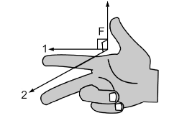
Consider the following picture on Fleming's right hand rule of electromagnetic induction:
Image
(ii) Angle between directions 1 and 2 is:
  • A
    $45^{\circ}$
  • B
    $60^{\circ}$
  • C
    $65^{\circ}$
  • $90^{\circ}$
Answer
Correct option: D.
$90^{\circ}$
(d)
$90^{\circ}$
Explanation :
All the directions of force, magnetic field and current are mutually perpendicular. So, the angle between directions 1 and 2 is $90^{\circ}$.
View full question & answer
MCQ 301 Mark
Consider the following picture on Fleming's right hand rule of electromagnetic induction:
Image
(i) What the direction 1 and 2 indicates?
  • A
    1-Current; 2- Magnetic field
  • B
    1-Current; 2- Electric field
  • C
    1-Electric field; 2- Magnetic field
  • 1-Magnetic field; 2- Current
Answer
Correct option: D.
1-Magnetic field; 2- Current
(d)
1 - Magnetic field; 2- Current
Explanation:
As per the Fleming's Right Hand Rule of electromagnetic induction, direction 1 indicates direction of magnetic field and direction 2 indicates direction of current.
View full question & answer
MCQ 311 Mark
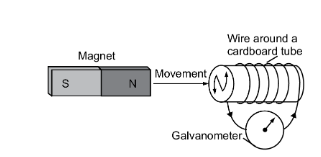
Consider the following figure:
Image
If the solenoid moves to the right instead of the bar magnet, the galvanometer will deflect in which direction?
  • A
    The galvanometer will deflect towards right.
  • The galvanometer will deflect towards left.
  • C
    The galvanometer will fluctuate with equal frequency.
  • D
    The galvanometer will remain as it is.
Answer
Correct option: B.
The galvanometer will deflect towards left.
(b)
The galvanometer will deflect towards left.
Explanation:
If the solenoid moves to the right instead of the bar magnet, the galvanometer will deflect towards the left. Similar thing can be observed if the bar magnet moves to the left keeping the solenoid stationary.
View full question & answer
MCQ 321 Mark
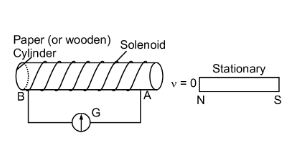
Consider the following figure:
Image
(ii) Which of the following will happen if the magnet's poles are reversed and brought closer to the solenoid?
  • A
    The galvanometer will deflect towards right.
  • The galvanometer will deflect towards left.
  • C
    The galvanometer will fluctuate with equal frequency.
  • D
    (d) The galvanometer will remain as it is.
Answer
Correct option: B.
The galvanometer will deflect towards left.
(b)
The galvanometer will deflect towards left.
Explanation:
If the magnet's poles are reversed, i.e., the South pole is faced towards the solenoid and brought closer to the solenoid the galvanometer will deflect towar left.
View full question & answer
MCQ 331 Mark
Consider the following figure:
Image
(i) Which of the following will happen if the magnet is brought closer to the solenoid?
  • The galvanometer will get deflect towards right.
  • B
    The galvanometer will get deflect towards left.
  • C
    The galvanometer will fluctuate with equal frequency.
  • D
    The galvanometer will remain as it is.
Answer
Correct option: A.
The galvanometer will get deflect towards right.
(a)
The galvanometer will get deflect towards right.
Explanation:
If the magnet is brought closer to the solenoid the galvanometer will deflect towards right.
View full question & answer
MCQ 341 Mark
Between the pole components of a horse-shoe magnet, a flat rectangular coil is turned. The e.m.f changes direction in which position of the coil with respect to the magnetic field?
  • A
    If the plane of coil and the magnetic field is parallel.
  • When the plane of the coil passes from the position normal to the magnetic field.
  • C
    If the plane of coil and the magnetic field is perpendicular
  • D
    None of the above.
Answer
Correct option: B.
When the plane of the coil passes from the position normal to the magnetic field.
(b)
When the plane of the coil passes from the position normal to the magnetic field.
Explanation:
When the plane of the coil moves from normal to the magnetic field, the e.m.f. will changes direction. If the plane of coil and the magnetic field is parallel, the e.m.f. will be maximum and if they are perpendicular the e.m.f. will be minimum (0).
View full question & answer
MCQ 351 Mark
Lenz's law is based upon which of the following law/laws?
  • Law of conservation of energy
  • B
    Law of conservation of mass
  • C
    Law of conservation of momentum
  • D
    Law of conservation of current
Answer
Correct option: A.
Law of conservation of energy
(a)
Law of conservation of energy
Explanation:
The law of conservation of energy is the foundation of Lenz's law. It demonstrates that the mechanical energy used in working against the moving magnet's opposing force is converted into electrical energy. Because of this, current passes through the solenoid.
View full question & answer
MCQ 361 Mark
When a charge is moving in a magnetic field, in a direction other than the direction of magnetic field it experiences a force. This force is referred as ____________ .
  • A
    Laffer force
  • B
    Newton force
  • Lorentz force
  • D
    Brownian force
Answer
Correct option: C.
Lorentz force
(c)
Lorentz force
Explanation:
A charge travelling in a magnetic field in a direction other than the magnetic field's direction receives a force. It is known as the Lorentz force
View full question & answer
MCQ 371 Mark
Which of the following instruments can be found in the electric bell?
  • A
    A soft iron armature
  • B
    A hammer
  • C
    A gong
  • All of the above
Answer
Correct option: D.
All of the above
(d)
All of the above
Explanation:
In the construction of electric bell a horse-shoe electromagnet, a soft iron armature, a hammer, a gong, a battery, a metallic spring, a switch, an adjusted screw etc. are used.
View full question & answer
MCQ 381 Mark
Electromagnets are capable to lift the weight of _________ kg of iron in a single lift.
  • 20,000
  • B
    50,000
  • C
    70,000
  • D
    100,000
Answer
Correct option: A.
20,000
(a)
20,000
Explanation:
For lifting and carrying large iron scrap, girders, plates, and other similar items when human labour is not available. Electromagnets can lift up to 20,000 kg of iron in a single lift.
View full question & answer
MCQ 391 Mark
Why in permanent magnet steel is used instead of soft iron?
  • Retentivity of steel is higher than soft iron.
  • B
    Retentivity of steel is lower than soft iron.
  • C
    Ductility of steel is lower than soft iron.
  • D
    Ductility of steel is higher than soft iron.
Answer
Correct option: A.
Retentivity of steel is higher than soft iron.
(a)
Retentivity of steel is higher than soft iron.
Explanation:
As retentivity of steel is higher than soft iron, thus once it is magnetised, it does not quickly lose its magnetism.
View full question & answer
MCQ 401 Mark
Horse-shoe magnet has a shape of ____________ .
  • A
    H
  • B
    l
  • U
  • D
    s
Answer
Correct option: C.
U
(c)
U
Explanation:
An electromagnet can be created in any shape, but the two most common configurations are, the I-shape (or bar) magnet and the U-shape (or horseshoe) magnet.
View full question & answer
MCQ 411 Mark
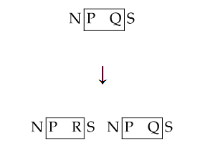
A magnet PQ is broken like this
PQ → PRSQ
The polarity of R and S will be: (P is north)
  • SN
  • B
    NS
  • C
    SS
  • D
    NN
Answer
Correct option: A.
SN
(a)
SN
Explanation:
If P is north
Image

View full question & answer
MCQ 421 Mark
The most suitable material for making the core of an electromagnet __________ .
  • Soft iron
  • B
    Brass
  • C
    Aluminium
  • D
    Steel
Answer
Correct option: A.
Soft iron
(a)
Soft iron
Explanation:
Soft iron is the desirable material to make magnetic cores, as it can withstand high levels of the magnetic field without saturating.
View full question & answer
MCQ 431 Mark
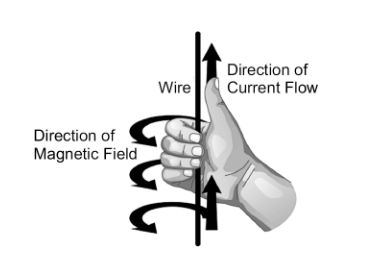
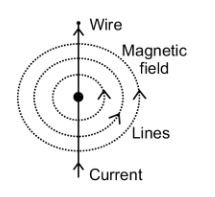
As per the Right Hand Thumb Rule, if you hold the current carrying conductor in your right hand such that the thumb point is in the direction of the current, then which finger/fingers will indicate the direction of magnetic field?
  • Fingers encircle the wire
  • B
    Index finger
  • C
    Thumb
  • D
    Either (b) or (c)
Answer
Correct option: A.
Fingers encircle the wire
(a)
Fingers encircle the wire
Explanation:
Image
As per the right hand thumb rule "If we hold the current carrying conductor in our right hand such that the thumb points in the direction of flow of current, then the fingers encircle the wire in the direction of the magnetic field lines
View full question & answer
MCQ 441 Mark
Looking at the face of a loop, if the current around the face is in an anticlockwise direction, which kind of polarity will the face have?
  • A
    North polarity
  • South polarity
  • C
    East polarity
  • D
    West polarity
Answer
Correct option: B.
South polarity
(b)
South polarity
Explanation:
As per the clock rule, looking at the face of a loop, if the current around the face is in an anticlockwise direction then the face which have current in clockwise direction has the North polarity, while the face has the South polarity.
View full question & answer
MCQ 451 Mark
Which of the following is referred to as a neutral point?
It is the point where,
  • A
    Magnetic field due to current and the earth magnetic field is equal and opposite.
  • B
    Magnetic field due to current and the earth magnetic field is not necessarily equal but opposite.
  • The sum of magnetic field due to current and the earth magnetic field is zero.
  • D
    Both (a) and (c).
Answer
Correct option: C.
The sum of magnetic field due to current and the earth magnetic field is zero.
(c)
The sum of magnetic field due to current and the earth magnetic field is zero.
Explanation:
The neutral point is the point where the two fields are equal and opposite. The resultant magnetic field is zero at the neutral point, and the compass needle can be moved in any direction.
View full question & answer
MCQ 461 Mark
Tesla $(T)$ is the unit of :
  • A
    Electric field
  • B
    Electric flux density
  • C
    Mass flux density
  • Magnetic field
Answer
Correct option: D.
Magnetic field
(d)
Magnetic field
Explanation:
Unit of magnetic field is $NA ^{-1} m^{-1}$. It is also known as tesla ( T ) or weber/metre ${ }^2$.
View full question & answer
MCQ 471 Mark
What will be the impact on deflection of the compass needle when the current in the conducting wire is increased?
  • Deflection of the compass needle will increase.
  • B
    Deflection of the compass needle will decrease.
  • C
    Deflection of the compass needle will remain the same.
  • D
    Deflection of the compass needle will depend upon the material of the wire.
Answer
Correct option: A.
Deflection of the compass needle will increase.
(a)
Deflection of the compass needle will increase.
Explanation:
The deflection of the compass needle rises as the current in the wire increases, implying that the intensity of the magnetic field around the wire increases.
View full question & answer
MCQ 481 Mark
Which parameter can be detected with the compass needle?
  • A
    Current
  • Magnetic field
  • C
    Electric field
  • D
    Gravitational field
Answer
Correct option: B.
Magnetic field
(b)
Magnetic field
Explanation:
A compass needle can be used to determine the presence of a magnetic field at any location surrounding the current carrying path.
View full question & answer
MCQ 491 Mark
The true statement for the magnetic field near a long straight wire ____________ .
  • A
    The field consist of straight lines perpendicular to the wire.
  • B
    The field consist of straight lines parallel to the wire.
  • The field consist of radial lines originating from the wire.
  • D
    The field concentric of circuits centered on the wire.
Answer
Correct option: C.
The field consist of radial lines originating from the wire.
(c)
The field consist of concentric circles centered on the wire.
Explanation:
Image
View full question & answer
MCQ 501 Mark
The magnetic field lines for a bar-magnetic planed vertically above a horizontal wooden hold ______________ .
  • In all planes around the magnetic
  • B
    in honzontal as well as in vertical planes around the magnet
  • C
    Only in horizontal plane around the magnet
  • D
    Only in vertical plane around the magnet
Answer
Correct option: A.
In all planes around the magnetic
(a)
In all planes around the magnet
View full question & answer
MCQ - Physics STD 10 Questions - Vidyadip